Any Gun Can Play by Kevin Grant

anygun.jpg

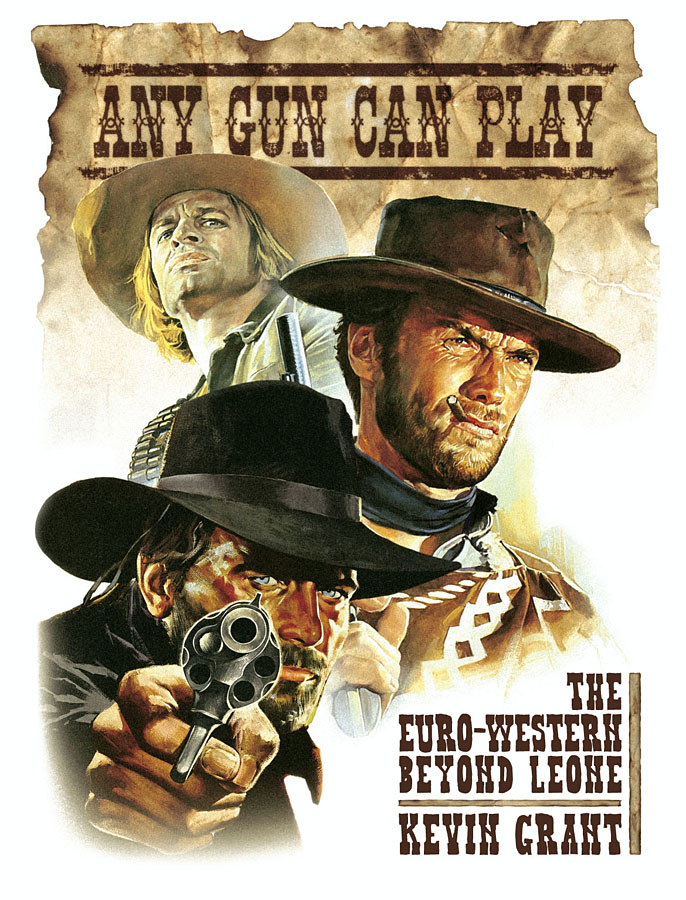
This was something I put together last year for FAB Press but the book has only been published in the past month. The design was little more than an assembly job on my part, with Harvey at FAB requesting a montage of the three poster-art gunmen plus suitable Western typography. We went through a number of generic fonts then I added a little creative touch with the background for the title type which was a sheet of paper scorched and stained using tap water, a tea bag and a gas-ring. Forget Photoshop filters, you still can’t beat the trusty tea bag for random stains.

Cynical and stylish, bloody and baroque, Euro-westerns replaced straight-shooting sheriffs and courageous cowboys with amoral adventurers, whose murderous methods would shock the heroes of Hollywood Westerns. These films became box-office sensations around the world, and their influence can still be felt today.

Any Gun Can Play puts the phenomenon into perspective, exploring the films’ wider reaches, their recurrent themes, characters, quirks and motifs. It examines Euro-westerns in relation to their American ancestors and the mechanics of the Italian popular film industry, and spotlights the unsung actors, directors and other artists who subverted the ‘code’ of the Western and dragged it into the modern age.

Based on years of research backed up by interviews with many of the genre’s leading lights, including actors Franco Nero, Giuliano Gemma and Gianni Garko, writer Sergio Donati, and directors Sergio Sollima and Giuliano Carnimeo, Any Gun Can Play will satisfy both connoisseurs and the curious.

Despite my minimal contribution, this is a very handsome volume to be connected to. I’ve had Christopher Frayling’s Spaghetti Westerns (1981) book for years so I’m already disposed towards the subject. Frayling’s book is a semi-academic analysis which for a long time was the only serious study of the subgenre. Additional studies by Frayling and others have followed but Kevin Grant’s book, subtitled The Essential Guide to Euro-Westerns, looks like a tough one to beat: 480 pages, detailed analyses, a who’s who section, filmography, and a huge quantity of photos and poster graphics, many in colour. There’s also a foreword by actor Franco Nero, threatening everyone on the cover in his Django guise. To test the author’s thoroughness I looked up Se sei vivo spara (1967) (If You Live, Shoot!), a film also known as Django Kill! even though it’s nothing to do with the Django series. Giulio Questi’s film is a very bizarre (and occasionally inept) blend of Spaghetti tropes and horror-style scenes of graphic gore, featuring (among other things) a crucified hero, a vampire bat, and a band of black-clad homosexual cowboys. Frayling’s book devotes a few paragraphs to the film while Grant gives it two-and-a-half pages plus pictures. IMDB may tell us the facts about a film’s production but the barely-literate reviews and troll-filled discussion boards on that site are useless. For authoritative review and analysis you still need a book like this. Any Gun Can Play can be ordered direct from FAB Press where they’re selling a limited number signed by Franco Nero and the author.

Clive Barker, Imaginer

barker.jpg

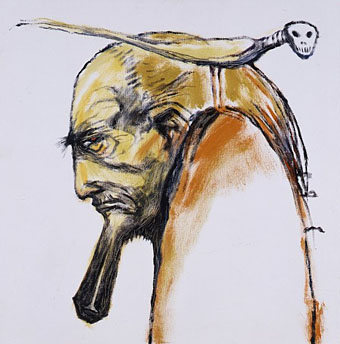
Sea Captain by Clive Barker.

The inhabitants of Carlisle in the north of England are fortunate that the town’s Crown Gallery is hosting the first exhibition of Clive Barker’s artwork outside the US with a show entitled Clive Barker, Imaginer which opens this weekend. The artist will be attending the opening this Saturday, July 16th, and there’s also a signing planned the day after. Tickets are required for both these events so anyone interested will need to contact the gallery. No details as to what will be on display but the exhibition will run to August 23rd, 2011. Barker’s paintings, drawings and photo prints can be purchased through Bert Green Fine Art, Los Angeles.

Cthulhu under glass

bl-exhibition.jpg

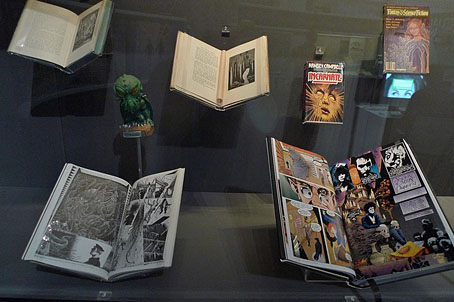
Having had two separate visitors to the British Library’s Out of this World exhibition tell me that some of my work was featured there, it’s been a good to finally discover what was on display. Many thanks to John Keogh for notifying me of his exhibition photo set which includes the above shot of the relevant display case. This is an odd collection for what’s been widely advertised as a science fiction event. Pages from my 1988 adaptation of The Call of Cthulhu are in there along with other fantasy and horror titles including Neil Gaiman’s Sandman, Incarnate by Ramsey Campbell, an edition of Fantasy & Science Fiction with Robert Holdstock’s Mythago Wood on the cover, and a Sidney Sime illustration for Lord Dunsany’s Gods of Pergana. Cthulhu originates out of this world, of course, and that phrase is general enough to encompass other genres.

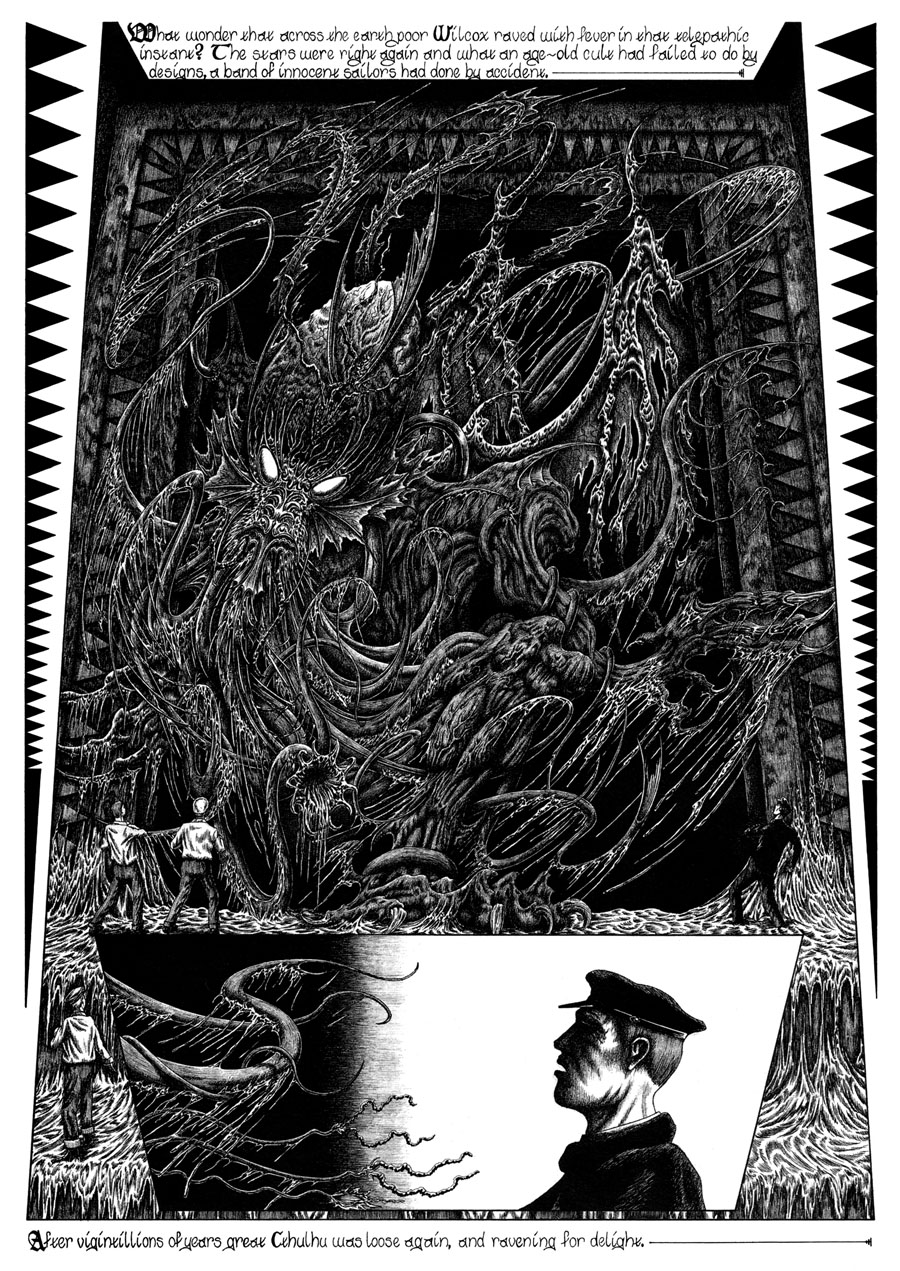
coulthart-cthulhu.jpg

This page from the climax of Lovecraft’s story was the first drawing I made of the living Cthulhu, all earlier representations following Lovecraft’s scheme of the creature manifesting throughout history in different human artworks and religious icons. Since most of those representations are highly stylised I wanted to make the awful reality seem a lot more visceral and even incoherent, hence the mass of flailing tentacles and ropes of slime. This is also the only full view you receive, everything else is fragmentary and allusive so there’s space for the reader’s imagination. I think the book in the library display is the Lovecraft anthology The Starry Wisdom but The Call of Cthulhu is also present in my Haunter of the Dark collection which includes a couple more portraits of “the green, sticky spawn of the stars”.

Out of this World is a free exhibition which will run to September 25th, 2011.

Elsewhere on { feuilleton }
The Lovecraft archive

Miwa Yanagi’s fairy tales

yanagi.jpg

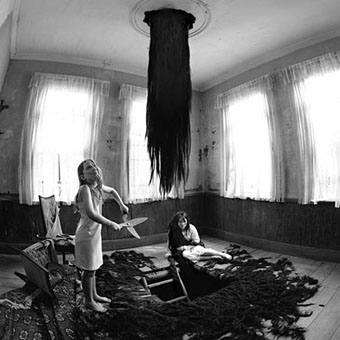
Rapunzel (2004).

Emphasising the “grim” in the Brothers Grimm is what Japanese artist Miwa Yanagi achieves with Fairy Tale, a series of staged photos. It’s a familiar approach, of course, mining childhood for a darker subtext, and the effect is reminiscent in places of earlier explorers of this disturbing territory such as David Lynch and Jan Švankmajer. But Yanagi adds some twists of her own, not least the alarming figures of young girls masked to resemble old women. Despite being based on tales from the West, there’s a distinctly Eastern flavour to some of these scenes: in Rapunzel the usual golden locks have become a black torrent which can’t help but seem sinister when one recalls the legacy of supernatural hair in ghost stories like Yotsuya Kaidan.

fairytale.jpg

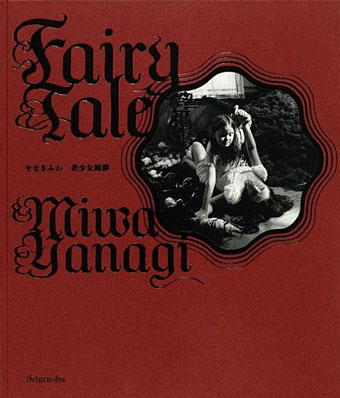
There’s a catalogue of these works available although the text may well be Japanese-only. And speaking of Švankmajer, it’s worth noting again that Alice is now available on DVD. David Moats enthuses about the film here.

Thanks to Gabriel for the Yanagi tip!

Previously on { feuilleton }
Kwaidan
The art of Maleonn Ma

Weekend links 60

fini1.jpg

Jean Genet (1950) by Leonor Fini.

• Bibliothèque Gay looks at a series of erotic engravings made by Leonor Fini for La Galère (1947) by Jean Genet. The author reciprocated with Mademoiselle: A Letter to Leonor Fini. At the hetero end of the erotic spectrum, Tate Liverpool will be showing a series of drawings by René Magritte produced for a proposed edition of Madame Eduarda by Georges Bataille. René Magritte: The Pleasure Principle opens next month.

George Clinton will be appearing with Nona Hendryx at the British Library on 18th June, to talk about “all things galactic”. In addition there’s a screening of John Akomfrah’s The Last Angel of History, a documentary about Afrofuturism and black science fiction. See an introduction to that here. Related: the Smithsonian’s National Museum of African American History and Culture has acquired the Parliament-Funkadelic Mothership for its collection.

• RIP Gil Scott-Heron. “Why does this colossus remain relatively unknown? Is he too political? Too uncompromising? Too angry? Too satirical? Too painful? Too playful? Too alive? Too black? Too human?” Jamie Byng in Gil Scott-Heron: poet, campaigner and America’s rough healer.

fini2.jpg

Le Fils du Maçon (1950) by Leonor Fini.

China Miéville examines alternative histories in Brian Aldiss’s The Malacia Tapestry, David Britton’s Lord Horror and Richard Curtis’s chilling dystopia, Notting Hill.

• What happened to Rolf-Ulrich Kaiser and Gille Lettmann when the Kosmische Musik dream collapsed? Find out here.

• Mlle Ghoul interviews Will Errickson of Too Much Horror Fiction about horror paperbacks, good and bad.

• Another Surrealist woman: Claude Cahun at Strange Flowers.

The Key of Hell: an eighteenth-century sorcery manual.

Partitura 001: realtime sound visualisation.

Scientific Illustration: a Tumblr.

Cosmic Slop (1973) by Funkadelic | Cosmic Slop (1991) by Material.