S. Latitude 47°9′, W. Longitude 126°43′

shipattack.jpg

Then, driven ahead by curiosity in their captured yacht under Johansen’s command, the men sight a great stone pillar sticking out of the sea, and in S. Latitude 47°9′, W. Longitude 126°43′, come upon a coastline of mingled mud, ooze, and weedy Cyclopean masonry which can be nothing less than the tangible substance of earth’s supreme terror—the nightmare corpse-city of R’lyeh, that was built in measureless aeons behind history by the vast, loathsome shapes that seeped down from the dark stars. There lay great Cthulhu and his hordes, hidden in green slimy vaults and sending out at last, after cycles incalculable, the thoughts that spread fear to the dreams of the sensitive and called imperiously to the faithful to come on a pilgrimage of liberation and restoration.

HP Lovecraft, The Call of Cthulhu (1928)

“Great Cthulhu and his hordes…” People never mention the hordes, do they? I’m pleased to say that the loathsome horde gathered in my forthcoming Cthulhu Calendar are in situ at last, since I’ve found the time this week to get everything finished. I still need to write a couple of new web pages then upload all the images to CafePress. I’ll be doing that over the weekend so Monday will be the launch day.

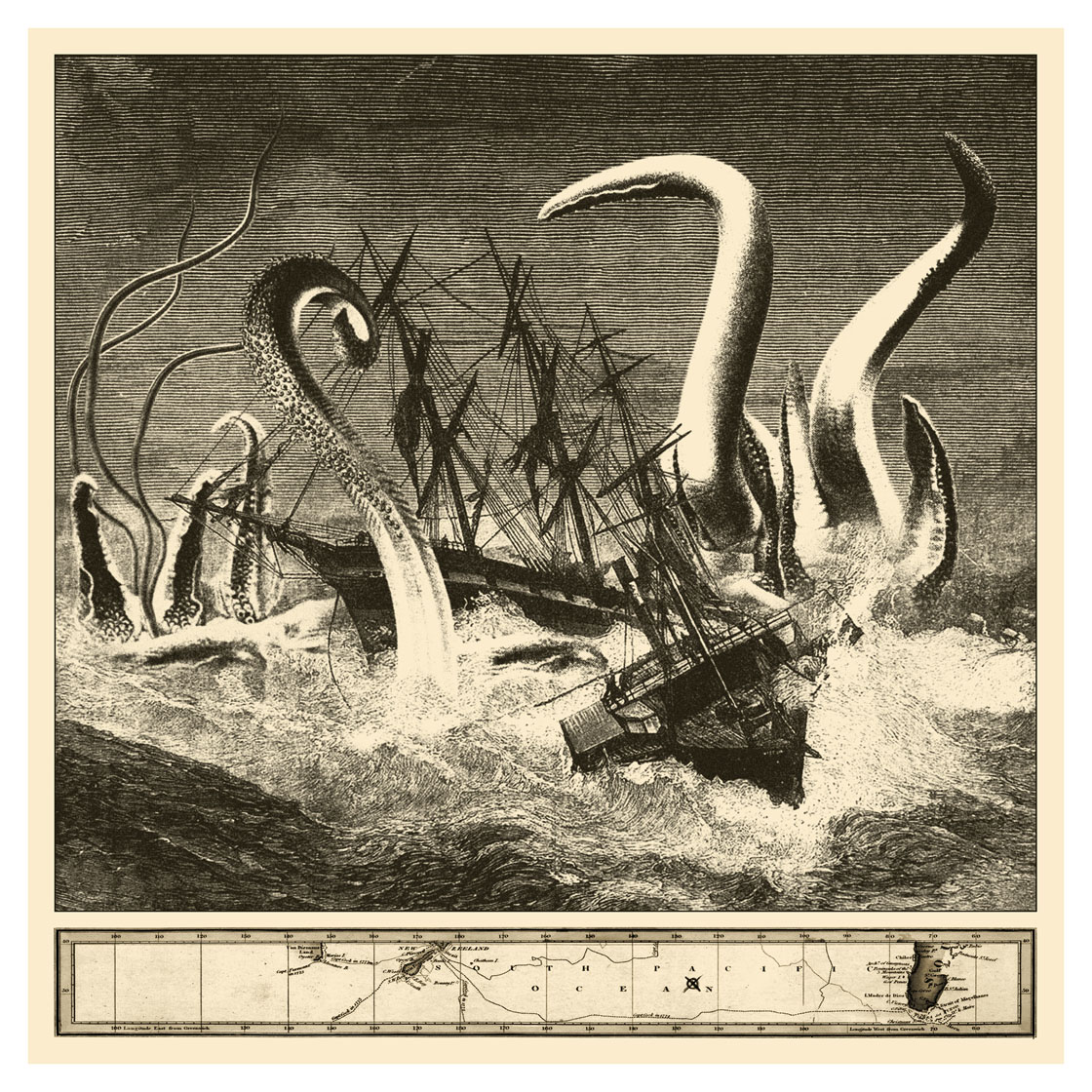
For the final piece I decided against doing another portrait in favour of a picture of an attack at sea as it might have appeared in a 19th-century newspaper. This kind of imagery will now make many people think of the Kraken scenes in the second Pirates of the Caribbean film but it predates cinema, of course, as it also predates Lovecraft. Despite Lovecraft’s indelible association with monstrous tentacles there are a lot more incidents of this nature in William Hope Hodgson’s stories and novels than in the Cthulhu Mythos. In which case this scene, which will be the page for December, can be regarded as a tip of the hat to William as much as to Howard.

Elsewhere on { feuilleton }
The Lovecraft archive

Les Jeux des Anges by Walerian Borowczyk

jeux1.jpg

Les Jeux des Anges.

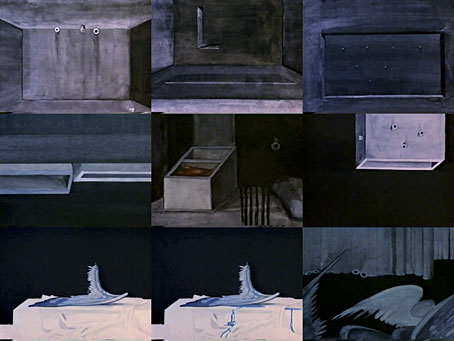
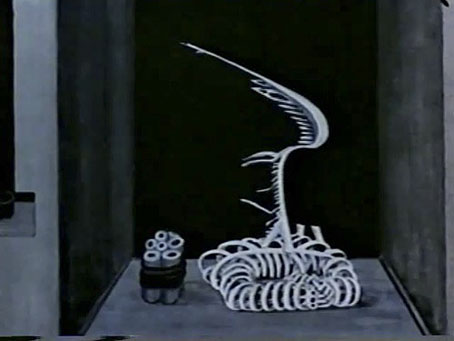
Following yesterday’s post, we can be certain that Terry Gilliam had seen Les Jeux des Anges (1964) because in 2001 he included it in a list of ten favourite animated films. Jan Lenica co-directed Dom (1959) with Walerian Borowczyk but doesn’t work on this film which is the darkest and strangest of all Borowczyk’s works I’ve seen to date. Once again there’s some unavoidable subtext, although whether that applies to the Holocaust or to Stalinist repression is for the viewer to decide. What we see is a series of painted tableaux in which various mechanical processes are butchering angels. The atmosphere isn’t far removed from the cruelties of Roland Topor while the painted scenes are very similar to those that David Lynch would be animating a couple of years later. The soundtrack is credited to electronic composer Bernard Parmegiani. Watch it for yourself here.

jeux2.jpg

Previously on { feuilleton }
Labirynt by Jan Lenica
Les Temps Morts by René Laloux
Short films by Walerian Borowczyk

Resurgam variations

resurgam1.jpg

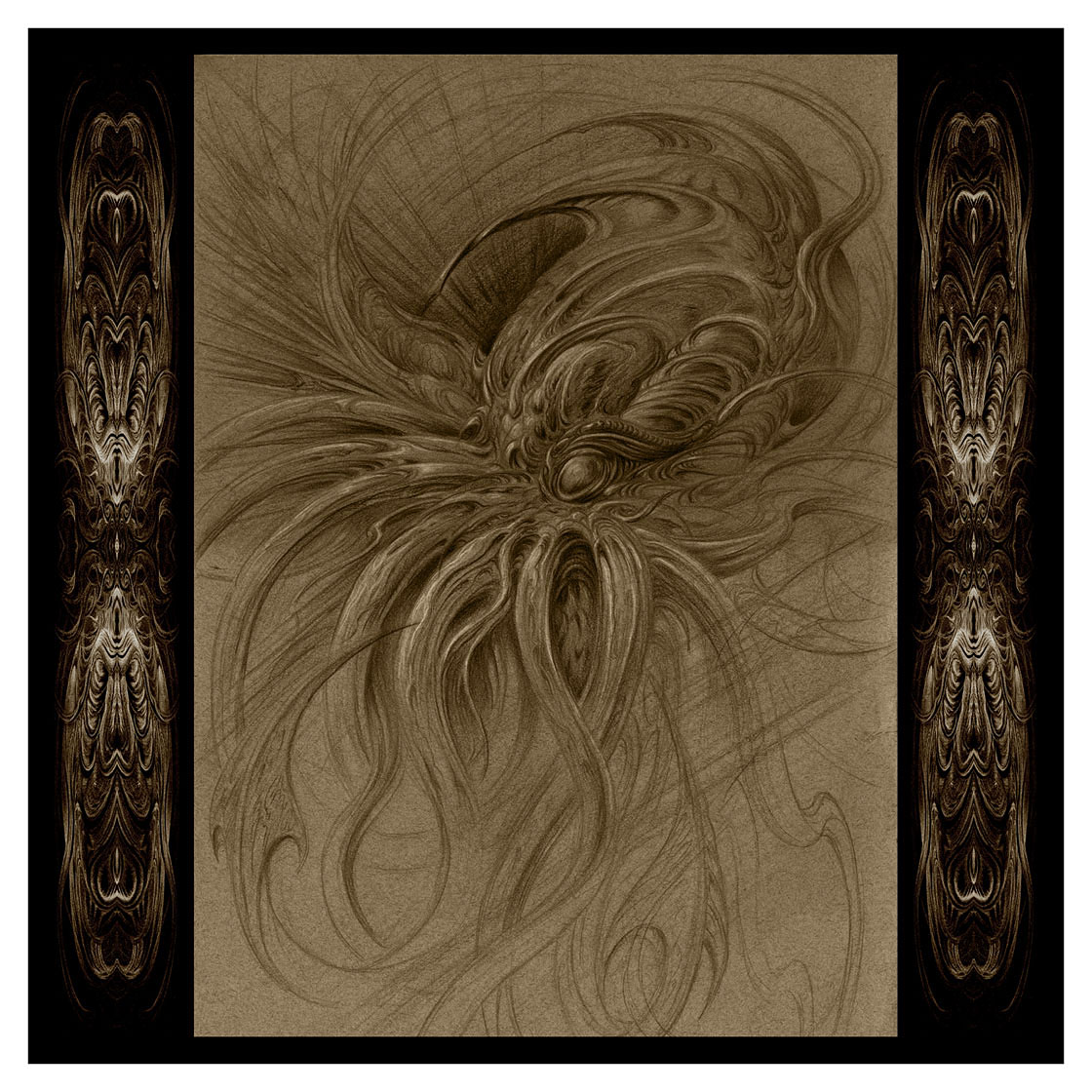
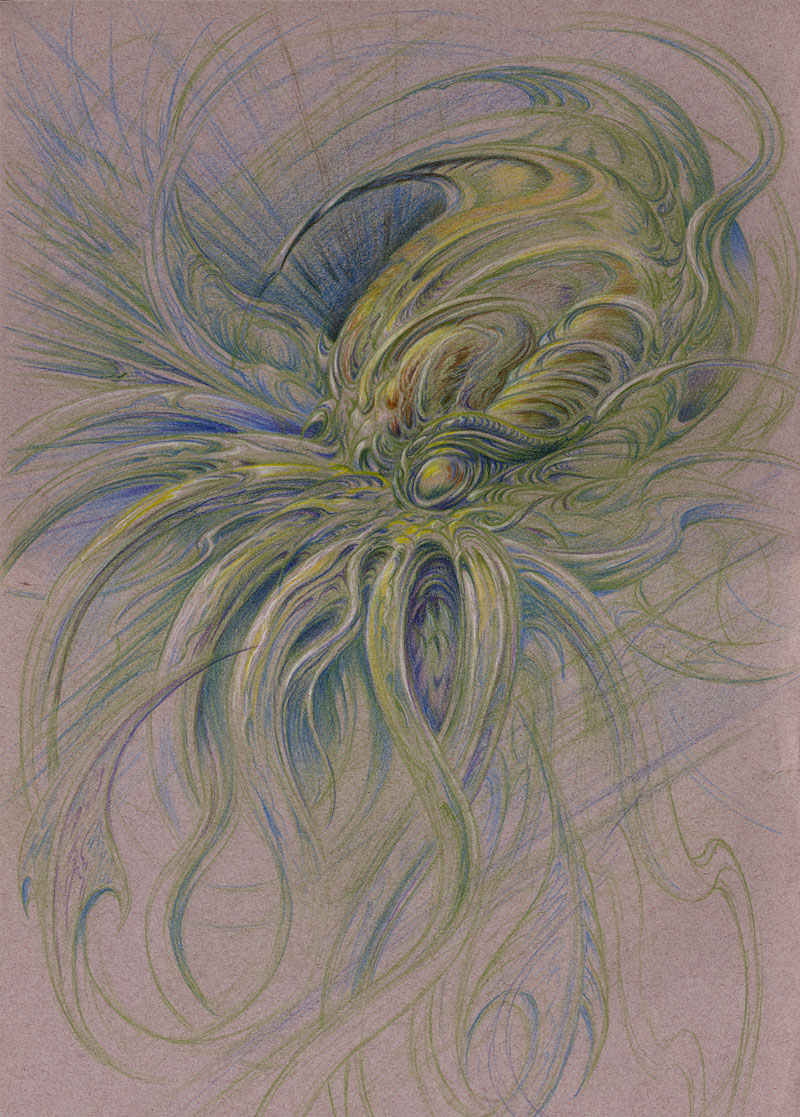
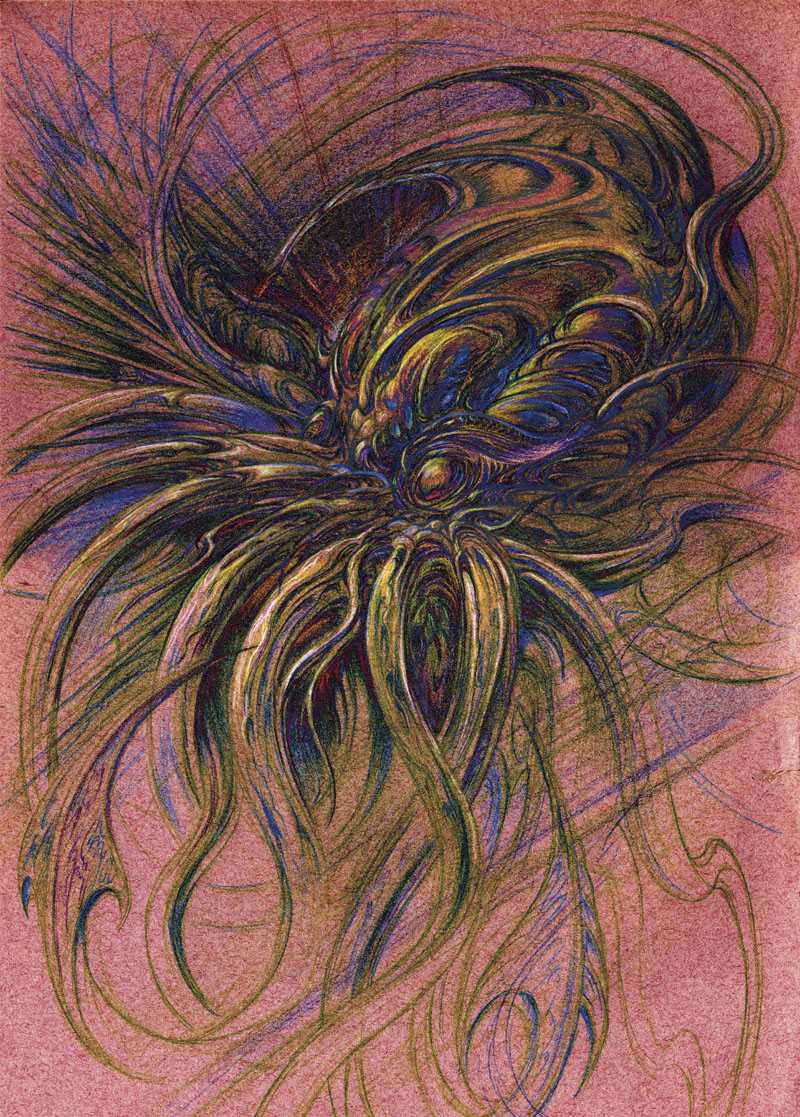
Another new page completed for my forthcoming Cthulhu Calendar, I decided to give this one another Latin title for maximum pomposity. “Resurgam” means “I shall rise again” which seems a fitting sentiment for the loathsome Spawn of the Stars. This piece was an improvised drawing which from the outset I wanted to leave incomplete. I’ve always liked pencil drawings which grade from detail to an insubstantial sketchiness, and most of the other representations in the calendar are already highly finished. I usually can’t resist filling every last centimetre so this should be regarded as a rare exercise in restraint.

resurgam2.jpg

This is the drawing in its original state. After scanning it and messing with various colour overlays I decided to go with sepia tones. The calendar is already heavy on the green so umber shades will vary things a little. Since it’ll be a CafePress product all the pages have to be square which presents a problem for non-square artwork. I dislike cropping a drawing to fill the page so the additional panels are samples from the drawing quartered and mirrored, a simple effect that always works well. The picture below is one of the earlier variations, the result of applying some Photoshop solarisation then inverting the image.

resurgam3.jpg

I now have one more page to fill then the calendar will be finished. (The cover is already done.) I’m hoping to have it completed by this time next week. Keep your tentacles crossed.

Elsewhere on { feuilleton }
The Lovecraft archive

Weekend links 126

dogo.jpg

Mala Reputación (1991) by Dogo Y Los Mercenarios. Cover art by Nazario Luque.

Artist Nazario Luque was Spain’s first gay comic artist who’s also known for the drawing which appeared (without permission) on the sleeve of Lou Reed Live – Take No Prisoners in 1978. On his website Nazario says he’s been described as “Exhibicionista, solidario, provocador, agitador moral, rompedor, arriesgado, polifacético, transgresor, canalla, pintiparado, morigerado o simplemente superviviente…” Via Música, maestros, a two-part post (second part is here) about album cover art by comic artists.

The BBC Radiophonic Workshop Returns. And quite conveniently, Ubuweb posts some original Radiophonic creations by electronic music genius Delia Derbyshire. Ms Derbyshire is profiled along with her other pioneering colleagues in an hour-long TV documentary, Alchemists of Sound.

• Tor.com celebrates the fiction of Shirley Jackson. Too Much Horror Fiction has a substantial collection of Shirley Jackson book covers.

Phantasmagorical and all but plotless, Nightwood flings itself madly upon the night, upon Wood, and upon the reader. Its sentences pomp along like palanquins and writhe like crucifixions. They puke, they sing. Their deliriums are frighteningly controlled. […] TS Eliot loved Nightwood so much that he shepherded its publication and wrote the introduction to the first edition. Dylan Thomas complimented it with his left hand by calling it “one of the three great prose books ever written by a woman” and with his right hand by stealing from it. […] Nightwood’s Dr. Matthew-Mighty-grain-of-salt-Dante O’Connor, florid monologist and transvestite, seems to have been a model (along with Captain Ahab) for Judge Holden in Blood Meridian. The difference is that Cormac McCarthy’s Judge is essentially Satan, whereas O’Connor is essentially Christ; they’re only just on opposite sides of the border of madness.

Austin Allen on The Life and Death of Djuna Barnes, Gonzo “Greta Garbo of American Letters”. There’s a lot more Djuna Barnes at Strange Flowers.

• Out at the end of the month, Extreme Metaphors, interviews with JG Ballard, 1967–2008, edited by Simon Sellars & Dan O’Hara.

• The favourite Polish posters of the Brothers Quay. Over at Cardboard Cutout Sundown there are more Quay book covers.

The Mancorialist: people on the streets of Manchester are given the Sartorialist treatment.

The Liverpool International Festival Of Psychedelia takes place on 29th September.

The Caves of Nottingham are explored in a detailed post at BLDGBLOG.

• In Remembrance: Bill Brent, Groundbreaking Queer Sex Publisher.

Confessions of a Bookplate Junkie

The Uranus Music Prize 2012

Fuck Yeah René Lalique

Dr Who: original theme (1963) by Ron Grainer with Delia Derbyshire | Falling (1964) by Delia Derbyshire | The Delian Mode (1968) by Delia Derbyshire | Blue Veils And Golden Sands (1968) by Delia Derbyshire.

The Garden of Adompha

adompha1.jpg

…the growths of that garden were such as no terrestrial sun could have fostered, and Dwerulas said that their seed was of like origin with the globe. There were pale, bifurcated trunks that strained upwards as if to disroot themselves from the ground, unfolding immense leaves like the dark and ribbed wings of dragons. There were amaranthine blossoms, broad as salvers, supported by arm-thick stems that trembled continually.

And there were many other weird plants, diverse as the seven hells, and having no common characteristics other than the scions which Dwerulas had grafted upon them here and there through his unnatural and necromantic art.

These scions were the various parts and members of human beings. Consummately, and with never failing success, the magician had joined them to the half-vegetable, half-animate stocks on which they lived and grew thereafter, drawing an ichor-like sap. Thus were preserved the carefully chosen souvenirs of a multitude of persons who had inspired Dwerulas and the king with distaste or ennui. On palmy boles, beneath feathery-tufted foliage, the heads of eunuchs hung in bunches, like enormous black drupes. A bare, leafless creeper was flowered with the ears of delinquent guardsmen. Misshapen cacti were fruited with the breasts of women, or foliated with their hair. Entire limbs or torsos had been united with monstrous trees. Some of the huge salver-like blossoms bore palpitating hearts, and certain smaller blooms were centered with eyes that still opened and closed amid their lashes. And there were other graftings, too obscene or repellent for narration.

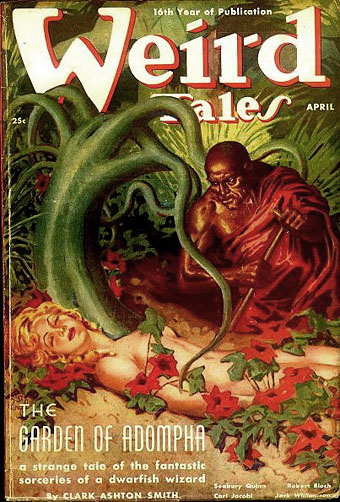
Thus Clark Ashton Smith in The Garden of Adompha, one of the stories in the author’s Zothique cycle which was first published in Weird Tales in April, 1938. Zothique was Smith’s contribution to the Dying Earth subgenre, sixteen stories set on the last continent in the final days of the Earth, and a home to no end of sorcery and cruelty. I’ve always enjoyed this subgenre, especially in the hands of Jack Vance whose later Dying Earth stories show the influence of Zothique, so these are some of my favourites among Smith’s prodigious output. The Garden of Adompha is a particularly grotesque piece, concerning the sequestered garden of the title to which King Adompha has undesirables removed. Once there his wizard, Dwerulas, drugs the victims and grafts parts of their bodies to the garden’s hothouse plants. Virgil Finlay’s cover painting downplays the horror somewhat, and Dwerulas’s supine prey, Thuloneah, looks like a very typical American girl, but then for a story that reads like a pulp equivalent of Octave Mirbeau it’s surprising it made the cover at all.

adompha2.jpg

Re-reading some of Smith’s stories over the past week, The Garden of Adompha among them, there’s been the additional pleasure of searching for illustrations from their original publication. I knew that Virgil Finlay had painted this cover, one of the few cover features Smith received from Weird Tales, but Alistair Durie’s Weird Tales (1979) collection only has a monochrome reproduction. The always reliable Golden Age Comic Book Stories not only has a copy of Finlay’s original painting but also the interior illustration which looks like a litho drawing rather than the artist’s more usual scratchboard. The most recent book collection featuring the story was The Collected Fantasies Of Clark Ashton Smith Volume 5: The Last Hieroglyph (2010) from Night Shade Books. (I would have linked to the publisher’s page but their site seems to be broken.)

Update: Golden Age Comic Book Stories changed its name then vanished altogether. The picture links here have been updated.

adompha3.jpg

Previously on { feuilleton }
Vathek illustrated
The Vengeance of Nitocris
The House of Orchids by George Sterling
Haschisch Hallucinations by HE Gowers
Odes and Sonnets by Clark Ashton Smith
The King in Yellow
Clark Ashton Smith book covers