
Because Wilde’s worth it
| Matthew Bourne makes Dorian gay.
Category: {gay}
Gay
Raymond Voinquel

Projet pour le ‘Narcisse’ de Paul Valéry (1940).
Photographs by Raymond Voinquel (1912–1994).
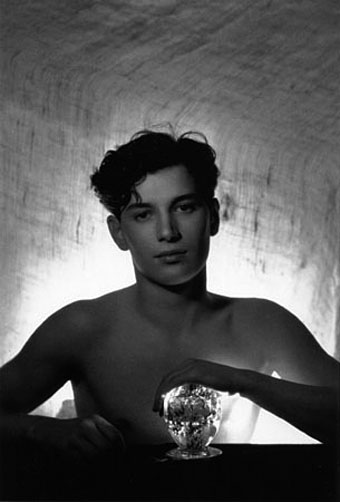
Hommage au Bronzino (1940).
• A gallery site | A Flickr set
Via Fabulon.
Previously on { feuilleton }
• Norman McLaren
• Reflections of Narcissus
• Narcissus
Phallic worship

And why not, say I? Being a born-again pagan I’d much rather venerate the generative organ of the human male in all its splendour than abase myself before one of the invisible sky gods; I had my fill of that when I was an unwilling young Catholic. And besides, what gay man doesn’t worship the phallus in some form?
Most people have heard of the Japanese festival, Kanamara Matsuri, a Shinto fertility celebration. Giant ceremonial phalluses are paraded through the streets and a good time is had by all. Less well-known is a similar Dionysian festival which takes place in the small town of Tyrnavos, Greece on the first Monday of Lent.
If you want to eat phallus-shaped bread, drink through phallus-shaped straws from phallus-shaped cups, kiss ceramic phalluses, sit on a phallus-shaped throne and sing dirty Greek songs about the phallus, then you should visit the little Greek town of Tyrnavos each year on “Clean Monday.”
…
The festival is in honor of Dionysus, the Greek god of wine, madness and ecstasy. While the men, women and children of Tyrnavos celebrate the penis, the rest of Greece marks the beginning of the pre-Easter fast more modestly by flying kites and eating octopus, olives and unleavened bread. More.

Bronze statuette of the Roman fertility god Priapus, made in two parts (shown here in assembled and disassembled forms).
Fitting then, now that spring is passing into summer, that Taschen are following up their Big Book of Breasts with the Big Penis Book. The splendid cover needs to be seen in action (as it were) since the underwear is printed on a clear wrapper which can be removed to expose the wonderful tumescence beneath. I like the sly humour in the design which makes the background of the breasts book blue while the penis book is pink. I’m not too sure about the quality of the contents from their previews, much of it seems to be filled out with photo shoots from gay porn of the Seventies. But I’ll suspend my judgement until I’ve given it a proper viewing. If anything was going to be the phallic worshipper’s bible, this must be it. Good to see Taschen flying the flag as always for high-quality porn/erotica.
Elsewhere on { feuilleton }
• The book covers archive
Previously on { feuilleton }
• The art of ejaculation
Markus Bollingmo

Photography by Markus Bollingmo.
Saint Sebastian in NYC
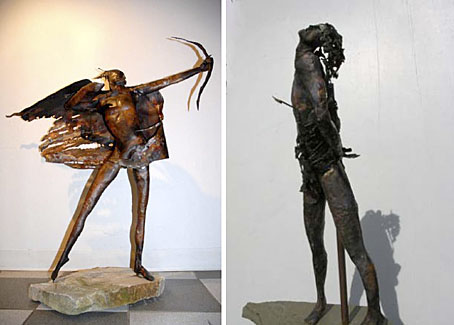
The Archer & Saint Sebastian by Lubomir Tomaszewski.
Saint Sebastian is an exhibition of new interpretations of the image of the pierced saint currently running at the CFM Gallery, New York, in association with JKK Fine Arts, “the Gallery of Modern Symbolism”. The show runs from May 9th to June 8th, 2008, and among the artists there’s Michel Henricot who was featured here recently. You can see more of the works in the PDF brochure. Thanks to Jan for the tip!
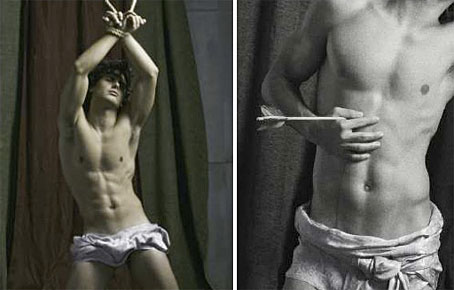
Saint Sebastian by David Vance.
Elsewhere on { feuilleton }
• The gay artists archive
Previously on { feuilleton }
• The art of Michel Henricot
• Guido Reni’s Saint Sebastian
• The art of Takato Yamamoto
• Fred Holland Day