Phallic bibelots

phallus1.jpg

Does Priapus rule the month of October? Having this lot appear in the same week makes it seems likely. The carved carnelian sealing ring above comes via Silent-Porn-Star.

phallus2.jpg

Then this Vivienne Westwood pendant turned up at Fabulon.

phallus3.jpg

Finally, there’s the discovery of two artists producing phallic glasswork. Paul Thomas created the pendants above while Jamie Burress is responsible for the penis table.

phallus4.jpg

Elsewhere on { feuilleton }
The gay artists archive

Previously on { feuilleton }
Phallic worship
The art of ejaculation

The recurrent pose 20

taddei.jpg

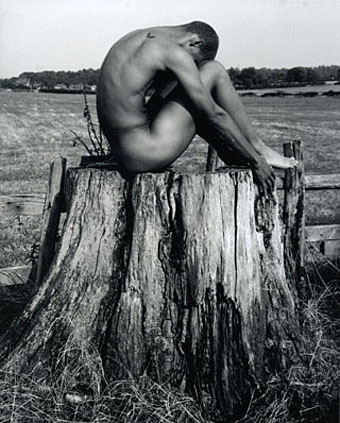
Meditation by Richard Taddei (2003).

Many of Richard Taddei‘s paintings of male figures draw upon Classical and other references so encountering the Flandrin pose in his work isn’t too surprising. I really like the semi-abstract works of which Meditation is an example.

Elsewhere on { feuilleton }
The gay artists archive
The recurrent pose archive

Vintage swordplay

sword1.jpg

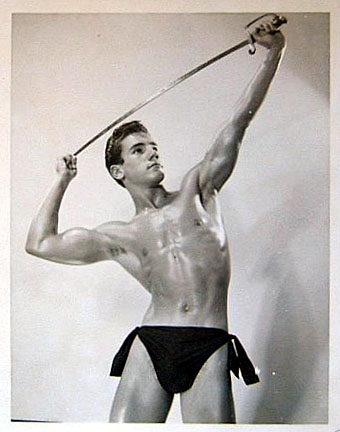
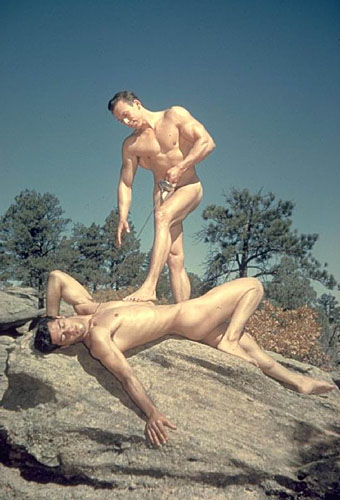
A couple of lubricated additions to the burgeoning collection of pulchritudinous swordsmen. I know I’m not the only one who appreciates these pictures given the amount of times some of the posts below are examined. The photos this time were submitted by The Other Andrew and Thom at Fabulon respectively. Thanks, boys!

sword2.jpg

Elsewhere on { feuilleton }
The men with swords archive

Dark horses

equus1.jpg

A juxtaposition of old and new theatre posters in the New York Times caught my eye this week, part of a feature about the current Broadway run of Peter Shaffer’s play. The news there, of course, has been Daniel Radcliffe’s on-stage nudity; understandable, perhaps, but celebrity trivia has overshadowed appraisal of Shaffer’s work as a piece of art.

What struck me seeing these was the two very different approaches to the same design problem. Given the subject matter, using an image of a horse is somewhat unavoidable as well as being immediately attractive since horses nearly always look good. The freight of historical and cultural association they carry is also one of the themes of the play. I really like the spare treatment of Gilbert Lesser’s 1976 poster for the National Theatre (left) and much prefer it to the new version used for the London and New York shows. The Lesser poster has the quality of a puzzle, matching the psychological piecing together of the story and Alan Strang’s accusation that Dysart the psychiatrist is always “playing games”. It also has a sinister quality lacking in the contemporary version; Shaffer’s Equus is an unforgiving god and the black eyes could refer to the blinded horses. The Photoshop horse looks altogether too mundane and is it my imagination or is the horse head misshapen slightly in order to fit the torso?

Continue reading “Dark horses”