Weekend links 581

oz33.jpg

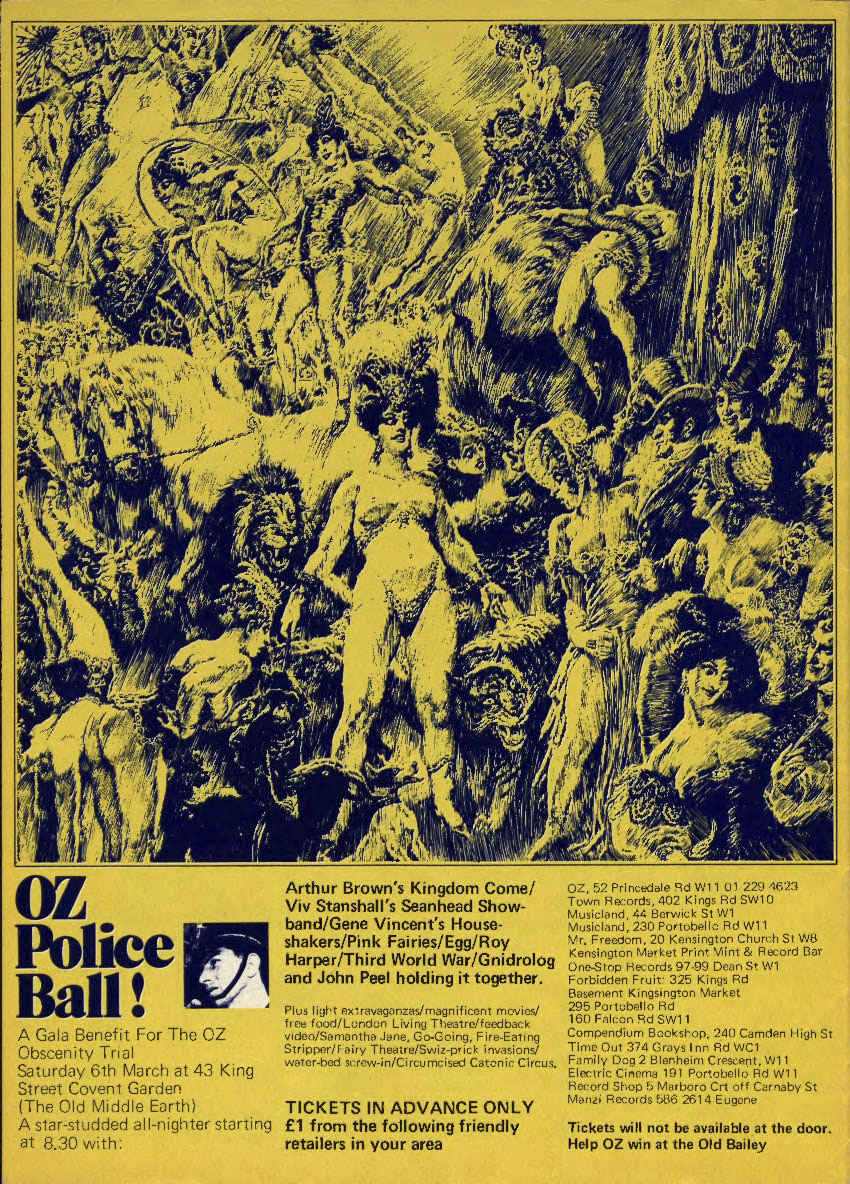
The back cover of Oz 33, February 1971. Art by Norman Lindsay.

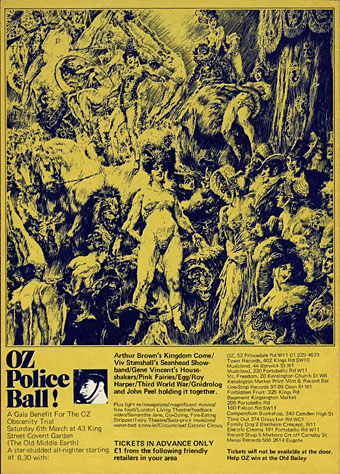
Walker Mimms looks back 50 years to the trial of the editors/publishers of Oz magazine, in which the trio were accused of “conspiracy to corrupt public morals” following the appearance of Oz 28, the “Schoolkids Issue”, in May 1970. Elsewhere: corrupt your own morals by reading the offending issue; then see Hugh Grant in a hippie wig in The Trials of Oz, a BBC dramatisation of the courtroom drama; after which you can watch the real editors—Richard Neville, Jim Anderson and Felix Dennis—discuss the whole affair with other interested parties 20 years on (and also see Germaine Greer shame Jonathan Dimbleby into saying the word “cunt” on live TV).

• New music: Caves – A Compilation Of Silences by Other People (“This collection of silences and music can be used as timers for cooking, meditation, running, walking, sleeping or anything you want”), and Vaganten by ToiToiToi, the next release on the Ghost Box label.

Chris Carter‘s favourite albums. I think I own more of the albums listed here (including the ABBA) than any other entry in this long-running series. Which isn’t really surprising…

What I would say about that in general is what I’ve written in the new introduction to Teenage, which is that the 60s youth culture that we’ve been talking about, the progressive, critical side of it came as a complete surprise to adults. And once they identified what was going on, they were incredibly hostile, and authorities were incredibly hostile to it. And from the Thatcher government in the 80s you have a series of measures, a series of laws, a series of attitudes, a series of structures put in place to make sure that that never happens again. So youth itself has been deliberately depoliticised and also had a lot of the opportunities for any kind of autonomy taken away from it. That is, it has been a deliberate government policy right the way through, including Blair, and definitely with the current lot.

Echoes of the Oz debate in this discussion between Jon Savage and Owen Hatherley

• At Perfect Sound Forever: RIP Jon Hassell: honouring a one-of-kind musician/composer.

• At Spoon & Tamago: Edward Luper’s 36 Views of the BT Tower (after Hokusai).

• At Unquiet Things: Doorways into Awareness: An interview with Century Guild.

• Mix of the week: The Ivy-Strangled Path Vol. XXIV by David Colohan.

• Ghost notes: Michio Kurihara‘s favourite guitar solos.

• “Future space travel might require mushrooms.”

• At Dennis Cooper’s: Alexander Hammid Day.

Wyrd Daze Lvl.4 FIVE STAR is live.

Like A Tear (1968) by The World Of Oz | Return To Oz (2004) by Scissor Sisters | Il Pavone Di Oz (Praslesh Remix) (2014) by Verrina & Ventura

Music for people with three ears

teb.jpg

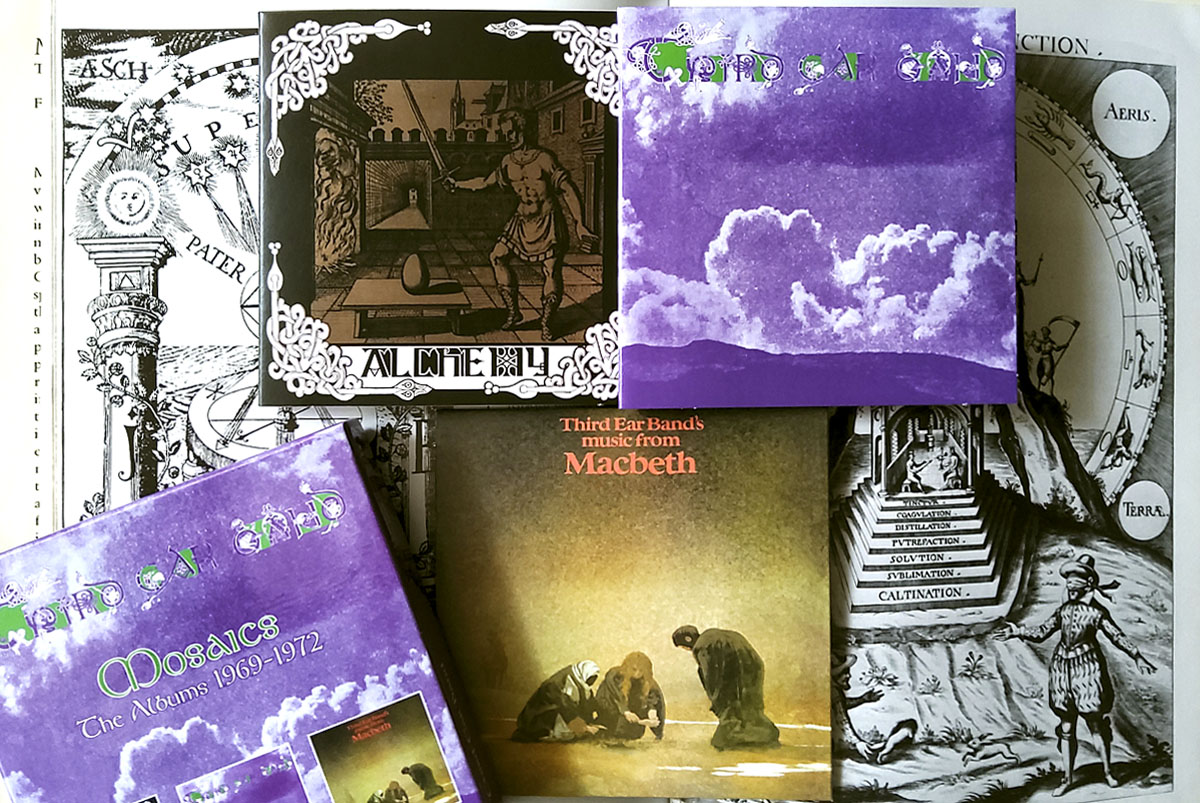
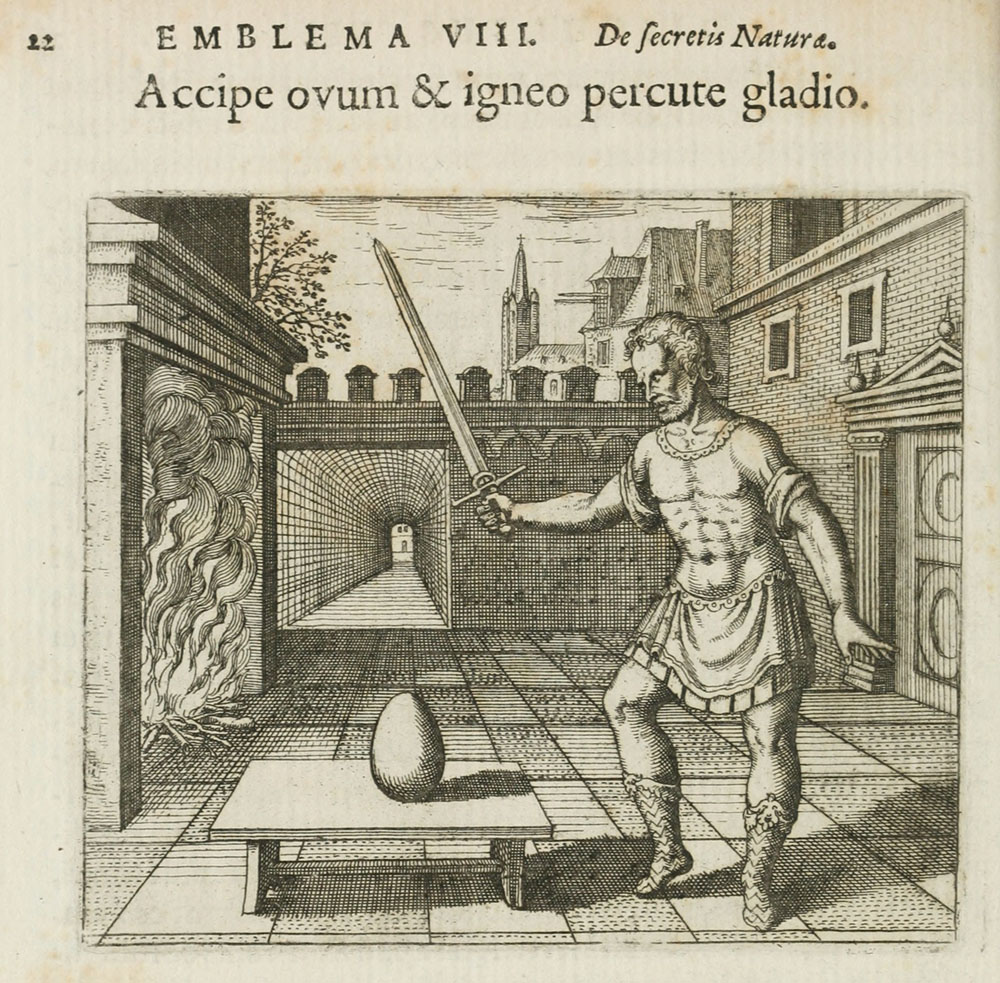
Cherry Red Records this month reissues the first three albums by the unique and wonderful Third Ear Band. I like CDs, and I especially like having them collected into boxes with Japanese-style facsimile sleeves, so this collection is irresistible. The group’s first two albums, Alchemy (1969) and Third Ear Band (1970), still sound timeless despite being products of their time, with the track you’d most expect to sound dated, Ghetto Raga, being free of sitars or Indian pastiche. Third Ear Band music is a kind of improvised folk, predominantly the product of oboe, violin and percussion, which sounds like something the group might have tuned into when they were playing for Druids at ancient sites (Stone Circle and Druid One are further track titles). The first two albums also have the additional attraction for this listener of a heavy emphasis on medieval mysticism, from the Atalanta Fugiens illustration by Matthäus Merian on the cover of Alchemy, and the symbols and astrological diagrams that fill out the inside cover of the second album, to the titles of that album which continue the alchemical theme: Air, Earth, Fire and Water. The group also borrowed some graphics from Aubrey Beardsley when they issued their musical manifesto in 1969.

merian.jpg

Music From Macbeth (1972) is constrained in comparison to the albums that precede it, being subservient to Roman Polanski’s feature film, although there’s more music here than was used in the film. It’s also closer to rock music in places, with occasional fuzzed guitar, a Mellotron, and rumbles from a VCS 3 synthesizer played by a future member of Hawkwind, Simon House. The cover painting by Roger Dean isn’t one of his best. In Views Dean complains that Polanski “got the imagery wrong” for the scenes with the witches, a comment I’ve never understood. Polanski’s film is a naturalistic interpretation of the play which is well-served by the Third Ear Band’s drones and medievalisms. Incidentally, I’m sure the phrase “music for people with three ears” was used on a Harvest records press ad but if it was I’ve been unable to find any evidence of it. Anyone out there know the source?

Previously on { feuilleton }
Night’s black agents
Atalanta Fugiens

Weekend links 580

kausch.jpg

The Collective Lie We All Live By, a cut-paper collage by Allan Kausch from Maintenant 15, A Journal of Contemporary Dada Writing and Art.

• “It’s unusual that an album manages to be at once so much of its moment, yet so much outside it. Time was unmistakably a response to the electronic and synth waves that rose in the wake of punk. It was also a concept album about time travel, which couldn’t have been more pre-punk had it been focus-grouped that way.” David Bennun on Time (1981), ELO’s masterwork of science-fiction pop. The first song on the album, Twilight, is a thundering piece of synth bombast that prefigures Trevor Horn’s equally bombastic productions, and was used to memorable effect in the copyright-infringing animation made in 1983 for the opening of Daicon IV.

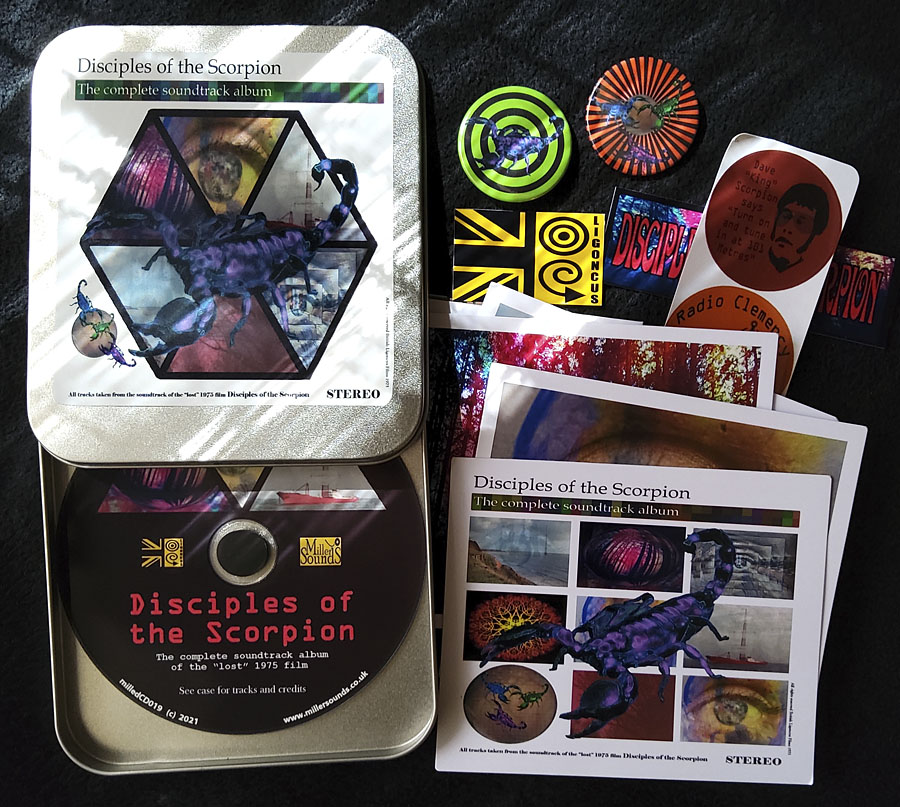
• New music: Disciples Of The Scorpion by The Rowan Amber Mill, and Shade by Grouper.

• “Psychedelic spirituality: Inside a growing Bay Area religious movement“.

• “It’s time to farewell this project,” says Ballardian.

• At Wormwoodiana: the seven greek vowels.

• A playlist for The Wire by Douglas Benford.

Norman Blake‘s favourite albums.

Astronomia Playing Cards.

• RIP Dusty Hill.

Time (1973) by David Bowie | Time (1976) by La Düsseldorf | Time (1992) by Lull

Ravi Shankar’s metempsychosis

ravi.jpg

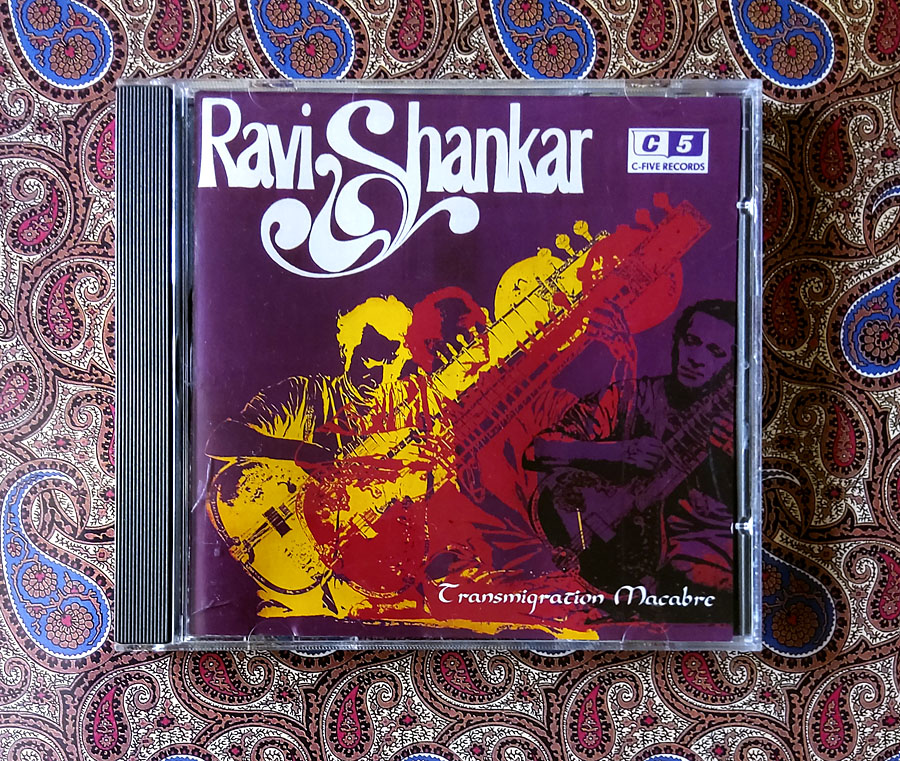
Transmigration Macabre is the curious title of a disc by Ravi Shankar that turned up in one of the local charity shops this week. The album is the score for a short British film, Viola, made in 1967 when Indian music was enjoying its fleeting novelty status in the West. Prior to this, Shankar had provided music for Jonathan Miller’s TV film of Alice in Wonderland, Conrad Rooks’ Chappaqua, and an obscure independent feature, The Psychedelics. Transmigration Macabre wasn’t released until 1973, however, when the sitar fad had long since expired, but it does does work well as an album in itself, albeit a short, monophonic one. I wrote something about the album in 2008 after it provided the key to a minor musical mystery. At the time I only had a collection of mp3s so it’s good to find a cheap disc of the music.

davis.jpg

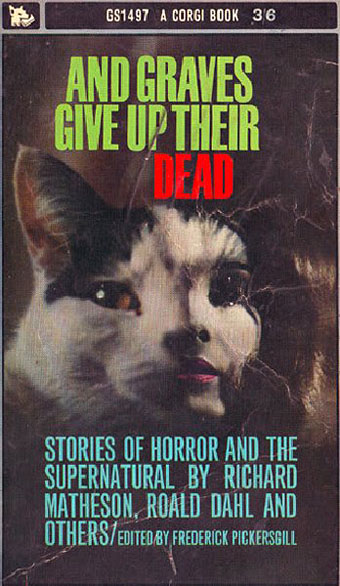
The most notable feature of the score, also the feature that solved my musical mystery, is the appearance on several tracks of the Cristal baschet, a unique instrument made of glass rods and metal cones created by Bernard and François Baschet, and played by Structures Sonores (aka Structures Sonores Lasry Baschet), the group the Baschet brothers formed with Yvonne and Jacques Lasry. The combination of the Cristal’s weird timbres with Ravi Shankar’s sitar playing works so well I wish the ensemble had recorded more together. The presence of the Cristal also makes Viola one of the few films that features the instrument at all, something I find surprising given the otherworldliness of the Cristal sound. Viola is a supernatural story directed by Dunstan Pereira in which “a man believes that his dead wife has returned in the form of a cat to haunt him”, hence the need for uncanny sounds. The film is described as being comprised of still photos, a common technique for low-budget shorts. Producer Richard Davis adapted his own short story, The Female of the Species, which was first published in And Graves Give Up Their Dead in 1964, a book that also appears to illustrate his story on its cover. The BFI has a copy of the film that’s free to watch but it wouldn’t play for me so I’ll just have to imagine the visuals while listening to the music.

Previously on { feuilleton }
Alice in Wonderland by Jonathan Miller
Cristalophonics: searching for the Cocteau sound