Alejandro Jodorowsky’s Dune

dune1.jpg

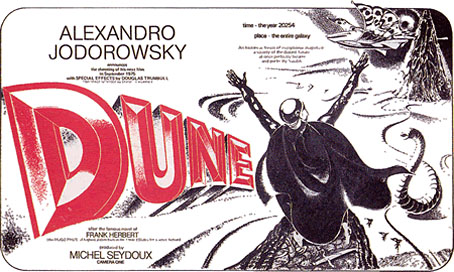
Fortunate Londoners can get to see a new exhibition, Alejandro Jodorowsky’s ‘Dune’: An exhibition of a film of a book that never was, which runs at The Drawing Room until October 25, 2009. As well as production designs from concept artists Moebius, HR Giger and Chris Foss, there’s newly commissioned work by artists Steven Claydon, Matthew Day Jackson and Vidya Gastaldon.

Jodorowsky’s proposed 1976 adaptation of the Frank Herbert novel is now the stuff of legend, and it’s possible that his outrageously ambitious plans are more fun to dream about than they would have been on the screen. But it remains a tantalising prospect that Jodorowsky might well have pulled off a science fiction equivalent of Fellini’s Satyricon. Either way, along with Stanley Kubrick’s unmade Napoleon, it’s one of the great lost films of the 1970s.

Among Jodorowsky’s proposed cast were Orson Welles, Mick Jagger and Salvador Dali, the last of whom was to play the Emperor of the Universe, who ruled from a golden toilet-cum-throne in the shape of two intertwined dolphins. Unable to secure the money from Hollywood to create the ‘Dune’ of his imagination, Jodorowsky abandoned the film before a single frame was shot. All that survives of this project is Jodorowsky’s extensive notes, and the production drawings of Moebius, Giger and Foss. These reveal a potential future for sci-fi movie making that eschewed the conservative, technology-based approach of American filmmakers in favour of something closer to a metaphysical fever-dream.
dune2.jpg

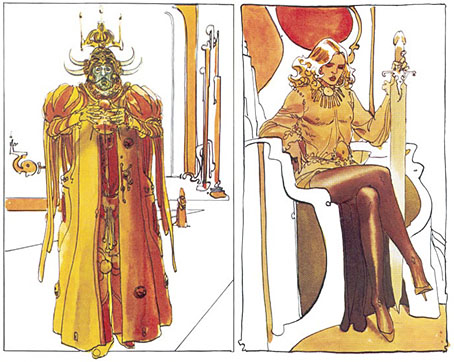
left: Emperor Shaddam IV; right: Feyd Rautha.

Moebius’s designs are wildly different from those used in David Lynch’s 1984 adaptation (which I like nonetheless). His sketch of the Emperor on the left gives some idea of how Salvador Dalí might have appeared in the film, while the figure on the right is Baron Harkonnen’s effete nephew, Feyd, a far more radical conception than the grinning fool played by Sting in the Lynch version. There’s a lot more of Moebius’s sketches at the excellent Dune.info site.

Previously on { feuilleton }
Dalí and Film
Jodorowsky on DVD

David Lynch window displays

lynch1.jpg

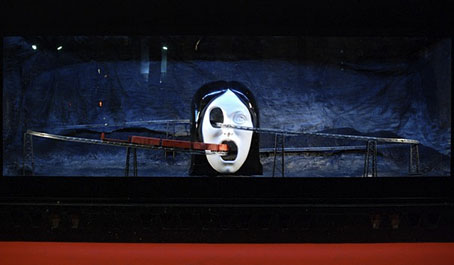
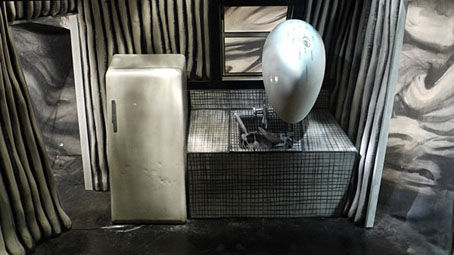
Two of the stunning displays created from sketches by David Lynch for the Galeries Lafayette department store, Paris. The series is entitled Machine-Abstraction-Women, and I don’t think Mr Lynch would mind too much having his description of the works translated in an extruded manner from French to English:

I was always fascinated by the spectacle of the women in front of the windows of the department stores. By designing the fronts of the Lafayette Galleries, I wanted to show all the identities which coexist at the woman of the 21st century. With the reflection of glass which returns the floutée image of the passers by, this set of parallel universes approaches my films, where the same actress interprets several characters. I drew very abstract decorations. Landscapes cubists populated of sculptures, wheels, pieces of furniture, of vidéos, sounds. I see these windows like a labyrinth, a street museum where to move through indices. A window, it is a transparent door on the unknown. (More.)

Much as I like Lynch’s films, I’ve never been very taken with his paintings, they always seem to lack the powerful quality he achieves in other media. But I like these a great deal and it’s a shame this is a one-off commission for a store. He’s also produced an attendant series of lithograph works, I See Myself.

David Lynch aux Galeries
David Lynch en vitrine

lynch2.jpg

Previously on { feuilleton }
David Lynch in Paris
Inland Empire

Battersea Power Station

battersea.jpg

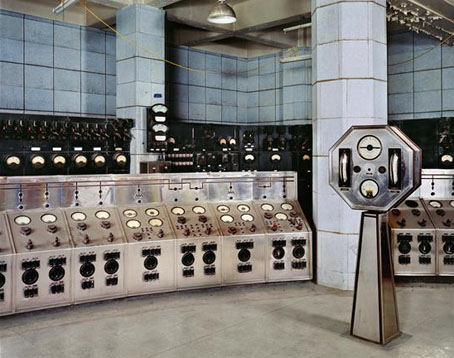
A photograph of the control room of Battersea Power Station, London, by Michael Collins, one of a series which will shortly be on display at the Royal Institute of British Architects.

The images show Battersea Power Station as what Collins describes as a “twentieth century ruined castle” – a building that was built to last, with a high quality structure and interior, including Art Deco walls and ceilings.

Giles Gilbert Scott’s enormous temple of heavy industry continues to sit decaying on the banks of the Thames while property developers come and go. The latest of these, Real Estate Opportunities, has fallen into debt which means proposals to develop the site are once again on hold. A part of me likes the idea of the building sitting there unused and purposeless year after year, like some vast Steampunk Stonehenge; Giles Gilbert Scott’s other Thames-side power station, Bankside, was successfully transformed as Tate Modern, but we know from various proposals that the fate of Battersea, whether as theme park or shopping centre, is likely to be a lot less edifying.

quark1.jpg

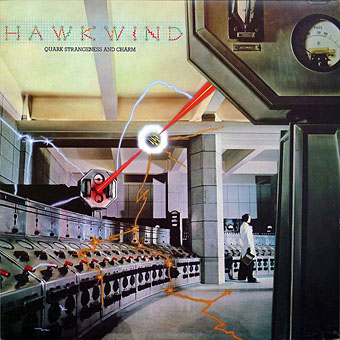
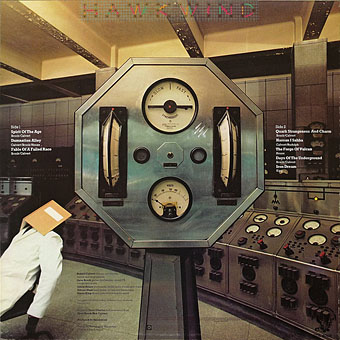
It took redevelopment to transform Bankside from temple of industry to temple of culture but Battersea’s unmistakable presence has a powerful cultural history of its own. Everyone knows the Hipgnosis sleeve design for Pink Floyd’s Animals (1977); less familiar is the photos of the control room which Hipgnosis used for Hawkwind’s Quark, Strangeness and Charm the same year. I tend to prefer the back cover of this sleeve to the front; that octagonal readout device is more interesting than the rather unconvincing sparks and exchanges of energy. And speaking of energy, my former employers are still active, unlike the rancorous Floyd.

quark2.jpg

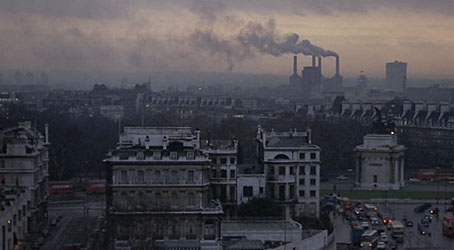
There’s a page here listing other uses of the power station, including its many film appearances which date back to the 1930s. That list mentions the control room’s use as a background for the “Find the Fish” sequence in Monty Python’s The Meaning of Life (1983) but they omit an earlier Monty Python appearance when you briefly see the building in operation during And Now for Something Completely Different (1971). It was closed down a few years later. So here it is, then, belching fumes over west London on a profoundly gloomy winter afternoon.

battersea2.jpg

Elsewhere on { feuilleton }
The album covers archive

Previously on { feuilleton }
The Sonic Assassins
The Bradbury Building: Looking Backward from the Future