Winter music

nordfjord.jpg

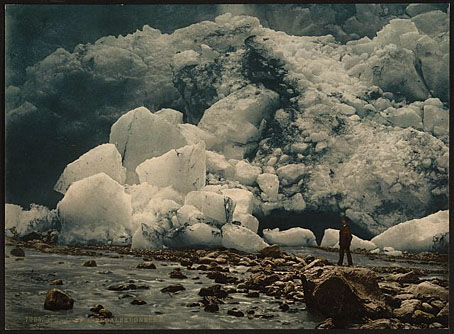
Kjendalskronebrae, Nordfjord, Norway (c. 1900). From the Library of Congress Prints and Photographs Division via Wood s Lot.

Are you suffering list fatigue yet? I certainly have been, especially from the apparently endless “best ___ of the decade” catalogues which would have you believe that the significant cultural products of the past ten years have been thoroughly sifted, reviewed and appraised. So yes, there’s a degree of hypocrisy in adding to the list surplus but, as with the Halloween music lists, it’s difficult to write about an area of listening without compiling something like this. As it happens, my Halloween playlists proved briefly popular this year when they were noticed by Stumbleupon users so someone appreciates them.

The present selection is music to complement the season and its chilly weather which in our part of the world has been colder than usual and laden with snow. It might also serve as a suggested alternative to the dreary plague of Christmas songs. This isn’t definitive, of course, and I could have added more than ten. I kept the choices in the electronic spectrum but there’s a whole other list which could be made of winter-themed folk songs, folk music of all kinds being sensitive to the changing seasons.

Sonic Seasonings (1972) by Wendy Carlos.
Between her electronic transcriptions of Baroque music and the score for A Clockwork Orange, Wendy Carlos released a collection of four long pieces of electronic atmospherics blended with natural sound recordings, with each track dedicated to a different season. The album may not have had the formal intent of Brian Eno’s ambient albums but ambient it certainly is, preceding Eno’s Discreet Music by three years whilst predicting much of what would become over-familiar during the 1990s. The Winter track is the one which concerns us here, a droning Moog landscape of echoed notes, tinkling ice, distant wind and Rachel Elkind’s lupine howls. Carlos and Elkind carried the synthesised chill into their opening music for The Shining a few years later, and Carlos returned to the theme with the digital improvisations of Land of the Midnight Sun, included as a bonus on the Sonic Seasonings CD.

Eskimo (1979) by The Residents.
A conceptual masterpiece, and an album which still sounds as strange and timeless as it did when it first appeared. Eskimo is the first and (one presumes) only example of what might be labelled “Eskimo exotica” since the whole work is more Eskimo-esque than an authentic musical rendering of the world of the Inuit people. Like Wendy Carlos’s Winter, these are shifting soundscapes augmented by ritual chants and synthesised animal sounds. For those who found the album to be musically inaccessible the group released Diskomo, a segue of the musical themes matched to a thumping dance beat.

Iceland (1979) by Richard Pinhas.
Another far north concept album and the third solo release from the Heldon guitarist who subdues his Robert Fripp impersonations in favour of synth arrangements. The CD version includes a 22-minute bonus, Winter Music.

Victorialand (1986) by Cocteau Twins.
Much of the Cocteau Twins’ chiming and reverb-drenched output would suit the colder months but Victorialand in particular takes its title from a region of Antarctica, and many of the track titles—Whales Tails, How to Bring a Blush to the Snow—point in that direction. Another timeless work.

White Out (1990) by Johannes Schmoelling.
Schmoelling was a member of Tangerine Dream in what I consider to be their last worthwhile incarnation from 1980 to 1986. His third solo album also takes Antarctica as its theme and while some of the music tends to a jaunty blandness at its best it manages to evoke the isolation of the continent through lengthy synthesiser pieces. When the Polydor release went out of print, Schmoelling re-worked the album slightly for reissue on his own label.

Songs from the Cold Seas (1995) by Hector Zazou.
Many of the late Hector Zazou‘s albums were concepts of some kind, often involving a roster of guest artists. Songs from the Cold Seas follows this pattern with singers from around the world delivering a variety of songs from the world’s colder regions. For a contrast to the Residents’ ethnological forgeries, Song of the Water is a chant by Inuit artists Elisha Kilabuk and Koomoot Nooveya. Among other highlights there’s Björk who restrains her vocal gymnastics for once with a delicate Icelandic lullaby, Vísur Vatnsenda-Rósu.

Polar Sequences (1996) by Higher Intelligence Agency & Biosphere.
A collaboration between Bobby Bird of HIA and Biosphere‘s Geir Jenssen, recorded live with sounds sourced in and around Jenssen’s home town of Tromsø at the Arctic Circle. I much prefer this to the other HIA releases which lack its detailed textures. One track, Meltwater, sounds just as you’d expect, all running water and crackling ice.

Substrata (1997) by Biosphere.
Still one of the finest Biosphere releases (although Nordheim Transformed is probably my favourite) and included here for its chilly and mostly beatless atmosphere which includes further samples from the far north.

La Marche de L’Empereur (2005) by Emilie Simon.
I still haven’t seen La Marche de L’Empereur (March of the Penguins) but the soundtrack for the original French release is a fantastic collection of songs illustrating the survival struggles of the film’s penguins. Emilie Simon is frequently described as “the French Björk”, a lazy label which only connects the pair because they’re female singers who also happen to be “foreign” and users of unorthodox electronic arrangements. The recordings here feature glitch-inflected rhythms and glass instruments which means they were far too interesting for the American release of the film. The Hollywood version dropped the songs in favour of a traditional orchestral score.

Alaska Melting (2006) by Monolake.
The latest album from Monolake, aka Robert Henke, was released earlier this month. Silence has a winter scene on the cover and a track entitled Infinite Snow but winter isn’t a predominant theme. While the music is up to Henke’s usual high standard, it’s a lot less urgent than Alaska Melting, a one-off release on 12″ vinyl with two slices of vibrant techno that foreground Henke’s environmental concerns. The most uptempo and abrasive work on this list.

Previously on { feuilleton }
A playlist for Halloween: Voodoo!
Dead on the Dancefloor
Cristalophonics: searching for the Cocteau sound
A Clockwork Orange: The Complete Original Score
A cluster of Cluster
Fragment Endloss by Robert Henke
Another playlist for Halloween
Thomas Köner
A playlist for Halloween

Kubrick shirts

kubrick1.jpg

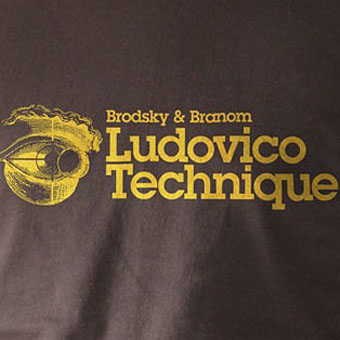
These days I still wear T-shirts but only under other clothes, I’m no longer happy with the T-shirt as an item on its own. (It doesn’t help that my arms are so skinny they always look awkward depending from a pair of short sleeves.) The irony is that I’ve spent a lot of time over the past thirty years creating T-shirt designs, starting with tour shirts for Hawkwind in the early Eighties, and if I still wore anything with a distinctive design I’d probably want one of these, especially the HAL 9000 whose logo matches the one seen in the film.

kubrick2.jpg

All of these are from Last Exit to Nowhere who specialise in apparel derived from various cult and genre films. Most of their Kubrick items are shown here whereas films such as Blade Runner and the Alien series have a number of fictional brands to choose from. Smart and funny, although I feel that the Ludovico Technique should be promoted with a logo that looks more typically Seventies given the way A Clockwork Orange projects 1971 into the future. But kudos for not burdening the things with superfluous slogans; you either get the joke or you don’t.

kubrick3.jpg

Previously on { feuilleton }
Readouts
A Clockwork Orange: The Complete Original Score
Juice from A Clockwork Orange
Clockwork Orange bubblegum cards
Alex in the Chelsea Drug Store
2001: A Space Odyssey program

Naked furniture

blazquez.jpg

Taking a break from the psychedelic overload today with a return to (what else?) black and white photographs of naked men. The subjects this time are from Mobilario Humano, fanciful suggestions for furniture designs by David Blázquez which use the photographer himself as the subject, collaged into a series of pliable clones. Allen Jones produced similar work with female figures in the 1960s—and Stanley Kubrick borrowed Jones’ idea for A Clockwork Orange—but this is the first time I’ve seen male figures used this way.

Thanks to Carmine for the tip!

Readouts

hal9000.jpg

The HAL Project.

January flew by in a blizzard of work so posting here tended to rely more on pictures than words. As usual the things I’ve been designing will be unveiled when they’re closer to being published or released but for now here’s some new or not-so-new items worthy of note.

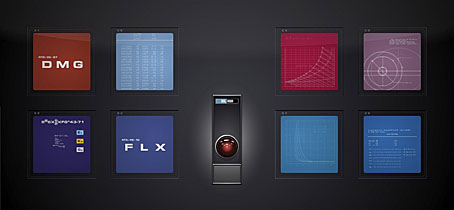
The HAL Project screensaver. I’ve never had much time for gaudy screensavers, I prefer something which doesn’t get annoying when I’m otherwise engaged. For a while now I’ve been using the Mac-only Lotsawater which turns your monitor into a vertical water tank with slow motion ripples. I replaced that this week with Joe Mackenzie’s HAL Project screensaver (for Mac and Windows) which throws up random samplings of the HAL 9000 monitor animations from 2001: A Space Odyssey. Sounds a bit dull until you see it in action, very crisp and detailed graphics, many of which mimic the animations of those in the film. I’ve belatedly realised how similar these fields of colour and their lines of white type are to the opening titles of A Clockwork Orange, yet another connection between the two films. Now I can sit trying to figure out some of the less obvious 3-letter codes for the spacecraft’s systems; Stanley Kubrick was so thorough you just know they all mean something.

Via the Kubrick obsessives at Coudal.

A pair of new blogs. Designer Barney Bubbles should need little introduction here but if you require one then read this. Paul Gorman has been in touch to inform me of a new online companion to his BB book, Reasons To Be Cheerful, which already looks like a treat with displays of Bubbles creations that didn’t make the book.

Writer Russ Kick was also in touch this week with news of his books and book culture blog, Books Are People, Too. Russ is the author of several books for Disinformation and his Memory Hole website notoriously caused a headache for the Bush regime when he forced photos of flag-draped coffins returning from Iraq onto the front pages of American newspapers.

Songs of the Black Würm Gism. And speaking of books, the much delayed sequel to DM Mitchell’s landmark Lovecraft anthology, The Starry Wisdom comes shambling into the light of day at last. The Creation Oneiros website describes it thus:

The Black Würm Gism Cult – oceanic insect porn – a vortex of cosmic mayhem stalked by ravening lysergic entities – a post-human psychedelic seizure of Lovecraftian text, art and fragments. SONGS OF THE BLACK WÜRM GISM picks up where the acclaimed anthology THE STARRY WISDOM left off and goes beyond – way beyond! – what H.P. Lovecraft dared to show. Editor D.M. Mitchell presents an illustrated brainstorm of visceral deep-sea dream currents, aberrant trans-species sex visions, and frenzied ophidian entropy.

Contributors include: alan moore (cover illustration), john coulthart (introduction), grant morrison, david britton, ian miller, john beal, david conway, kenji siratori, herzan chimera, james havoc, reza negarestani, & many others

Yes, the rather pompous introduction for this volume is mine and the cover is Alan Moore’s psychedelic arachnoid rendering of the demon Asmodeus, the same picture I used to create my little hidden film on the Mindscape of Alan Moore DVD. The Starry Wisdom roused a vaporous fury among the more staid Lovecraft readers so I look forward to seeing what squeaks of outrage this new book inspires. Publication is set for September 2009 but you can order it now from Amazon and other outlets.

ghost_box.jpg

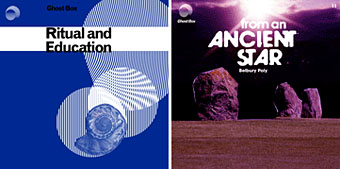
Ghost Box haunts again. And if anything was going to provide a suitable soundtrack to “aberrant trans-species sex visions, and frenzied ophidian entropy” you could do worse than some of the works of the Ghost Box collective, especially the spooky and abrasive Ouroborindra by Eric Zann. Ritual and Education is a new download-only sampler of Ghost Box tracks and probably an ideal place to start if your curiosity is piqued by my recurrent raves about these releases. From An Ancient Star is the latest CD from Belbury Poly which swaps the Pelican Books graphics of earlier works for a convincing piece of crank lit. cover art which wouldn’t look out of place in the RT Gault archives.

Previously on { feuilleton }
The Demon Regent Asmodeus
The Séance at Hobs Lane
Ghost Box
2001: A Space Odyssey program

Planet by Marc Quinn

quinn.jpg

Planet by Marc Quinn. Photo by Christopher Furlong.

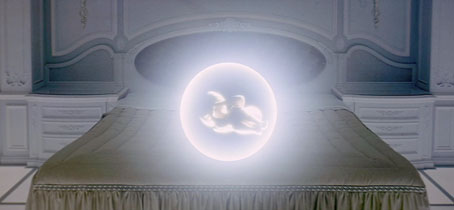
Marc Quinn’s remarkable sculpture is one of several pieces by different artists (including Salvador Dalí) being displayed in the gardens of Chatsworth House until November 2, 2008. I much prefer this to Quinn’s recent works which have gained attention almost solely for having Kate Moss as their model. A floating baby with a stellar name can’t help but remind me of another weightless infant with a cosmic genesis.

2001.jpg

Previously on { feuilleton }
Giant Skeleton and the Chocolate Jesus
2001: A Space Odyssey program