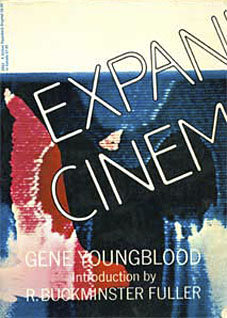
Expanded Cinema by Gene Youngblood

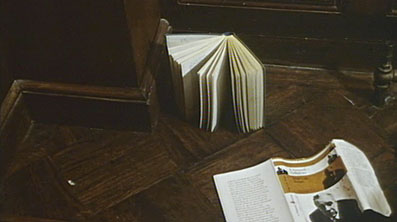
expanded.jpgThis prescient out-of-print volume from 1970 is available as a free PDF download here. Also at the essential ubu.com. (Thanks to Jay for the tip!)

From the original back jacket copy:

“Today when one speaks of cinema, one implies a metamorphosis in human perception,” writes the author of this extraordinary book. “Just as the term ‘man’ is coming to mean man / plant / machine, so the definition of cinema must be expanded to include videotronics, computer science, and atomic light.”

In a brilliant and far-ranging study, Gene Youngblood traces the evolution of cinematic language to the end of fiction, drama, and realism. New technological extensions of the medium have become necessary. Thus he concentrates on the advanced image-making technologies of computer films, television experiments, laser movies, and multiple-projection environments. Outstanding works in each field are analyzed in detail. Methods of production are meticulously described, including interviews with artists and technologists. Expanded Cinema is filled with provocative post-McLuhan philosophical probes into: “the Paleocybernetic Age,” “the videosphere,” and “the new nostalgia,” all in the context of what the author calls “the global intermedia network.” In “Image-Exchange and the Post-Mass Audience Age,” Mr. Youngblood discusses the revolutionary implications of videotape cassettes and cable television as educational tools. His observations are placed in a comprehensive perspective by an inspiring introduction written by R. Buckmister Fuller. Vast in scope, both philosophical and technical, Expanded Cinema will be invaluable to all who are concerned with the audio-visual extensions of man, the technologies that are reshaping the nature of human communication.

About Gene Youngblood:

Gene Youngblood is an internationally known theorist of electronic media arts, and a respected scholar in the history and theory of experimental film and video art, which he has taught for 34 years. He is the author of Expanded Cinema (1970), the first book about video as an art medium, which was influential in establishing the field of media arts. He is also widely known as a pioneering voice in the Media Democracy movement, and has been teaching Media and Democracy for 30 years. He has lectured at more than 400 colleges and universities throughout North America, Europe, Japan, and Australia, and his writing is published extensively around the world. He has received grants from the Rockefeller Foundation, the Rockefeller Brothers Fund, the National Endowment for the Arts (NEA), The New Mexico Arts Division, and the New Mexico Endowment for the Humanities. He has taught at CalArts, The California Institute of Technology, Columbia University, the School of the Art Institute of Chicago, UCLA and USC.

Elsewhere on { feuilleton }
The abstract cinema archive

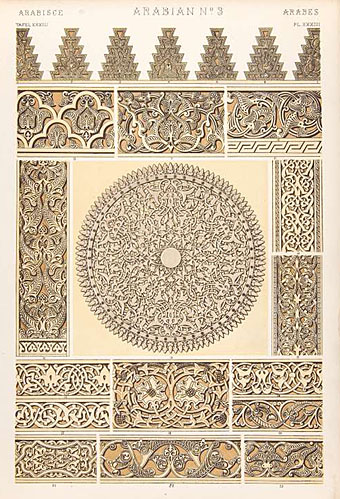
The Grammar of Ornament by Owen Jones

Owen Jones’ landmark study of the world’s decorative history was published in 1856. I have a facsimile edition from the 1980s and it’s a beautiful volume even besides its value as a reference work. Now illuminated-books.com has made high-res scans of the pages available for free. They do the same for a number of other books, including other titles by Owen Jones and his contemporaries William Morris and Walter Crane. Crane’s Decorative Illustration is recommended for anyone interested in the history of book design.

grammar.jpg

View: The Modern Magazine

charles_henri_ford.jpg

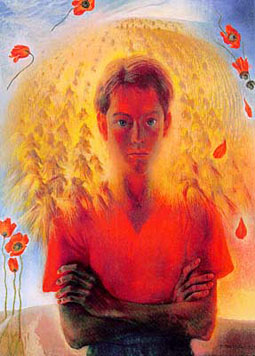
Portrait of Charles Henri Ford in Poppy Field by Pavel Tchelitchew (1933).

View magazine was an American periodical of art and literature, published quarterly from 1940 to 1947 with heavy emphasis on the Surrealist art of the period. The astonishing list of contributors included Jorge Luis Borges, Alexander Calder, Albert Camus, Marc Chagall, Joseph Cornell, Jean Dubuffet, Lawrence Durrell, Max Ernst, Jean Genet, Paul Klee, Henry Miller, René Magritte, André Masson, Joan Miró, Georgia O’Keefe, Pablo Picasso, Man Ray, Edouard Roditi, Yves Tanguy, and Pavel Tchelitchew.

Continue reading “View: The Modern Magazine”

My Life in the Bush of Ghosts

mylifealbum.jpg

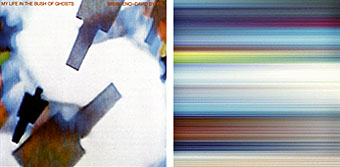
Brian Eno and David Byrne’s 1981 album gets a remastered reissue this month, something I’m looking forward to hearing as all the early Eno albums sounded pretty crappy on their initial CD release. My Life in the Bush of Ghosts is being given an added publicity push this time round with much being made of its status as an inspiration to later generations of musicians and DJs. The album site includes tracks that will be available for anyone to download (after signing a Creative Commons form) for purposes of remixing.

While the album’s wonderful grooves certainly deserve their reputation, I still get rather aggravated by claims made for its landmark status as “the first sampling album” or similar. These assertions derive from the way most of the tracks mix recordings taken from American radio or from Arabian “world music” albums in a manner that was unusual at the time, but certainly not without precedent. I think Eno and Byrne would be first to acknowledge that they were popularising a technique that already existed, just as Eno brought Terry Riley’s tape loop experiments to a wider audience on recordings such as (No Pussyfooting), Evening Star and Discreet Music.

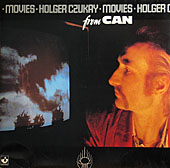
movies.jpgThere are at least two Terry Riley-like figures behind the genesis of My Life…. One is Holger Czukay, bass player from the German band Can, and editor and tape collagist for all of Can’s music. Czukay released a solo album in 1979 called Movies which does exactly what My Life… does but considerably better for the most part (there’s even a track entitled Persian Love that mixes Middle-Eastern radio singers with Czukay’s guitar). My Life… overlays the voices (almost all from a single source only) on the music in a manner which isn’t particularly inventive; Czukay on the other hand not only interleaves multiple recordings across his tracks but even makes it sound as though the radio recordings have been made specially for each track. Cool in the Pool contains a lengthy sax solo taken from the radio that matches Czukay’s music so perfectly he must have planned the entire track around the place where the solo would occur. Eno would have been well aware of this album seeing as he’s a lifelong Can aficionado and played with Czukay on a couple of the Cluster releases in the late-Seventies.
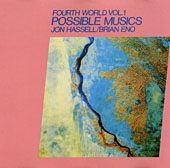
possible.jpgThe other eminence gris behind My Life… is Jon Hassell, a composer and musician I’ve had the good fortune to work as a designer recently. Eno was very impressed by Hassell’s early “Fourth World” albums and helped Hassell produce the third of these, Possible Musics, in 1980. He also invited Hassell to play trumpet on Houses in Motion when he was producing Remain in Light for Talking Heads in the same year. Hassell has always maintained that My Life… came out of this period of his association with Eno and Byrne and that the album was originally intended to be a three-way Fourth World collaboration. Whatever the veracity of this, Peter Gabriel recognised the lineage in 1982 when he compiled the first WOMAD album, Music and Rhythm. Among a number of acknowledged talents from different countries playing what people still class as “world music”, there was Jon Hassell with a version of Ba-Benzélé from Possble Musics, and Holger Czukay with Persian Love. Oh yes, and a piece by David Byrne…
If this sounds like a denigration of My Life… it isn’t intended as one. I bought this album when it came out and still have the original vinyl copy. The criticism is addressed to lazy journalists whose assertions about musical history don’t always stand up to close scrutiny. To his credit, Paul Morley in the sleevenotes to the reissue acknowledges both Can and Jon Hassell but then he always was a journalist capable of thinking for himself, rather than parroting the platitudes of others.

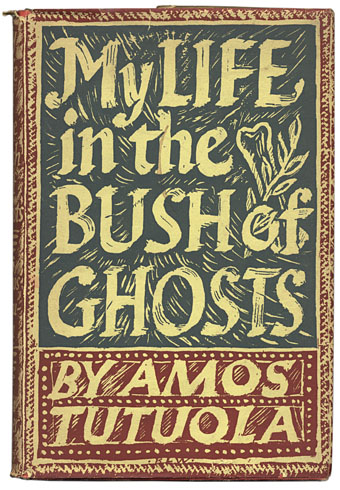
Finally, here’s my copy of the book that gave the album its title. I’ve had this for years and still not read it. Maybe now would be a good time.

mylifebook.jpg