A few thousand science fiction covers

sf_covers.jpg

Seems that this has been around for a while but I’ve only just run across it. Jim Bumgardner has created a browsable “table-top” of thousands of sf magazine covers using minimal Flash and Perl scripting; unlike many Flash-oriented web toys you don’t have to waste valuable minutes watching a progress bar before it starts working. Rest your mouse anywhere on the picture and a cover lifts itself from the mass; double-click that cover and it grows larger. He also has a similar page for covers of Mad magazine and 1001 graphic novels and comics. And an explanation of how it all works.

Previously on { feuilleton }
The book covers archive

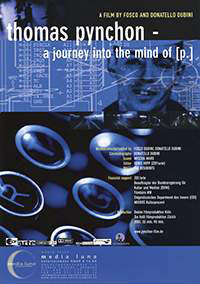
Thomas Pynchon – A Journey into the Mind of [P.]

pynchon_film.jpg

Thomas Pynchon – A Journey into the Mind of [P.] (2001)
Written and directed by Fosco Dubini
and Donatello Dubini
Music by The Residents
Language: English
Runtime: 96mins

“Things are not as they seem.” In US writer Thomas Pynchon’s case, this is a mantra, cornerstone to a life and labyrinthine oeuvre freighted with ceaseless speculation. In books like V. and Gravity’s Rainbow, the covert arenas of the contemporary order (the military-industrial complex, governmental conspiracy, the sinister reaches of science) mesh with counter-cultural values, permeating paranoia, arcane knowledge-systems and profoundly ironic humour in an encyclopaedic investigation of modernity. Central to this is a (doomed) quest for some singular explanation of things, a motif taken up by the Dubini duo in their intriguing derive that takes in his biography, times and obsessive supporters.

On the surface it’s a tall order: Pynchon is one of the great cultural recluses, unphotographed for 40 years, his absence from the flashgun glare now an inseparable part of his “project.” So the film offers an atmospheric collage, chaptered around varying recollections and his synchronicity with resonant aspects of post-war US society. Apposite newsreel and found-footage of missile experiments and Agency psychedelics tests mix with talking heads, spoken extracts and Pynchon’s articulate fans. Stand-ins, doubles, lookalike contestants populate a shifting reality, scored to a trippy, fragmented soundscape care of The Residents, that builds towards a compelling final act, searching for the grail of a new image of the writer. Reflecting the hall of mirrors in which the novels, history, the novelist and his “researchers” move, this documentary, while uneven and occasionally over-extended, provides required viewing for devotees, and should reward those keen to explore the mysterious dynamics of the age via one of their definitive surveillants.

Gareth Evans, Time Out.

The Grey Lodge is torrenting a 632MB avi version. Buy the DVD here.

Previously on { feuilleton }
A literary event: new Thomas Pynchon

Le horreur cosmique

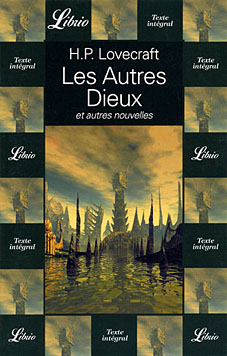
hpllibrio.jpgI’ll be in Paris this week so some French-related postings are in order.

Michel Houellebecq’s HP Lovecraft: Against the World, Against Life (which I still haven’t read) has been in the news again recently, with a number of reviews appearing in UK newspapers and magazines, most of which present the by-now rather tired spectacle of reviewers who normally wouldn’t give any of this nasty pulp stuff a second thought having to take Lovecraft seriously because Houellebecq is a serious author. (“He’s a bad writer!” they bleat. And Lou Reed is a bad singer; you’re missing the point, you fools.) The Observer last week had one of the better ones. Last year the Guardian published an extract from Houellebecq’s book.

Curious how often it requires the French to make the Anglophone world look anew at marginalised elements of its own culture; Baudelaire championed Edgar Allan Poe, it was French film critics who gave us the term “film noir” when they identified a new strain of American cinema and the Nouvelle Vague writers and filmmakers were the first to treat Hitchcock as anything other than a superior entertainer. The French have always liked Lovecraft so it was no surprise to me at least when Houellebecq’s book appeared.

Oddly enough, the only association I’ve had so far with French publishing is the use of my 1999 picture of Cthulhu’s city, R’lyeh, on the cover of a reprint of HPL stories from Houellebecq’s publishing house (above). Something I’ll be looking for in Paris if I have the time will be more of Philippe Druillet‘s Lovecraft-inflected work. Druillet has been working with the imagery of cosmic horror since the late 60s and even illustrated the work of William Hope Hodgson, one of HPL’s influences and an English writer the broadsheet critics have yet to hear about. Take a look at these pictures for stories written before the First World War then go and look at some stills from the latest Pirates of the Caribbean movie. What was once the preserve of Weird Tales and other pulp magazines is now mainstream culture.

Previously on { feuilleton }
Davy Jones
Charles Méryon’s Paris

A literary event: new Thomas Pynchon

MutedPosthorn.jpgNew Thomas Pynchon novel to be released
Mysterious author’s first novel in almost a decade comes out in December

NEW YORK—Thomas Pynchon fans, the long wait is apparently over: His first novel in nearly a decade is coming out in December.

But details, as with so much else about the mysterious author of such postmodern classics as “V.” and “Gravity’s Rainbow,” have proved a puzzle.

Since the 1997 release of “Mason & Dixon,” a characteristically broad novel about the 18th-century British explorers, new writings by Pynchon have been limited to the occasional review or essay, such as his introduction for a reissue of George Orwell’s “1984.” He has, of course, made no media appearances or allowed himself to be photographed, not counting a pair of cameos in “The Simpsons,” for which he is sketched in one episode with a bag over his head.

This much is known about the new book: It’s called “Against the Day” and will be published by Penguin Press. It will run at least 900 pages and the author will not be going on a promotional tour.

“That will not be happening, no,” Penguin publicist Tracy Locke told The Associated Press on Thursday.

Like J.D. Salinger (who at one point Pynchon was rumored to be), the 69-year-old Pynchon is the rare author who inspires fascination by not talking to the press. Alleged Pynchon sightings, like so many UFOs, have been common over the years, and his new book has inspired another round of Pynchon-ology on Slate and other Internet sites.

Late last week, the book’s description—allegedly written by Pynchon—was posted on Amazon.com. It reads in part:

“Spanning the period between the Chicago World’s Fair of 1893 and the years just after World War I, this novel moves from the labor troubles in Colorado to turn-of-the-century New York, to London and Gottingen, Venice and Vienna, the Balkans, Central Asia, Siberia at the time of the mysterious Tunguska Event, Mexico during the Revolution, postwar Paris, silent-era Hollywood, and one or two places not strictly speaking on the map at all.

“With a worldwide disaster looming just a few years ahead, it is a time of unrestrained corporate greed, false religiosity, moronic fecklessness, and evil intent in high places. No reference to the present day is intended or should be inferred.”

The description was soon pulled from the site, with Penguin denying any knowledge of its appearance. According to Amazon.com spokesman Sean Sundwall, Penguin requested the posting’s removal “due to a late change in scheduling on their part. We expect the description to be reposted to the book’s detail page in the next day or two.”

Locke declined comment on why the description was taken down, but did reluctantly confirm two details provided by Sundwall, that the book is called “Against the Day” (no title is listed on Amazon.com) and that Pynchon indeed wrote the blurb, which warns of more confusion to come.

“Contrary-to-the-fact occurrences occur,” Pynchon writes. “If it is not the world, it is what the world might be with a minor adjustment or two. According to some, this is one of the main purposes of fiction. Let the reader decide, let the reader beware. Good luck.”

New work for July

sh_cover.jpg

This new Savoy volume was an exhausting task, 608pp with illustrations on nearly every page. The book is another study of Savoy’s long career as publishers with many digressions examining the various maverick and often unsavoury characters that have fuelled David Britton’s books and the wider Savoy corpus, from real and imagined fascists to pulp writers, movie cowboys, PJ Proby and sundry rock’n’rollers. It forms a loose trilogy with two earlier books, Robert Meadley’s A Tea Dance at Savoy and DM Mitchell’s A Serious Life.

For the design I wanted to avoid the obvious that the title would imply and play around with a different brand of totalitarian imagery, namely the iconography of Soviet Russia and its accompanying propaganda. We used Jonathan Barnbrook’s Newspeak font for all of the titles and headings, a great design that has the right look while still being contemporary. The cover and interior chapter spreads borrow elements of the Soviet style, with some nods towards the general Bauhaus and Art Deco designs of the 1920s and ’30s. It was an enjoyable project even if it did seem interminable at times.