The End of Books, 1894

robidabooks01.jpg

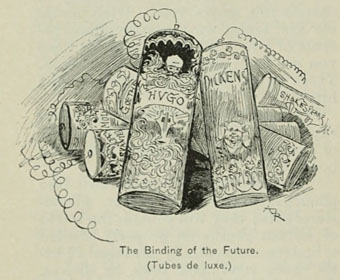
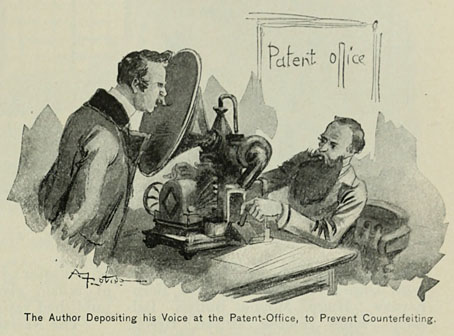
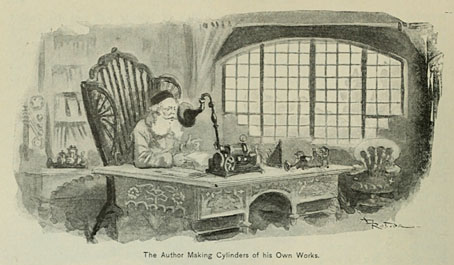
More illustrations from Albert Robida, and a riposte to anyone thinking that the idea of the end of books is a recent thing. This article by bibliophile Octave Uzanne appeared in Volume 16 of Scribner’s Magazine (July–December 1894). The piece opens with a description of various scientists and artists at a Royal Society evening making predictions about life in the future. Among other proposals there’s that old saw of science fiction, the meal of condensed nutrients which would supposedly put an end to world hunger. Uzanne’s account of the future of the book involves authors speaking their works into recording devices. Despite Robida’s somewhat comic extrapolations Uzanne seemed to have been semi-serious; even if he wasn’t he made a good job of predicting audio books, and (after a fashion) television: those wanting illustrations would have images projected by one of Edison’s Kinetoscopes.

There will be registering cylinders as light as celluloid penholders, capable of containing five or six hundred words and working up on very tenuous axles, and occupying not more than five square inches; all the vibrations of the voice will be reproduced in them; we shall attain to perfection in this apparatus as surely as we have obtained precision in the smallest and most ornamental watches.

As to the electricity, that will often be found in the individual himself. Each will work his pocket apparatus by a fluent current ingeniously set in action; the whole system may be kept in a simple opera-glass case, and suspended by a strap from the shoulder.

As for the book, or let us rather say, for by that time books “will have lived,” as for the novel, or the storyograph, the author will become his own publisher. To avoid imitations and counterfeits he will be obliged, first of all, to go to the Patent-Office, there to deposit his voice, and register its lowest and highest notes, giving all the counter-hearings necessary for the recognition of any imitation of his deposit. The Government will realize great profits by these patents.

The full article may be read here.
robidabooks02.jpg

robidabooks03.jpg

Continue reading “The End of Books, 1894”

Le Vingtième Siècle by Albert Robida

robidasiecle01.jpg

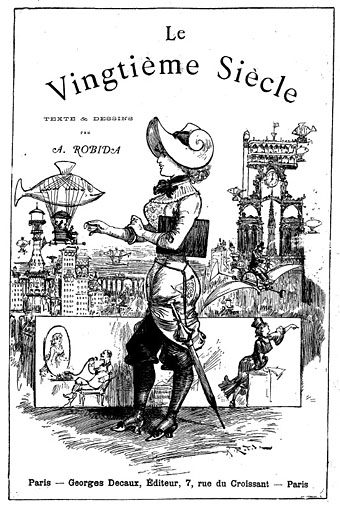
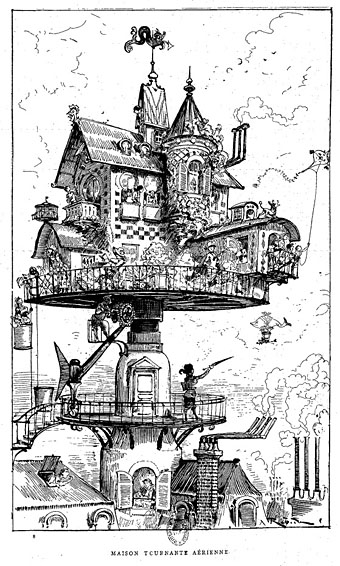
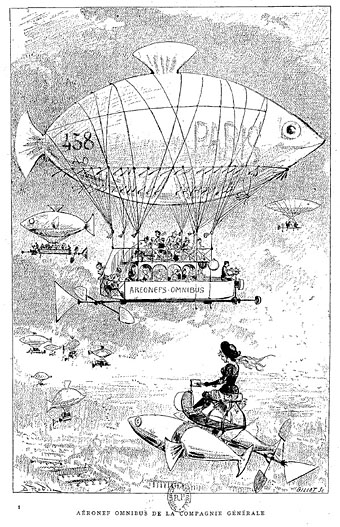
More 19th-century futurism from French illustrator and author Albert Robida. Le Vingtième Siècle was published in 1883, and is a far more comical look at life in the 20th century than La Vie Électrique, showing a future where most of the airships are shaped like enormous fish. This is a copiously illustrated volume of over 500 pages so the selection is again limited. These examples are taken from a copy at Gallica but some of the larger drawings can be seen in higher quality at this Flickr set.

robidasiecle02.jpg

robidasiecle03.jpg

Continue reading “Le Vingtième Siècle by Albert Robida”

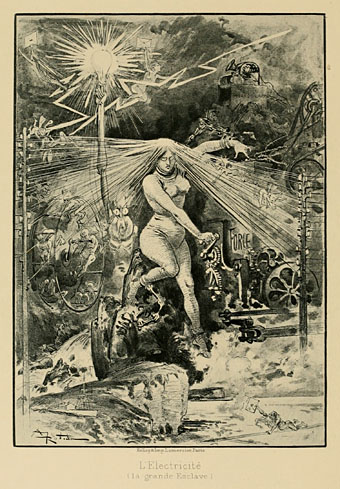
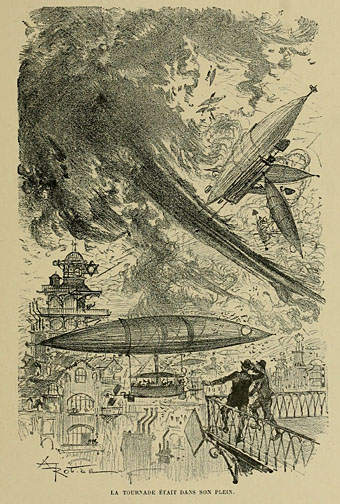
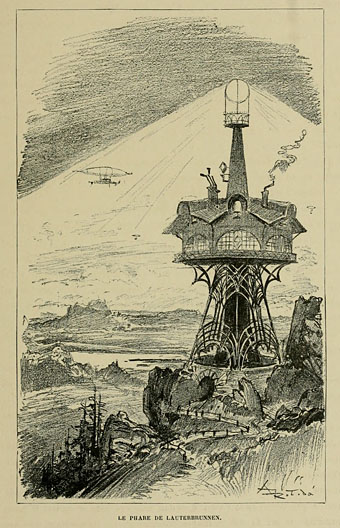
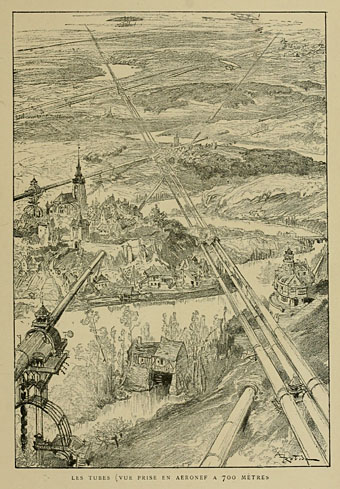
La Vie Électrique by Albert Robida

robidavie01.jpg

Albert Robida (1848–1926), a French illustrator and writer, might be less well-known today had he not authored several books which attempt to predict what life might be like in the 20th century. He was sufficiently well-regarded in his lifetime to be given the task of imagining “Old Paris” for one of the attractions at that cult event of mine, the Exposition Universelle of 1900. These days his work mostly appears in histories of science fiction as a result of books such as Le Vingtième Siècle: La Vie Électrique, a comic novel published in 1890 that looks at French life in the distant year of 1955. The attitude may be humorous, with a drawing style that resembles the contraptions of William Heath Robinson rendered by Gustave Doré, but some of Robida’s predictions are as prescient as those of HG Wells. The inhabitants of France in the 1950s may still dress like those in the 1890s but they communicate via “Téléphonoscope” while the military wage biological and chemical warfare. The usual fleets of fanciful airships fill the skies; the idea that everyone in the future would be the owner of a flying-machine goes back a long way. Robida also shows submarines, transit tubes connecting cities, and pollution caused by the new technologies.

La Vie Électrique is copiously illustrated so the selection here is a necessarily small sample. Anyone wishing to see the whole book can browse it or download it at the Internet Archive.

robidavie02.jpg

robidavie03.jpg

robidavie04.jpg

Continue reading “La Vie Électrique by Albert Robida”

Weekend links 118

owczarek.jpg

The Garden of Urban Delights (2010) by Marcin Owczarek.

His protagonists are misfits: alienated, implicitly gay, longing for love, frequently hard to be around, always fixated on small pleasures that compensate for an essential feeling of not belonging. […] His patroness Edith Sitwell termed him “that rare being, a born writer.” William Burroughs dedicated The Place of Dead Roads to him, declaring Welch “certainly the writer who most directly influenced my work.” John Waters has called In Youth is Pleasure “so precious, so beyond gay, so deliciously subversive, [it] is enough to make illiteracy a worse social crime than hunger.”

Sadie Stein on Denton Welch, a writer I’m embarrassed about still not having read. Edith Sitwell and William Burroughs had a famously disputatious correspondence in the pages of the TLS over The Naked Lunch. An appreciation of Welch’s work was one of the few things they had in common.

• Don’t mention guitars: Robert Hampson on acousmatic music, the curse of Loop and the rebirth of Main.

• No Straight Lines: A Collection Of Queer Comics part one, part two, part three. A history by Justin Hall.

Pieces Of Gold by The Aikiu: shots from gay porn videos repurposed via some smart editing.

• RIP İlhan Mimaroğlu, electroacoustic composer. Ubuweb has a selection of his recordings.

“A good ground rule for writing in any genre is: start with a form, then undermine its confidence in itself,” he says. “Ask what it’s afraid of, what it’s trying to hide – then write that.” For Harrison, the most satisfying writers are “at odds with their cultural context. They’re trying to fit in and failing, or they’re trying to remove themselves and failing. The attempt to resolve the conflict is an angle – a frame or a context – in itself.”

The Guardian’s A Life in Writing profiles M. John Harrison. His new novel, Empty Space, was published on Thursday. There’s also this recent video interview with Arc magazine.

• Stephen Usery interviews editor Russ Kick about The Graphic Canon: Volume One.

At home with Prince Zaleski, the “most decadent and imperial detective in fiction”.

• A Visit with Magritte: photographs by Duane Michals.

Loitering airships could dispense drones on demand.

• Creating a Forever Object: Ian Schon’s Pen Project.

• A Tumblr for the late, lamented Arthur Magazine.

• “Few cities can boast a railway line for the dead.”

The Lost Tapes by Can: An Oral History.

Space Reflex (1963) by Dick Hyman & Mary Mayo | Space Is Deep (1972) by Hawkwind | Space Is The Place (1973) by Sun Ra | Space Moment (1995) by Stereolab | Space Pong (2006) by T++

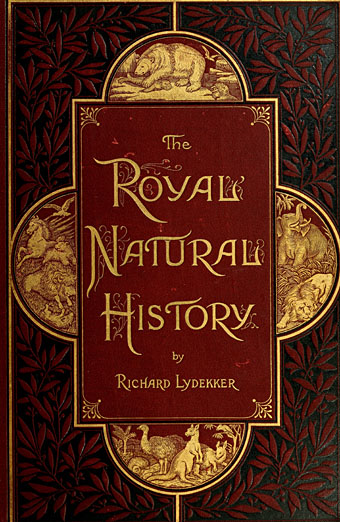
The Royal Natural History by Richard Lydekker

nathist01.jpg

The second surprise of the weekend came, as in the best Lovecraftian tradition, with the chance discovery of a small sheet of paper, a reminder from the librarian when I was at sixth form college to return three overdue books. This was an odd survival from my schooldays since I kept hardly anything from that period. One of the books was this volume, The Royal Natural History (1894), vol. 1, sec. 2, written by Richard Lydekker with engraved illustrations by a variety of artists. I said goodbye to higher education when I quit sixth form after a year; the interval there was miserable but the place did have a very good library in which I spent a lot of time reading instead of attending classes. Many of the books there were better than those in the town library—my first sight of James Joyce’s Ulysses was on those shelves—and included a small number of older titles which were in surprisingly good condition for school books.

nathist02.jpg

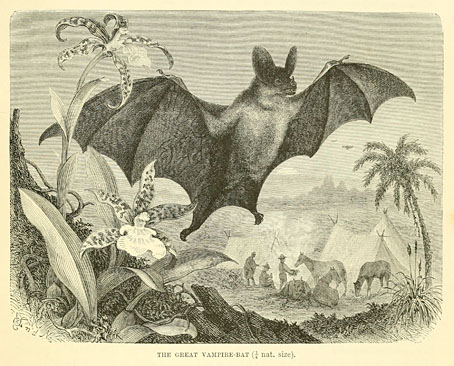
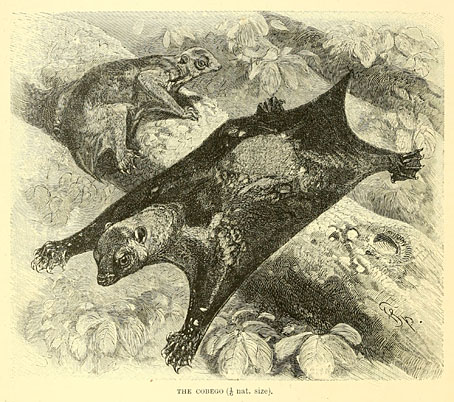
What’s nice about tracing this book is finding the title of one of those volumes whose engravings I found so fascinating and whose identity I’ve wondered about for years. The pictures are all excellent renderings, far better than the illustrations in a set of similar books I own which are forty years older and where the animals tend to be goggle-eyed comical things. Although this was the one I borrowed I suspect the library may have had more in Lydekker’s series since I recall one depicting fish and other marine creatures. The copies here are from the Internet Archive, of course, where they have a complete set that I’ve yet to look through. (There are twelve books in the set.) I wondered at first why I’d borrowed a book about the larger mammals until I saw the picture of a lynx below which I remember using as reference for a drawing. The Lydekker and the purchase a year later of Wilfried Sätty’s illustrated Edgar Allan Poe is where my engraving obsession really took off.

nathist03.jpg

Continue reading “The Royal Natural History by Richard Lydekker”