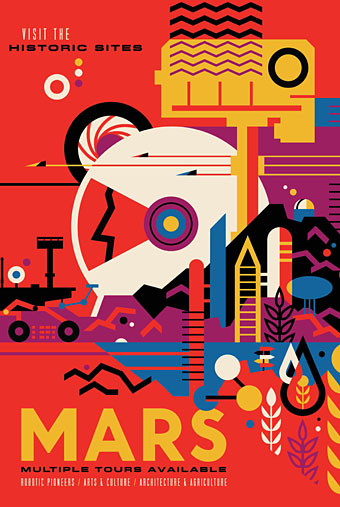
Mars (variant design): one of three new posters for NASA by Invisible Creature.
• “If the point of Sade’s work was to marry sexual frustration and release to the practice of interpersonal violence, he could confidently gaze out on the landscape of our popular culture and declare it a fait accompli.” Hussein Ibish on The United Sades of America.
• Gravitational Waves Exist: The Inside Story of How Scientists Finally Found Them by Nicola Twilley. Sean Carroll explains the importance of the discovery.
• Another This Heat interview: Bruce Tantum interrogates Charles Bullen and Charles Hayward about being a group ahead of their time.
The English word comes ultimately from Greek magike (in which the original Persian word is spliced with tekhne, “art”), while the Persian magos “one of the members of the learned and priestly class” ultimately derives from magush, “to be able, to have power”, from which we may also derive the word “machine”. So my social hierarchy is your magic, and my magic might be your craft—or even your machinery. My religion is your magic. Your religion is my fairy lore. Or your religions might be a mass of fakery and trickery and foolery. Hence in making magic into an intellectual discipline, I theorize based on my observations, which might not be mine but those of others, heritable observations. But because what I do looks very like empiricism, as I examine materials for the tricks or fooleries, or for the real alterations, checking my results against descriptions of previous experiments, what I do feels like science, feels like the template for Baconian empiricism and its great instauration.
Diane Purkiss reviewing The Book of Magic: From Antiquity to the Enlightenment, edited by Brian Copenhaver
• The Strange World Of…The Residents: Sean Kitching talks to The Residents’ resident artist, Homer Flynn.
• At Strange Flowers: film of Natalie Barney in 1962 reminiscing about Oscar Wilde and Marcel Proust.
• From Battleship Potemkin to Baker Street: Ian Christie on Sergei Eisenstein’s trip to London.
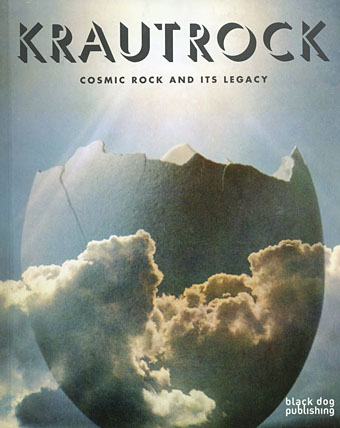
• Mixes of the week: Krautrock Mix by Tarotplane, and Mix #15 (Transversales) by Jon Brooks.
• From Rock en Stock (France, 1973): Can and Agitation Free in live performance.
• Twenty classic British folk-horror stories: a selection by Kai Roberts.
• Immemory: a Flash version of Chris Marker’s CD-ROM.
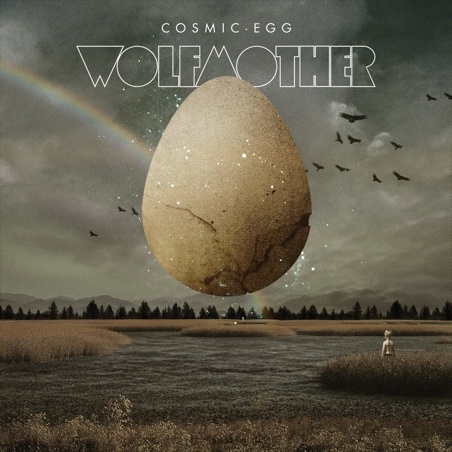
• Static Gravity (1980) by Chrome | Zero Gravity (2001) by Monolake | Gravity (2013) by Roly Porter