In the Mad Mountains

madcover.jpg

Cover design by Elizabeth Story. Cover art by Mike Mignola.

The subtitle tells you everything you need to know about this new collection of Joe R. Lansdale stories from Tachyon. I designed the interior of the book, less floridly than some of my previous designs for Tachyon, and a little more abstractly than I’d usually do for a title such as this. All of the stories have been published before, and since I’d illustrated one of them (for Lovecraft’s Monsters) I had vague hopes of incorporating my earlier illustration while providing new ones for the rest of the stories. This proved impossible, however; I was working on the layout while still finishing the design for The Bumper Book of Magic so didn’t have the time to do seven more drawings. I’ll post the illustration here anyway.

bleeding.jpg

The Bleeding Shadow is a great story, a low-rent detective tale set in the 1920s in which the predicament from The Music of Erich Zann—violinist has to keep playing his instrument in order to keep something terrible at bay—is recast with shellac 78s and a blues guitarist. Among the other pieces there’s a story that manages to successfully contrive a meeting between Huckleberry Finn, Brer Rabbit and the Cthulhu Mythos; and the final story which gives the collection its name, wherein the setting of Lovecraft’s Antarctic epic becomes a Sargasso-like landscape of shipwrecks, lost planes and horrors great and small. I especially enjoyed The Crawling Sky, a story of the Old Weird West featuring a Solomon Kane-like itinerant preacher, the Reverend Jebidiah Mercer. Lansdale’s grotesque humour is to the fore in this one. I’d like to see the Reverend given a collection of his own someday.

mad1.jpg

mad2.jpg

mad3.jpg

Elsewhere on { feuilleton }
The Lovecraft archive

Previously on { feuilleton }
Things Get Ugly
Lovecraft’s Monsters

Weekend links 738

rossetti.jpg

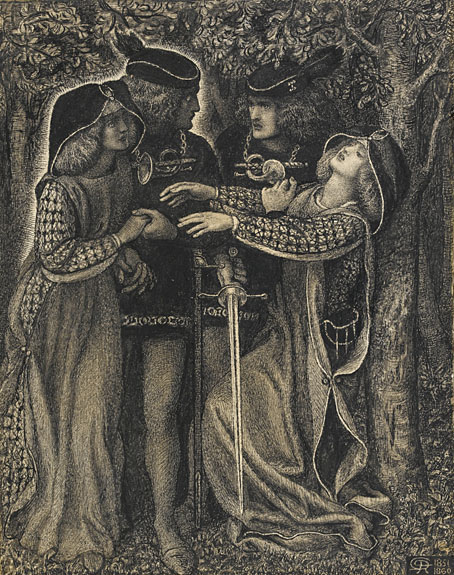
How They Met Themselves (1860) by Dante Gabriel Rossetti.

• At Igloo magazine: Justin Patrick Moore interviews inventor and electronic music composer Don Slepian about his life and work.

• At The Washington Post (archived link): Michael Dirda in praise of weird fiction, horror tales and stories that unsettle us.

• At The Daily Heller: Tina Touli’s explosively twirling typography. Steven Heller’s font of the month is Doublethink.

• At Colossal: Dreams and memories form and dissipate in Tomohiro Inaba’s delicate iron sculptures.

• At Unquiet Things: Jerome Podwil’s captivating cover art.

• New music: Strangeness Oscillation by 137.

• At Dennis Cooper’s: Craig Baldwin’s Day.

Brìghde Chaimbeul’s favourite albums.

Penguin Series Design

Double Image (1971) by Joe Zawinul | Double Flash (1999) by Leftfield | Double Rocker (2001) by Stereolab

Weekend links 735

wyeth.jpg

The Adventure of the Giant Squid (c.1939) by NC Wyeth.

• Mix of the week is a superb XLR8R Podcast 860 by Kenneth James Gibson. Elsewhere there’s DreamScenes – July 2024 at Ambientblog, and Deep Breakfast Mix 267 at A Strangely Isolated Place.

• A trailer for a restored print of Time Masters (1982), the second animated feature by René Laloux, with character designs/decor by Moebius. Now do Gandahar.

• Coming soon from Strange Attractor: Music From Elsewhere: Haunting Tunes From Mythical Beings, Hidden Worlds, and Other Curious Sources by Doug Skinner.

Not only a prolific lyricist, Lovecraft considered his main vocation to be poetry. And at its best, his verse can be judged an apt expression of his philosophical vision, in which cosmic horror embodies the predicament of all sentient beings in a meaningless universe. That Lovecraft’s poetry never reaches the heights attained by such Modernists as T.S. Eliot or Ezra Pound should not diminish the fact that his is verse that, in the most archaic of ways, advances a startlingly modern metaphysic, a poetic encapsulation of what Thomas Ligotti in The Conspiracy Against the Human Race describes as an affirmation that the universe is a “place without sense, meaning, or value.” Lovecraft, with his antiquated prosody and his anti-human ethics, presented readers with a type of counter-modernist poetry. Ironically, he is the radical culmination of William Carlos Williams’s injunction of “No ideas but in things;” he is an author for whom there are only things. Graham Harman in Lovecraft and Philosophy describes Lovecraft as a “violently anti-idealist” who “laments the inability of mere language to depict the deep horrors his narrators confront.” Unpleasant stuff, for sure. It is verse that at best exemplifies something that controversial poet Frederik Seidel called for in the Paris Review: “Write beautifully what people don’t want to hear.”

Ed Simon on The Unlikely Verse of HP Lovecraft

• Among the new titles at Standard Ebooks, the home of free, high-quality, public-domain texts: The Case of Charles Dexter Ward, by HP Lovecraft.

• At Spoon & Tamago: An ethereal bubble emerges from a Japanese townhouse.

• New music: The Head As Form’d In The Crier’s Choir by Sarah Davachi.

Mabe Fratti’s favourite albums.

Bubble Rap (1972) by Can | Bubbles (1975) by Herbie Hancock | Reverse Bubble (2014) by Air

Weekend links 719

rimmington.jpg

The Decoy (1948) by Edith Rimmington.

• “Among other things, [Dalí’s] storyboards involved [Ingrid] Bergman turning into a statue that would then break up into ants.” Tim Jonze talks to film scholar John Russell Taylor about the storyboards for Alfred Hitchcock’s films, including the ones for Spellbound which Taylor found in a bric-a-brac sale.

• “Of all the pop acts that proliferated in the early 80s, it was Soft Cell who retained punk’s sharp, provocative edges.” Matthew Lindsay on 40 years of Soft Cell’s This Last Night In Sodom.

• Coming soon from White Rabbit books: Futuromania: Electronic Dreams, Desiring Machines and Tomorrow’s Music Today by Simon Reynolds.

Anathema to many philosophical systems, or perhaps philosophy itself, Lovecraft’s philosophical project fundamentally holds that contemplations of higher reality or the nature of things can never be fully realised. Ultimately, the search for knowledge does not constitute some telos, some purpose, for humankind, but rather leads to the violent dissolution of the self. Higher reality is that which the limited human psyche can never fully comprehend.

Sam Woodward on the cosmic philosophy of HP Lovecraft

• At Public Domain Review: Grotesqueries at Gethsemane: Marcus Gheeraerts’ Passio Verbigenae (c.1580).

• “Here is a remarkable form of popular heraldry.” Mark Valentine on the mystique of old inn signs.

• At Bandcamp: Brad Sanders on where to begin with Lustmord’s cosmic ambient.

• New music: Eleven Fugues For Sodium Pentothal by Adam Wiltzie.

• At Aquarium Drunkard: Jason P. Woodbury talks to Roger Eno.

Gomorrha (1973) by Can | Sodom (1978) by Can | Spellbound (1981) by Siouxsie And The Banshees

Weekend links 715

hugo.jpg

Portrait d’Arthur Rimbaud (1933) by Valentine Hugo.

• Among the new titles at Standard Ebooks, the home of free, high-quality, public-domain texts: At the Mountains of Madness by HP Lovecraft.

Retro-Forteana is “Andrew May’s Forteana Blog, focusing on the weirder fringes of history (and other old-fashioned stuff)”.

• Mixes of the week Bill Laswell Mix No. 7: The Return of Celluloid by Voice of Cassandre, and Isolatedmix 126 by Saphileaum.

• At Bajo el Signo de Libra: The second part of a look at photographs by Herbert List of Italians and Italian life.

• New music: Worship: Bernard Herrmann Tribute by The Lord, and Cursory Asperses by Celer.

• At Wormwoodiana: Mark Valentine on the joy of obscure journals.

• At Dennis Cooper’s: Paul Clipson Day.

Persher’s favourite music.

At The Mountains Of Madness (1968) by HP Lovecraft | Mountains Of The Moon (2002) by Jah Wobble And Temple Of Sound | Mountains Crave (2012) by Anna von Hausswolff