Take Your Time: Olafur Eliasson

eliasson.jpg

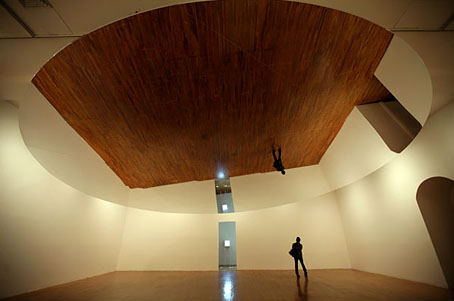
New work by Danish artist Olafur Eliasson is always welcome here and the above is exactly that, a large rotating mirror installed at the P.S. 1 Contemporary Art Center, New York, along with other pieces comprising a major survey of his work.

Take Your Time a new piece at P.S. 1, made for the show, consists of a huge, tilted, disc-shaped mirror suspended horizontally from a gallery ceiling. What strikes you at first is the omniscient, bird’s-eye reflection of the room below, with you standing in the middle of it. Then you notice that the mirror is rotating very slowly, and with a subtly undulating motion that causes the room itself feel warped and unstable. You experience this as much with your sense of balance as with your eyes.

The New York Times takes a critical look at Eliasson’s work and complains about his not being radical enough, an objection which seems curiously old-fashioned as well as being the kind of issue that only plagues art critics, other artforms getting on perfectly well without concerning themselves with being avant garde and challenging above all else. Better to ignore the redundant polemic and look at the slide show of his works.

Take your time: Olafur Eliasson runs until June 30, 2008.

Previously on { feuilleton }
Olafur Eliasson’s BMW
Olafur Eliasson’s Serpentine Pavilion
New Olafur Eliasson

Forever Changes by Jim Lambie

lambie.jpg

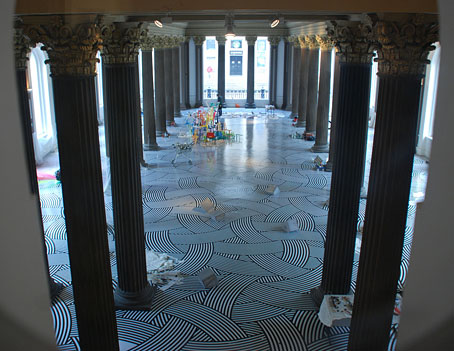
Nothing to do with the late Arthur Lee, well…not directly anyway. I love the contrast between the dizzying floor design (created with vinyl tape) and the rather dour Corinthian columns in Jim Lambie’s installation. I believe the Flickr photo above shows the work being prepared.

Forever Changes, which also includes some of the artist’s playful sculptures, is at the Gallery of Modern Art, Glasgow, as part of the Glasgow International arts festival until September 29, 2008. A review for The Scotsman describes some of its details. Lambie likes his floor coverings, having previously produced dazzlingly vibrant works such as ZOBOP which you can see being created in a little time-lapse movie here.

The Maison Lavirotte

lavirotte11.jpg

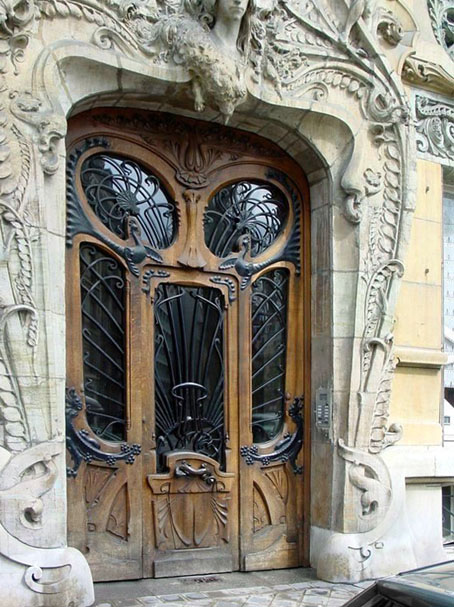
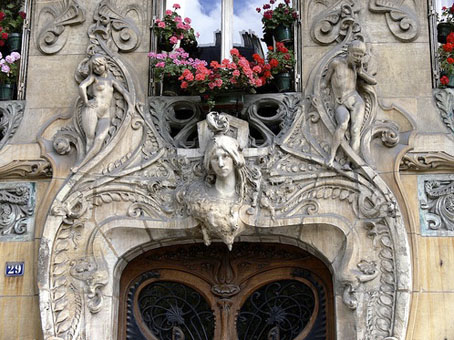
More Art Nouveau and more Paris…. I can’t believe I missed this place when I was in Paris for a week, staying just a few streets away. The building is at 29 Avenue Rapp in the 7th arrondissement and I crossed that street several times when walking to the Champs de Mars and the Eiffel Tower.

lavirotte2.jpg

The architect was Jules Lavirotte (1864–1929) and the building was named after him following its construction in 1901. His other works aren’t as excessively florid as this, nor do they display the Nouveau elegance of contemporaries such as Hector Guimard, so this façade may owe more to the capitulations of fashion than innate style. The attractively unclad figures on the pediment cock their hips at passers-by in a provocative manner that would never be allowed in British architecture of the period, and the door has some great details with stylised peacocks between the windows and a huge brass lizard for the handle.

Continue reading “The Maison Lavirotte”

The art of Ying-Yueh Chuang

chaung11.jpg

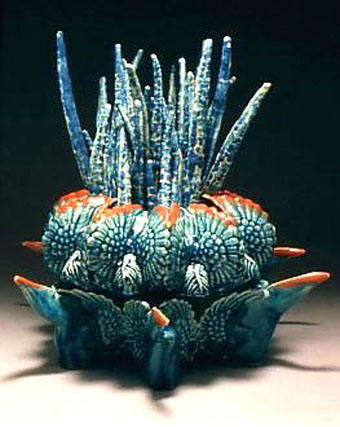
Plant creature 1 (2001).

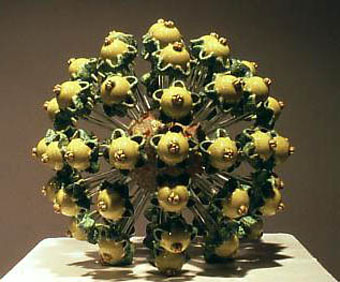
Ying-Yueh Chuang’s ceramic sculptures are based on plant and animal forms, especially sea life. I haven’t seen any mention of her being inspired by Haeckel’s Art Forms in Nature but many of her creations certainly resemble the plants and animals in Haeckel’s illustrations.

chaung2.jpg

It blooms on the day 1 (2004).

Via Fabulon.

Previously on { feuilleton }
The art of Jennifer Maestre
Kirsten Hassenfeld’s paper sculptures
Darwin Day
The glass menagerie

The Divine Sarah

bernhardt11.jpg

Sarah Bernhardt by Jean-Léon Gérôme (1895).

You can’t be a fin de siècle fetishist and not develop a fascination with actress Sarah Bernhardt, a woman who was muse to many of the era’s finest artists, most notably Alphonse Mucha, who she employed as her official designer. Mucha’s marvellous posters are endlessly popular, of course; less well-known is the sculpture by academic painter and Orientalist Jean-Léon Gérôme, a rare three-dimensional work inspired by the actress.

bernhardt2.jpg

Inkwell by Sarah Bernhardt (1880).

Even less well-known is Ms Bernhardt’s own design for a curious bat-winged inkwell. I’ve read of her having created other sculptural works but so far this is the only one I’ve seen a picture of. With something as decadent as this you’d really have to use peacock quills for pens, wouldn’t you?

bernhardt4.jpg

bernhardt3.jpg

Bracelet by Alphonse Mucha & Georges Fouquet (1899).

And in a similar sinister vein to the inkwell there’s this serpentine bracelet and ring, a superb one-off, designed by Mucha and crafted by the jeweller Fouquet. After seeing works such as this and the Lalique dragonfly (which Ms Bernhardt once wore), most other jewellery seems timid and unadventurous in comparison.

Update: Added another photo of the inkwell.

Previously on { feuilleton }
The art of Philippe Wolfers, 1858–1929
Lalique’s dragonflies
Lucien Gaillard
Smoke
The Masks of Medusa