Mark Beard’s artistic circle

beard1.jpg

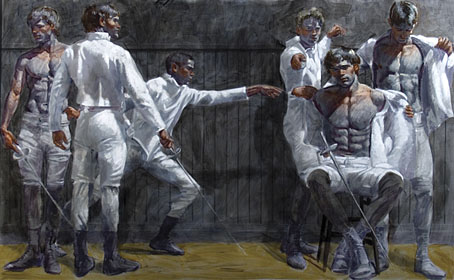
The Fencing Team by Bruce Sargeant.

Artists in the 20th century used to be multifarious in their activities, often taking their work through different stages or periods of evolution; Picasso and Max Ernst are two good examples of this. In today’s inflated art market this is no longer a wise move. As Brian Eno has noted in the case of the polymathic Tom Phillips, the pressure is there to establish yourself as a person who does one thing only, to turn yourself into a brand.

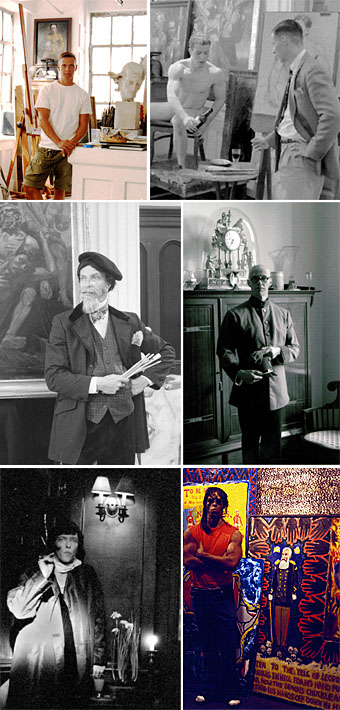
American artist Mark Beard isn’t happy with that situation. In order to satisfy a desire to create in whatever styles he chooses, he’s developed a number of distinct artist personalities, each with their own detailed biographies and even photographs (below). This isn’t entirely unprecedented, Marcel Duchamp famously had a female alter-ego named Rrose Sélavy, and was photographed by Man Ray in feminine attire, but offhand I can’t think of another artist going as far as creating six distinct personas. The painting above is one of a homoerotic sports-themed series by artist Bruce Sargeant who died, we’re told, in 1938 as a result of a wrestling accident. Examples of Beard’s other influences follow. For the complete artist biographies, see the Mark Beard pages at the Carrie Haddad gallery.

The artists
beard2.jpg

top left: Mark Beard (b. 1956); right: Bruce Sargeant and model (1898-1938)
middle left: Hippolyte-Alexandre Michallon (1849-1930); right: Brechtolt Steeruwitz (1890-1973)
bottom left: Edith Thayer Cromwell (1993-1962); right: Peter Coulter (b. 1948)

Their works
beard3.jpg

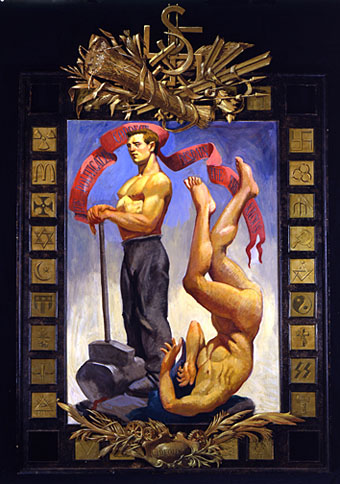
Ideology: The Politically Correct Disdain the Frivolous by Mark Beard (1989).
beard4.jpg

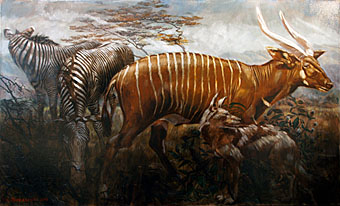
Avant la Fuite by Hippolyte-Alexandre Michallon (1894).
beard5.jpg

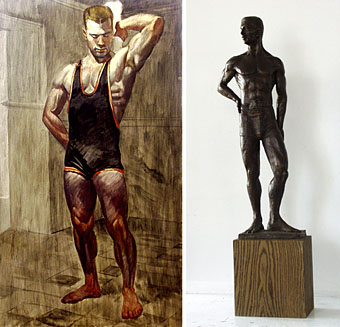
Swimmer Drying Himself, Berlin Olympics (1936), Young Athlete by Bruce Sargeant.
beard6.jpg

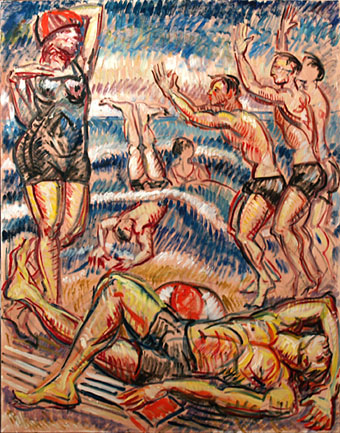
On the Strand by Edith Thayer Cromwell.
beard7.jpg

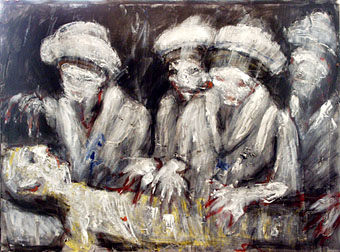
Das Krakenhaus by Brechtolt Steeruwitz (At the Hospital) (1923).
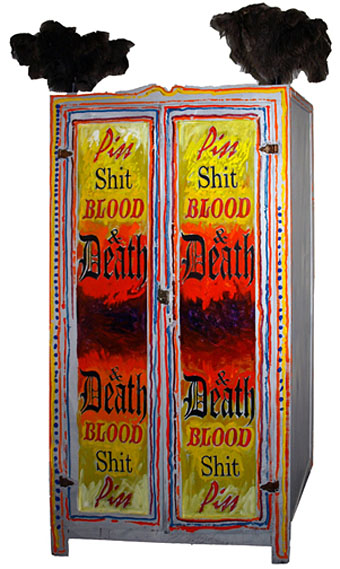
beard8.jpg

Cabinet by Peter Coulter.

Elsewhere on { feuilleton }
The gay artists archive

The art of Jacek Malczewski, 1854–1929

malczewski1.jpg

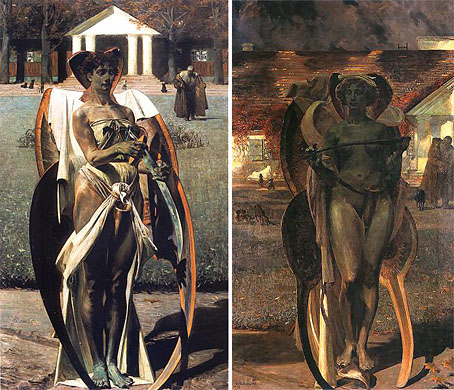
Thanatos I & II (1898).

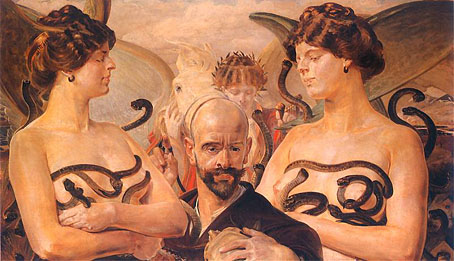
The Symbolist movement in painting found adherents across Europe but the western Europeans have always been the ones who receive the most attention for their work. Jacek Malczewski was a Polish artist who produced a number of paintings which can be classed as Symbolist—the usual complement of angels and chimeras—even though much of his output is more mundane fare. He also had a peculiar Dalínian propensity for putting himself in many of his pictures, as in the example below. The pictures here are from a substantial web collection.

malczewski2.jpg

Finis Poloniae (1906).

Previously on { feuilleton }
Carlos Schwabe’s Fleurs du Mal

Robert Rauschenberg, 1925–2008

rauschenberg.jpg

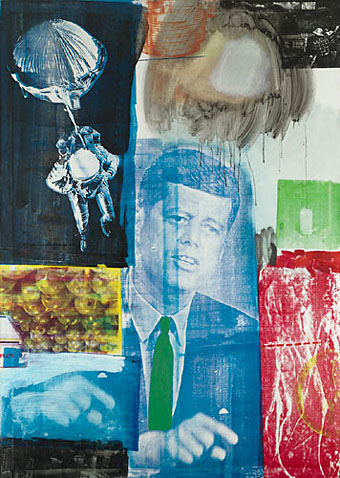
Retroactive I (1964).

My youthful enthusiasm for art acquainted me with the name of Robert Rauschenberg (who died two days ago) earlier than most. Surrealism and Pop Art held an appeal that was immediate, if rather superficially appreciated at the time, and it was seeing works from both those movements which were the most memorable aspect of my first visit to the Tate Gallery when I was 13. Later on when I was reading JG Ballard’s stories and essays in back numbers of New Worlds, Rauschenberg was one of a handful of artists who seemed to depict in visual terms what Ballard was describing in words. In this respect Robert Hughes’s discussion of the “landscape of media” (Ballard’s common phrase would be “media landscape”) below is coincidental but significant. Retroactive I was painted a couple of years before Ballard began the stories that would later become The Atrocity Exhibition and it could easily serve as an illustration for that book.

There are and will be plenty of words written elsewhere about Rauschenberg’s work and influence. I’ll note here his inclusion in the list of gay artists at GLBTQ for his creative and personal partnership with another great Pop artist, Jasper Johns.

One of the artists (television) most affected in the Sixties was Rauschenberg. In 1962, he began to apply printed images to canvas with silkscreen—the found image, not the found object, was incorporated into the work. “I was bombarded with TV sets and magazines,” he recalls, “by the refuse, by the excess of the world … I thought that if I could paint or make an honest work, it should incorporate all of these elements, which were and are a reality. Collage is a way of getting an additional piece of information that’s impersonal. I’ve always tried to work impersonally.” With access to anything printed, Rauschenberg could draw on an unlimited bank of images for his new paintings, and he set them together with a casual narrative style. In heightening the documentary flavour of his work, he strove to give canvas the accumulative flicker of a colour TV set. The bawling pressure of images—rocket, eagle, Kennedy, crowd, street sign, dancer, oranges, box, mosquito—creates an inventory of modern life, the lyrical outpourings of a mind jammed to satiation with the rapid, the quotidian, the real. In its peacock-hued, electron-sweetbox tints, this was an art that Marinetti and the Berlin Dadaists would have recognized at once: an agglomeration of memorable signs, capable of facing the breadth of the street. Their subject was glut.

Rauschenberg’s view of this landscape of media was both affectionate and ironic. He liked excavating whole histories within an image—histories of the media themselves. A perfect example is the red patch at the bottom right corner of Retroactive I. It is a silkscreen enlargement of a photo by Gjon Mili, which he found in Life magazine. Mili’s photograph was a carefully set-up parody, with the aid of a stroboscopic flash, of Duchamp’s Nude Descending a Staircase, 1912. Duchamp’s painting was in turn based on Marey‘s photos of a moving body. So the image goes back through seventy years of technological time, through allusion after allusion; and a further irony is that, in its Rauschenbergian form, it ends up looking precisely like the figures of Adam and Eve expelled from Eden in Masaccio’s fresco for the Carmine in Florence. This in turn converts the image of John Kennedy, who was dead by then and rapidly approaching apotheosis as the centre of a mawkish cult, into a sort of vengeful god with a pointing finger, so fulfilling the prophecy Edmond de Goncourt confided to his journal in 1861:

“The day will come when all the modern nations will adore a sort of American god, about whom much will have been written in the popular press; and images of this god will be set up in the churches, not as the imagination of each individual painter may fancy him, but fixed, once and for all, by photography. On that day civilization will have reached its peak, and there will be steam-propelled gondolas in Venice.”

Robert Hughes, The Shock of the New (1980).

Previously on { feuilleton }
Transfer drawings by Robert Rauschenberg
Jasper Johns
Michael Petry’s flag
JG Ballard book covers

The Feminine Sphinx

colette.jpg

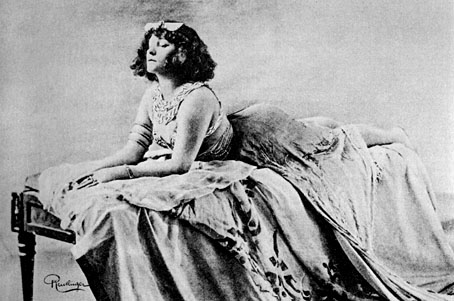
Colette.

Work this week designing a CD of readings from Colette had me searching books for pictures of the author. Of the few I found this is the most interesting, one of several Colette portraits made by photographer Leopold Reutlinger and one of at least two from 1907 which Colette used to promote her Moulin Rouge pantomime, Rêve d’Égypte. (You can see another one here.) The Egyptian theme explains the sphinx pose and her costume but there’s no indication as to whether the pose was borrowed from Franz Stuck’s famous painting (below) or whether the resemblance is coincidental.

stuck.jpg

The Sphinx by Franz Stuck (1889).

Stuck produced two nearly identical paintings on this theme; the other version is here in a rather muddy copy. I like the frame design for this one which explains in pictures the secret of the famous riddle which the Sphinx asks of Oedipus, “Which creature goes on four feet in the morning, two feet at noon, and three in the evening?” Stuck painted another sphinx picture three years earlier, The Kiss of the Sphinx, which portrays a less feminine and distinctly more rapacious hybrid.

rubenstein.jpg

Ida Rubenstein.

Colette was famously bisexual and so too was dancer Ida Rubenstein. In the same book as the Colette picture, there’s this photo of Ida recumbent in a sphinx-like pose in a very exotic boudoir. Photographs such as these are the material connection between the extravagances of the fin de siècle and the Decadent strain of early cinema in works such as Cabiria (written by Ida Rubenstein’s friend Gabriele D’Annunzio), Intolerance and (of course) Alla Nazimova’s Salomé.

Previously on { feuilleton }
The art of Heidi Taillefer
Dorian Gray revisited
Beardsley’s Salomé
Lussuria, Invidia, Superbia
Alla Nazimova’s Salomé
The art of Giulio Aristide Sartorio, 1860–1932

The art of Mihály Zichy, 1827–1906

zichy1.jpg

The Triumph of the Genius of Destruction (1878).

A Hungarian artist with a flair for the pandemoniac, as can be seen from this lurid anti-war painting. Zichy is also known today for Love, a series of erotic etchings produced in the 1870s. These may or may not include the masturbating male at the end of this post, attributed to Zichy and included here for curiosity value. Masturbating women are a common sight in drawn or painted porn, men far less so unless the artists were gay. In a similar vein, there’s this picture.

Continue reading “The art of Mihály Zichy, 1827–1906”