Weekend links 806

wilson.jpg

Cover art by George Wilson for The Twilight Zone #45, September 1972. Via.

• At Public Domain Review: Thea Applebaum Licht on the history of art within art, or cabinets of curiosity and paintings within paintings.

• The final 2025 catalogue of lots for the After Dark: Gay Art and Culture online auction. Homoerotic art, photos, historic porn. etc.

• At Smithsonian Mag: See the “Mona Lisa of Illuminated Manuscripts,” a 600-Year-Old Bible covered in intricate illustrations.

It’s amazing, the number of people out there who love everything about queer life except for queer sex, who would prefer that sex and sexual orientation live in entirely different zip codes, that they exist as non-overlapping magisteria; it’s so much safer that way. Who wants gay sex polluting their enjoyment of the abstraction that is Being Gay?

That is what gay love is, now, in the collective imagination of American commerce: a set of identity relations projected onto bored and indifferent celebrities who will half-heartedly play along with the idea because doing so moves units and, anyway, what does it cost them? The more that sexual orientation slouches to the point of pure abstraction, the less effort it takes. Anyone and anything can be gay, now, because gay is just a set of pompous liberal cultural signifiers that have no earthly material relation to homosexuals.

“I miss when homoeroticism was erotic,” says Freddie deBoer. I’ve made similar complaints myself over the years. For some genuinely erotic homoeroticism, see the latest auction link above.

• At Ultrawolveunderthefullmoon: Illustrations for Edmund Weiss’s Bilderatlas der Sternenwelt.

• DJ Food’s latest harvestings of psychedelic ephemera may be seen here.

• At Dennis Cooper’s: Bruce Connor’s Day.

• The Strange World of…David Lynch.

• RIP Udo Kier and Tom Stoppard.

Atlanta Surrealist Group

Menergy (1981) by Patrick Cowley | Eros Arriving (1982) by Bill Nelson | Erotic City (“Make Love Not War Erotic City Come Alive”) (1984) by Prince & The Revolution

Carnacki’s first manifestation

carnacki1.jpg

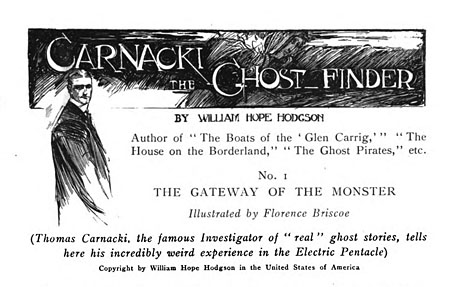
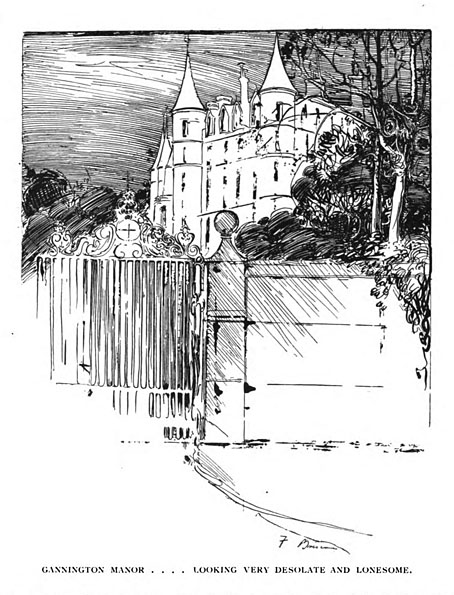
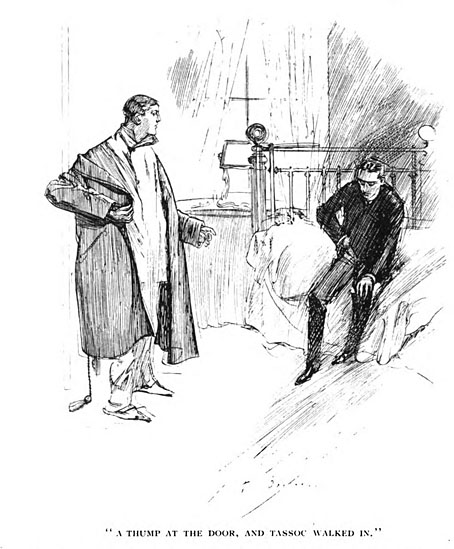
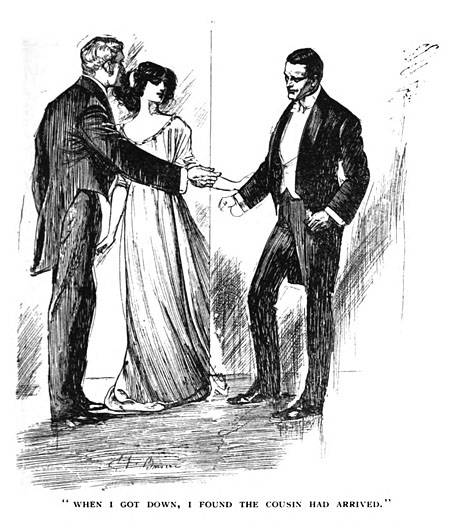
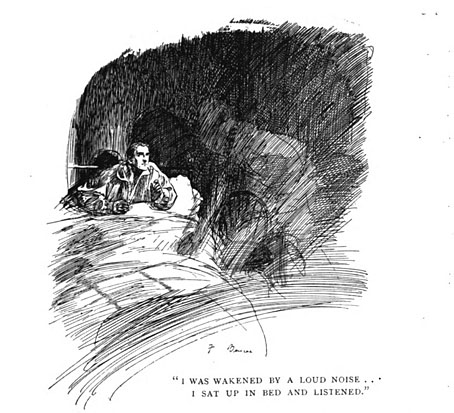
Visual manifestation, that is. The first Carnacki story to see print was The Thing Invisible, published in 1909 as a part of The Ghost Pirates, A Chaunty, and Another Story. The book wasn’t illustrated, nor was the Carnacki collection published by Eveleigh Nash in 1913. The five stories that ran in The Idler, however, were all decorated with sketchy illustrations by Florence Briscoe, all of which may be seen in this collection of extracted pages from the issues for 1910. (For the complete magazines, look here.)

carnacki2.jpg

The House Among the Laurels.

Miss Briscoe (and she does appear to have been a Miss at this point) has the distinction of being one of the first illustrators (possibly the first) of any of Hodgson’s fiction. She was also a friend of the author and may well have used him as a model for many of her illustrations. James Bojaciuk suggests as much in this piece of biographical research that I’d managed to miss when it was posted at Greydogtales. I think we can take Hodgson as a definite model for the portrait of Carnacki that illustrates the magazine header, the similarity between the drawing and one of the author’s photos is beyond doubt even if some of the other Carnacki drawings show less of a resemblance. Carnacki also seems to be quite tall, or at least of average male height, something that the diminutive Hodgson was not.

carnacki4.jpg

The Whistling Room.

Portraiture aside, Florence Briscoe’s illustrations tend to be of a type that I refer to as “people standing about in rooms”, a common form in the world of magazine illustration. Sidney Paget’s famous drawings of Sherlock Holmes are almost all of this type, stories of cerebral industry and ratiocination being rewarding for the reader, less so for the jobbing illustrator. (The Hound of the Baskervilles is a notable exception, with its dramatic locations and spectral atmosphere.) The most obvious difference between Carnacki and Holmes is that Carnacki encounters genuine manifestations of eldritch horror which he manages to keep at bay with his incantations and electrical devices. Miss Briscoe shows us none of this, unfortunately. But her figures are well-drawn, and as general illustration her work is of a higher standard than the often amateurish renderings you find in the early pulp magazines of the 1920s. The growing sphere of Hodgsonian illustration begins with these few stories.

carnacki3.jpg

The Horse of the Invisible.

carnacki5.jpg

The Searcher of the End House.

Elsewhere on { feuilleton }
The illustrators archive

Previously on { feuilleton }
The Whistling Room, 1952
The art of Jean-Michel Nicollet
Suspicion: The Voice in the Night
Hodgsonian vibrations
The Horse of the Invisible
Tentacles #2: The Lost Continent
Tentacles #1: The Boats of the ‘Glen Carrig’
Hodgson versus Houdini
Weekend links: Hodgson edition
Druillet meets Hodgson

Weekend links 805

strausfeld.jpg

A poster by Peter Strausfeld for a 1966 screening of Alphaville and La Jetée.

• At Bandcamp Daily: “Caroline True obsesses over compilations so you don’t have to,” says Erick Bradshaw. I recommend CTR’s compilations.

• At The Wire: Read an extract from Music Stones: The Rediscovery Of Ringing Rock by Mike Adcock.

• At Colossal: Pastoral landscapes brim with patterns in luminous paintings by David Brian Smith.

One of the markers that sets Mamoru Oshii apart from his peers is his willingness to allow place to speak for itself. From the seasonality captured in his works, like the first two Patlabor films, to the otherworldly environments of Ghost In The Shell 2: Innocence (all projects in which Ogura was also involved heavily) and even the fantasy scapes of his Angel’s Egg, Oshii’s attention to place, and allowing it to be a player in the story, gives as much voice to world building, as he does to characterisation. This attentiveness and patience for place, allows us to settle deeply inside a worldview that is often simultaneously familiar but unerringly alien.

Lawrence English talks to art director Hiromasa Ogura and composer Kenji Kawai about their work on Oshii’s Ghost in the Shell

• At the BFI: Leigh Singer suggests where to begin with the films of Lucile Hadžihalilović.

• Necromodernist Architectures in Contemporary Writing: an essay by David Vichnar.

• New music: Hydrology by Loula York; Love Letters Via Echelon by Nerthus.

• There’s more Intermittent Eyeball Fodder at Unquiet Things.

• The Strange World of…Early Cabaret Voltaire.

• Winners of the Drone Photo Awards 2025.

Lautréamont’s Apocrypha

Drone Um Futurisma (1992) by Cusp | ABoneCroneDrone 1 (1996) by Sheila Chandra | Suspicious Drone (2009) by Demdike Stare

The Return of the Crawling Chaos

nyarlathotep.jpg

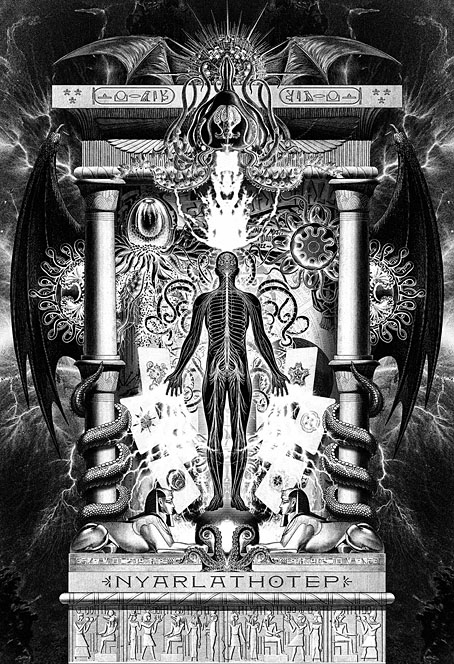
Behold Nyarlathotep, v. 3.0, this being yet another revision of an old illustration. Some readers may recognise the imagery from version 2.0 (2009) or even the original that appeared in my Haunter of the Dark book in 1999. Earlier this month the work I’ve been doing for the new edition of the book reached the end of another stage with the completion of all the necessary redrawing of The Dunwich Horror. I’ve also just finished drawing page 24 of the story, the page I’d left half-done when the strip was abandoned in 1989. Everything I do from now on will be new material.

Having got this far I decided to pay a little more attention to the upgrading of the book’s fourth section, The Great Old Ones, by finishing Nyarlathotep, something I began this time last year then set aside when I got involved in rescanning all the old comics pages. As I’ve mentioned before, several of the pieces for this section of the book were some of my earliest digital illustrations, created a few months after I’d bought a secondhand and very underpowered Macintosh computer. Nyarlathotep was an attempt to depict the hybrid nature of a Mythos entity which combines elements of an Egyptian pharaoh, the diabolic “Black Man” of European witch cults, a sinister stage magician or scientist, and the winged abomination that Robert Blake finds lurking in the steeple of the Starry Wisdom church. Version 1 was one of my very first digital collages which suffered as a result of my inexperience with the new medium, hence my eagerness to rework the design in 2009 when Cyaegha, a metal band I’d been working with, requested a Nyarlathotep-themed T-shirt. The first version had been aimed more at the theatrical/scientific aspect of the character, with a poster in the background from John Nevil Maskelyne’s Egyptian Hall in London. For version 2 I added a number of organic elements to bolster the “Haunter of the Dark” side of the character. Version 3 keeps all the details from version 2 while replacing some of the collaged elements with similar ones taken from better sources. The new design is also slightly taller to account for the enlarged page size of the new book.
sephiroth.jpg

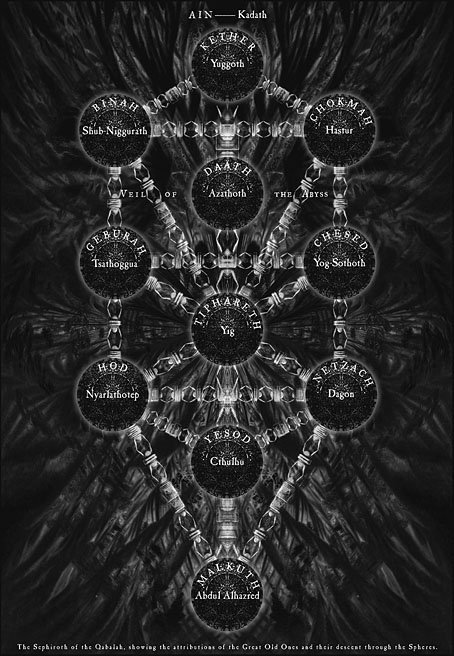
The Sephiroth chart from the second edition of the book, 2006.

The most notable additions to the new piece are the names of the character in Latin letters and Egyptian hieroglyphs (𓋔𓇋𓄿𓂋𓈌𓊵), the latter being a suggestion from this Reddit post. The Egyptian spelling is conjectural but I have a guidebook to the hieroglyphic language which confirms that most of the letters are the ones they should be. The words aren’t included solely as decoration. The Great Old Ones was a collaboration with Alan Moore in which Alan wrote eleven texts or invocations which position each god or entity on one of the spheres of the Kabbalistic Tree of Life. Alan was heavily involved with the Kabbalah at this time, being also engaged with the first few issues of Promethea, a story which involves a physical (or metaphysical) journey from Malkuth to Kether. The Great Old Ones takes the same journey in reverse, and from a much darker perspective, like a Lovecraftian equivalent of the Qliphoth, the “nightside” of the Kabbalistic spheres. In Alan’s scheme, Nyarlathotep is positioned at sphere 8, Hod (or “Splendour”), a sphere associated with gods of magic and language like Thoth, Hermes and Mercury. I imagine most Mythos-acquainted occultists would agree with adding Nyarlathotep to this pantheon. In addition to being gods of magic and language, Thoth, Hermes and Mercury also serve as celestial messengers, a function which Lovecraft assigns to Nyarlathotep in The Whisperer in Darkness when one of the Mi-Go declares “To Nyarlathotep, Mighty Messenger, must all things be told.”

As for the rest of The Great Old Ones, I have four more of them still to be reworked, one of which, Abdul Alhazred (or Lovecraft himself) is almost finished. Further progress will be posted here.

Elsewhere on { feuilleton }
The Lovecraft archive

Previously on { feuilleton }
Lettering Lovecraft
Weird ekphrasis and the Dunwich Horrors
Kadath and Yog-Sothoth
Another view over Yuggoth
Nyarlathotep: the Crawling Chaos
Sphinxes

sphinx09.jpg

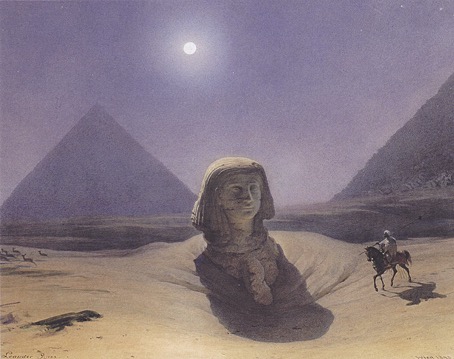
Bei den Pyramiden (1842) by Leander Russ.

A horde of sphinxes from NYPL Digital Collections and Wikimedia Commons, a pair of sites I was searching through last week. I was looking for a very particular kind of sphinx, not the Great Sphinx that sits near the Pyramids at Giza. What I wanted was something smaller and less ruined, like the sentinels that proliferated during the fads for Egyptian art and design in the early 1800s and the 1920s. My search was satisfied eventually, the results of which will be revealed in the next post.

sphinx06.jpg

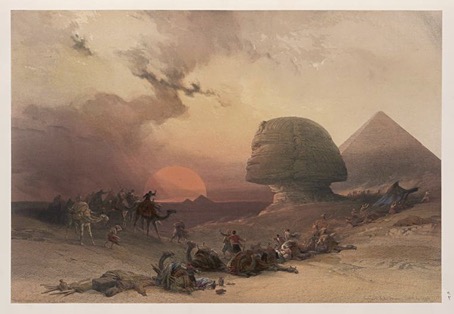
Approach of the Simoom. Desert of Gizeh (c. 1846–49) by David Roberts. 

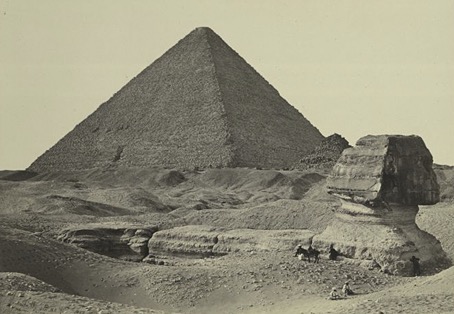
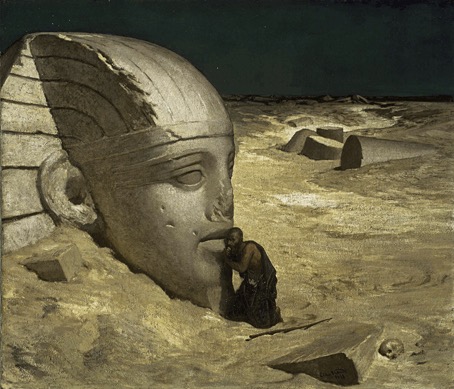
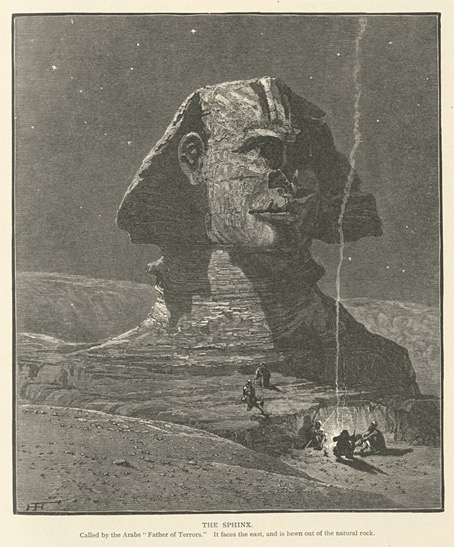
As for the Great Sphinx, I enjoy seeing artistic representations of the monument, especially those which place the creature in a dramatic setting. Older depictions tend to look bizarre or even comical, especially the ones made during the centuries when the figure was little more than a head protruding from the drifting sands. The photographs I prefer are those that show the Sphinx in the 19th century before all the restorations began, when the creature was another half-buried fragment of antiquity, not something that seems to have just been removed from a box in a museum.

sphinx08.jpg

The Sphinx and Great Pyramid, Geezeh (1858–1859).

sphinx10.jpg

The Questioner of the Sphinx (1863) by Elihu Vedder.

sphinx07.jpg

The Sphinx by Harry Fenn (1881–1884). “Called by the Arabs “Father of terrors.” It faces the east, and is hewn out of the natural rock.”

Continue reading “Sphinxes”