Art Institute, Stockholm, 1897

stockholm.jpg

More eccentric exposition architecture. This edifice towered briefly over the Stockholm skyline for the General Art and Industrial Exposition of 1897, an event for which there seems to be very little information online. The exposition doesn’t receive an entry at ExpoMuseum and this is the only photo at the Library of Congress’s wonderful Photocrom archive. The Swedish Pavilion at the Paris Exposition three years later was the most eccentric structure on display and received favourable reviews as a result, many people finding it a lot more interesting than the staid architecture of other nations.

Previously on { feuilleton }
The Columbus Monument
The Palais du Trocadéro
The Evanescent City
Ephemeral architecture

Odilon Redon lithographs

redon1.jpg

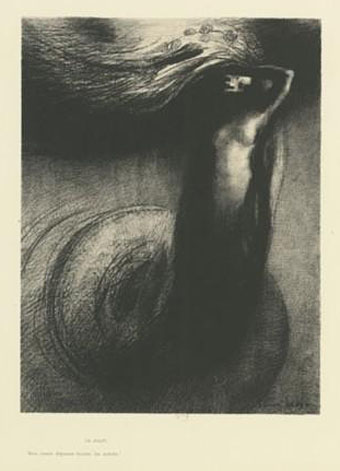
La mort: mon ironie dépasse toutes les autres! (1889).

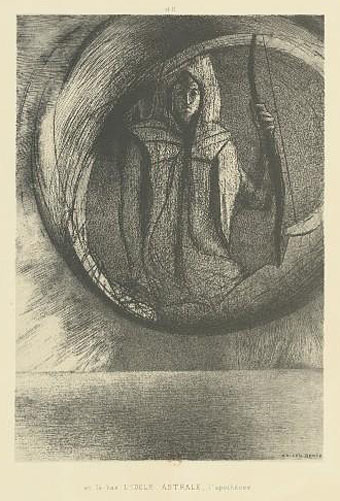
Two samples from a collection of Odilon Redon etchings lithographs at Gallica, an archive I’ve only recently begun to look at. A shame that the larger images scale up the content and the empty margin, often leaving a very small picture in the centre not much bigger than thumbnail size. Oh, well… On the plus side there’s a portrait I hadn’t seen before of Des Esseintes from Huysmans’ À Rebours, the book which in 1884 introduced Redon’s work to a wider public. Via BibliOdyssey, without whom, etc.

redon2.jpg

Et là-bas l’IDOLE ASTRALE, l’apothéose (1891).

Previously on { feuilleton }
The eyes of Odilon Redon
Arthur Zaidenberg’s À Rebours

Weekend links 39

galas.jpg

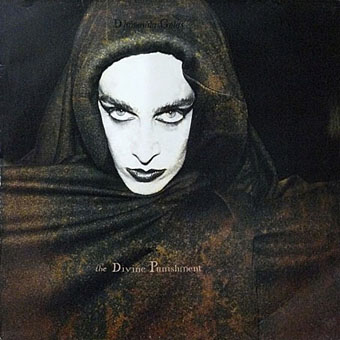
The Divine Punishment (1986) by Diamanda Galás. Design by Paul White/Me Company.

What the Catholic League and certain members of the House presumably wish to remove from their consciousness is thirty years of death sentences handed down to their parishioners and citizenry, who were told not to wear condoms, and the mistreatment of those stigmatized as miscreants and sinners by their viral status and/or homosexuality and/or status as drug addicts.

• Diamanda Galás responds in her usual forthright manner to the censoring of David Wojnarowicz’s film (and her music which accompanied it) by the Catholic League and members of the House of Representatives earlier this week. Related: Demonstrators gather to protest removal of Wojnarowicz art from NPG | Is the censored David Wojnarowicz video really ‘anti-Christian’? | Vengeance is hers: a conversation with Diamanda Galás.

Update: Hide/Seek: Too shocking for America. One of the exhibition curators speaks out against the censorship.

“Their attitude is: ‘Next time you think of writing about sex, don’t,'” said Susie Bright, who was the editor of the Best American Erotica anthology series for 15 years. “I can’t think of any other fundamental human experience that writers would be encouraged to keep to themselves.” Melissa Katsoulis, a literary reviewer for the Times of London, certainly seemed to conform to Bright’s impression when asked to comment on the award by the BBC: “Sex is a subject best avoided altogether,” she said. “If I was writing a novel, I wouldn’t attempt to write it except in the most Victorian and prim way, because it’s awful. It’s a cliché, but the moments of genuine frisson in books are when hardly anything happens.” Speak for yourself, missy.

Laura Miller dissing the Literary Review‘s annual Bad Sex Award. Good to find more voices being raised against this drivel and the admission of failure which it implies.

The latest offbeat experiment from filmmaker David Lynch: pop singles. He gets crazy with the vocoder here. Related: David Lynch talks new music projects.

scenaillustrata.jpg

Scena Illustrata (1914). Cover by Ezio Anichini (?). Via this set of magazine covers from 1880–1920.

• Tumblrs of the week: Heart Killer and Pretty Pictures from the Paleo-Future Blog.

The Big Picture’s 2010 Hubble Space Telescope Advent Calendar.

National Geographic‘s Best Underwater Views of 2010.

A seasonal gift from a famous Northampton resident.

Paris versus New York: A Tally of Two Cities.

This is your browser on drugs.

Double-Barrel Prayer (1988) by Diamanda Galás, with a video directed by the late Peter Christopherson.

The art of Hunter Stabler

stabler1.jpg

Magick Kruller Alefbet Lamen of the Golden Dawn.

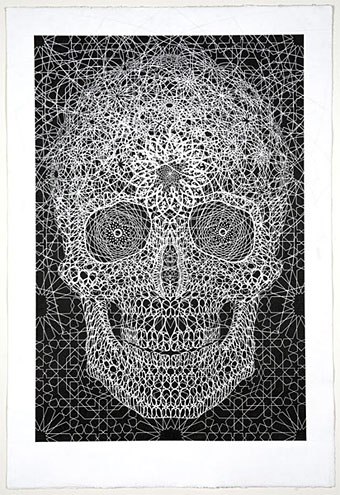
People cast around the superlatives when describing Hunter Stabler’s hand-cut paper artworks with good reason. The skull below is an ink drawing but the artist’s website features many paper works which are just as intricate. Via Phantasmaphile.

stabler2.jpg

Hare Christmas Maharishi.

Previously on { feuilleton }
The Sapphire Museum of Magic and Occultism

Ecce homo redux

serrano.jpg

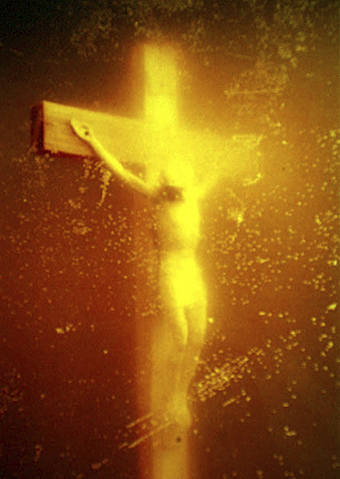
Piss Christ (1987) by Andres Serrano.

If the news of the past few weeks has felt like a re-run of the 1980s—ongoing recession, government cuts, riots in London, Tories casting aspersions on the undeserving poor, the threat of another royal wedding—then add to the list of déjà vu moments a flurry of outrage concerning art and religion in America that’s like a recapitulation of the Helms vs. NEA spats of 1989. On that occasion Andres Serrano’s Piss Christ was in the firing line, accused of being a blasphemous portrayal. This week it’s been the turn of a video installation of a short film made the same year, A Fire in My Belly, by David Wojnarowicz, a work featured in an exhibition I linked to a couple of weeks ago, Hide/Seek: Difference and Desire in American Portraiture at the National Portrait Gallery, Washington DC. A Los Angeles Times piece previewing the exhibition also connected Hide/Seek and the earlier attacks by the right against the NEA, ending by saying “Times and attitudes change”. Well, not always…
fire.jpg

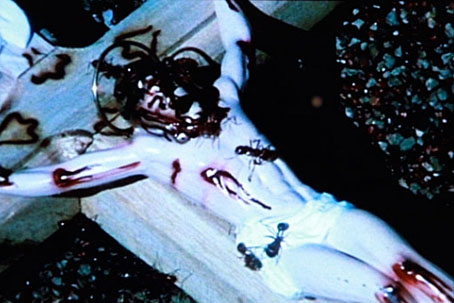
A Fire in My Belly (1987) by David Wojnarowicz.

Piss Christ notoriously shows a plastic crucifix immersed in urine; A Fire in My Belly is a 30-minute film which features among its blizzard of images a crucifix besieged by marauding ants. Wojnarowicz’s work wasn’t even mentioned in the LA Times piece but this week’s furore has made it the focus of the entire show after the gallery withdrew the video following protests from the usual suspects, the Catholic League and a right-wing politician, Rep. John Boehner. The complaints are the standard bluster about blasphemy (again) and taxpayers funding “filth”. None of the complainants appear to care that Wojnarowicz’s film is a tribute made by a gay artist to his friends as they were dying from AIDS during the 1980s, a disease which also killed him in 1992, they see the work only as an offensive act. It’s too much to expect anyone reacting with such fervour to consider that the artist may have been comparing the suffering and treatment of people with Aids in that decade with Christ’s suffering on the cross, to do so would be to admit that the artist might have a point. In response to the work’s withdrawal the Transformer Gallery in Washington DC has been screening the film and organised a protest at the National Portrait Gallery. (Update: They also issued an open letter urging the reinstatement of the work.)

Continue reading “Ecce homo redux”