Maurice Sendak, 1928–2012

sendak1.jpg

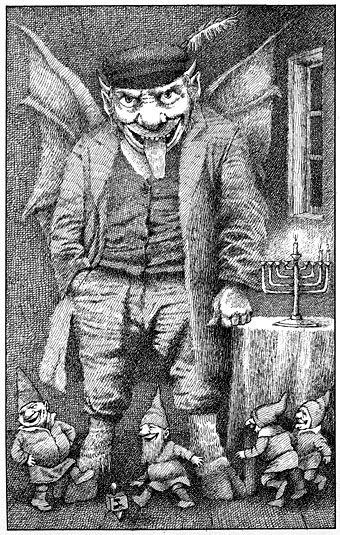
From Zlateh the Goat and Other Stories (1966) by Isaac Bashevis Singer.

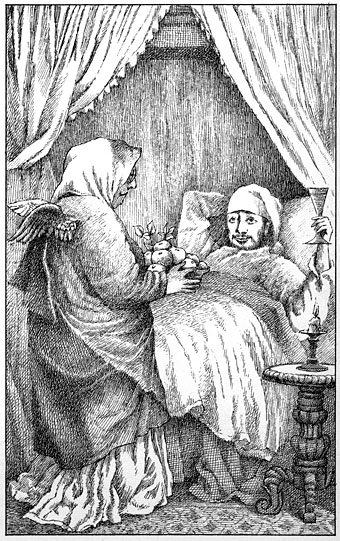
All the obituaries of the late Maurice Sendak have focused inevitably on Where the Wild Things Are. That gives me a chance to draw attention to some less familiar Sendak drawings whose finer crosshatching naturally appeals to an inveterate crosshatcher such as myself. The combination of bold characterisation and dense shading makes these pieces look remarkably similar to Mervyn Peake’s illustrations of the 1940s. Sendak spoke to Nick Meglin about some of the influences on his drawing in The Art of Humorous Illustration (1973). Given what he says here it’s evident that he and Peake (who also admired Cruikshank and Rowlandson) shared antecedents:

Many of the artists who influenced me were illustrators I accidentally came upon. I knew the Grimm’s Fairy Tales illustrated by George Cruikshank. I just went after everything I could put my hands on illustrated by Cruikshank and copied his style. It was quite as simple as that. I wanted to crosshatch the way he did. Then I found Wilhelm Busch and I was off again. But happily Wilhelm Busch also crosshatched so the Cruikshank crosshatching wasn’t entirely wasted. And so an artist grows. I leaned very heavily on these people. I developed taste from these illustrators.

The 1860’s, the great years of the English illustrators from whom so much of my work is derived, are familiarly known as “the sixties” to admirers of Victorian book illustration. The influence of Victorian artists such as George Pinwell and Arthur Hughes, to name just two, is evident in the pictures I created for Higglety Pigglety Pop! (Harper and Row, 1967), Zlateh the Goat (Harper and Row, 1966), and A Kiss for Little Bear (Harper and Row, 1968). And I’ve learned from other English artists as well. Randolph Caldecott gave me my first demonstration of the subtle use of rhythm and structure in a picture book. Hector Protector and As I Went Over the Water (Harper and Row, 1965) is an intentionally contrived homage to this beloved teacher.
sendak2.jpg

From Zlateh the Goat and Other Stories (1966) by Isaac Bashevis Singer.

For other fine points in picture book making, I’ve studied the works of Beatrix Potter and William Nicholson. Nicholson’s The Pirate Twins certainly influenced Where the Wild Things Are (Harper and Row, 1963).

A retrospective of my English passion can be found in Lullabies and Night Songs (Harper and Row, 1965). The illustrations for this book, which skip from Rowlandson to Cruikshank to Caldecott and even to Blake, are a noisy pastiche of styles, though I believe they still resonate with my own particular sound. Mr. Rabbit and the Lovely Present (Harper and Row, 1962) is as far as I am aware the only book I’ve done that reveals my admiration for Winslow Homer.
sendak3.jpg

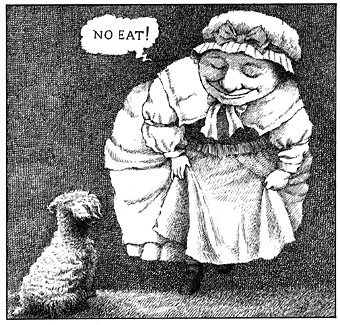
Higglety Pigglety Pop! Or, There Must Be More to Life (1967).

About two-and-a-half years after the publication of Where the Wild Things Are, I finally became conscious of my reviving interest in the art I’ve experienced and loved as a child. The trigger was an exhibit (at The Metropolitan Museum) of pages from Little Nemo in Slumberland, Winsor McCay’s famous newspaper comic strip of the years 1905 to 1911. Before the exhibit I was ignorant of this popular American artist’s pure genius for graphic fantasy. It now sent me scooting back with new eyes to the popular art of my own childhood.

This recognition of personal roots is in no way meant as a triumphant revelation or as reverse snobbism, a put-down of my earlier, more ‘refined’ influences. What I’ve learned from English as well as French and German artists will, if I have my wish, become more absorbed into my creative psyche, blending and living peaceably with my own slice of the past. But of course all this happens on its own or it doesn’t happen at all.

Elsewhere on { feuilleton }
The illustrators archive

Die Entwicklung der modernen Buchkunst in Deutschland

buchkunst01.jpg

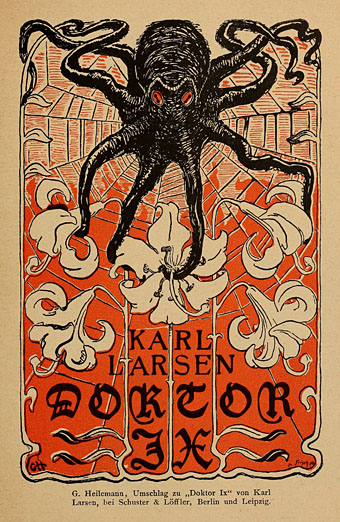
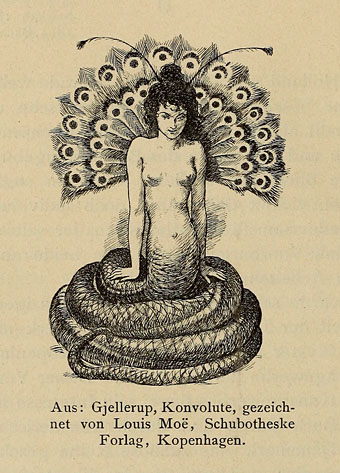
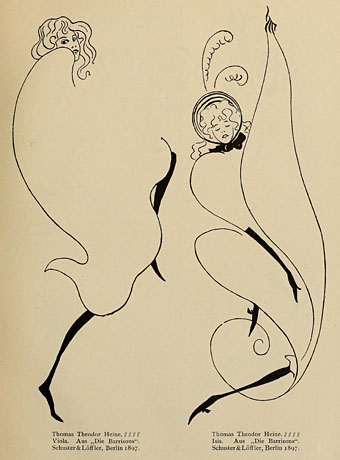
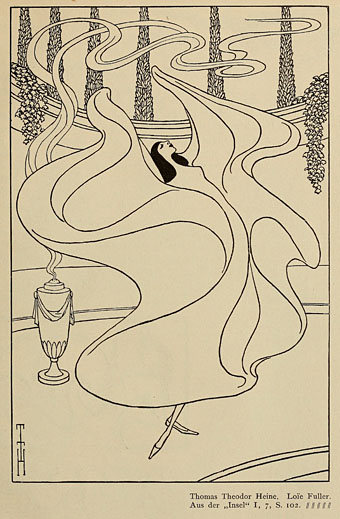
Thanks are due again to Mr Peacay at BibliOdyssey for drawing attention to this recent addition to the Internet Archive from the Smithsonian collection. Die Entwicklung der modernen Buchkunst in Deutschland (1901) is a compendium of German book illustration edited by Otto Grautoff, and its a particularly good anthology with a lot of content I haven’t seen repeated elsewhere. Many of the artists represented have been featured here already, not least because a number of them appeared regularly in Jugend magazine: Thomas Theodor Heine, Ephraim Moses Lilien, Heinrich Vogeler, and the most eccentric of all German artists of the period, the naturist and mystic known as Fidus (Hugo Höppener) whose drawings receive an entire chapter.

buchkunst02.jpg

buchkunst03.jpg

buchkunst04.jpg

Heine’s depiction of “butterfly dancer” Loïe Fuller.

Continue reading “Die Entwicklung der modernen Buchkunst in Deutschland”

Mrs Patrick Campbell

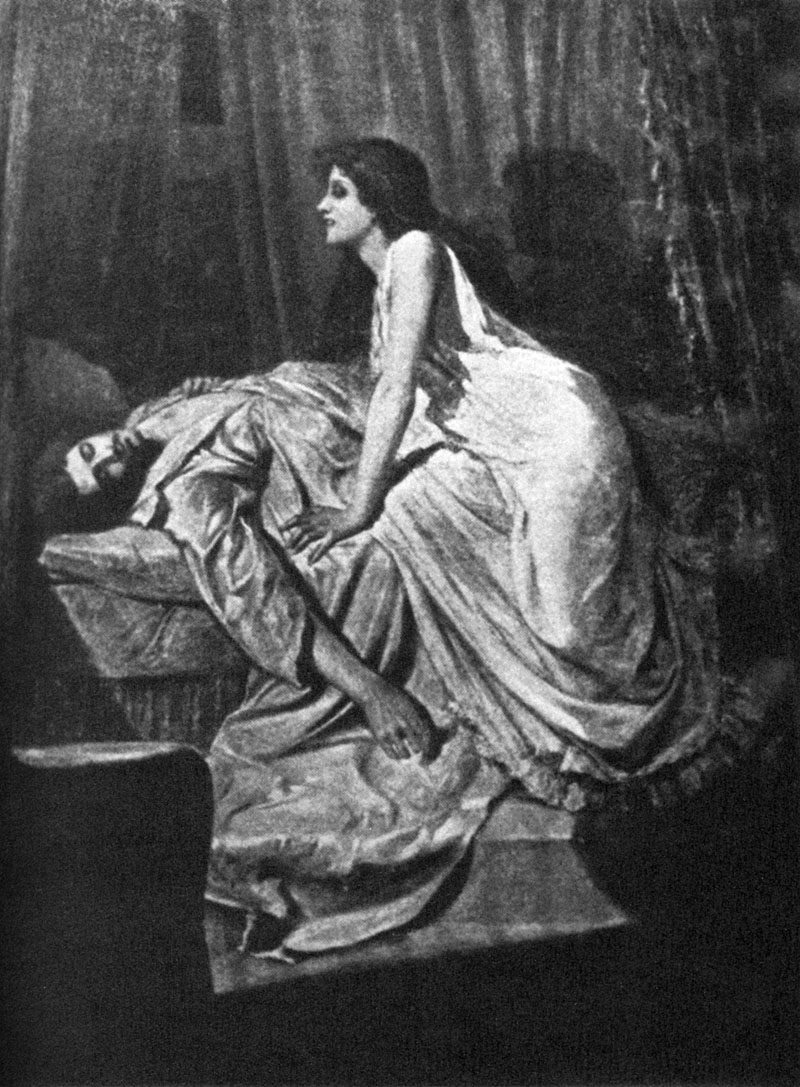
vampire.jpg

The Vampire (1897) by Philip Burne-Jones.

Two pictures of the same woman—Mrs Patrick Campbell (1865–1940)—that were regarded as scandalous in their time. Since the centenary of Bram Stoker’s death recently passed I was looking for better copies of the only painting by Philip Burne-Jones that anyone today bothers with, but the best copies to be had are in books so this is a scan from the Coulthart library. It seems the original is either lost or destroyed which makes its status as poor old Burne-Jones’ most celebrated work doubly unfortunate.

Philip Burne-Jones was the son of Edward Burne-Jones, and Burne-Jones Jr’s depiction of a predatory woman was deemed scandalous not for its content—predatory women were a common fixture of male paranoia in the 1890s—but for the rumours that its model, stage actress Mrs Patrick Campbell, and the artist, were having an affair. Mrs Patrick Campbell was born Beatrice Stella Tanner but took her first husband’s name as her stage name. Given the theme, and the fact that Burne-Jones painting was first exhibited the year that Bram Stoker’s Dracula was published, prints of The Vampire are a regular fixture in books about the cultural history of vampires in general and Dracula in particular.

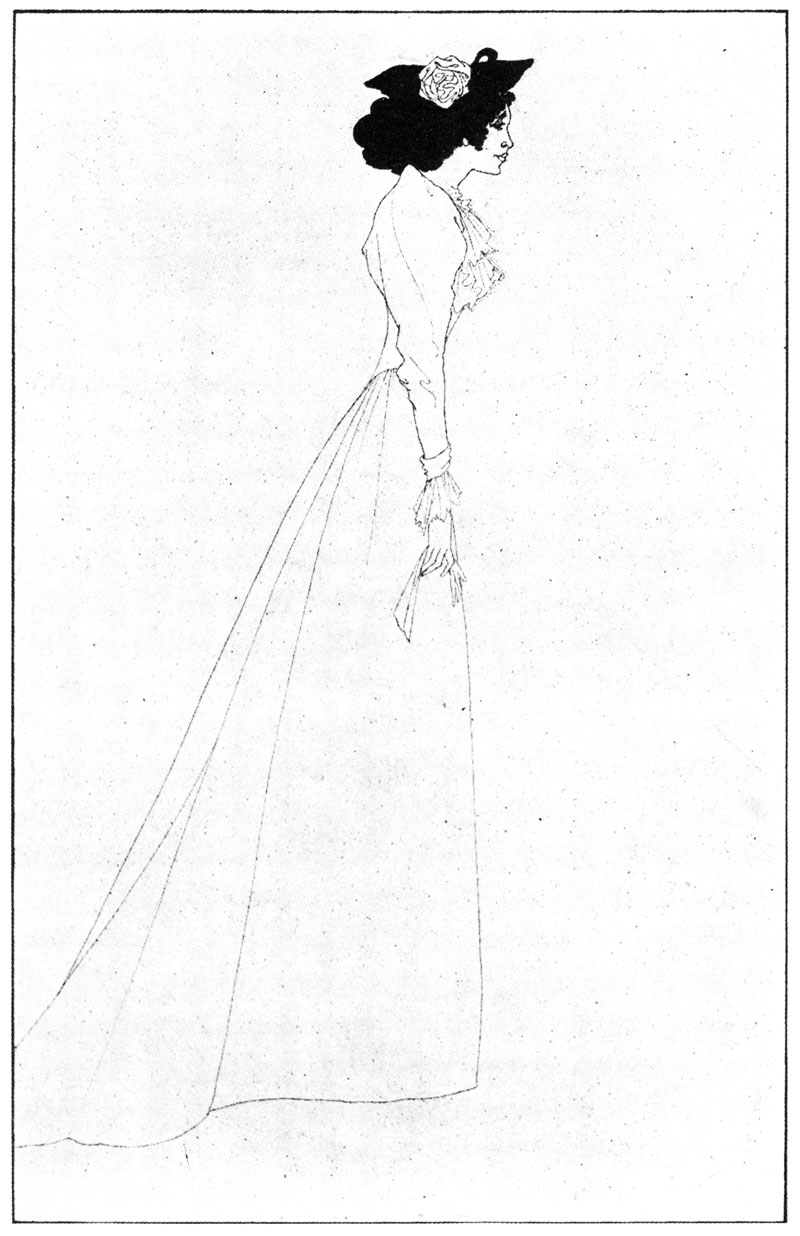
beardsley.jpg

Mrs Patrick Campbell (1894) by Aubrey Beardsley. From The Yellow Book, Vol. I.

As for Aubrey’s delightful drawing, this is one of the many Beardsley pictures that caused great consternation when they were first printed yet which appear today to be quite innocuous. Beardsley’s presence in The Yellow Book, and the umbrage taken against drawings such as this, helped give that publication an edge which it lost when Beardsley was forced to leave the magazine following Oscar Wilde’s imprisonment in 1895.

Previously on { feuilleton }
Symbolist cinema
Druillet’s vampires

Weekend links 107

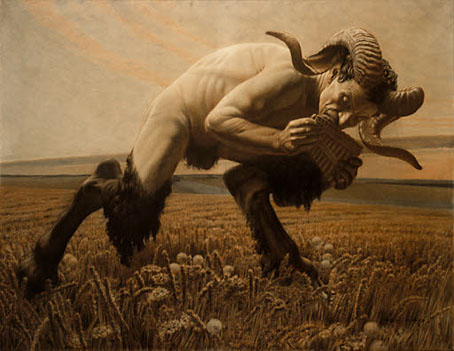
schwabe.jpg

Le Faune (1923) by Carlos Schwabe.

• “When I recently attended a conference in China, many of the presenters left their papers on the cloud—Google Docs, to be specific. You know how this story ends: they got to China and there was no Google. Shit out of luck. Their cloud-based Gmail was also unavailable, as were the cloud lockers on which they had stored their rich media presentations.” Ubuweb’s Kenneth Goldsmith on why he doesn’t trust the Cloud.

• “I’m a poet and Britain is not a land for poets anymore.” A marvellous interview with the great Lindsay Kemp at Dangerous Minds. Subjects include all that you’d hope for: Genet, Salomé, David Bowie, Ken Russell, Derek Jarman, The Wicker Man and “papier maché giant cocks”.

• “As early as the 1950s, Maurice Richardson wrote a Freudian analysis which concluded that Dracula was ‘a kind of incestuous-necrophilious, oral-anal-sadistic all-in wrestling match’.” Christopher Frayling on the Bram Stoker centenary.

Björk gets enthused by (among other things) Leonora Carrington, The Hourglass Sanatorium and Alejandro Jodorowsky’s YouTube lectures.

• Before Fritz Lang’s Metropolis there was Algol – Tragödie der Macht (1920). Strange Flowers investigates.

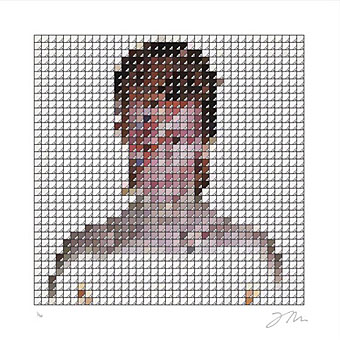
marsh.jpg

David Marsh recreates famous album covers using Adobe Illustrator’s Pantone swatches.

• New titles forthcoming from Strange Attractor Press. Related: an interview with SAP allies Cyclobe.

• 960 individual slabs of vinyl make an animated waveform for Benga’s I Will Never Change.

• An exhibition of works by Stanislav Szukalksi at Varnish Fine Art, San Francisco,

Keith Haring‘s erotic mural for the NYC LGBT Community Center is restored.

The Situationist Times (1962–1967) is resurrected at Boo-Hooray.

• Doors Closing Slowly: Derek Raymond‘s Factory Novels.

Will Wilkinson insists that fiction isn’t good for you.

• More bookplates at BibliOdyssey and 50 Watts.

The Top 25 Psychedelic Videos of All Time.

Flannery O’Connor: cartoonist.

• RIP Adam Yauch.

• Their finest moment: Sabotage (1994) by Beastie Boys.

Swords against death

huell.jpg

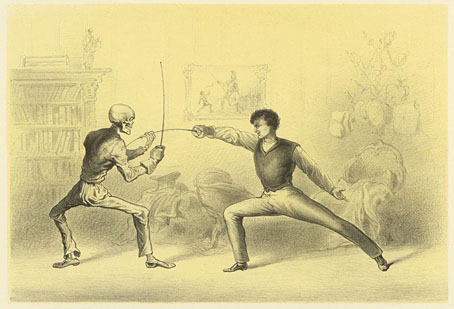
Earlier this week Mr BibliOdyssey posted a link on Twitter to a blog entry of his from 2008, a collection of prints by Dutch artist Alexander Ver Huell (1822–1897). If I’d seen his post originally I didn’t recall it so this swordfight gives me an opportunity to draw attention to Ver Huell’s macabre and diabolical work. This unwinnable duel brings to mind the battle with the band of skeletons from Ray Harryhausen’s Jason and the Argonauts (1963), one of my favourite things in the whole world when I was 10. Given how many of the pictures in the Men with swords archive have a quasi-classical theme it’s perhaps appropriate to list Jason and co. among them.

jason.jpg