What Is A Happening?

technicolor.jpg

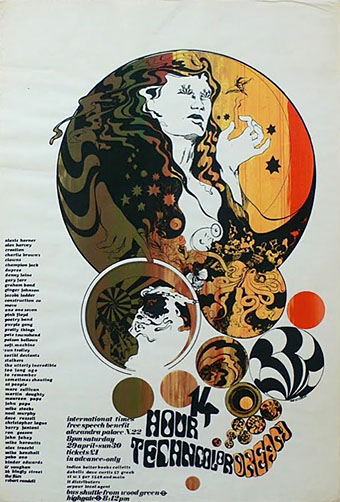
Poster for the 14 Hour Technicolor Dream (1967) by Michael McInnerney.

“The language of Mellow Yellow, the art of the Happening…”

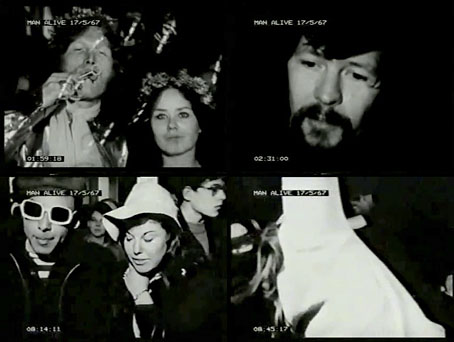
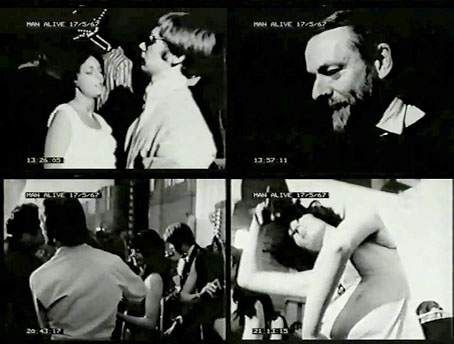
Yesterday’s story from International Times appeared in the same week in 1967 as this 30-minute BBC documentary shown as part of the Man Alive documentary strand. Taking them together you receive contrasting views of a major moment for London’s psychedelic underground, The 14 Hour Technicolor Dream, an all-night indoor arts-and-music festival staged at Alexandra Palace on 29th April, 1967. The event was a benefit to raise money for International Times following a prosecution for obscenity (Oz magazine later had to endure a similar, more notorious rigmarole). Alexandra Palace was an odd choice of location, being a huge Victorian exhibition space which had once served as the BBC’s main studios. (The first Quatermass serial was filmed there in 1953.) The venue was apparently chosen because it had previously hosted blues all-nighters but the acoustics are dreadful for live music, as the BBC’s documentary demonstrates. The film also shows that most of the audience wouldn’t have been too concerned; being there was more important.
manalive1.jpg

When you’ve been reading about an event like this for years it’s fascinating to get an extended view of the thing. The BBC were there all night, and capture many key incidents. The three interviewers are deeply sceptical of the whole business but that’s inevitable when they were making a film for a general audience. All the same, the repeated questions of “Why are you here? What’s this for?” are ones that would never be asked of a group of visitors to, say, Ascot, or the Henley Regatta. “It’s the audience which is the interesting part,” an upper-class Chelsea bookseller astutely declares, the interviewer seeming surprised that an older person might wish to be present. If the event looks trivial and even stereotypical today (tripped-out kids and blissful sentiments), it needs to be remembered that this was the very first time anything like this had been seen in Britain, hence the presence of the documentary crew. For sceptics and initiates alike the night was a glimpse of bright new territory opening up. The excitement of the moment still communicates itself.

What Is A Happening?: part one | part two | part three

The 14 Hour Technicolor Dream at UK Rock Festivals
manalive2.jpg

Previously on { feuilleton }
My White Bicycle

My White Bicycle

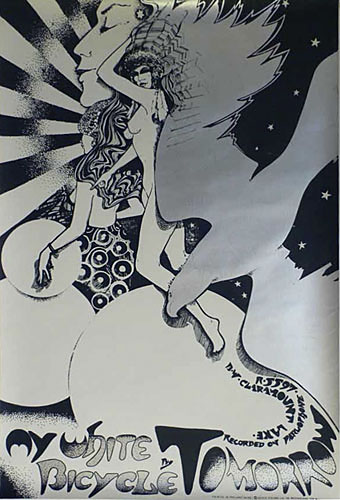
tomorrow1.jpg

My White Bicycle (1967), poster by Hapshash and the Coloured Coat. Too risqué for EMI.

In what passes here for spare time I’ve been working on a private project that concerns events in London during a single week in 1967. I won’t elaborate for now but the research has been fun, and has led down byways where it’s easy to get lost in a profusion of historic detail. The International Times archive is a great time-sink if you want to see London’s psychedelic culture evolving from one week to the next. Oz magazine covered much of the same ground but in broader strokes; IT being a weekly paper was the closest thing the underground of the time had to a journal of record which means you’ll find things there which weren’t reported anywhere else.

tomorrow3.jpg

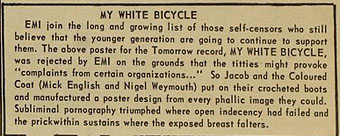
International Times, Volume 1, issue 13, 19/05/1967.

A brief item about a poster for the debut single by Tomorrow caught my eye, the artwork being an early piece by Hapshash and the Coloured Coat (Michael English and Nigel Waymouth) who we here discover were briefly known by another name:

MY WHITE BICYCLE

EMI join the long and growing list of those self-censors who still believe that the younger generation are going to continue to support them. The above poster for the Tomorrow record, MY WHITE BICYCLE, was rejected by EMI on the grounds that the titties might provoke “complaints from certain organizations…” So Jacob and the Coloured Coat (Mick English and Nigel Weymouth [sic]) put on their crocheted boots and manufactured a poster design from every phallic image they could. Subliminal pornography triumphed where open indecency had failed and the prick within sustains where the exposed breast falters.

Tomorrow were one of the first British psychedelic bands. My White Bicycle is their most memorable song but the rest of their self-titled debut album still holds up today. Ace guitarist Steve Howe became a lot more famous in Yes a few years later, while drummer Twink was in a host of bands in the late 60s and early 70s, Hawkwind included. My White Bicycle sounds superficially like a typical piece of psych whimsy à la Pink Floyd’s Bike (both songs were recorded at Abbey Road) but according to Twink there’s an anarchist subtext:

“My White Bicycle” was written out of what was actually going on in Amsterdam. One of the owners of Granny Takes a Trip, Nigel Weymouth [sic], had gone there and come back with a Provos badge which he gave to me. They were kind of like a student anarchist group that believed everything should be free. In fact, they had white bicycles in Amsterdam and they used to leave them around the town. And if you were going somewhere and you needed to use a bike, you’d just take the bike and you’d go somewhere and just leave it. Whoever needed the bikes would take them and leave them when they were done.

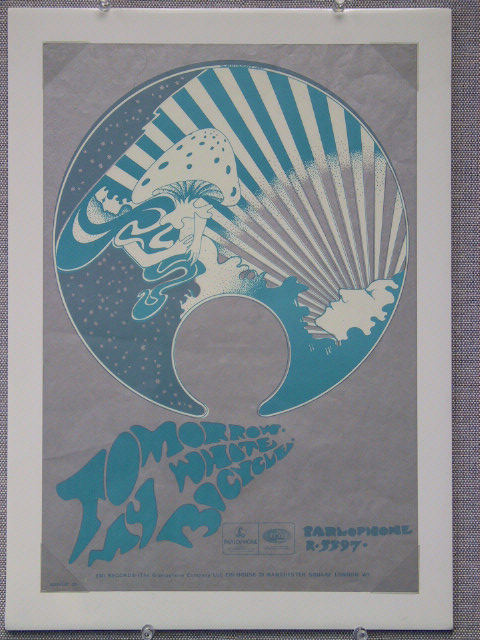
What would have been dismissed as pure utopianism now looks like prescience when bike-sharing schemes have become a reality. As to the redrawn poster, there’s a copy here which is described as very rare, hence its absence from other Hapshash galleries. Not really as phallic as the IT report implies; Aubrey Beardsley got away with a lot more priapic subterfuge in the 1890s when the strictures were also more severe.

tomorrow2.jpg

My White Bicycle (1967), the replacement poster by Hapshash and the Coloured Coat.

On the same page of IT there’s a brief announcement that The Beatles will have a new album out in June, something entitled Sgt. Pepper’s Lonely Hearts Club Band. That album also gave EMI a headache with both Lucy In The Sky With Diamonds and A Day In The Life being accused by “certain organisations” of promoting drugs. If the record company could have seen the greater headache that was coming less than ten years later from Malcolm McLaren and his King’s Road scallywags they might not have been so uptight.

Previously on { feuilleton }
Hapshash Takes a Trip
Michael English, 1941–2009
The Look presents Nigel Waymouth
The New Love Poetry

Weekend links 165

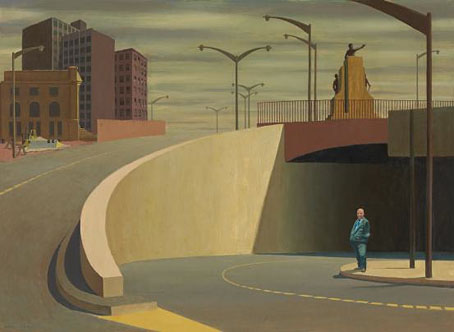
smart.jpg

Cahill Expressway (1962) by Jeffrey Smart whose death was announced this week.

• “Russell Beale is awed by the beauty of the Roman silver Warren Cup showing men and youths making love, so startlingly erotic that the first time the British Museum was offered it in the 1950s, it turned it down flat. In 1999, when it came on the market again, the museum had to raise £1.8m to acquire it. ‘It’s just heaven, isn’t it?’ Russell Beale sighs.” Maev Kennedy on Same-Sex Desire and Gender Identity, a new exhibition at the British Museum.

• “The route to Tyburn Tree snaked through Holborn and St Giles, then went along Tyburn Road, today’s Oxford Street. It was dense with spectators.” Matthew Beaumont on the tiny memorial (Google view) for the estimated 50,000 people executed in the centre of London.

• Mixes of the Week: Bottoms Up by Staffan Lindberg for BUTT Magazine, and Electronic Ladyland, a collection of women with synths (and other instruments) from Bitch Media.

But the very thing that is valuable about diversity – the cultural and ideological clashes that it brings about – is precisely what many people fear. And that fear takes two forms. On the one hand you have the little Englander sentiment: immigration is undermining the national fabric, eroding our sense of British or Englishness, turning our cities into little Lahores or mini-Kingstons. And on the other you have the multicultural argument: that diversity is good, but it has to be policed to minimise the clashes and conflicts and frictions that diversity brings in its wake. And so we have to restrain speech, and police the giving of offence.

Kenan Malik on The Pleasures of Pluralism, The Pain of Offence.

L’Empire des Lumières is a great title for Anne Billson’s blog about Belgium. Tram-wire covered streets are one of my favourite things.

The Outer Church, 28 musical artists with an uncanny temperament collected by Joseph Stannard for Front & Follow.

His Heavy Heart, a film by Alan Moore & Mitch Jenkins, is looking for Kickstarter funding.

• In 1997 Quentin Crisp wrote about “Ten Wonderful Gangster Movies” for Neon magazine.

Raymond Chandler’s The Big Sleep redesigned for the Penguin Design Award, 2013.

• Out on DVD/Blu-Ray this month: The Curtis Harrington Short Film Collection.

A billion-pixel panoramic view of the planet Mars from the Curiosity Rover.

• In the TLS: Robert Craft on Stravinsky and The Rite of Spring.

Typophonic: Album cover typography.

The Owl Theremin is a thing.

LSD ABC

Spring Rounds From The Rite Of Spring (1975) by Alice Coltrane | Revenge Of The Black Regent (1999) by Add N To (X) | Sore Ga Afrirampo (2010) by Afrirampo

Nocturnes

night1.jpg

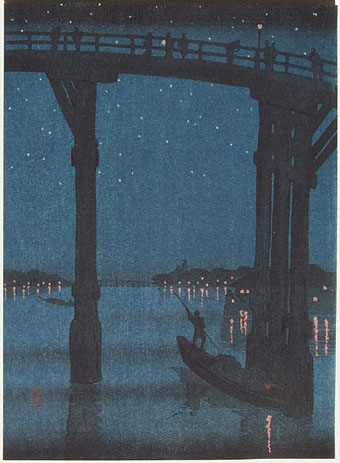
KOBAYASHI, Eijiro–”A High Bridge by Night”

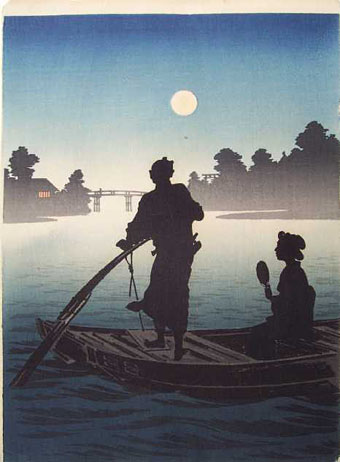
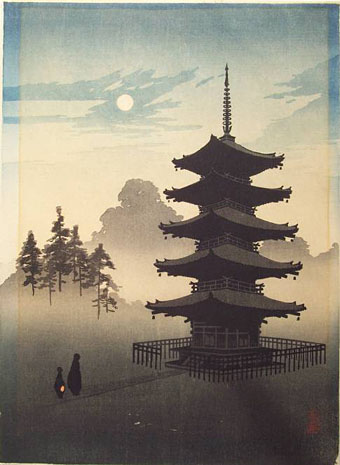
The Night Scenes is a series of 21 woodcut prints by Japanese artists published by Hasegawa/Nishinomiya in the early 1900s. Gorgeous work, and apparently popular enough for the prints to have been reissued many times since. These examples are from a print-selling site with several extensive galleries of 20th-century Japanese prints.

The High Bridge at Night struck me for being remarkably similar to Whistler’s famous painting of Old Battersea Bridge, Nocturne: Blue and Gold (1872–75). Whistler, of course, developed his mature style through looking at Japanese prints, and the Tate’s note for his painting says it may have been derived from a Hiroshige print. The Hiroshige looks nothing like the High Bridge at Night, however; was the latter based on an earlier print which Whistler had seen, or is the High Bridge (which post-dates Whistler’s painting) an example of the Japanese stealing back some of their influence from the West?

(Thanks to Wood s Lot for the prints tip.)

night2.jpg

ARAI, Yoshimune II–”A Ferry Boat”

night3.jpg

KOBAYASHI, Eijiro–”A Pagoda by Moonlight”

Continue reading “Nocturnes”

Sidney Sime paintings

sime1.jpg

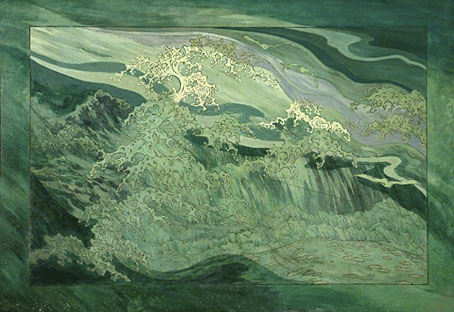
Painting of Waves.

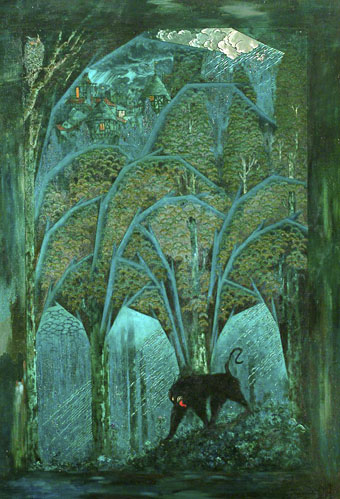
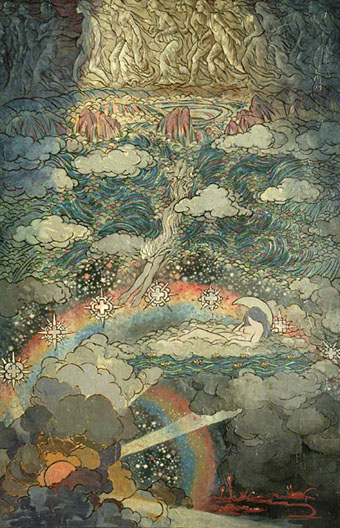
Most of the art for which Sidney Sime (1867–1941) is remembered is black-and-white or monochrome work, in part because he was engaged as a magazine illustrator at a time prior to widespread colour reproduction. All of the reproductions in Sidney Sime—Master of the Mysterious (1980) by Simon Heneage & Henry Ford are monochrome, so it’s good to find 188 of Sime’s paintings on the BBC’s British paintings website. Or it’s good up to a point… Most of the works are small oil sketches and landscape studies which would be of little interest if the artist’s name was unfamiliar. The examples here are some of the few which match the unique imagination which people still value today. Heneage & Ford refer to his painting throughout his career but it seems the best of that work must now be in private collections. All of the paintings on the BBC pages are from the collection at the Sidney H. Sime Memorial Gallery at Worplesdon near Guildford, Surrey, where there’s more of his art to be seen.

sime2.jpg

Woods and Dark Animals.

sime3.jpg

Illustrative.

Continue reading “Sidney Sime paintings”