Mistaken Memories Of Mediaeval Manhattan

eno1.jpg

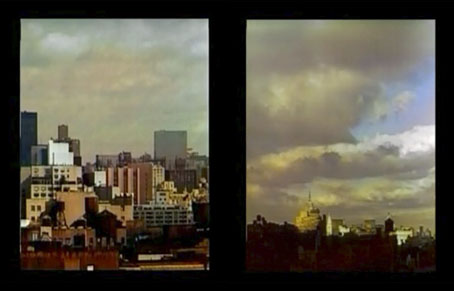
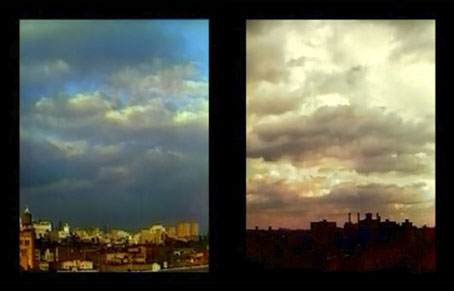
The first ambient film, at least in the Brian Eno sense of the term, although one can think of other examples prior to this, not least Andy Warhol’s Empire (1964) which is possibly alluded to in a sequence showing the Empire State Building in the distance. Eno filmed several static views of New York and its drifting cloudscape from his thirteenth-floor apartment in 1980–81. The low-grade equipment (and NTSC video) give the images a hazy, impressionistic quality. Lack of a tripod meant filming with the camera lying on its side so the tape had to be re-viewed with a television monitor also turned on its side. The assembled videos were later screened in galleries with music from some of the Ambient series of albums, and also two unique pieces.
eno2.jpg

An edited suite of seven pieces running 47 minutes was released on VHS tape in 1987. Like the original recordings, these could only be viewed by turning your TV on its side, something I used to think was a combination of the hazardous and foolhardy to all but the most diehard Eno aficionados. Television sets in the 1980s were either portable things in cheap plastic enclosures (some with curved sides), or cathode-tube monsters that would require two people two handle, assuming they weren’t screwed to a stand. I’ve yet to hear of anyone other than Eno himself who ever went to this trouble to watch a single video recording. It’s notable that recent DVD reissues of these videos, and the later Thursday Afternoon, have included horizontal as well as vertical versions.

The screen grabs here are from a 26-minute edit of the suite. The 14 Video Paintings DVD is currently out-of-print but a vertical copy can be found at Ubuweb.

Previously on { feuilleton }
Brian Eno: Imaginary Landscapes
Thursday Afternoon by Brian Eno
Moonlight in Glory
Tiger Mountain Strategies
Generative culture
My Life in the Bush of Ghosts
Fiendish Schemes

fiendish.jpg

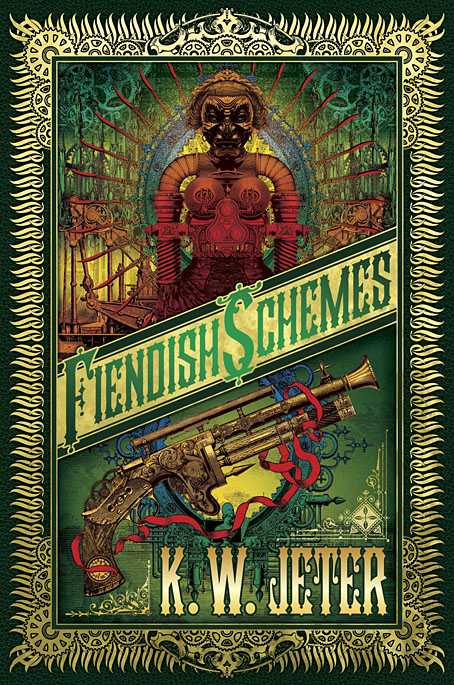
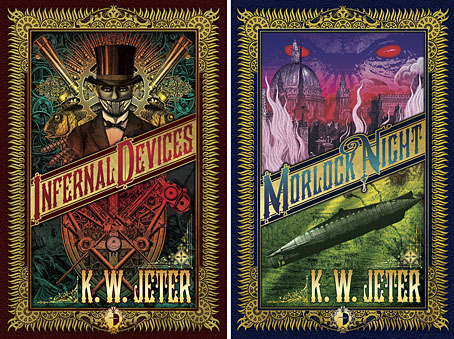
Now that this cover has appeared on Amazon I can mention it here. As usual, the machinery of publishing grinds slowly: this cover was commissioned in November last year, and worked on from the end of that month up to Christmas. Fiendish Schemes is a sequel by KW Jeter to his Infernal Devices, one of the original steampunk novels which was first published in 1987. In 2011 I created covers for reprints by Angry Robot of that title and the author’s earlier Morlock Night. Both those covers were very well received so Tor Books asked me to match their designs with a cover for the new book. This is quite unusual in publishing. Unless they make a real impact, cover designs seldom last beyond a couple of editions before being updated, and they rarely travel to other publishers.

jeter.jpg

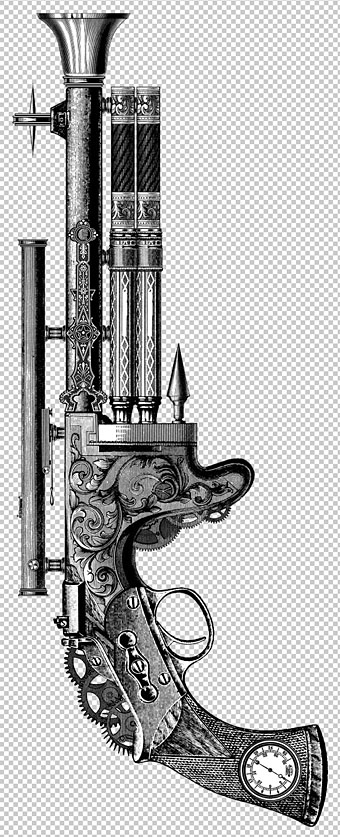
As with the earlier designs, the artwork is pieced together from very small pieces of period engravings, mostly from product catalogues or design books. In the novel, the steampunk weapon below is more alluded to than described but I was pleased with the way the illustration of it came together. Even though it’s composed of pieces of guns, fountain pens and clock parts it looks like something that could physically exist. One of the challenges I enjoy with this kind of collage illustration is trying to make something which doesn’t appear collaged at all.

Fiendish Schemes will be published on October 15th, 2013.

fiendish2.jpg

Previously on { feuilleton }
Ghosts in Gaslight, Monsters in Steam
Steampunk Revolution
The Bookman Histories
Aether Cola
Crafting steampunk illustrations
SteamPunk Magazine
Morlocks, airships and curious cabinets
The Steampunk Bible
Steampunk Reloaded
Steampunk overloaded!
More Steampunk and the Crawling Chaos
Steampunk Redux
Steampunk framed
Steampunk Horror Shortcuts

The art of Sergius Hruby, 1869–1943

hruby1.jpg

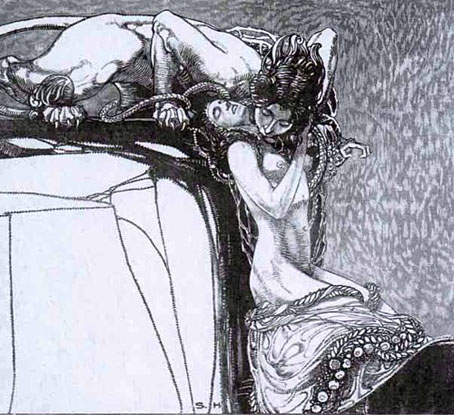
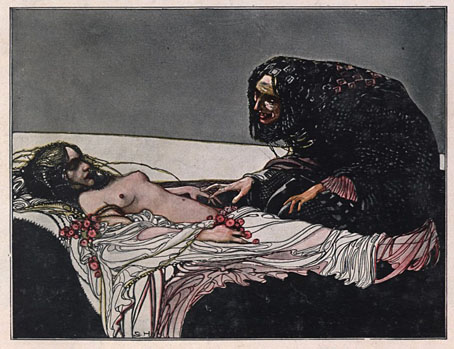
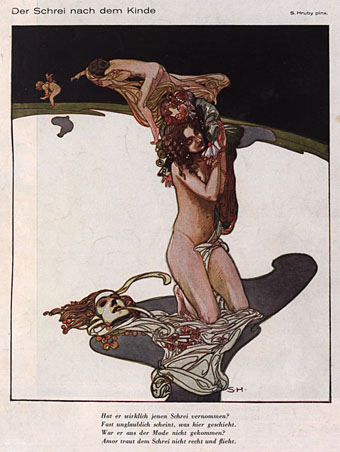
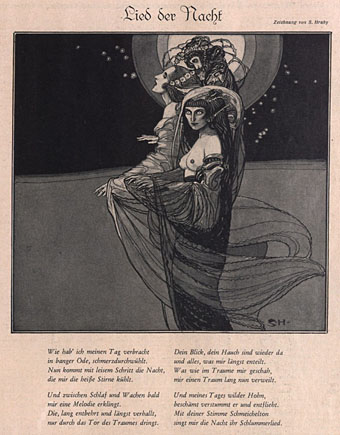
Sergius Hruby was an Austrian artist who specialised in that fin de siècle staple, the malevolent or sinister woman. Or so it would seem from these examples which, since I’ve chosen the more assertively Decadent fare, may be doing him a disservice. The style is very similar to another Austrian artist, Franz von Bayros, albeit without the overt pornography that’s a feature of Bayros’s drawings. What’s surprising about the Hruby pictures below is that they’re all from the pages of Die Muskete for 1933, a Viennese periodical which ran humorous articles, cartoons, and “glamour” pictures of a type which would have been far too risqué for a British magazine of the same period. Hruby’s work wouldn’t have seemed out of place in 1903 but in 1933 it looks somewhat old-fashioned. Another artist requiring further research, especially if there are more vampire sphinxes lurking somewhere. (And another tip via Beautiful Century.)

hruby2.jpg

hruby3.jpg

hruby4.jpg

Continue reading “The art of Sergius Hruby, 1869–1943”

Weekend links 166

foxxbelbury.jpg

The Julian House cover art for the forthcoming collaboration between John Foxx and Belbury Poly (here renamed) has been revealed. Single no. 9 in the Ghost Box Listening Centre Study Series is now available.

• In addition to new Ghost Box records there’s more Hauntological (for want of a better term) cinema on the way this summer with the DVD/BR release of Ben Wheatley’s A Field in England. The potted description at Movie Mail is “a monochrome psychedelic trip into magic and madness set during the English Civil War”. Julian House has made a trailer. Meanwhile at Fangoria, there’s a PIF mixtape from The Advisory Circle. This accompanies an interview with John Krish, director of the most bizarre of the UK’s many strange and alarming public information films from the 1970s.

• More mixes: The hour-long OH/EX/OH show for The Geography Trip on Chorlton FM. “Expect slumber / tension / euphoria in almost equal measures.” It’s marvellous. At Self-Titled mag there’s DJ Food with O Is For Orange: Boards of Canada, Broadcast, The Books, etc.

Tangiers is a computer game based on the fiction of William Burroughs. Jim Rossignol talked to Alex Harvey about the development of the project.

walpurgisnacht.jpg

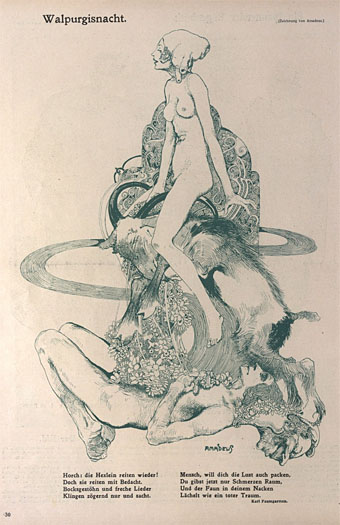
Walpurgisnacht (1917) by Amadeus. A drawing that could easily be from the late 1960s. If anyone knows the full name of the artist, please leave a comment. Via Beautiful Century.

Rebecca J. Rosen asks “What would the night sky look like if the other planets were as close as the moon?”

• The mystery of Charles Dellschau and the Sonora Aero Club.

The Surreal Cave Paintings Of Stockholm’s Metro Stations.

• At 50 Watts: More strange art from Marcus Behmer.

Ry Cooder in 1970. Directed by Van Dyke Parks!

The Post Office Tower: now you see it…

• At Little Augury: 99 Meninas.

Sartori In Tangier (1982) by King Crimson | City Of Mirage (2010) by John Foxx

Proverbial details

bruegel06.jpg

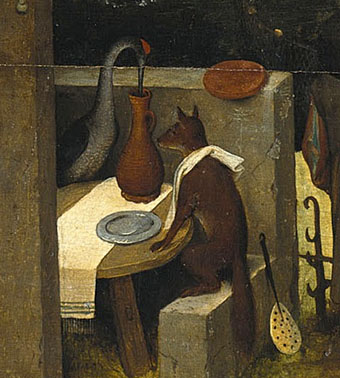
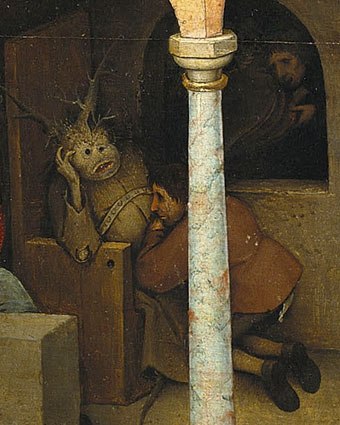
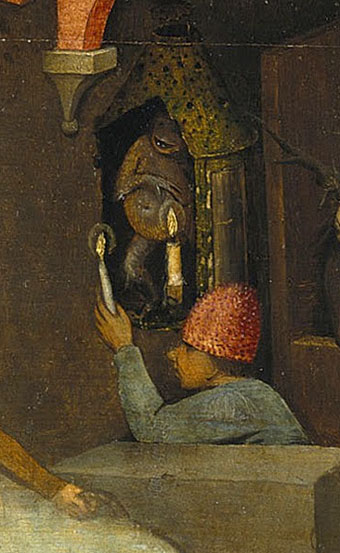
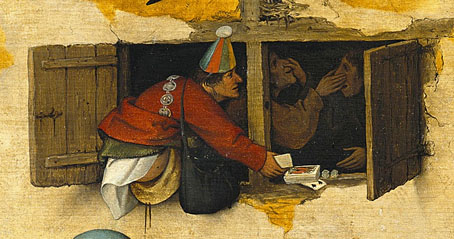
More Google Art Project details from the amazing Pieter Bruegel the Elder. The Netherlandish Proverbs (1559) is one of Bruegel’s many paintings which are crammed with curious incident; it’s also one of the more bizarre examples. In a crowded scene the artist depicts in a literal manner one hundred different proverbs or figures of speech. Wikipedia has a guide to the details but if you ignore that you can treat the whole thing as another example of Surrealism before its time. In addition to the usual complement of medieval grotesques there’s a fair amount of earthy humour of a kind which pretty much vanished from painting until the 20th century.

bruegel01.jpg

bruegel02.jpg

bruegel03.jpg

Continue reading “Proverbial details”