Weekend links 35

cr.jpg

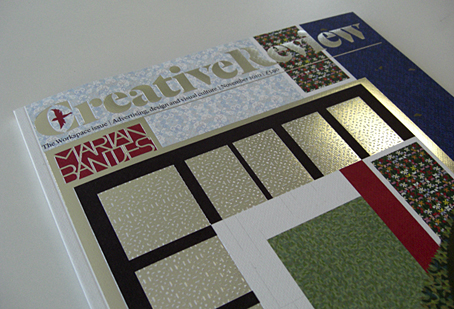
Marian Bantjes designs the cover of the latest Creative Review and there’s a feature about her work inside.

• “…the question: ‘was Shakespeare gay?’ strikes me as so daft as to be barely worth answering. Of course he was. Arguably he was bisexual, of sorts, but his heart was never on his straight side.” Don Paterson throws the cat among the pigeons in an examination of the Shakespeare’s sonnets. Related (sort of): Shakespeare and Company: The bookshop that thinks it’s a hotel. Also related: Jeanette Winterson revisits Shakespeare and Company.

100 orbs of light float in the Schuylkill River. Also in Philadelphia: Animators Amok in a Curiosity Cabinet: the Brothers Quay are making a film in the Mütter Museum. Can’t wait to see it.

• More Alan Moore: Fossil Angels, a lengthy essay about magic and the occult, was written in 2002 but hasn’t been given a public airing until now.

Alberto Manguel is always worth reading:

As Borges was well aware even then, the history of literature is the history of this paradox. On the one hand, the deeply rooted intuition writers have that the world exists, in Mallarmé’s much-abused phrase, to result in a beautiful book (or, as Borges would have it, even a mediocre book), and, on the other hand, to know that the muse governing the enterprise is, as Mallarmé called her, the Muse of Impotence (or, to use a freer translation, the Muse of Impossibility). Mallarmé added later that all who have ever written anything, even those we call geniuses, have attempted this ultimate Book, the Book with a capital B. And all have failed.

• Here Comes Everybody: Wake In Progress is a self-described “foolhardy attempt to illustrate Finnegans Wake”. Easier to illustrate than make a film of the book, I’d have thought, and Mary Ellen Bute already attempted the latter.
hoffmeister.jpg

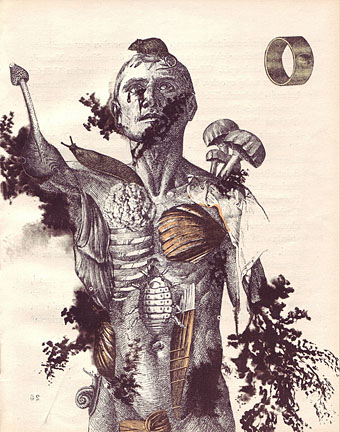
Psychic Explosion: Adolf Hoffmeister’s illustrations for a 1967 edition of Lautréamont’s Poesies at A Journey Round My Skull.

Craig Colorusso’s Sun Boxes can be seen at Turner Falls, Massachusetts, during November.

Clive Hicks-Jenkins has a book and retrospective exhibition of his art due next year.

• A sneak peek into The Steampunk Bible to which I’m a contributor. And also here.

• “Human or other; depends who comes”: the Ballardian films of Paul Williams.

Transmission (1979) by Joy Division; Transmission (1995) by Low; Monkey (2010) by Robert Plant.
Will Bradley’s Fringilla

bradley1.jpg

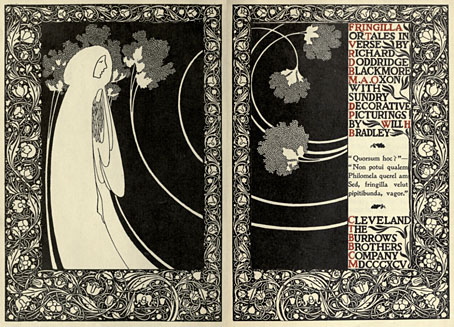
Title spread.

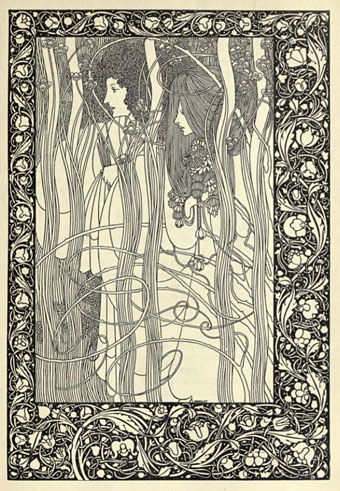
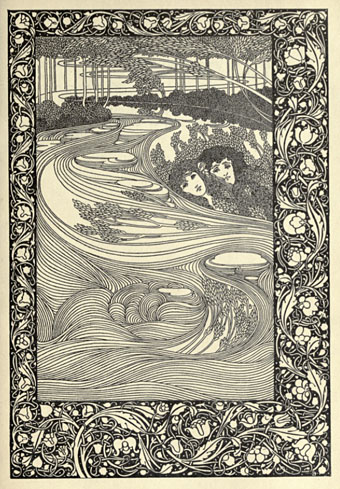
Like Marcus Behmer, another Beardsley follower from the Internet Archive, Will Bradley‘s work has been featured here before and should be familiar to anyone interested in illustrators of the 1890s. As well as being one of the great American illustrators, Bradley was also a very accomplished and successful practitioner of what we now call graphic design, and you see some of his design sensibility at work in these pages which illustrate RD Blackmore’s “tales in verse”, Fringilla (1895). The page borders are in the William Morris style which Beardsley imitated for Le Morte Darthur; Aubrey dropped this kind of heavy decoration when he moved to other books but Bradley made the borders his own for a while, using them in unlikely places such as adverts for that new-fangled transport device, the bicycle.

bradley2.jpg

Pausias and Glycera.

The Internet Archive also has A Booklet of Designs by Bradley, a collection of motifs and very cartoony advertising illustrations from 1914. As art it’s a lot less worthwhile than Frangilla but for anyone interested in early design methods it’s worth a look for the insight it offers into how things were done in the days of scissors and paste.

bradley3.jpg

Kadisha.

Elsewhere on { feuilleton }
The illustrators archive

Previously on { feuilleton }
Bradley does Beardsley

The art of Marcus Behmer, 1879–1958

behmer05.jpg

Salomé: Der Wunsch.

Back in March I wrote something about Alex Koch’s art periodical, Deutsche Kunst und Dekoration, a guide to German arts, crafts and architecture founded in Darmstadt in 1897. The Internet Archive has a nearly complete run of these and I’ve recently been working my way through their scans, a process which takes a while as there’s more than 10,000 pages to be looked at. When I find the time I’ll be posting some of the finds from this wonderful publication, the early issues of which are devoted to the best examples of the Art Nouveau style in Germany and elsewhere.

behmer06.jpg

Salomé: Die Erfüllung.

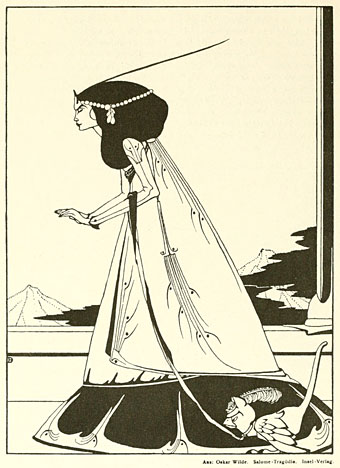
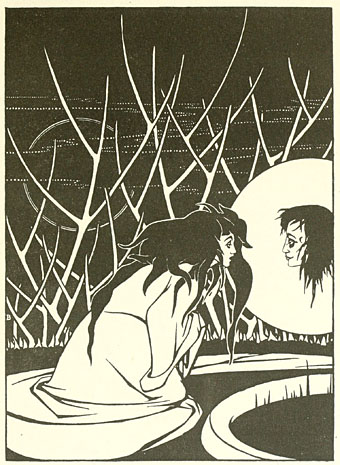
For now, however, I can’t resist posting these pictures from volume 18 (April–Spetember 1906) which form part of a feature about German illustrator Marcus Behmer. I’ve only seen one or two of Behmer’s drawings before and they didn’t really show him at his best. What’s immediately apparent is the great debt his work owed at this point to Aubrey Beardsley, right down to the treatment of foliage and a deliberately grotesque approach to character. It’s also good to find another treatment of the Salomé theme in black-and-white, and the pictures here are credited as being based on Wilde’s play.

behmer07.jpg

Salomé: Das Opfer.

Wikipedia has a page about the artist but it’s all in German, unfortunately, so a crude translation has to suffice. As with Beardsley, the grotesquerie extended to the sexual sphere and it would be nice to know more about the byways of Behmer’s career if only to see where his curious erotic drawings pieces come from. Wikipedia notes that “Behmer was already since 1903 member in the first homosexual organization of the world in Berlin” so I assume that means he was part of Adolf Brand’s circle, and may have contributed to Brand’s publication Der Eigene. A few examples of the erotic work can be found here and here. Further examples from Deutsche Kunst und Dekoration follow.
Continue reading “The art of Marcus Behmer, 1879–1958”

Weekend links 34

austin.jpg

Halloween in Austin, Texas this year will look and sound like this.

• “Blade Runner will prove invincible“: Philip K Dick’s letter of praise to the film’s producers. Related: one of the Blade Runner designers, Syd Mead, has recently styled New York’s Bar Basque and Foodparc.

• “I decided to go into fields where mathematicians would never go because the problems were badly stated…I have played a strange role that none of my students dare to take.” RIP Benoît Mandelbrot.

Science and poetry: “a richly vexed topic badly in need of rethinking”. Related: Why the Singularity isn’t going to happen.

• In case you missed this week’s earlier announcement, a reminder that I was interviewed at Coilhouse. My vanity: it knows no bounds.

• Franklin Booth’s illustrations for The Flying Islands of the Night (1913) by James Whitcomb Riley.

On the Verge (1950) by Maurice Sandoz, illustrated by Salvador Dalí. Also this and this.

bowie.jpg

Bowie Sphinx, 1969. Photo by Brian Ward.

The Laughing Gnostic: David Bowie and the Occult.

• “Moonlighting as a Conjurer of Chemicals“: Isaac Newton’s alchemical interests.

• “A sense of otherness that goes right back“: Alan Garner at Alderley Edge.

Jimmy’s End—Alan Moore’s new feature film and spin-off TV series.

A Guide to the New Ruins of Great Britain by Owen Hatherley.

• The It Gets Better Project now has a dedicated website.

Quicksand (1971) by David Bowie.

Charles Robinson’s King Longbeard

robinson1.jpg

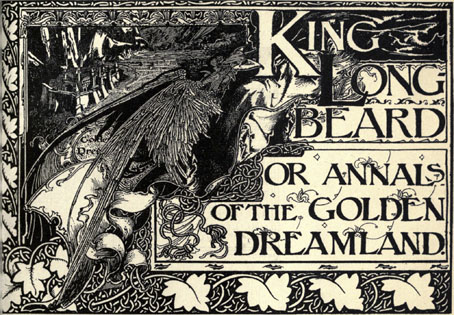
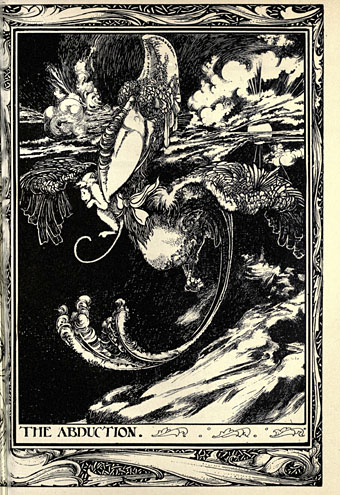
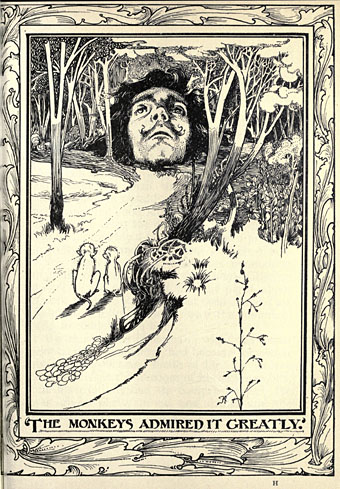
For proof that it’s worth persevering with the eccentric tagging or non-labelling at the Internet Archive, look no further than this tremendous edition of King Longbeard (1898) by Barrington MacGregor which features some astonishing illustrations by Charles Robinson. The illustrator’s name isn’t attached to the book files, I found this by cross-referencing, something I’ve been doing a lot of in order to find other books about design history. I’ve written about Robinson’s work before but I was still taken aback by some of these drawings, a handful of which verge on outright Surrealism. The two monkeys peering at a giant head is one I’ve seen reproduced elsewhere, although I couldn’t say where, so it’s good to be able to find the source at last. I haven’t read through any of the stories so the explanation of that scene remains a mystery. If you want the solution then the book files are here (click the “All files: HTTP” link for the full set).

robinson2.jpg

robinson3.jpg

Continue reading “Charles Robinson’s King Longbeard”