David Becket’s bookplates

becket.jpg

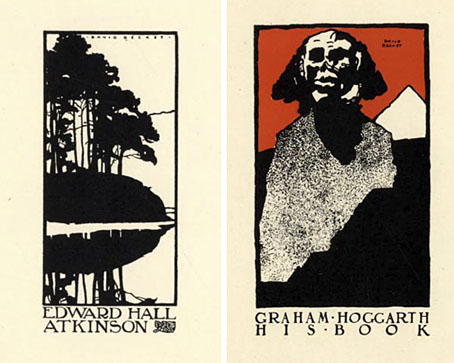
From David Becket: His Book of Bookplates, a slim volume published in 1906. The wonderfully spare style of these looks advanced for the time but probably owes something to William Nicholson‘s earlier work. Nicholson collaborated with brother-in-law James Pryde (as “The Beggarstaffs”) on poster designs with the same reduced detail, masses of black and hand-drawn type.

For 764 (!) further bookplates, see LUNA Commons.

Charles Ricketts’ Hero and Leander

ricketts1.jpg

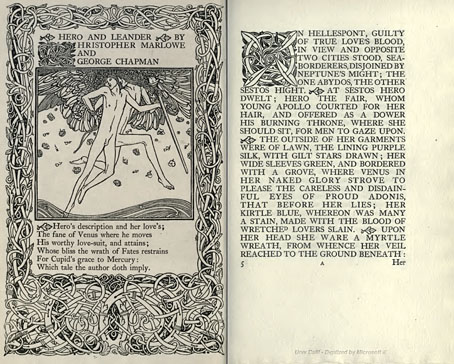
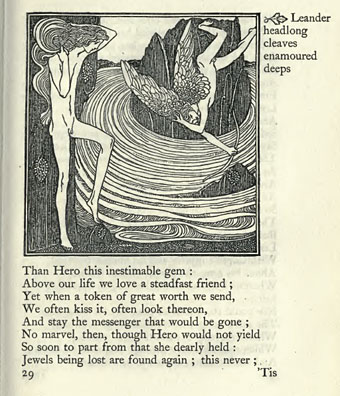
Enthusiasts of Charles Ricketts’ illustrations can find book collections of his drawings and paintings but the artist (with partner Charles Shannon) was also a printer, typographer and book designer who would no doubt have preferred his illustrations to be seen in their intended setting. The Internet Archive has a few choice examples of Rickett’s books, of which the most profusely illustrated is Hero and Leander (1894), Christopher Marlowe’s poem (completed by George Chapman).
ricketts2.jpg

Also of interest is Danaë (1903) by Thomas Sturge Moore with its black and red type, A Bibliography of the Books Issued by Hacon & Ricketts (1904), and A Defence of the Revival of Printing (1899). The latter is of interest to book designers and typographers for its presentation of Ricketts’ aesthetic philosophy. Ricketts’ and Shannon’s books made continual use of a small leaf motif as a pilcrow to mark a fresh paragraph. In A Defence of the Revival of Printing Ricketts discusses his replacement for the ampersand (&), which he disliked, preferring instead a new character combining the letters E and T, ampersands being a contraction of the Latin word “et”. There’s also some discussion of his unique type designs which he charmingly refers to as “founts”, preferring, like contemporary William Morris, the antique terminology.
ricketts3.jpg

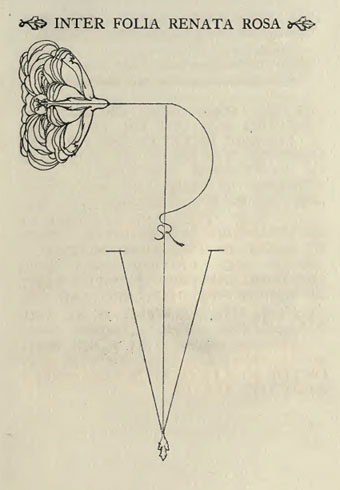
Colophon from Hero and Leander. A rose forms the monogram of Ricketts’ and Shannon’s Vale Press.

Elsewhere on { feuilleton }
The illustrators archive

Previously on { feuilleton }
Art Nouveau illustration
Dorian Gray revisited

Another Midsummer Night

perkins.jpg

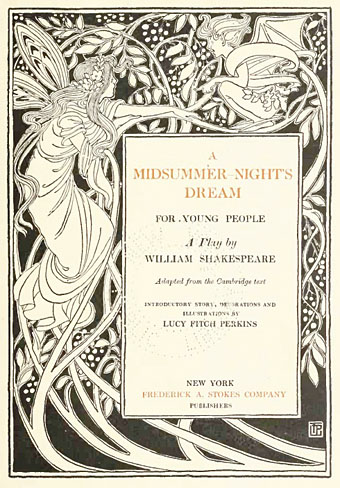
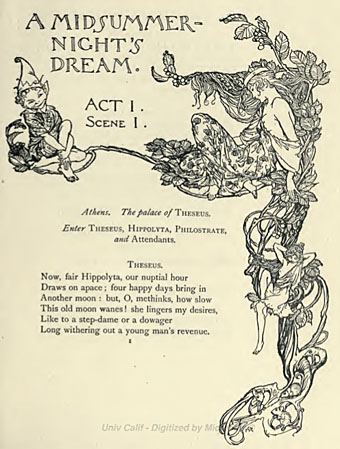
Another illustrated Shakespeare and another Internet Archive scan. Lucy Fitch Perkins’ adaptation dates from 1907 and while her colour work in this volume is distinctly bland, her ink drawings are styled with some tasty Art Nouveau flourishes. Puck with bat wings is an unusual touch.

Elsewhere on { feuilleton }
The illustrators archive

Previously on { feuilleton }
Arthur Rackham’s Midsummer Night’s Dream
A Midsummer Night’s Dadd
William Heath Robinson’s Midsummer Night’s Dream

Arthur Rackham’s Midsummer Night’s Dream

rackham.jpg

Something for the Summer Solstice, the whole of Arthur Rackham’s Shakespeare at the Internet Archive. Rackham’s paintings are classics of the period but for me William Heath Robinson’s black and white drawings are the superior renderings of this story. Happily you can see that book as well.

Elsewhere on { feuilleton }
The illustrators archive

Previously on { feuilleton }
A Midsummer Night’s Dadd
William Heath Robinson’s Midsummer Night’s Dream

Merely fanciful or grotesque

graphic.jpg

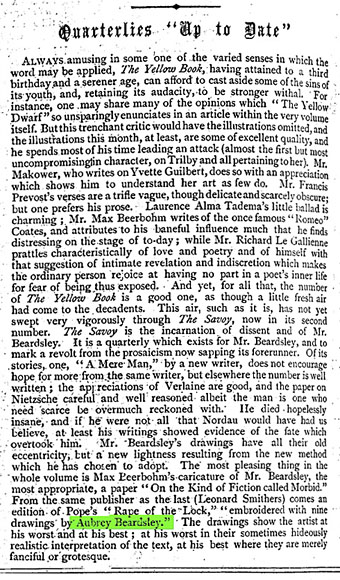
Thus the judgement of a reviewer examining Aubrey Beardsley’s work in The Graphic for May 23, 1896. The work in question was Beardsley’s Rape of the Lock illustrations being unveiled for the first time in the second number of The Savoy, the magazine which Beardsley co-founded with Arthur Symons and Leonard Smithers as a rival to the staid Yellow Book, also reviewed in the same column. Beardsley’s illustrations for Pope are now considered some of his very finest works and it’s difficult from our perspective to find any grotesquery there at all. It may be a reference to The Cave of Spleen, a drawing which saw the brief return of Beardsley’s earlier foetus creatures and a work to which some of Harry Clarke’s style would seem to owe a debt. In which case the reviewer should have been grateful to be spared the giant phalluses of The Lysistrata which Aubrey was also drawing for Smithers at this time.

The column above is one of many mentions of Beardsley and company to be found at the British Library’s new online archive of 19th century British newspapers. What might be a treasure trove is compromised slightly for me by being a collection of newspapers only, rather than magazines. A magazine database would give us all of The Savoy and The Yellow Book, as well as other titles which featured the work of fin de siècle illustrators. Patience is the key here, with every passing year more of the past becomes easily accessible.

So now, given the quantity of references there’s likely to be, dare I search for Oscar Wilde?

Elsewhere on { feuilleton }
The Aubrey Beardsley archive