Gothic alphabets

gothic1.jpg

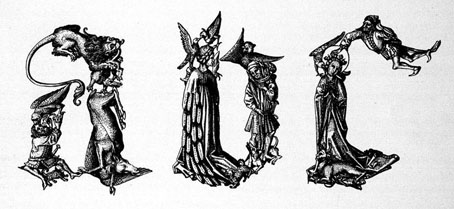
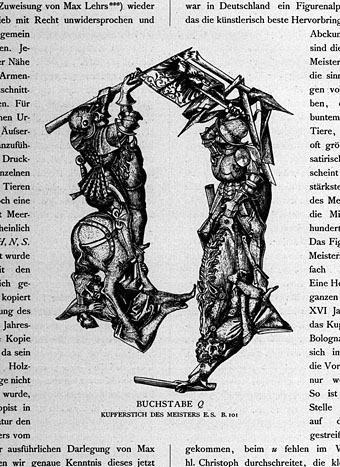
I have a couple of books with examples of medieval capitals like these, each letter being an amalgam of people, animals or (in the case of the example below) duelling knights. These are from Gothische Alphabete (1897), a book by Jaro Springer at the excellent University of Heidelberg which has the whole volume available as a PDF or as scans of individual pages.

gothic2.jpg

Previously on { feuilleton }
Letters and Lettering

Pamela Colman Smith’s Russian Ballet

pcs1.jpg

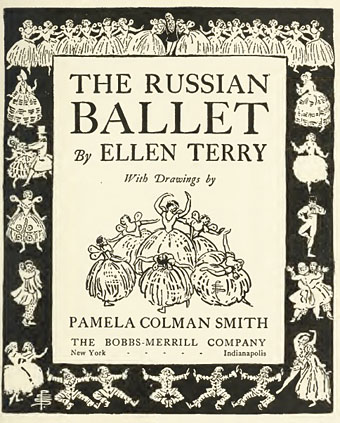
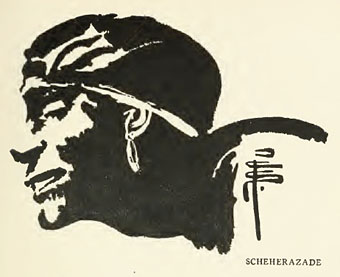
Another chance find at the Internet Archive. This small book from 1913 is an appraisal of Diaghilev’s Ballets Russes written by noted actress Ellen Terry and with illustrations—which Archive.org doesn’t mention—by Pamela Colman Smith, an artist whose Tarot designs are some of the most successful ever created yet who received little credit for her work while she was alive. It’s a shame that the Internet Archive perpetuates this state of affairs despite her name on the book’s title page. This is a fascinating set of ink sketches all of which are marked by the distinctive monogram familiar from her Tarot cards. One of the drawings in the book is also marked by an obscene doodle; I’ll leave it to the curious to discover which one.

pcs2.jpg

Continue reading “Pamela Colman Smith’s Russian Ballet”

Louis Rhead bookplates

rhead1.jpg

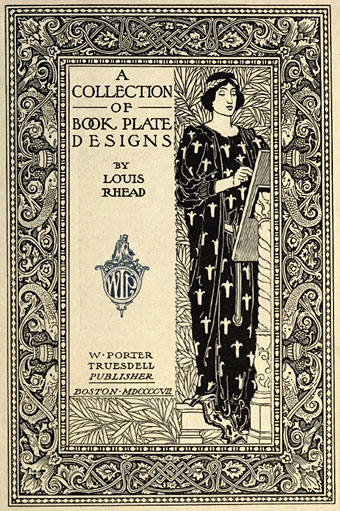
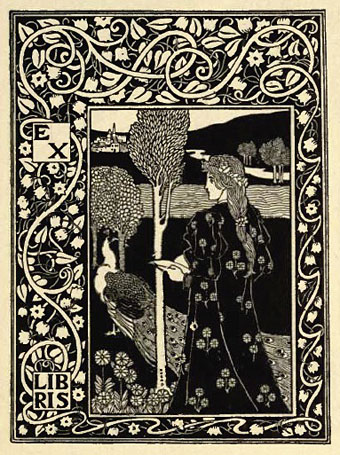
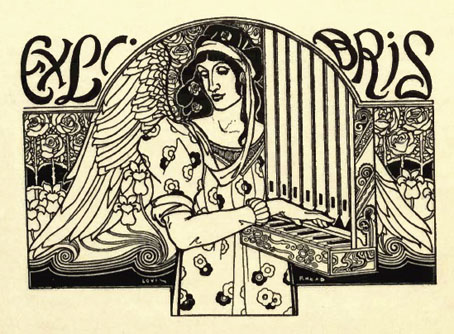
Yet another Internet Archive discovery, examples from a small book collection from 1907 of ex libris plates by Art Nouveau illustrator Louis Rhead (1857–1926). Rhead’s brightly-coloured poster art is often represented in Art Nouveau design books, less visible is his black-and-white work, some of which, like the example below, owes a clear debt to Aubrey Beardsley.

rhead2.jpg

rhead3.jpg

Elsewhere on { feuilleton }
The illustrators archive

Previously on { feuilleton }
Pratt Libraries Ex Libris Collection
The Evil Orchid Bookplate Contest
David Becket’s bookplates
Louis Rhead’s peacocks
More Arabian Nights
Buccaneers #1

Jugend, 1899

jugend-99-01.jpg

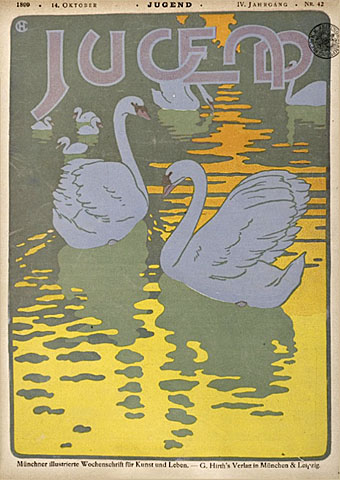
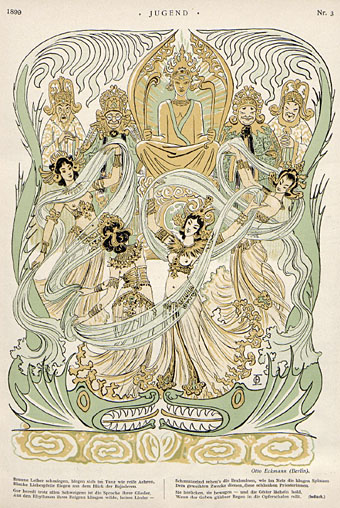
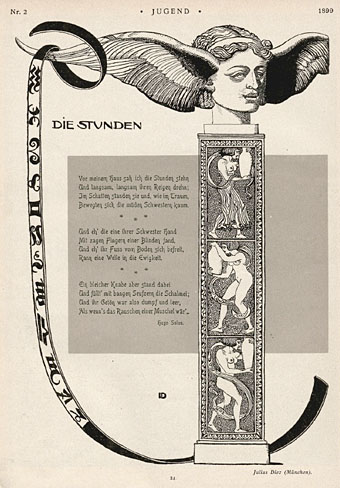
Continuing the delve into back issues of Jugend magazine, the German fin de siècle periodical of “art and life”, this post covers the year 1899. The earlier years of the magazine are replete with a variety of elegant and often bizarre graphics, as well as some classic examples of Art Nouveau graphic design. 1899 is the point in the magazine’s history that the variety (and, for me, the interest) begins to diminish. The covers lose their earlier inventiveness while the Art Nouveau stylings within are being replaced by drab illustrations of the German middle classes and patriotic depictions of country folk. There are still gems to be found, however, some of which follow below. As before, anyone wanting to see more of these graphics is advised to explore the bound volumes at the Heidelberg University archive. The two books for 1899 can be found here and here.

jugend-99-02.jpg

Otto Eckman (above) and Julius Diez (below) were heavily featured in the earlier years of the magazine and Diez in particular produces some of the best work in this year’s run.

jugend-99-03.jpg

Continue reading “Jugend, 1899”

The Oscar Wilde Galop

wilde_galop.jpg

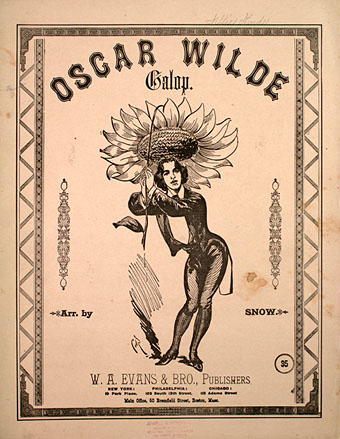
When Oscar Wilde arrived in America to begin his lecture tour in 1882 the excursion provoked considerable comment on both sides of the Atlantic. Wilde was there in his capacity as an ambassador for Aestheticism, a position which had already made him a figure of fun in the pages of Punch magazine while the Aesthetes generally and Wilde in particular had been caricatured the year before by Gilbert & Sullivan in their opera, Patience. The Oscar Wilde Galop was one of a number of topical dance pieces which capitalised on Wilde’s arrival in America, the full score of which can be seen in the Levy Sheet Music Collection at Johns Hopkins University. No one seems to give the name of the composer of these works for some reason, but this piece and others like it can be found on a CD, To Oscar: A Collection of Aesthetic Melodies.

I suspect Oscar would have been flattered by his portrayal on the sheet music, it’s milder than the Punch cartoons and gives him a wasp waist he never possessed even in his youth. Wilde enjoyed his lecture tour, and was always happy to be the centre of attention, of course, but America (and others) paid the price for the ribbing later on, as in this exchange from The Picture of Dorian Gray:

“I am told, on excellent authority, that her father keeps an American dry-goods store,” said Sir Thomas Burdon, looking supercilious.

“My uncle has already suggested pork-packing Sir Thomas.”

“Dry-goods! What are American dry-goods?” asked the duchess, raising her large hands in wonder and accentuating the verb.

“American novels,” answered Lord Henry, helping himself to some quail.

The duchess looked puzzled.

“Don’t mind him, my dear,” whispered Lady Agatha. “He never means anything that he says.”

“When America was discovered,” said the Radical member—and he began to give some wearisome facts. Like all people who try to exhaust a subject, he exhausted his listeners. The duchess sighed and exercised her privilege of interruption. “I wish to goodness it never had been discovered at all!” she exclaimed. “Really, our girls have no chance nowadays. It is most unfair.”

“Perhaps, after all, America never has been discovered,” said Mr. Erskine; “I myself would say that it had merely been detected.”

“Oh! but I have seen specimens of the inhabitants,” answered the duchess vaguely. “I must confess that most of them are extremely pretty. And they dress well, too. They get all their dresses in Paris. I wish I could afford to do the same.”

“They say that when good Americans die they go to Paris,” chuckled Sir Thomas, who had a large wardrobe of Humour’s cast-off clothes.

“Really! And where do bad Americans go to when they die?” inquired the duchess.

“They go to America,” murmured Lord Henry.

Elsewhere on { feuilleton }
The Oscar Wilde archive