Illustrating Poe #5: Among the others

kupka_poe.jpg

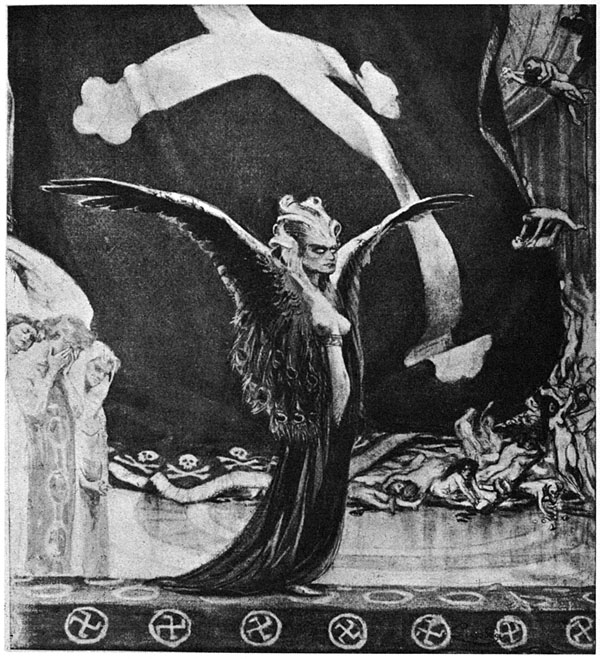
The Conqueror Worm (c. 1900) by František Kupka.

Poe’s illustrators are legion, you could easily devote an entire blog to nothing but depictions of his stories and poems. By way of rounding off this week of posts I thought I’d point to some of the works which have caught my attention over the years, several of them being obscure enough to warrant further investigation.

František Kupka’s drawing is, as far as I can gather, one of a series based on Poe’s poem; this seems to be a related piece. As with many Symbolists artists, you can spend a great deal of time scouring the available resources to find more of their work. We’re told that one of Kupka’s more well-known paintings, The Way of Silence (1903), was inspired by the poem Dream-land.
martini_poe.jpg

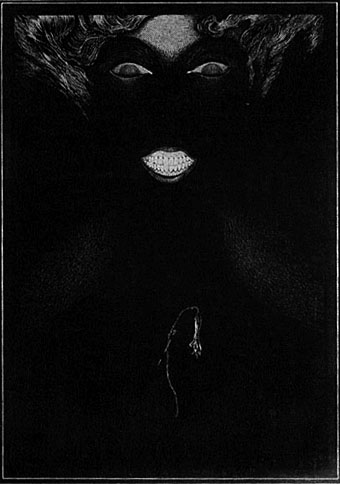
Berenice (1905) by Alberto Martini.

Alberto Martini (1876–1954) is a fascinating artist whose work bridges the decline of Symbolism and the rise of Surrealism. He’s also another talent whose work is woefully underrepresented on the web so let’s hope that changes soon. Wikipedia describes him as having produced 135 Poe illustrations of which only a small handful are visible online, and most of the ones that are go unlabelled. I know this one is for Berenice since I have it in a book but any Poe reader should guess the title from those blazing teeth. A few more of Martini’s drawings can be seen here.
Continue reading “Illustrating Poe #5: Among the others”

Illustrating Poe #3: Harry Clarke

hc_poe1.jpg

And so to the master. Harry Clarke’s illustrated edition of Tales of Mystery and Imagination was published by Harrap in 1919, with a new edition following in 1923 that featured an additional series of colour plates. I can’t imagine anyone ever producing a better illustrated version of Poe than Clarke managed, the morbid quality which some complain about in his work is perfectly suited to that most morbid of writers. So too are Clarke’s haunted and neurasthenic figures, and the many decorative details which provide an analogue to the author’s distinctive prose style. The first four drawings which follow repeat the earlier order of the Beardsley illustrations; an unfair comparison, perhaps, since the subject matter didn’t suit Aubrey’s temperament, but a comparison shows how differently the same stories might be illustrated, and how much Clarke brings the macabre elements to the fore.

There’s no need to post a large selection this time when quality scans have already appeared at A Journey Round My Skull and Golden Age Comic Book Stories. These drawings really do need to be seen showing all their fine detail.

hc_poe2.jpg

The Black Cat: “I had walled the monster up within the tomb!”

hc_poe3.jpg

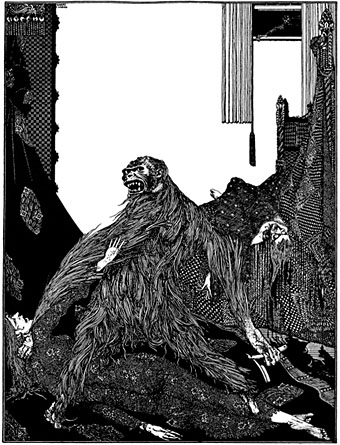
The Murders in the Rue Morgue: “Gnashing its teeth, and flashing fire from its eyes, it flew upon the body of the girl.”

Continue reading “Illustrating Poe #3: Harry Clarke”

Illustrating Poe #2: William Heath Robinson

whr_poe01

The Raven.

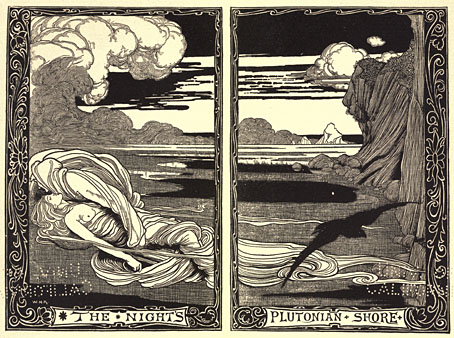
Some of these drawings have been featured here before but they’re always worth seeing again. One of the problems for the early illustrators of Poe was a lack of sympathy among many of them for the author’s doom-laden Romanticism. It’s a shame that Aubrey Beardsley didn’t try illustrating some of the poems, as William Heath Robinson does here, Poe’s verse is significantly lighter in atmosphere than his stories.

whr_poe02

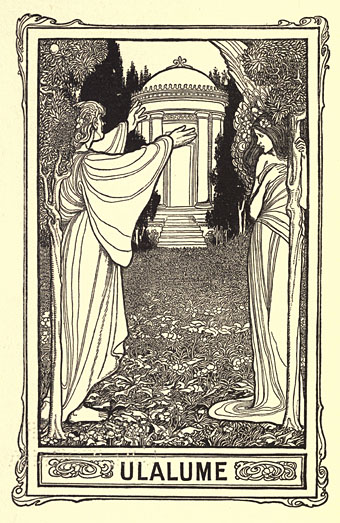
Ulalume.

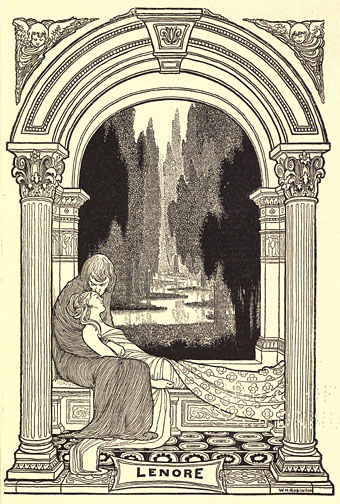
This collection is from 1900 and I much prefer this style of Robinson’s to the later comic inventions which made him a household name. The complete book can be found at the Internet Archive. For a very different interpretation of Poe’s poems, Golden Age Comic Book Stories just posted the 1912 Edmund Dulac edition.

whr_poe03

Lenore.

Continue reading “Illustrating Poe #2: William Heath Robinson”

Illustrating Poe #1: Aubrey Beardsley

beardsley_poe1.jpg

The Black Cat.

Halloween approaches, as if you needed reminding. In honour of that event it’s Poe Week here at {feuilleton}, and we’ll be skating through some favourite depictions of stories and poems by the Boston genius.

Aubrey Beardsley’s four Poe illustrations were commissioned by Herbert S. Stone and Company, Chicago, in 1894 as embellishment for a multi-volume collection of the author’s works. The Black Cat is justifiably the most reproduced of these. The other drawings are fine in themselves but not very successful illustrations of Poe’s tales. Aubrey wasn’t really suited to this kind of horror atmosphere; looking at his ear-ringed orangutan and the spotless furnishings surrounding it you’d never guess the scene of murderous simian frenzy which lies at the heart of the story.

beardsley_poe2.jpg

The Murders in the Rue Morgue.

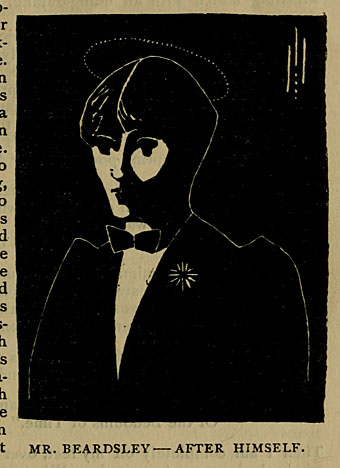
Herbert Stone’s company had begun publishing The Chap-Book in the same year, a witty American equivalent of British periodicals like The Yellow Book, and Beardsley’s work was featured in the early issues. Looking through some of these at the Internet Archive I was surprised to see the following illustration in a short appraisal of Beardsley’s art. If this is by the artist, as the credit implies, it’s a drawing I haven’t seen in any books of his work. If anyone can confirm this is a genuine Aubrey then please leave a comment. The other Poe illustrations follow.

beardsley_portrait.jpg

From The Chap-Book, May 15th, 1894.
Continue reading “Illustrating Poe #1: Aubrey Beardsley”

Will Bradley’s Fringilla

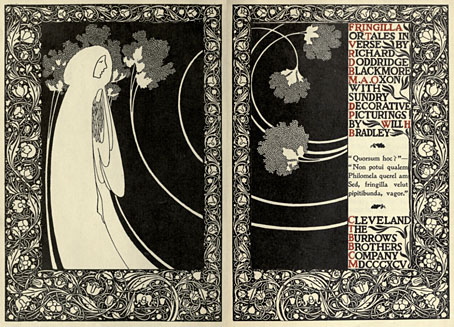
bradley1.jpg

Title spread.

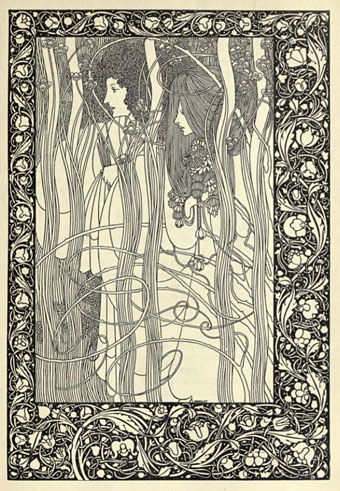
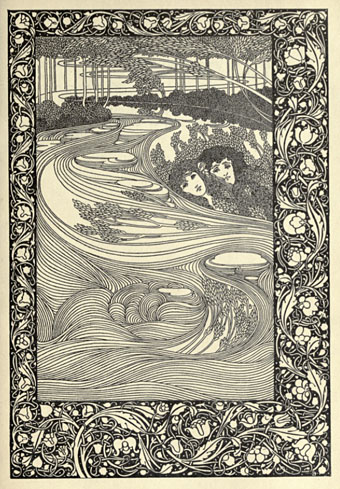
Like Marcus Behmer, another Beardsley follower from the Internet Archive, Will Bradley‘s work has been featured here before and should be familiar to anyone interested in illustrators of the 1890s. As well as being one of the great American illustrators, Bradley was also a very accomplished and successful practitioner of what we now call graphic design, and you see some of his design sensibility at work in these pages which illustrate RD Blackmore’s “tales in verse”, Fringilla (1895). The page borders are in the William Morris style which Beardsley imitated for Le Morte Darthur; Aubrey dropped this kind of heavy decoration when he moved to other books but Bradley made the borders his own for a while, using them in unlikely places such as adverts for that new-fangled transport device, the bicycle.

bradley2.jpg

Pausias and Glycera.

The Internet Archive also has A Booklet of Designs by Bradley, a collection of motifs and very cartoony advertising illustrations from 1914. As art it’s a lot less worthwhile than Frangilla but for anyone interested in early design methods it’s worth a look for the insight it offers into how things were done in the days of scissors and paste.

bradley3.jpg

Kadisha.

Elsewhere on { feuilleton }
The illustrators archive

Previously on { feuilleton }
Bradley does Beardsley