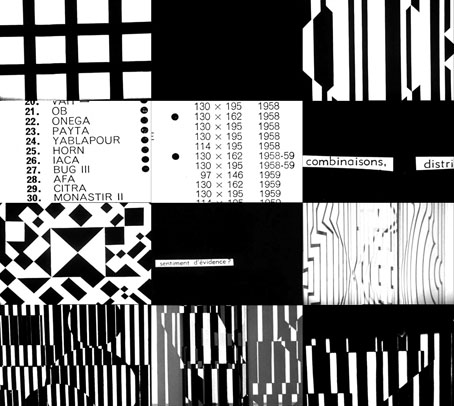
Vasarely, a film by Peter Kassovitz

vasarely.jpg

I’ve always liked Victor Vasarely’s brand of Op-Art so this short film from 1960 would be of interest even without the addition of a score, Neg-Ale, by Iannis Xenakis. Considering the stature of the composer the music fails to add much at all so it’s no surprise to read at Ubuweb that Xenakis later withdrew it from his catalogue. Kassovitz’s film is worth watching for Vasarely’s artworks, however, especially some three-dimensional creations I hadn’t seen before.

Previously on { feuilleton }
Escher and Schrofer

RS Sherriffs’ Tamburlaine the Great

sherriffs01.jpg

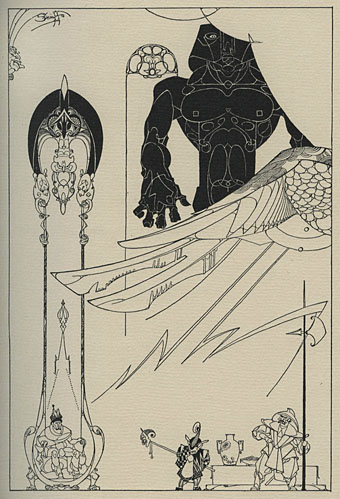
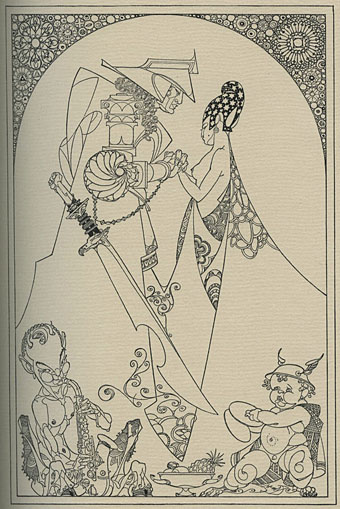
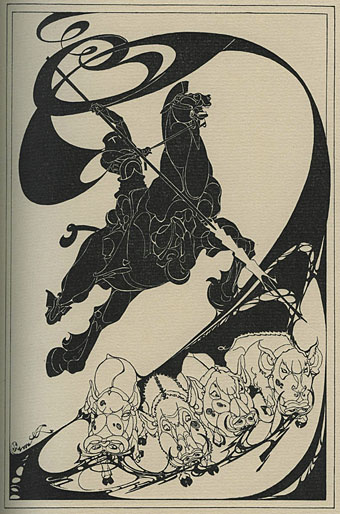
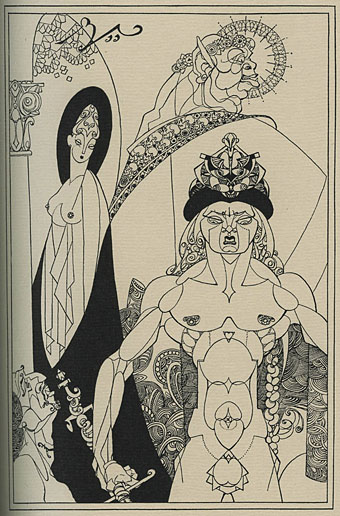
I would have posted this by now if it hadn’t been for the recent unpleasantness. Robert Stewart Sherriffs (1906-60) was a Scottish artist who I confess I hadn’t come across before until Nick H (thanks, Nick!) drew my attention to this book at silver-gryph’s eBay pages. Sherriffs’ illustrated edtion of The Life and Death of Tamburlaine the Great by Christopher Marlowe was published in a limited edition in 1930.

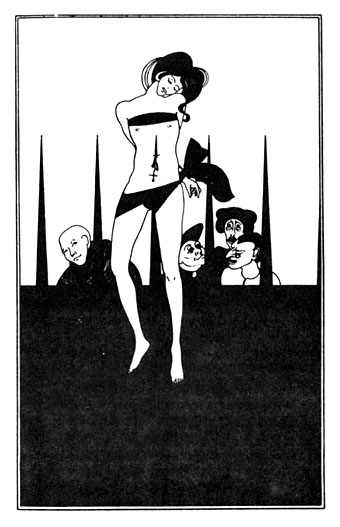
The drawings are black-and-white throughout, and of such a quality you have to wonder why Dover or someone hasn’t done a reprint. The general approach owes much to the usual suspects, notably Aubrey Beardsley and Harry Clarke, but there’s a development of these earlier styles that you also find in the work of Ray Frederick Coyle and Beresford Egan. In addition to the full-page plates Sherriffs also provided a number of insect vignettes, the last of which is a Death’s-head Hawkmoth.

sherriffs02.jpg

sherriffs03.jpg

sherriffs04.jpg

Continue reading “RS Sherriffs’ Tamburlaine the Great”

Paul Konewka’s Faust

faust01.jpg

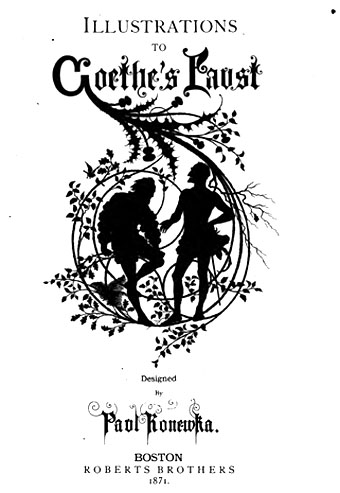
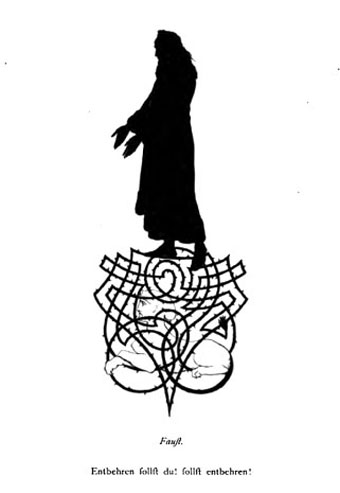
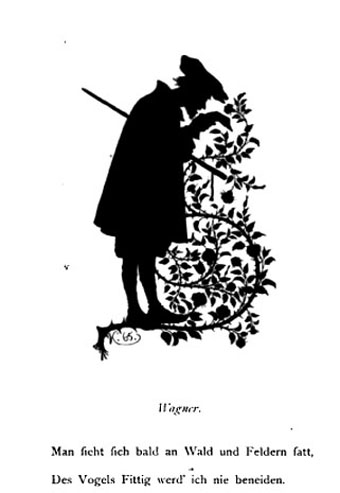
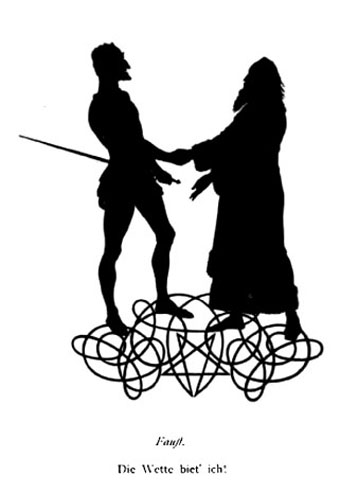
Discovered via the GoetheZeitPortal, these illustrations for Faust by German artist Paul Konewka (1841–1871) date from 1865, although the copies here are from a later edition. Konewka was a silhouette cutter so while these may look like ink illustrations they’re actually paper silhouettes displaying a formidable level of detail and complexity. Whatever the technique, the story itself is immediately recognisable from the characters even if none of the more dramatic scenes are represented. There aren’t many books you could treat in this fashion since the story has to be almost universally familiar; Shakespeare would be an obvious candidate—Konewka subsequently produced illustrations for A Midsummer Night’s Dream—fairy tales (like Arthur Rackham’s Sleeping Beauty), and also Lewis Carroll’s Alice books come to mind.

The copies shown here are from another shoddy Google scan at the Internet Archive but you do get to see all the pages. The Goethe site has better copies of the illustrations.

faust02.jpg

faust03.jpg

faust04.jpg

Continue reading “Paul Konewka’s Faust”

Antony Little’s echoes of Aubrey

little1.jpg

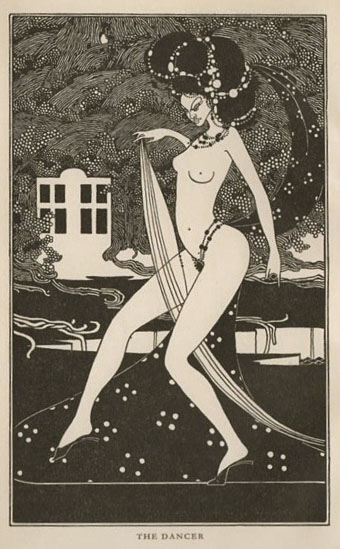
The Dancer (1967) by Antony Little.

My thanks to Sweet Jane this time for alerting me to her post about a series of Beardsley-inspired illustrations from 1967 by Biba designer Antony Little. The Wandering Jew and Other Stories was the first translation in English of Apollinaire’s 1910 collection L’Hérèsiarque et Cie. I’ve known about this book for a while but few of the illustrations have been on view anywhere until this post. There are eight in all, each of them very adeptly capturing different phases of Beardsley’s drawing style, from the spare black-and-whites to the more detailed renderings seen in his later work. The drawing below is another in the series from a post of Callum’s which also includes a favourite of mine by Beresford Egan.

Little’s designs, and the prominence of the Biba stores, did much to make Art Nouveau in general, and Beardsley in particular, a crucial component of London fashion in the late 1960s. For more on that subject see this Sweet Jane post featuring yet more Beardsley borrowings and monochrome design, plus Osborne & Little’s fantastic Chinese Dragon wallpaper which made a memorable appearance last year in Only God Forgives.

little2.jpg

Elsewhere on { feuilleton }
The Aubrey Beardsley archive
The illustrators archive

Aubrey in LIFE

life.jpg

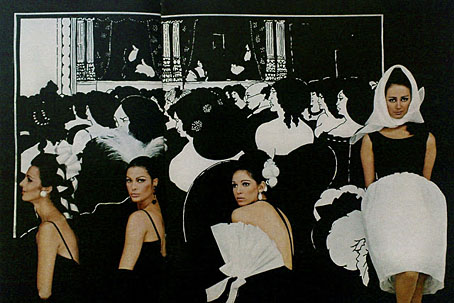
Turned out for a big night at the opera like Beardsley’s Wagnerites, girls wear bare-backed blacks by Trigère. Coiffed heads are by Hugh Harrison and Halston of Bergdorf Goodman’s; Halston also made the pouf-skirted dress. (Photo session by Milton Green & Joe Eula.)

Being determined to catalogue every last piece of Beardsley trivia from the 1960s, I’m compelled to note this post which I’d missed at Sweet Jane’s Pop Boutique a couple of years ago. An earlier post here showed one of the photos from a LIFE fashion feature using Aubrey’s drawings but the Sweet Jane post has scans of all the photos, plus accompanying text. This was published in February 1967, a few months after the summer exhibition at the V&A in London which introduced Beardsley’s work to a new generation, an exhibition which set in motion a wave of popular interest in his work.

I’m intrigued by the way the colour of the women’s bodies emerges from the drawings given the date when the magazine appeared. I’ve long seen 1966 as a very black-and-white year in graphic and aesthetic terms, whereas 1967 is obviously full-colour; the difference between the sleeves of the Beatles’ (Beardsley-derived) Revolver and Sgt Pepper albums are only two of the more prominent examples. These fashion photos could be regarded as being caught mid-way between the shift from one state to another. There are more shots of the Wagnerites above on this page. Thanks to Ian for drawing my attention to the Sweet Jane post.

Elsewhere on { feuilleton }
The Aubrey Beardsley archive