The art of Alan Odle, 1888–1948

odle1.jpg

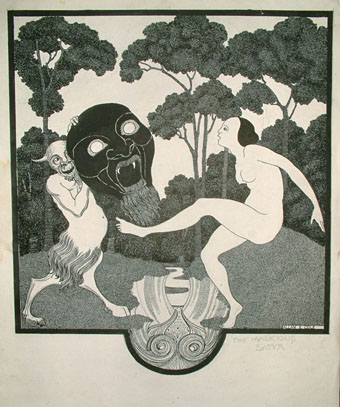
The Malicious Satyr.

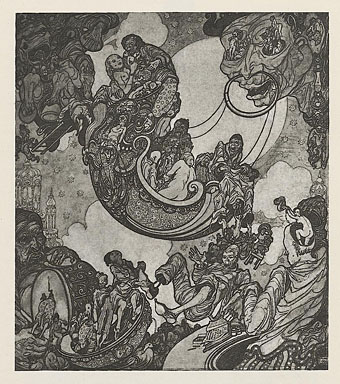
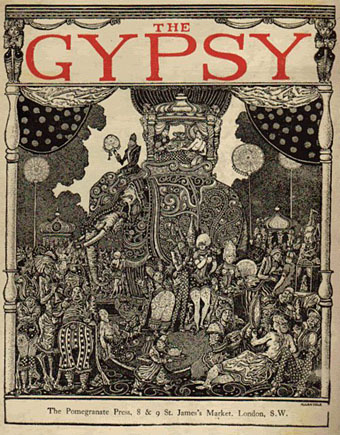
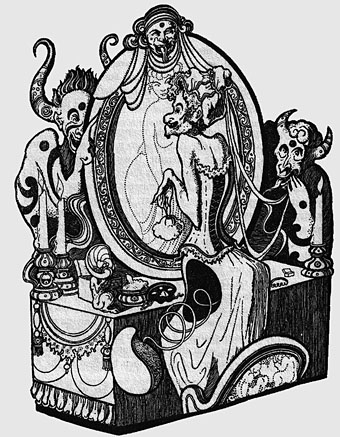
Following yesterday’s post, a little more about British illustrator Alan Odle. A cursory search between work sessions today yielded a variety of Odle drawings but not the illustrated edition of Candide I was hoping for. The examples here are all taken from Pinterest, and I believe the ones towards the end are from Candide but that’s only a guess. In a reversal of the usual state of affairs, Odle’s career has been overshadowed by that of his wife, Dorothy M. Richardson, a Modernist novelist of some note. But the neglect has been addressed recently with the publication in 2012 of a monograph, The Life and Work of Alan Odle by Martin Steenson. Mark Valentine reviewed the book at Wormwoodiana. Some of Odle’s drawings are for sale at the Victor Arwas and Chris Beetles galleries.
odle2.jpg

odle3.jpg

Continue reading “The art of Alan Odle, 1888–1948”

Harry Clarke and others in The Studio

odle.jpg

The Swing by Alan Odle.

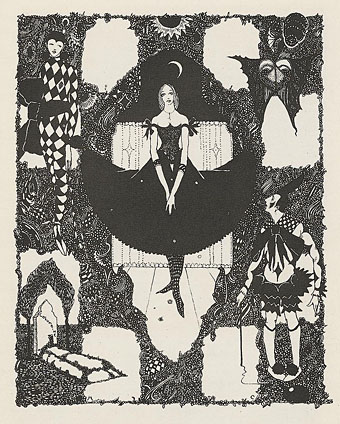
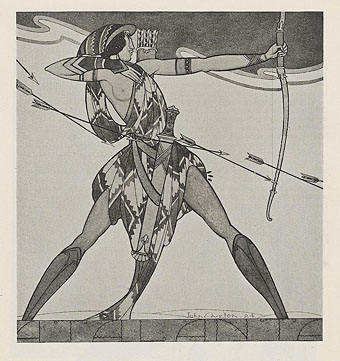
The University of Heidelberg has for some time now had several years of British art magazine The Studio in its archive but I’ve yet to delve fully into the later issues. These illustrations are from two articles from the volumes covering the year 1925, both of which feature the exceptional Irish artist Harry Clarke. In the first piece Clarke is present along with two contemporaries, John Austen and Alan Odle; the second is a review by novelist Dorothy M. Richardson (Alan Odle’s wife) of Clarke’s illustrations for Goethe’s Faust. All three artists owed an artistic debt to Aubrey Beardsley, and an earlier number of The Studio features a drawing by John Austen of Scheherazade in his Beardsley-derived style. (Thanks to Nick for the tip!)

clarke2.jpg

Columbine by Harry Clarke.

austen2.jpg

Atalanta in Calydon by John Austen.

Continue reading “Harry Clarke and others in The Studio”

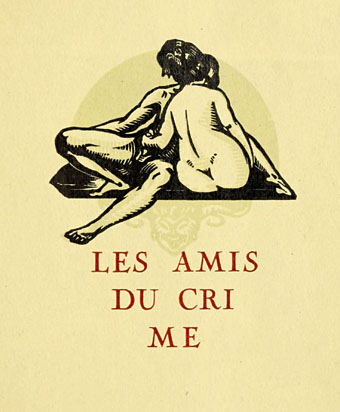
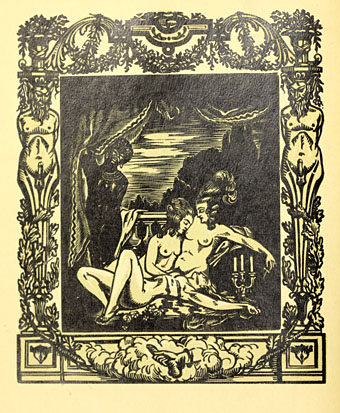
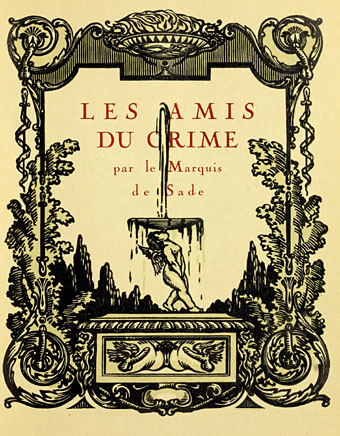
Célio’s Les Amis du Crime

celio01.jpg

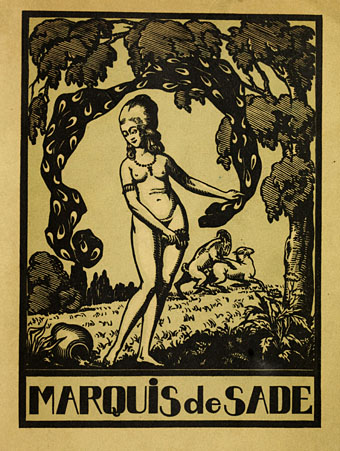
More porn. The Internet Archive has, until recently, been a somewhat chaste place where illustrations of sexual encounters are concerned. That’s mostly a result of their books being scans of works from libraries that wouldn’t have stocked illustrated editions of De Sade and company. Les Amis du Crime, together with yesterday’s volume, is part of the Wellcome Library’s sexology collection, an archive that includes eye-catching titles such as Curious Cases of Flagellation in France (1901).

Les Amis du Crime dates from around 1929. “Célio” was a pseudonym of artist Paul-Albert Moras whose woodcut illustrations imitate the engraved illustrations of De Sade’s own time. The borders follow the erotic style favoured by Franz von Bayros, albeit without Bayros’s attention to detail and graphic invention. This is, however, the first book I’ve seen where the page numbers are positioned between a woman’s open legs.

celio02.jpg

celio03.jpg

celio04.jpg

Continue reading “Célio’s Les Amis du Crime”

Invisible Cities: Miscellanea

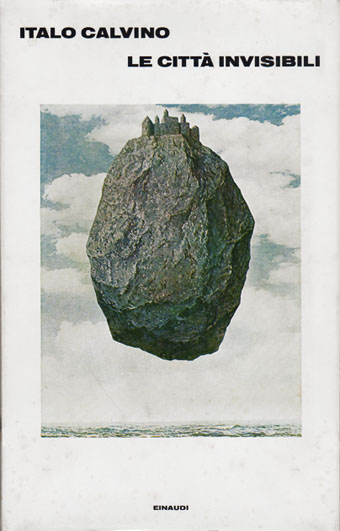
cities01.jpg

Cover art: The Castle in the Pyrenees (1961) by René Magritte.

A final post for this week devoted to Italo Calvino’s Invisible Cities, and it occurs to me that “Miscellanea” could easily be the name of one of Marco Polo’s cities.

One thing that’s become apparent over the past few days is that this subject is a very popular one with artists, especially in Italy. This is understandable but it also means you could probably fill another week of posts pursuing further illustrations and homages. Rather than belabour things I’m ending with a few of the more notable derivations including some cover designs. The Einaudi volume above was the first printing in Italy in 1972.

cities03.jpg

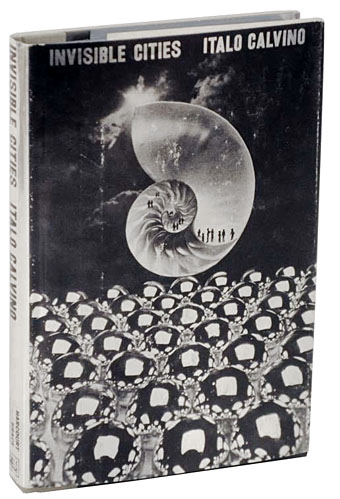
Cover design by Arnold Skolnick.

And this was the first American edition from Harcourt, Brace and Jovanovich in 1974. The cover is printed in silver foil which makes the book a particularly desirable item. This might explain why it’s also rather expensive today.

cities04.jpg

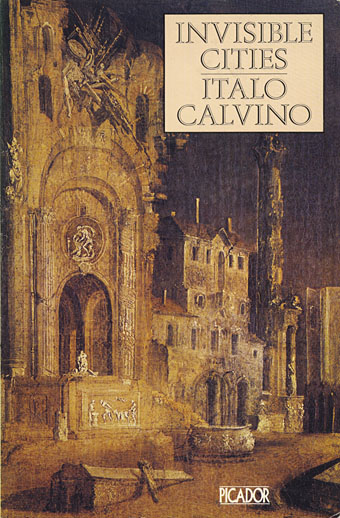
Cover art: Martyrdom of a Saint by Monsù Desiderio.

The 1979 Picador edition is one of two paperback editions I own. The enigmatic “Monsù Desiderio” has a confused identity (see this post), and specialised in curious architectural paintings so this is an apt choice.

Continue reading “Invisible Cities: Miscellanea”

Lichtspiel Schwarz-Weiss-Grau, a film by László Moholy-Nagy

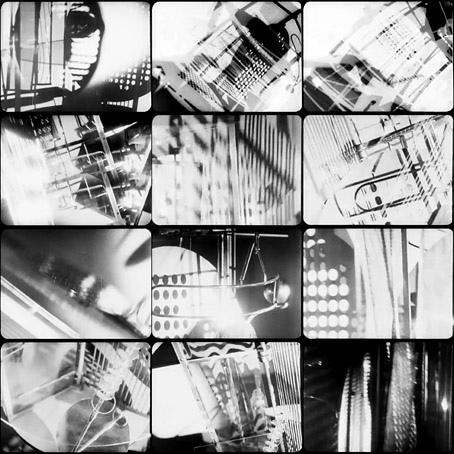
nagy.jpg

A beguiling short from 1930 made by the Hungarian artist to demonstrate the patterns of light and shade created by his Light-Space Modulator (aka Light Prop for an Electric Stage, 1922–1930), an early kinetic sculpture. The film could have worked well enough as a series of documentary shots but Moholy-Nagy compounds the effects with superimposition, lens fragmentation and even a brief negative sequence. Watch it here.

Previously on { feuilleton }
Ballet Mécanique