New things for October

big_pic.jpg

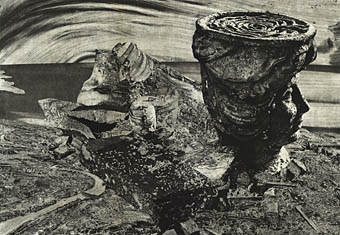
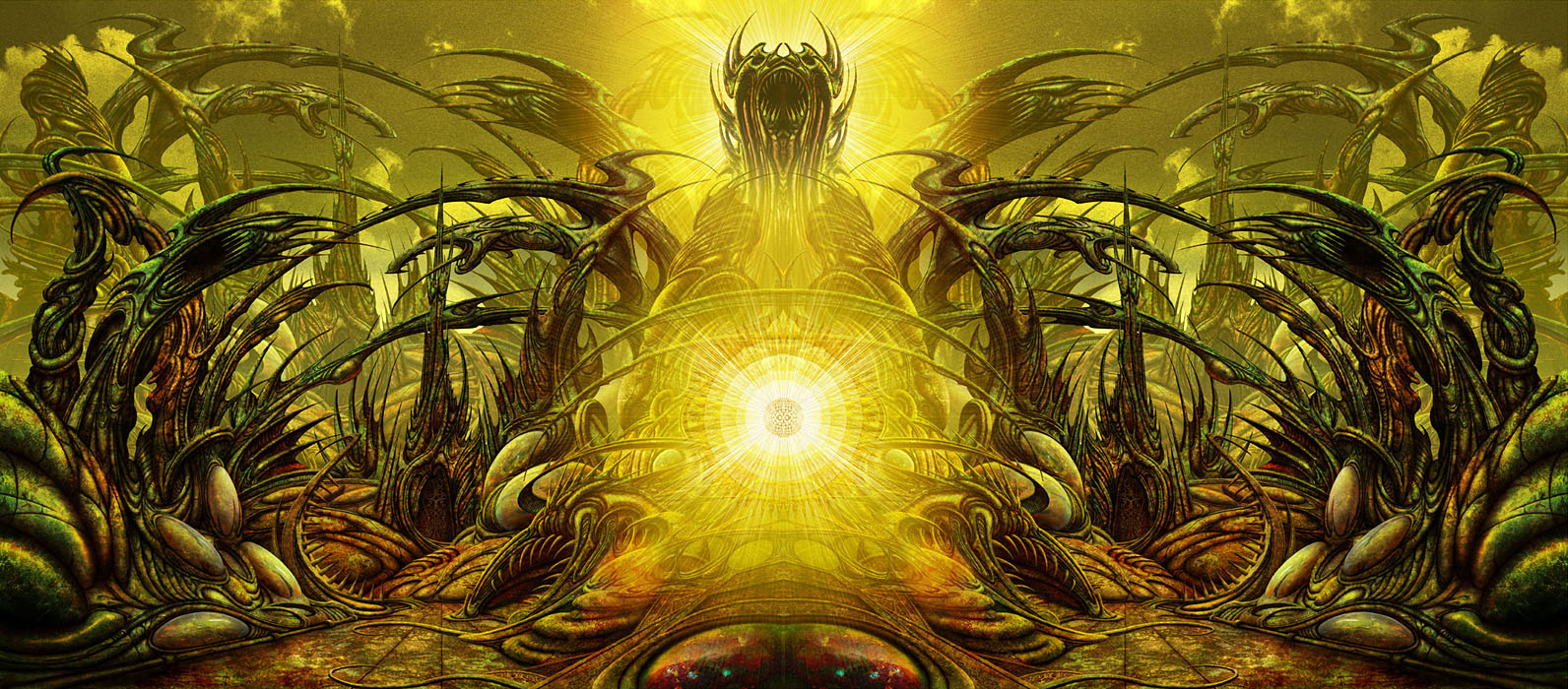
“Mirage in time—image of long-vanish’d pre-human city.”

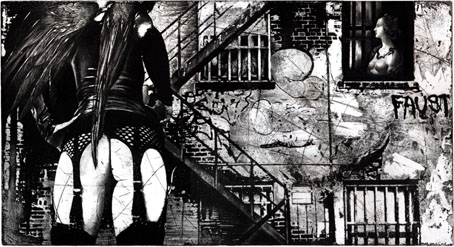
A couple pieces of news to catch up with here, both Lovecraft-related which is very apt for the month of Halloween. The first is the work I gave a teaser view of in August, a commission for Maison d’Ailleurs, the Museum of Science Fiction, Utopia and Extraordinary Journeys in Yverdon-Les-Bains, Switzerland. The brief for An Exhibition of Unspeakable Things: Lovecraft’s Commonplace Book was to choose an entry from HP Lovecraft’s Commonplace Book, his source of story ideas. The entry I chose implies some of the alien architecture which is a feature of At the Mountains of Madness although I’ll admit that the final result is debatable as architecture.

Continue reading “New things for October”

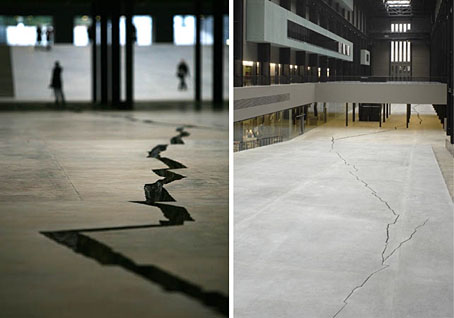
Doris Salcedo’s Shibboleth

salcedo.jpg

Art for crack addicts.

Tate Modern’s Turbine Hall is so vast and empty it’s quite a challenge for an artist to do anything interesting with it. One option is to try and fill the space which is what Anish Kapoor did with his enormous Marsyas, the first of the Turbine works I saw there in 2002.

Colombian artist Doris Salcedo has caused a stir this week by unveiling her own offering which seems to ruin the concrete floor with a succession of cracks that run the length of the building. I say “seem” because it looks from photos like she’s installed a series of large concrete slabs over the original floor (she won’t say how it’s been made), something that the structure of the cracks in close-up would seem to confirm. The rationale for this—that the work is “addressing a long legacy of racism and colonialism that underlies the modern world”—isn’t remotely obvious, a perennial problem with contemporary art; a crack in the floor can mean any number of things, after all, and it’s difficult to see how an unbriefed visitor would arrive at that conclusion. However, I’d still like to see this in situ even if it doesn’t match the splendour of Olafur Eliasson’s Weather Project from 2003.

Shibboleth can be seen from October 9th 2007–April 6th 2008.

Update: Builders and an architect ponder the mystery of the crack’s creation.

Shibboleth at Tate Modern
A video at The Guardian

Previously on { feuilleton }
Olafur Eliasson’s Serpentine Pavilion
Cloud Gate by Anish Kapoor

The House with Chimaeras

house1.jpg

The House with Chimaeras, 10 Bankovaya St, Kiev.

Via Wikipedia:

The House with Chimaeras was designed by the architect Vladislav Gorodetsky in 1901–1902. Gorodetsky was born in 1863 into a prosperous Polish szlachta family in the Podillia region. After finishing the Imperial Academy of Arts in Saint Petersburg in 1890, he moved to Kiev, where he lived for almost 30 years. At the time of the building’s construction, Gorodetsky had already established himself as a prominent Kiev architect, having designed many city buildings, from the St. Nicholas Roman Catholic Cathedral to a Karaite kenesa and the current National Art Museum of Ukraine. Besides architecture, Gorodetsky was also interested in big-game hunting, which explains why his building features many animals.

house2.jpg

The Italian sculptor Emilio Sala was responsible for both the internal and external sculptural decorations, such as mermaids, dolphins, and frogs on the roof of the building, sinking ships and hunting trophies on the exterior walls, and exuberant interior decorations, such as grand stairways and chandeliers depicting huge catfish strangled in the stems of lotus flowers.

A gallery of details
The House at night on Flickr

Previously on { feuilleton }
Adolph Sutro’s Gingerbread Palace
The Triangular Lodge

Piranesi as designer

piranesi1.jpg

Pier table for Cardinal Rezzonico (c. 1768).

This ostentatious object is on display at the Cooper-Hewitt National Design Museum in an exhibition devoted to Piranesi’s work as a designer. Piranesi (whose work adorns the current {feuilleton} header) is far more well-known for his Carceri d’Invenzione and Vedute di Roma prints than for his furniture design, of course, so this exhibition addresses a side of the artist/architect which is rarely explored outside the more extensive books about his work. I’d seen this table before in black and white photographs in John Wilton-Ely’s substantial monograph, The Mind and Art of Giovanni Battista Piranesi (1978) but those photos don’t fully convey its lavish (some might say gaudy) effect.

The exhibition runs from September 14, 2007–January 20, 2008. From the Cooper-Hewitt site:

This exhibition examines the artist’s role in the reform of architecture and design from the 18th century to the present. This is the first museum exhibition to show Piranesi’s full range and influence as a designer of architecture, elaborate interiors and exquisite furnishings. On view will be etchings, original drawings and prints by Piranesi, as well as a selection of three-dimensional objects. In addition to his better-known architectural projects, Piranesi also designed fantastic chimneypieces, carriage works, furniture, light fixtures and other decorative pieces. The exhibition is co-curated by Dr. Sarah E. Lawrence, director, Master’s Program in the history of decorative arts and design, Cooper-Hewitt, National Design Museum, and John Wilton-Ely, professor emeritus, University of Hull.

piranesi2.jpg

Diverse Maniere…, Open to Chimneypiece: Griffon Monopods on the Jambs (1769).

The original table design appeared in Diverse Maniere, a collection of prints showing design for clocks, furniture and fireplaces. Many of these are the most bizarre and detailed inventions in Piranesi’s corpus, especially the elaborate Egyptian-themed fireplaces. Very few of these confections were built at all but a number of the prints are in the exhibition and can be seen at its very elegant website.

NYT feature on Piranesi and the Cooper-Hewitt exhibition

Elsewhere on { feuilleton }
The etching and engraving archive