Jiří Barta’s Pied Piper

barta1.jpg

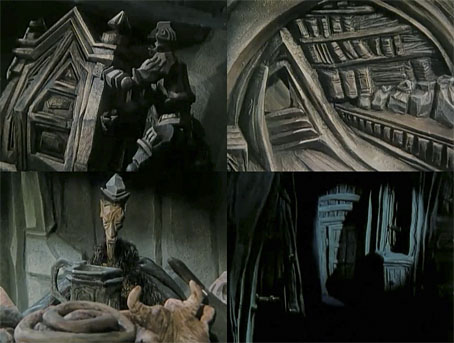
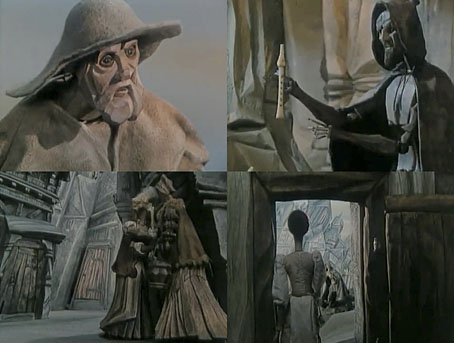
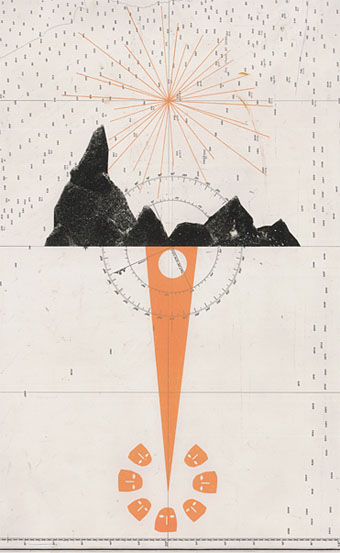
The last time I mentioned Jiří Barta’s extraordinary animation of the Pied Piper story there were only short clips on YouTube. That was several years ago, in which time the 53-minute film has been posted in its entirety. Barta pulls the tale away from its sanitised derivations back to its darker origins in the folk mythology of Central Europe; he also gives the end of the story a twist which I won’t reveal here. The characters are almost all angular wooden figures, while their rat-infested town is constructed from the disjunctive perspectives of German Expressionism. The whole effect is so successful it makes you wish even more that Barta might have completed his feature-length version of the Golem story.

barta2.jpg

Previously on { feuilleton }
Gloves
More Golems
Barta’s Golem

René Bull’s Rubáiyát

bull00.jpg

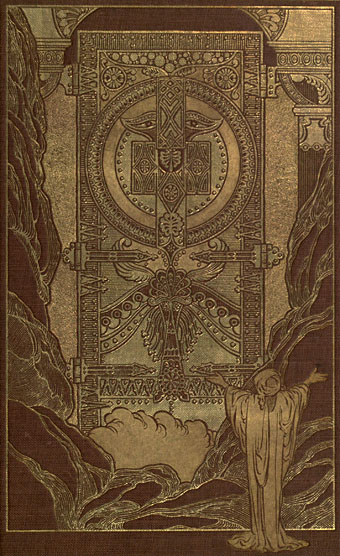
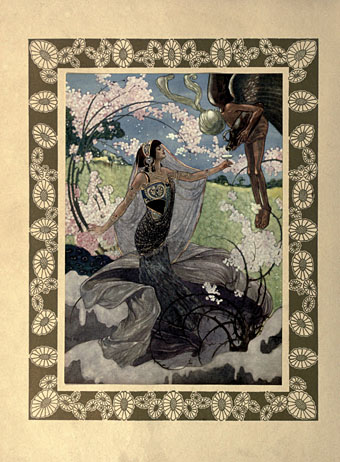
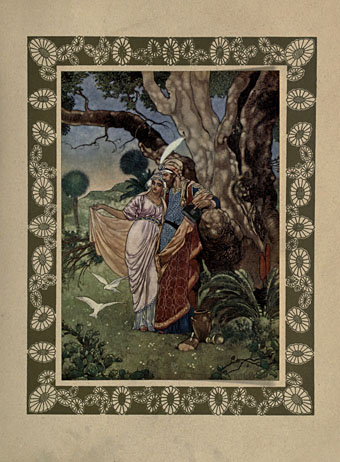
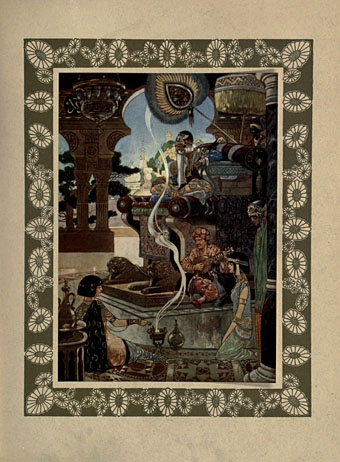
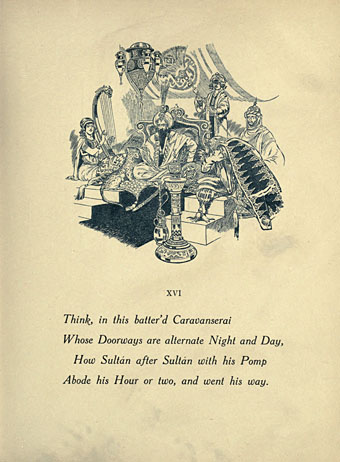
One of the more obscure artists from the Golden Age of the illustrated book, finding this volume by René Bull (1872–1942) makes up for my earlier dismissal of his Arabian Nights where the illustrations tend towards the comical. This volume dates from 1913, and shows Bull to be a fine exponent of Edwardian Orientalism. Browse the rest of it here or download it here.

bull01.jpg

bull02.jpg

bull03.jpg

bull04.jpg

Continue reading “René Bull’s Rubáiyát”

Hodgsonian vibrations

utpatel.jpg

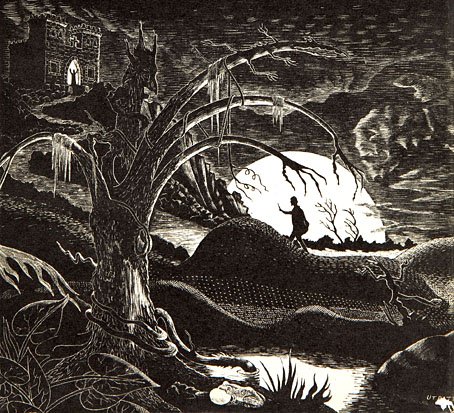
Illustration by Frank Utpatel from the 1947 Arkham House edition of Carnacki, the Ghost-Finder.

“Presently I got hold of myself a bit, and marked out a pentacle hurriedly with chalk on the polished floor; and there I sat in it almost until dawn. And all the time, away up the corridor, the door of the Grey Room thudded at solemn and horrid intervals. It was a miserable, brutal night.”

The Gateway of the Monster (1913) by William Hope Hodgson

“Word falling – Photo falling – Time falling – Break through in Grey Room”

The Ticket That Exploded (1962) by William S. Burroughs

Among other things, 2013 is the centenary of the first book publication of William Hope Hodgson’s collection of weird tales, Carnacki, the Ghost-Finder, and while I don’t believe that William Burroughs was referring to the supernatural eruption that occurs in Hodgson’s Grey Room it would be remiss of me to ignore the connection. Listening this week to Music for Thomas Carnacki by Jon Brooks (he of The Advisory Circle) had me wondering whether there’s any other Hodgson-derived music of note. Lovecraft has inspired hours of musical endeavour while Hodgson’s weird contemporaries, Algernon Blackwood and Arthur Machen, are referenced on some of the Ghost Box releases. Hodgson is the poor relation in these celebrations, often passed over despite the sonic potential of Carnacki stories such as The Whistling Room, The Horse of the Invisible, and especially The Hog, a tale whose manifestations are almost wholly perceived through the medium of sound. Searching around turned up the following examples.
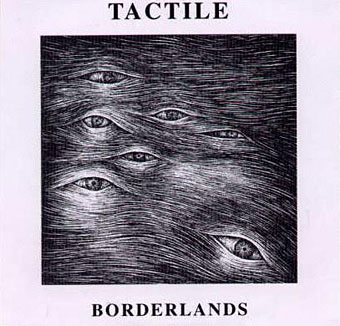
tactile.jpg

Borderlands (1999) by Tactile.

The House on the Borderland is the big favourite in this list, this album being a series of tracks by John Everall based on Hodgson’s novel. John Balance of Coil appears on the first track, Grief, reading the poem which opens the book.

Continue reading “Hodgsonian vibrations”

Allegro Non Troppo

allegro1.jpg

Having watched Disney’s Fantasia (1940) recently, I had to search out this as a palliative. There’s a lot I like about the Disney film but the explanatory interludes for the Great Unwashed are tiresome, I’ve always loathed Mickey Mouse’s voice (although the Sorceror’s Apprentice sequence is fine), and, for a film that aspired to artistic seriousness, the Pastoral Symphony episode has all the aesthetic gravitas of a packet of fizzy sweets.

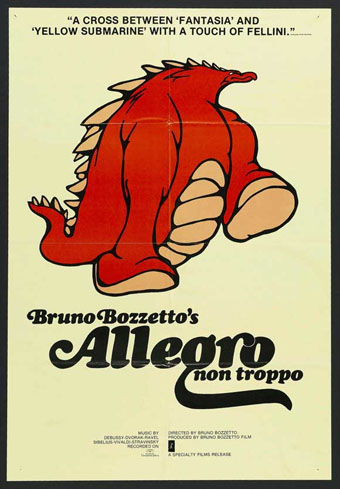
Bruno Bozzetto’s Allegro Non Troppo (1976) was a feature-length animated riposte to Disney’s pretensions. The concept is identical—well-known pieces of classical music illustrated by animation—but in place of inadvertent vulgarity there’s a heavy helping of deliberately crude behaviour. Bozzetto replaces the coyness of the Pastoral Symphony with the erotic melancholy of an ageing satyr set to Debussy’s Prélude à l’après-midi d’un faune. The laboured explanations of Fantasia become a series of live-action slapstick moments supposedly featuring the animator, conductor, and members of the orchestra, all of which explain nothing at all.

allegro2.jpg

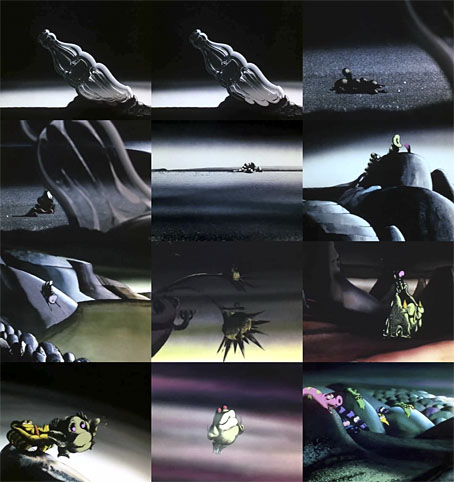
The one thing everyone remembers from Allegro Non Troppo is the Bolero sequence in which Bozzetto satirises Fantasia‘s evolutionary Rite of Spring. A departing spacecraft leaves a Coke bottle on the surface of a planet. The dregs left in the bottle give birth to a slime creature which crawls away and evolves along with Ravel’s music into a train of animals marching (and eating each other) across a treacherous landscape. The animation may lack Disney’s technical finesse but it’s a lot more memorable than his cartoon dinosaurs. Watch the whole sequence here.