Elliott Dold’s Night

dold01.jpg

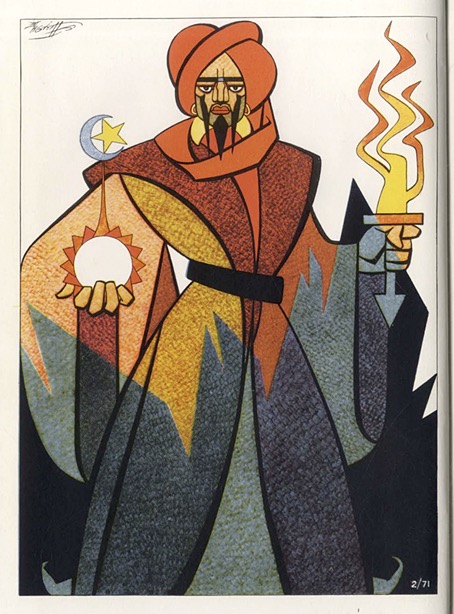
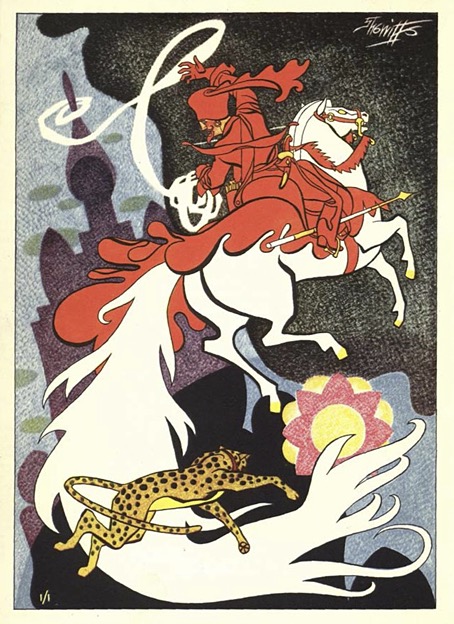
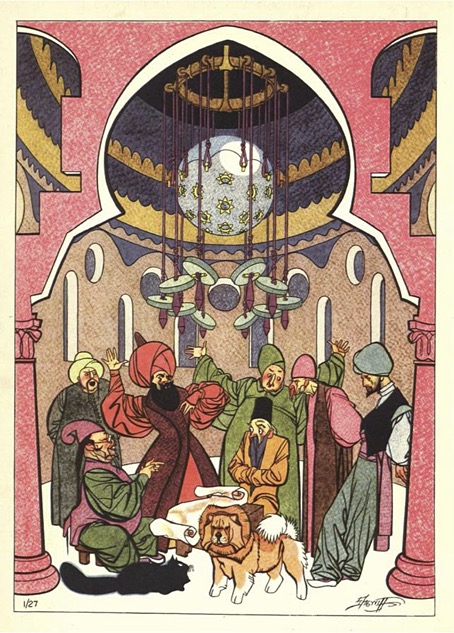
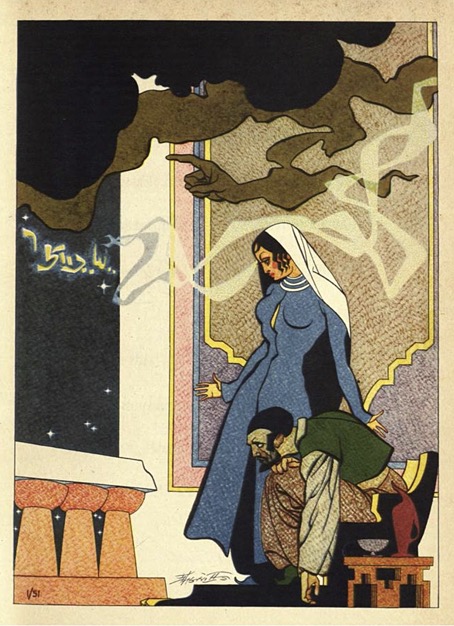
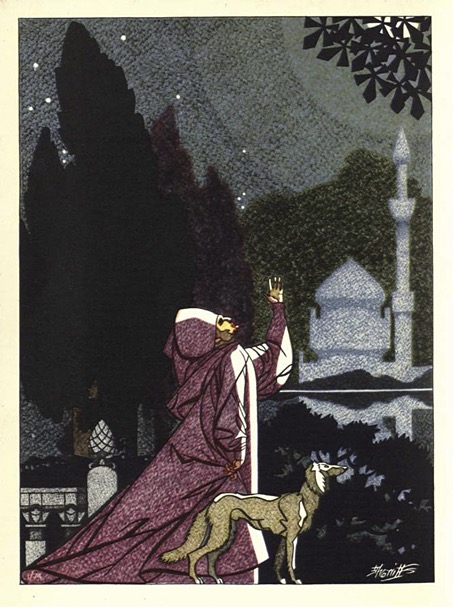
Looking for artwork by Elliott Dold turned up this remarkable set of illustrations for an unremarkable collection of poetry, Night, by a friend of the artist, Harold Hersey. Elliott Dold (1889–1957) was an American illustrator during the early days of the pulp magazines, best known today for drawings of huge machines which are a match for those by his more prolific contemporary, Frank R. Paul. The pulp magazines are so often filled with mediocre illustration that it’s a pleasure to find another talent lurking in their pages. But Dold was more than an illustrator of big science, as these illustrations for Hersey’s dubious poetry demonstrate.

dold02.jpg

Night is a collection of vaguely erotic poems, all of which Hersey labels “Nocturnes”. The collection was published in 1923 in a privately-printed subscriber-only edition, and every description I’ve read of it agrees that the illustrations are the best thing about it. The drawings are also radically different to Dold’s science-fiction art, to a degree that they could easily be taken for the work of a different illustrator. “What a pity the artist has to waste his time grinding out art for the pulps,” said HP Lovecraft, in a letter to Clark Ashton Smith. A pity, indeed. Dold’s illustrations are on a par with those that Wallace Smith was producing in the same year, and are close enough to Smith’s style that’s it’s tempting to accuse him of imitation. Smith’s style wasn’t unique, however; Ray Frederick Coyle was another American artist at work in the 1920s who favoured the same combination of strict black-and-white, careful linework and stylised figures. It’s curious that three books with somewhat controversial contents should have been published in the USA in 1922/23, all of them illustrated in a very similar manner: Ben Hecht’s Fantazius Malare (illustrated by Wallace Smith), James Branch Cabell’s new edition of Jurgen (illustrated by Ray Frederick Coyle), and Hersey’s Night. Rather than look for spurious influence I’d guess that this was a combination of coincidence and American literature acquiring a belated taste for Decadence which required suitably Beardsleyesque illustration. Similar trends were evident in cinema, especially in Alla Nazimova’s 1923 film adaptation of Oscar Wilde’s Salomé, where the costumes and settings were all based on Beardsley’s illustrations.

dold03.jpg

The images here are from a copy of the book at HathiTrust that’s another poor Google scan. The Hathi website isn’t as convenient for reading as the Internet Archive so I’ve downloaded all of the illustrations and, when necessary, cleaned the grey tone left by the scanner’s camera.

dold04.jpg

dold05.jpg

Continue reading “Elliott Dold’s Night”

Weekend links 798

atlantis.jpg

Atlantis (1971) by Bartolomeu Cid dos Santos.

• “Given the workaday settings of many of his movies (a hotel, a summer camp, a science fair), their mortal stakes may come as a surprise, or at least as a paradox—yet paradox is at the heart of his entire body of work.” Richard Brody explores the New Yorker roots of Wes Anderson’s The French Dispatch.

• “The power of the Kelmscott Chaucer is in how all the elements harmonise to create something visually spectacular.” Michael John Goodman on William Morris and his reinvention of book design.

• At Smithsonian Mag: “What actually sparks Will-o’-the-Wisps? A new study traces the science behind the mysterious, wandering lights“.

• At Dennis Cooper’s: A chronology of 26 things with Clive Barker’s name on them and what he thinks about that.

• At Wormwoodiana: The novels of Derek Raymond and the type of crime fiction he called “The Black Novel”.

• At Colossal: Untamed flora subsumes abandoned greenhouses in Romain Veillon’s Secret Gardens.

• At The Wire: Read an extract from James Tenney: Writings and Interviews on Experimental Music.

• The Strange World of…Mulatu Astatke.

• RIP Patricia Routledge.

The Garden (1981) by John Foxx | The Secret Garden: Main Title (1993) by Zbigniew Preisner | Secret Garden (2011) by Sussan Deyhim

Firebird, a film by Rein Raamat

varvilind1.jpg

There’s a Firebird of a different kind in this short film by an Estonian animator whose equally short Hell was featured here some time ago. Hell and Firebird are so stylistically opposed they look like the work of two different film-makers, although in the case of Hell this is a result of the film being based on the etchings of an Estonian artist, Eduard Wiiralt,  Firebird (1974) is simpler fare, another example of the cultural fallout from The Beatles’ Yellow Submarine, and a rather late one at that, not only in style but in the progress of its scenario.

varvilind2.jpg

Where The Beatles had Pepperland as a frozen monochrome world which has to be restored to life and colour by the Fab Four, Rein Raamat presents a monochrome city whose listless inhabitants are enlivened by the arrival in the sky of a giant coloured bird. The bird’s changing colours bring further life to the city itself; flowers and fountains burst forth, to the annoyance of a ferocious black cat who evidently preferred the earlier dispensation. As with any symbolic story made in the Soviet bloc, you can’t help but see this as a mirror for life in the world outside the cinema. Watch it here.

Previously on { feuilleton }
The groovy video look
Hell, a film by Rein Raamat
Tadanori Yokoo animations

Firebirds

bilibin.jpg

Ivan Tsarevich Catching the Firebird’s Feather (1899) by Ivan Bilibin.

The firebirds are those that you find on the covers of recordings of Stravinsky’s Firebird ballet score, or on its popular distillation, The Firebird Suite. The latter has long been one of my favourite pieces of classical music, in fact it was one of the first I owned, via a cheap vinyl pairing with The Rite Of Spring that was mainly of interest for being conducted by Stravinsky himself. The cover photo showed a ballerina as the Firebird in a ballet performance, a common choice for the covers of Firebird recordings.

firebird-1955.jpg

No artist/designer credited, 1955.

Much better was the cover of Tomita’s Firebird album (see below) which I bought around the same time, an uncredited tapestry design which is also a better album cover than the painting used on the earlier Japanese release. Depicting the Firebird itself is the other obvious choice when designing Stravinsky albums, and the dazzling, magical bird has helped this particular opus fare better in the world of classical album design than many other recordings.

firebird-1958.jpg

No artist/designer credited, 1958.

It’s easy to cast aspersions at the designers or art directors of classical records when you see an uninspired cover design, but the format presents a number of difficulties. There’s no such thing as a fixed design for a classical album because classical albums have no fixed form. With the exception of albums devoted to a single long composition most classical albums are compilations, pairing longer works with shorter ones, often by two or more composers. This confusion of identity creates problems for the designer, as does the huge quantity of classical releases. Then there’s the problems posed by the music itself which is so often abstract; you can’t “illustrate” The Goldberg Variations. The default choice is to use a painting or a drawing or a photograph of the composer as a cover image, or a photo of the conductor or performer. The easiest assigments, as these Firebird covers demonstrate, are albums based around a composition with a well-defined theme that can be depicted visually. Nobody has ever had a problem designing a cover for recordings of Debussy’s La Mer, for example, the only difficulty is deciding what picture of the sea you want to use.

firebird-1960-1.jpg

No artist/designer credited, 1960.

I’ve never had the impression that classical devotees care very much about these issues, it’s the music and the performance they’re interested in. Record labels (or their marketing departments) do seem to pay attention to visual matters now and then, and you’ll find occasional attempts to create a new line of themed covers. (The Orphic Egg series was one of the more bizarre examples from the 1970s.) Deutsche Grammophon have a history of decent cover design but even they resort to using photos of the artist or conductor far too often. I’ve never been asked to design a classical release, and I’m not sure I’d relish the task, but the problems raised by the form fascinate me. This is a subject I’ll no doubt keep returning to.

firebird-nd2.jpg

Irma Seidat, no date.

Continue reading “Firebirds”

Weekend links 797

robertson.jpg

Bloomsbury Roofs (no date) by J. Elspeth Robertson.

• “Lud Heat and Suicide Bridge…are only offshoots of a huge central corpus of mad experimental writing, prose and poetry and just research notes. Pages and pages and pages of this lunacy.” Iain Sinclair describing to Robert Davidson the genesis of his influential poem/book Lud Heat. Related: Serious houses: The Lud Heat Tapes.

• At Criterion Current: Deeper into Robert Altman, a look at five lesser-known films from the director’s expansive filmography. Good to see Quintet receiving some attention, a science-fiction film that’s not without flaws but is still closer to the written SF of the 1970s than the decade’s box-office hits.

• Among the new titles at Standard Ebooks, the home of free, high-quality, public-domain texts: Short Fiction, by Charles Beaumont.

• Mix of the week: Ambient Focus 26.06.21 by Kevin Richard Martin aka The Bug.

• At the BFI: Rory Doherty chooses 10 great films set in 1970s America.

• At Colossal: Frédéric Demeuse’s photos of ancient forests.

• RIP Claudia Cardinale and Danny Thompson.

• New music: If the Sun Dies by Greg Weeks.

• The Strange World of…Rafael Toral.

Silver Forest (1969) by Organisation | A Forest (1980) by The Cure | A Forest In The Sky (2024) by Hawksmoor