Alexander McQueen, 1969–2010

mcqueen1.jpg

“He was a Brothers Grimm of fashion, enchanting and captivating the audience with the most incredibly beautiful clothes, only to make their stomachs lurch with the underlying menace that shot through his work. Because every show contained outfits designed to thrill, shock – and catch the eye of picture editors – many people never realised that much of McQueen’s work was, quite simply, heart-stoppingly gorgeous: exquisite tailoring, beautifully sculpted dresses and glorious print.”
Jess Cartner-Morley. (More.)

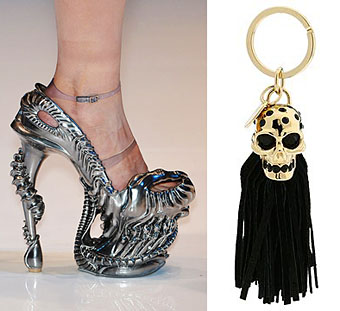
Butterfly-print dresses (how fitting for Darwin Day), Giger-style shoe designs, skull key chains… Yes, Alexander McQueen was something special.

Guardian obituary | Independent obituary

mcqueen2.jpg

Passage 12

passage12.jpg

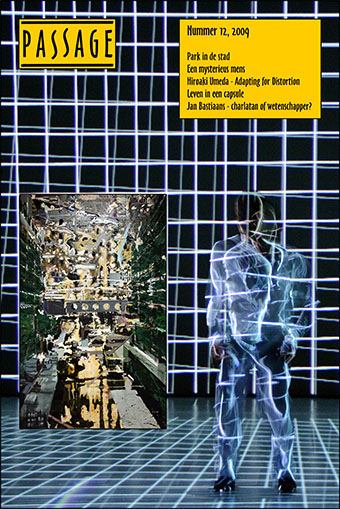
Ed Jansen writes again to notify me that the latest number of his web magazine, Passage, is now online, about which he says:

In Passage nr. 12 there are articles about a 17th century garden in The Hague, about the mysterious visit to The Hague by the Comte De Saint Germain. Was he really a enlightened man or a fraud? If you’re an occultist you’ll tend to believe the first, the historian thinks otherwise. Then there are the photos of the dancer and performer Hiroake Umeda. Strange movements underlined by light-effects. Living in a Capsule is a combination of the paintings by the Dutch artist Tjebbe Beekman and the work of J.G. Ballard. Lastly there is an article about Jan Bastiaans, the doctor who experimented with LSD to ‘free’ the victims of the concentration camps of the nightmares and repressed memories.

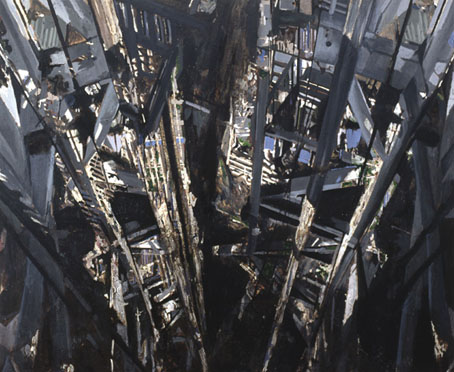
Once again the text content is in Dutch but that doesn’t exclude all visitors here. I hadn’t come across the work of Tjebbe Beekman before. His paintings of urban desolation are indeed a good match for one aspect of Ballard’s work, and they make an interesting contrast with Dick French’s earlier views of the author’s Drowned World.

beekman.jpg

Trust by Tjebbe Beekman (2005).

Previously on { feuilleton }
Drowned Worlds
Passage 11
Passage 10

Betty Blythe

blythe1.jpg

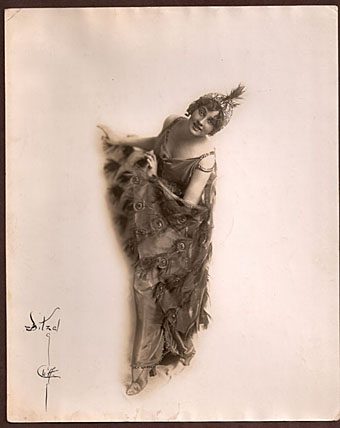
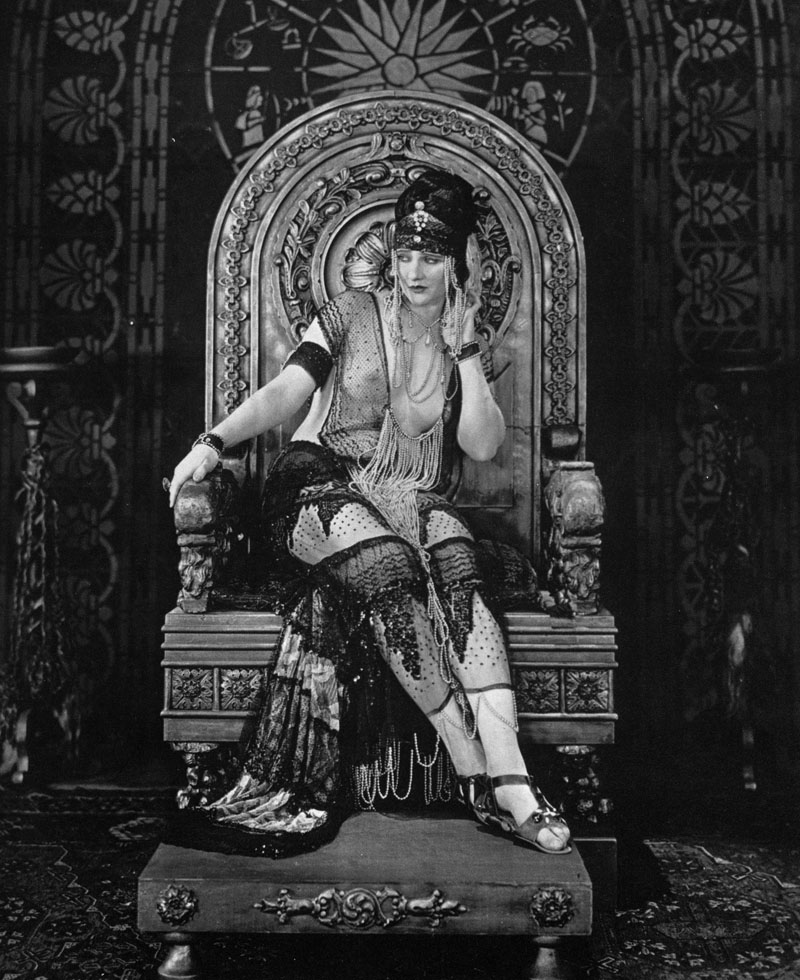
Yesterday’s search for Betty Blythe pictures turned up this pair which I couldn’t resist posting, with Ms. Blythe posed against a peacock in the first and wearing a peacock-styled outfit in the second. As I’ve noted before, silent films are very often like Symbolist paintings come to life, and The Queen of Sheba (1921) would appear to be another of these which makes its loss all the more disappointing. The photo below is from a Flickr set whose user has her own Tumblr blog of silent movie stars.

blythe2.jpg

Previously on { feuilleton }
The Mask of Fu Manchu
Salomé posters
Ruth St Denis
The Feminine Sphinx
Lussuria, Invidia, Superbia
Alla Nazimova’s Salomé

The Mask of Fu Manchu

fumanchu1.jpg

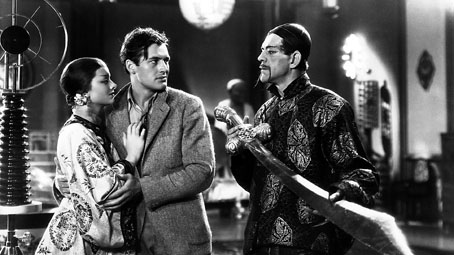
Myrna Loy, Charles Starrett and Boris Karloff.

Los Alamos ranch school where they later made the atom bomb and couldn’t wait to drop it on the yellow peril. The boys are sittin’ on logs and rocks eating some sort of food there’s a stream at the end of a slope. The counsellor was a southerner with a politician’s look about him. He told us stories by the camp fire culled from the racist garbage of the insidious Sax Rohmer. “East is evil, west is good.”

William Burroughs

More pulp, and yes, it’s still racist garbage but Charles Brabin’s 1932 film which stars Boris Karloff as Sax Rohmer’s Oriental super-villain has its pleasures if you look past the severely dated attitudes. Together with The Black Cat (1934), where Boris plays a Satan-worshipping Modernist architect (!), this is one of the best non-Frankenstein Karloff films of the 1930s, as I was reminded this weekend when re-watching it along with several Sherlock Holmes episodes.
fumanchu2.jpg

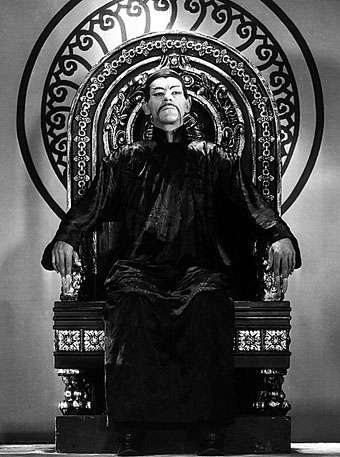
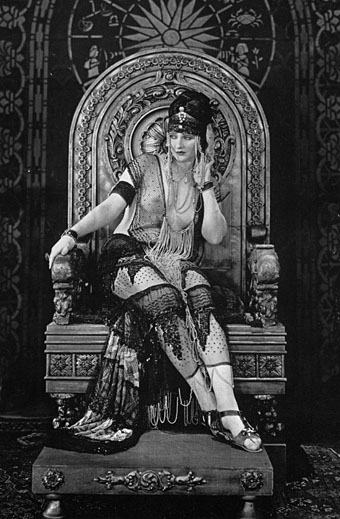
Christopher Lee is elegantly diabolical in the later Fu Manchu films but their cheap budgets force him to skulk around in dismal underground lairs. Karloff’s Doctor has a lavish Art Deco pad whose huge rooms are furnished with a noisy Van de Graaff generator and other scientific apparatus, plus a series of torture rooms where his guests may endure death by encroaching spikes (the “Slim Silver Fingers”), being lowered into an alligator pit, or driven mad by the incessant tolling of a giant bell. I happened to notice that the Doctor’s throne is quite possibly the same one (with a fresh coat of paint) as was used a decade earlier by a notoriously unclad Betty Blythe in The Queen of Sheba (1921), a lavish silent epic which is now unfortunately lost.
sheba.jpg

Betty Blythe as the Queen of Sheba.

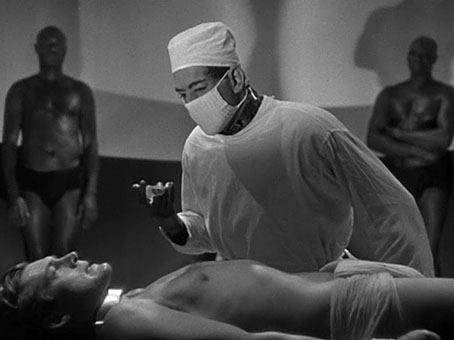
The flaunting of Ms. Blythe’s breasts were one of the many occurrences which led to Hollywood’s adoption of the Hays Code in the 1930s, although the Code’s full effects weren’t felt until later in the decade. The notable scene in The Mask of Fu Manchu where hunk Charles Starrett appears strapped to a table dressed in nothing but a skimpy loin cloth (having previously been thrashed by Fu’s lustful daughter) would have been toned down considerably had the film been made a few years later. All the more reason to watch it today, such scenes only add to the fun.
fumanchu3.jpg

The Doctor prepares to inject his captive with a serum which will turn the man into a compliant slave.

The Mask of Fu Manchu | A page about the original serial, the subsequent novel and its illustrators.

Previously on { feuilleton }
Wladyslaw Benda