Weekend links 808

kometen.jpg

Comets from Meyers Konversationslexikon (1885–90).

• At The Daily Heller: Steven Heller reviews A Life in Ink, a new monograph about the art of Ralph Steadman. Heller is full of praise for Steadman, and discusses commissioning his work for The New York Times. But in his bewilderment at Steadman’s lack of a knighthood he seems unaware of the degree to which state honours are frequently refused by Britons, especially those who position themselves in opposition to the established order. Americans are obsessed with awards and “halls of fame”, and appear to regard Britain’s state honours as something like the Oscars with a royal seal, rather than what JG Ballard once described as “a Ruritanian charade that helps to prop up the top-heavy monarchy.” If Steadman has deliberately shunned the honours list he’d be joining a venerable company.

• “In mid-19th century Italy, two eccentric aristocrats set forth on parallel projects: constructing ostentatious castles in a Moorish Revival style. Iván Moure Pazos tours the psychedelic chambers of Rochetta Mattei, optimised for electrohomeopathic healing, and Castello di Sammezzano, an immersive, orientalist fever dream.”

• New music: Ithaqua by Cryo Chamber Collaboration is this year’s installment in the Lovecraft-themed album series (previously) from Cryo Chamber. Also this week: Analog 2025 by Various Artists; and Flux (music for a performance by still still / Marta & Kim) by Rutger Zuydervelt and Lucija Gregov.

For all their bravura and maximalism, Powell and Pressburger understood the power of leaving things out, building into their films chasms that the mind must leap, gaps that the imagination must fill. Like Joan Webster, we discover that we don’t want things to be made too easy. We want to catch our own fish rather than have them delivered, to swim in the ocean rather than in a pool.

Imogen Sara Smith on I Know Where I’m Going, one of the films from Michael Powell and Emeric Pressburger’s golden decade, the 1940s

• Among the new titles at Standard Ebooks, the home of free, high-quality, public-domain texts: In the Days of the Comet by HG Wells.

• At the BFI: David Parkinson selects 10 great Sherlock Holmes films and TV adaptations.

• Winning entries for the Capture The Atlas Northern Lights Photographer of the Year.

• Books and original drawings by Austin Osman Spare on sale at Gerrish Fine Art.

• At Unquiet Things: The art of Chie Yoshii.

Kohoutek-Kometenmelodie (1973) by Kraftwerk | Cometary Wailing (1981) by Bernard Xolotl | Kometenmelodie Part 1 (1994) by 300,000 VK
Weekend links 272

sage.jpg

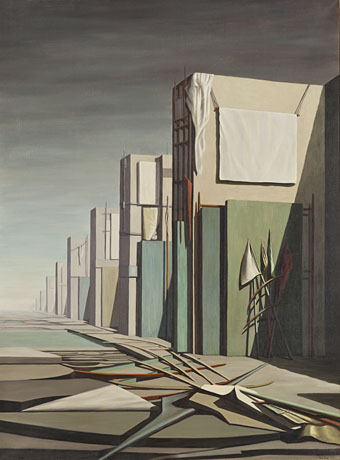
No Passing (1954) by Kay Sage.

• More Lovecraftiana: She Walks In Shadows, an illustrated all-woman Lovecraftian anthology, will be published in October. Related: “The octopus genome and the evolution of cephalopod neural and morphological novelties“, a study that’s been filtering through the press as “Do octopuses have alien DNA?”

• “The right to ‘subject each others’ fundamental beliefs to criticism’ is the bedrock of an open, diverse society,” says Kenan Malik in his TB Davie Memorial Lecture.

Sunn O))) with Attila Csihar at the Berlin Heimathafen. Related: Here’s what you missed at Sunn O)))’s sold out Berlin gig.

Caillois is fascinated by these “beveled buildings,” truly abundant in the Fifteenth, along with an unusually high incidence of blind walls, false façades, and merely ornamental windows, each beloved of his phantoms. In the parts of the arrondissement developed during the postwar period, Caillois’s attention is drawn instead to the ventilator shafts and drainage grates that dot the streets. These structures, built to clear away rainwater or aerate underground garages, have a secret function, according to him. Noting their uncanny similarity to some of the settings in the Weird Tales of HP Lovecraft, he speculates that they may have been constructed to provide the entry points for an extraterrestrial invasion of our planet.

Ryan Ruby on Roger Callois and the phantoms of the Fifteenth Arrondissement

• “I’m really into big moments,” says Julia Holter whose new album, Have You In My Wilderness, is released next month.

Adrian Utley talks to Peter Zinovieff, co-inventor of the EMS synthesizer. Related: What the Future Sounded Like.

• “Tarkovsky’s Solaris is the anti-2001: A Space Odyssey,” says Marissa Visci.

• Mix of the week: Gizehcast #17 by Rutger Zuydervelt.

Modernist architecture on film.

Thaumaturgy at Tumblr

The Call of Ktulu (1984) by Metallica | Cthulhu Dawn (2000) by Cradle of Filth | Cthulhu: A Cryo Chamber Collaboration (2014) by Various Artists

Machinefabriek in Manchester

machine1.jpg

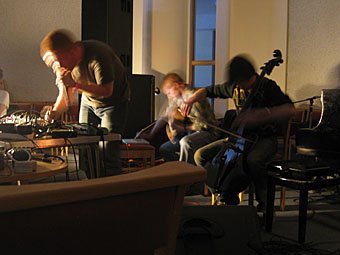
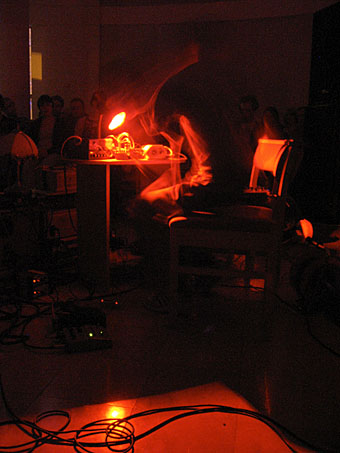
The Bacon-esque blur is Machinefabriek, aka Rutger Zuydervelt from the Netherlands, performing this evening at the Cross Street Chapel with Xela and friends. Events I’ve seen here before have been predominantly acoustic so it made a change to see something where the balance was shifted in favour of electronics or the electronic processing of acoustic sources. The chapel is a good, intimate venue, with seating in the round.

xela.jpg

Xela (above) played first, comprising John Twells (Mr Type Records, left) with an amended line-up featuring Danny Saul on guitar and laptop with Greg Haines on cello and the chapel’s own piano which he proceeded to treat in a distinctly secular fashion. These three set the tone for the evening, starting quietly and harmoniously then working into an accumulated frenzy of noise. Type Records are one of the best labels around at the moment, all their releases (and, it should be said, those of these artists) are worth checking out.

There was a break from the noise with Soccer Committee, who aren’t a group of Eindhoven footballer managers but a young woman named Mariska Baars. Mariska plays very quiet (and very good) songs on guitar and it’s a shame that most of her pieces were so short. I didn’t get any photos as she was playing in near dark and rapt silence from the audience.

wouter.jpg

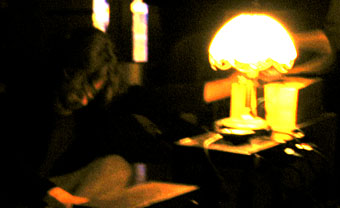
Next up was Wouter Van Veldhoven (above) playing a Stratocaster guitar through a variety of what looked like synth modules topped by an antique table lamp. One can’t help but speculate whether any German musicians (including my sainted Robert Henke) would dare to have such an anacronistic item near their gear.

machine2.jpg

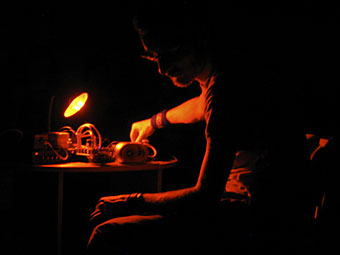
And so to Machinefabriek, an artist who releases a bewildering amount of limited edition CD-Rs, mostly on his own label. Mr Zuydervelt sat before his tiny table and proceeded to produce a quite incredible array of sounds from an electric guitar and what looked like effects pedals and electric egg-timers (and a pan-scourer…?). As with Xela, the sounds proceeded from melodic ambience to noise, in this instance great sheets of harmonic distortion which—like all the best noise performances—became deliriously overwhelming. Brilliant, compelling stuff, and it’s a shame he didn’t play for longer. After this, Wouter and Mariska returned and the three quickly launched into an improvised coda. A great evening.

Previously on { feuilleton }
Helios in Manchester
Music on Cross Street