Picturing Dorian Gray

dorian1.jpg

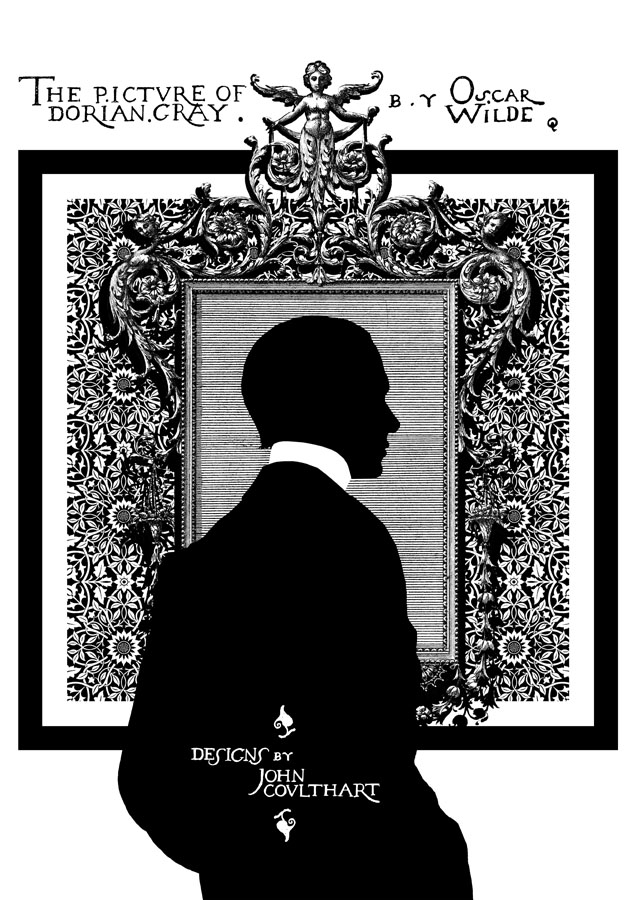
It’s taken a while but here at last are some of the pages from my series of illustrations based on The Picture of Dorian Gray, as featured in volume 2 of The Graphic Canon (“The World’s Great Literature as Comics and Visuals”) edited by Russ Kick. I agreed with Russ not to run everything so there’s some incentive to buy the book (or books…there are three volumes altogether). Now I’ve seen the printed edition the whole project seems even more remarkable: 500 large illustrated pages in a variety of media and art styles. Volume 2 runs through the 19th century and ends with my contribution; I opted to do this story in black-and-white but there’s colour used throughout the books. I especially like the Moby-Dick sequence by Matt Kish, a very different take on a very familiar tale.

As with many of the things I’ve been doing recently I opted for adapting materials of the period. Since I have a lot of Oscar Wilde-related reference material I was able to go further and incorporate details that relate directly to the book and Wilde’s life. All the text is taken from a scan of the first printing of the novel at the Internet Archive, the title lettering being drawn originally by Wilde’s friend, publisher and illustrator Charles Ricketts. A heavy black square on each page provides some continuity as well as resembling the frames of comic pages. (Or a picture frame.) The silhouette on the opening page is another of Wilde’s friends, the writer Max Beerbohm, taken from a drawing by William Rothenstein. The pair were dandyish Café Royal regulars throughout the 1890s.
dorian2.jpg

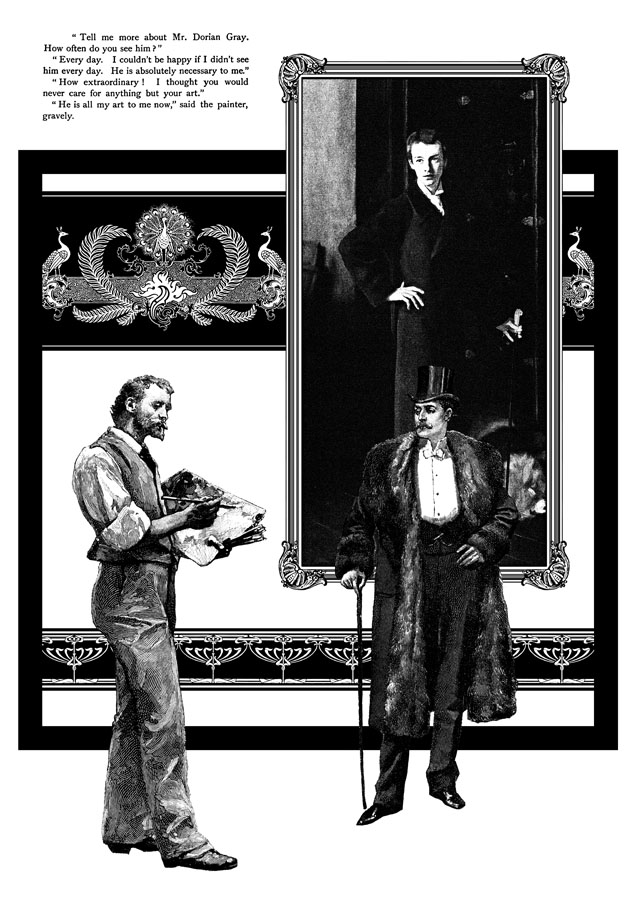
This is my favourite page. I liked the way the composition came together and also enjoyed being able to use John Singer Sargent’s portrait of W. Graham Robertson as the picture of Dorian. I’ve noted in an earlier post the similarity between this painting and the portrait seen in the BBC’s adaptation of the novel by John Osborne. Robertson was a theatre designer and illustrator who Wilde consulted when planning stage designs for what would have been the London debut of Salomé. Robertson was also (so far as we know) homosexual which adds an extra resonance.
dorian3.jpg

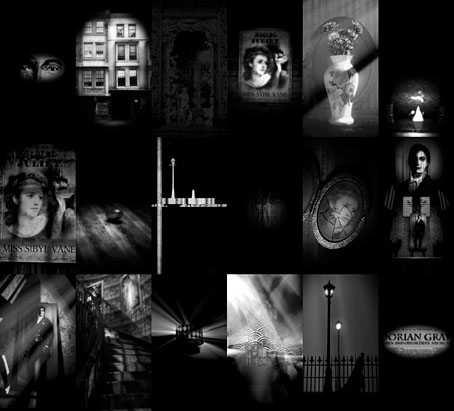
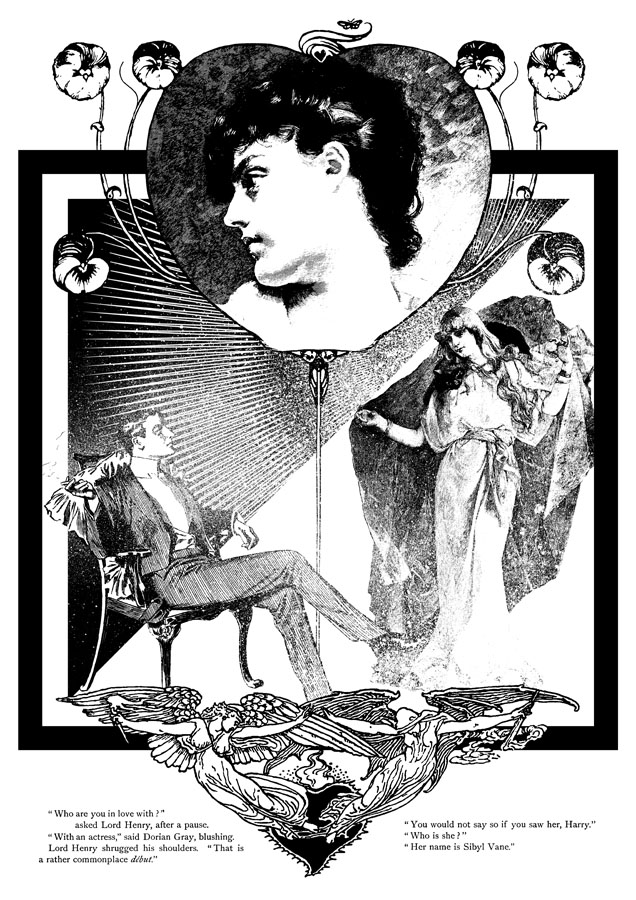
The Sibyl Vane page: a combination of details from The Studio, The Strand and The Magazine of Art. The motif at the foot of the page is by Walter Crane. Nothing of Wilde’s appeared in The Strand but that magazine’s most popular writer, Arthur Conan Doyle, had his second Sherlock Holmes adventure, The Sign of Four, commissioned at the same dinner that saw the commissioning of Dorian Gray, both novels being published by Lippincott’s Monthly Magazine in 1890.
dorian4.jpg

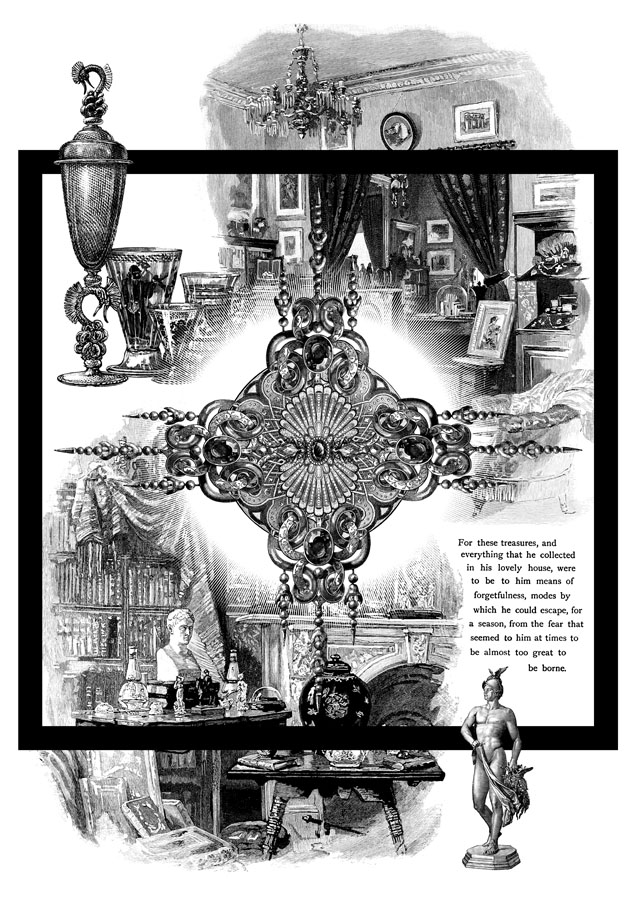
A page depicting Dorian’s distracting obsession with jewels and luxurious goods. This chapter can seem somewhat superfluous unless seen in the light of Wilde’s intention to write something like Huysmans’ À rebours (1884).
dorian5.jpg

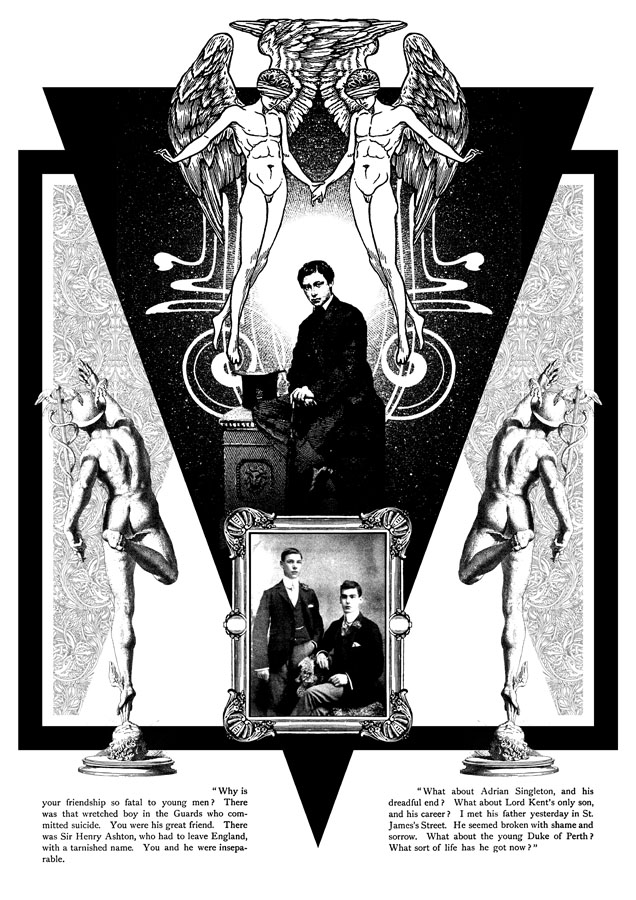
The “Love that dare not speak its name” page. This makes explicit the subtext of the book although if you read the two paragraphs I selected it’s evident enough why Dorian is causing a problem for so many young men. The blindfolded Eros was a drawing by Walter Crane which I doubled then re-drew slightly so the pair were holding hands. The boy below is a picture from The Strand of the young Edward VII, a robust heterosexual in later years but with a son, Prince Albert Victoria, who became linked to the notorious Cleveland Street Scandal which involved a male brothel catering to aristocrats. The two young men in the picture frame are described as a pair of “panthers” in Neil McKenna’s The Secret Life of Oscar Wilde (2003), by which he means that they were fin de siècle rent boys (as in Oscar’s remark about “feasting with panthers”); McKenna doesn’t give any further details about the photo but it suited the picture.

In addition to this series of illustrations, volume 2 of The Graphic Canon includes two of my Lewis Carroll illustrations in a section by different artists based on the Alice books. I’d be recommending The Graphic Canon even if I wasn’t a contributor, as I said above it’s a remarkable achievement. Watch out for it.

Elsewhere on { feuilleton }
The Oscar Wilde archive

Wildeana #8

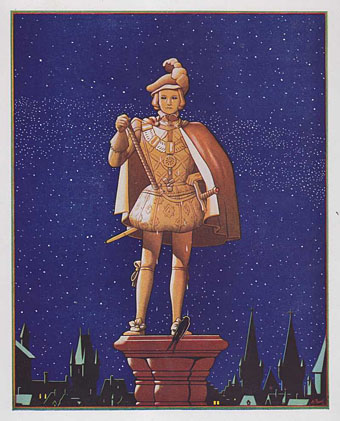
happy.jpg

Illustration by H. Paul.

Continuing an occasional series.

Front Free Endpaper has illustrations by one H. Paul from a “talking book” adaptation of Wilde’s The Happy Prince. This was a hardcover volume published in 1948 which came with a 78rpm vinyl disc containing a recording of the story by BBC newsreader Frank Phillips. Callum found the reading on YouTube. By coincidence I discovered this week that Klaus Kinski recorded some of Wilde’s stories in 1959, German versions of The Happy Prince (again) and The Selfish Giant, and also a reading of The Young King.

Wilde is strikingly prophetic in his denunciations of what he describes here as “authoritarian socialism”.  He says again that in the present state of affairs, at least some men with the advantages of privilege manage to find themselves, to realise their potential “If the Socialism is authoritarian; if there are governments to be armed with economic power as they are now with political power; if, in a word, we are to have industrial tyrannies, then the last state of man will be worse than the first.”  At least some can have freedom now, in this state, no-one would at all. Wilde sees no virtue at all in the equitable distribution of misery.  The collectivism of compunction which existed in Soviet Russia or Mao’s China was precisely the nightmare scenario he was warning against. It seems clear though that Wilde actually thought the sheer unattractiveness of this made it unlikely. “I hardly think any Socialist, nowadays, would seriously propose that an inspector should call every morning to see that each citizen rose up and did manual labour for eight hours”.  He may have ‘hardly thought’ it, but at the same time Wilde wrote this there were plenty of socialists who had just such a vision in mind – and sadly their type were to proliferate, and in some areas to predominate. No wonder that The Soul of Man was an inspiration to many revolutionaries rebelling against the Tsars of Russia, but was later suppressed and banned by Stalin himself.

Ben Granger takes a lengthy and perceptive look at The Soul of Man Under Socialism (1891), an essay of Wilde’s that seldom receives the same degree of attention as his other works.

• “As the weeks have gone by, it’s become clear to my actors that Dorian is the work of a much darker – more radical, and more modern – writer than the flippant genius we’re all so familiar with.” So says Neil Bartlett whose new stage production of The Picture of Dorian Gray is currently running at the Abbey Theatre, Dublin.

• A recipe for Oscar Wilde Strawberry Champagne cocktails? Yes, please.

Elsewhere on { feuilleton }
The Oscar Wilde archive

In the Key of Blue by John Addington Symonds

symonds1.jpg

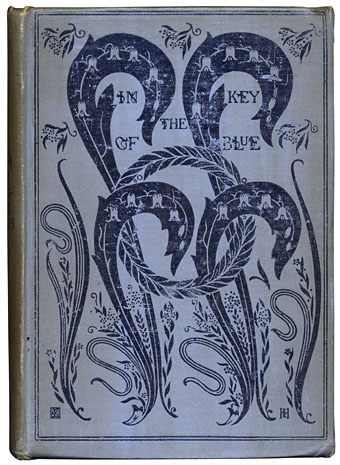
I probably overspent a little on this charity-shop purchase, the third edition (published 1918) of In the Key of Blue by John Addington Symonds (1840–1893), a personal selection of writings first published in 1893. First edition copies sell for over a thousand pounds so this was an opportunity to acquire something close to the original without breaking the bank. The book is significant for two reasons: on a decorative level the cover design is one of my favourites by book designer (he preferred the term “book builder”) Charles Ricketts. The first editions have the design blocked in gold on cream cloth (below); a few copies were made with blue cloth but Ricketts apparently changed the colour after worrying that reviewers would joke about “Reckitt’s Blue” a popular laundry product. The contraposed curves of the leaf shapes pre-empt the Art Nouveau style which only started to emerge a year or two later.

symonds2.jpg

The other notable feature of Symonds’ book is its being one of the more outspoken manifestations of the author’s advocacy for what he called “a man’s love for a man”. Symonds was a pioneer of what are now called gay studies: in addition to accurately translating the love sonnets of Michelangelo which previous translators had heterosexualised, his 1873 study A Problem in Greek Ethics sought to show 19th-century readers that the Ancient Greek culture they so admired had an indisputable history of same-sex relationships running through its core. This was only one side of Symonds’ work but it was an admirably continual thread. I often think of Symonds and Oscar Wilde as twinned in this respect: Wilde made frequent use of Greek attitudes as a justification for his views on love; both men had to perform a careful balancing act, trying to advocate the unacceptable without drawing too much attention to their own proclivities. If Wilde was the public advocate for Uranian desire then Symonds was a kind of think-tank man, labouring behind the scenes to bring to light the historical precedent. Finally, both men were connected by Charles Ricketts, a friend of Wilde’s who designed and illustrated a number of Wilde’s early editions.

In the Key of Blue was published in the last year of Symonds’ life by which time much of his previous equivocations had been abandoned. In homoerotic terms it’s far more out of the closet than pre-trial Wilde ever dared to be. The title piece is a poem which presents eight studies of an unnamed “you”, a figure seen by the poet in various Venetian settings, painted in a range of colours with blue as the dominant tone. I have the poem in another book; taken alone as it is there it seems mildly homoerotic—the ecstatically observed subject is obviously male—but remains ambiguous enough for any subtext to be a matter of interpretation. In the collected edition Symonds adds additional text that picks apart the poem, explaining the origin of each setting. Thus we learn that the mysterious “you” is a 19-year-old Venetian porter named Augusto whom the author had befriended. The explanatory paragraphs discuss the artistic intent of the poem, its depiction of contrasted tones and colours, while the circumstantial details quietly remove all the ambiguity from its paean to male youth.

Elsewhere in the book, there’s a discussion of male love among the Greeks, culled from Symonds’ earlier researches, then in Clifton and a Lad’s Love, written thirty years earlier, we have another piece of alternating poetic verse and prose description. Part seven of the poem could hardly be less equivocal:

I saw a vision of deep eyes
In morning sleep when dreams are true:
Wide humid eyes of hazy blue,
Like seas that kiss the horizon skies.

Then as I gazed, I felt the rain
Of soft warm curls around my cheek,
And heard a whisper low and meek:
“I love, and canst thou love again?”

A gentle youth beside me bent;
His cool moist lips to mine were pressed,
That throbbed and burned with love’s unrest:
When, lo, the powers of sleep were spent;

And noiseless on the airy wings
That follow after night’s dim way,
The beauteous boy was gone for aye,
A theme of vague imaginings.

Yet I can never rest again:
The flocks of morning dreams are true;
And till I find those eyes of blue
And golden curls, I walk in pain.

Anyone wishing to read In the Key of Blue can find most of Symonds’ work online. Project Gutenberg has all his major texts available while the Internet Archive has a scan of the 1918 edition, albeit in slightly better condition than my copy.

Elsewhere on { feuilleton }
The book covers archive

Previously on { feuilleton }
Greek games
Charles Ricketts’ Salomé
Achilles by Barry JC Purves
Der Eigene: Kultur und Homosexualität
Charles Ricketts’ Hero and Leander

The art of Guido Reni, 1575–1642

reni01.jpg

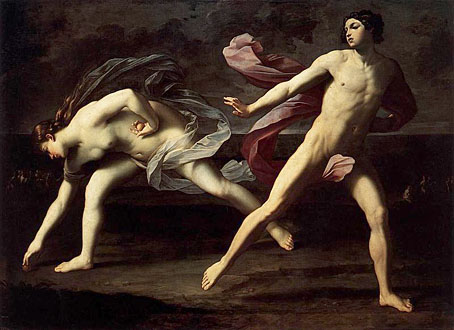
Atalanta and Hippomenes (c. 1612).

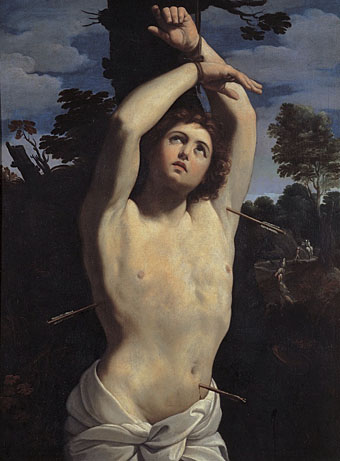
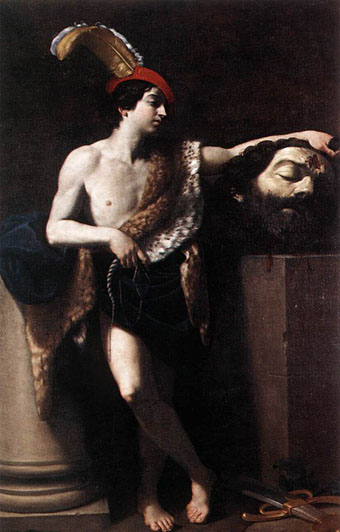
More golden apples appear in this painting by Guido Reni, not the most famous ones in art history—those would be all the Apples of Discord seen in the various Judgements of Paris—these are the fruit of the sacred tree in the Garden of the Hesperides which Hippomenes drops to prevent Atalanta from beating him in a race. The object of interest here isn’t the apples but the near-naked male, a favourite subject for Baroque artist Guido Reni whose work strikes viewers today as significantly homoerotic. This interpretation is by no means a recent one: Oscar Wilde was famously smitten with Reni’s depiction of Saint Sebastian (below) when he saw the painting in Genoa; in the 20th century the same painting (or one of Reni’s other Sebastians) excited the 12-year-old protagonist in Yukio Mishima’s novel Confessions of a Mask. Here’s what GLBTQ has to say about Reni:

Given the fierce homophobia prevailing in Europe during the Baroque era, historians seeking to reconstruct the lifestyles and works of queer artists often have to depend upon undocumented anecdotes and innuendoes.

Utilizing this type of evidence (including rumors about his supposed disdain of women, his possible romantic involvement with his long-time assistant, his interest in cross-dressing, and his “delicate” mannerisms), recent scholars interpret Guido Reni (1575–1642) as a gay artist.

The disdain of women is referred to in an earlier account, as are other pertinent details:

He was accustomed to paint with his mantle about him, gathered gracefully over his left arm. His pupils, of whom he had a great number—at one period no less than eighty, drawn from nearly every nation of Europe—vied with each other to serve him, esteeming themselves fortunate to have opportunities to clean his brushes or to prepare his palette. He had no dearth of models in the multitude of youths and disciples which surrounded him; but all that Guido cared of them was to refresh his memory by viewing their limbs and torsos, and after that he could adjust them and correct their imperfections.

In the same way any head sufficed him for a model. Being once besought by Count Aldovrandi to confide in him who the lady was of whom he availed himself in drawing his beautiful Madonnas and Magdalens, he made his color-grinder, a fellow of scoundrelly visage, sit down, and commanding him to look upward, drew from him such a marvelous head of a saint that it seemed as if it had been done by magic. Better than any other artist he understood how to portray upturned faces, and boasted that he knew a hundred ways of making heads with their eyes lifted to heaven. He often declared that his favorite, models were the ‘Venus of Medici’ and the wonderful heads in the Niobe group.

He was always in great fear of sorcery and poisoning, and for that reason could not endure women in his house, abhorring to have any dealings with them, and, when such were unavoidable, hurrying them through as rapidly as possible. Old women were his especial detestation, and he always fled from them, and lamented grievously if one of them should appear when he was about beginning or closing some commission.

From Guido Reni (1903)

That’s one way of either justifying your misogyny or explaining to the neighbours why your house is full of young men with no women.

reni10.jpg

Saint Sebastian (1615).

Speculation about the sexuality of artists from past centuries seldom leads anywhere but it can be a fun parlour game, provided you take accounts like the one above with a pinch of salt. In Reni’s case you’d have to point to the many paintings where a religious subject is used as the merest pretext for some shirtless male pulchritude. This was a common ploy in other areas of art: landscape painting evolved as a genre in its own right when post-Renaissance artists began to shrink the religious figures who were the ostensible subject of their commissions into the corner of a field or the shadows of a valley; the imagination could be given free rein by the expedient of painting an apocalypse or a Temptation of St Anthony.

Reni lets loose his temperament by returning to a range of religious subjects that happen to feature attractive youths. Even his picture of Sacred Love defeating Profane Love (below) shows a divine figure who seems to represent more of the libido than the subject should require. Elsewhere he follows Caravaggio with a youthful John the Baptist preaching in the wilderness in an almost total state of nature. Reni’s angels are some of the most androgynous figures you’ll find in Baroque painting; the model for his very girlish Archangel Gabriel also appears as Jesus in another painting, raising a somewhat scandalous implication as to the real paternity of Christ.

reni07.jpg

David with the Head of Goliath (1605).

The following selection of paintings is a prejudiced choice, of course. Some of these can be seen at a much larger size at the Google Art Project. Frivolous speculation aside, at his best Reni could be very good indeed as in this superb portrait of Saint Matthew with another androgynous angel. It’s no surprise to read that his work was in great demand throughout his life.

Continue reading “The art of Guido Reni, 1575–1642”

Thomas Beg’s Dorian Gray

dorian.jpg

Oscar Wilde’s story in this adaptation is shortened to a very brisk eight minutes which utilises 3D animation and makes some smart use of period photos. The film was an animation project by UCA Rochester student Thomas Beg who also has a brief rendering of Hieronymus Bosch’s Garden of Earthly Delights here.

The collage approach for Dorian Gray caught my attention since it’s not far removed from the collage style I used when adapting the story myself for the forthcoming second edition of The Graphic Canon. My version was in part a formal challenge which tried to use materials from Wilde’s time that also relate in some way to Wilde himself. More about that later. Thomas Beg’s version owes something to Albert Lewin’s 1945 film adaptation, especially in its views of the portrait, but it’s distinctive enough to stand alone. Watch it here.

Elsewhere on { feuilleton }
The Oscar Wilde archive