Harry Clarke’s Elixirs of Life

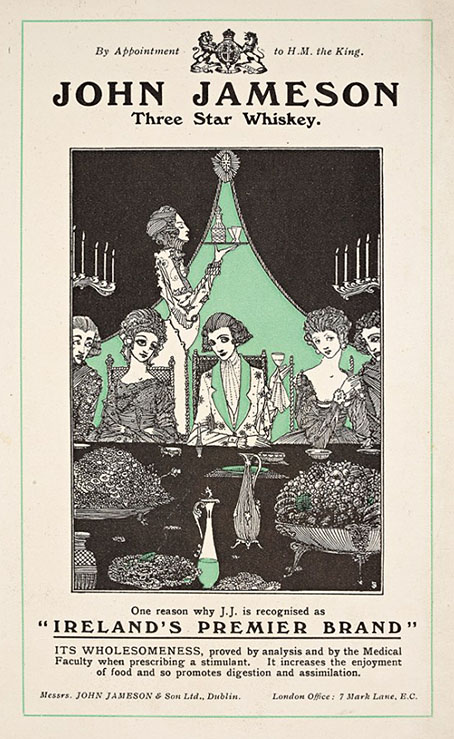
jamesonad.jpg

A magazine ad.

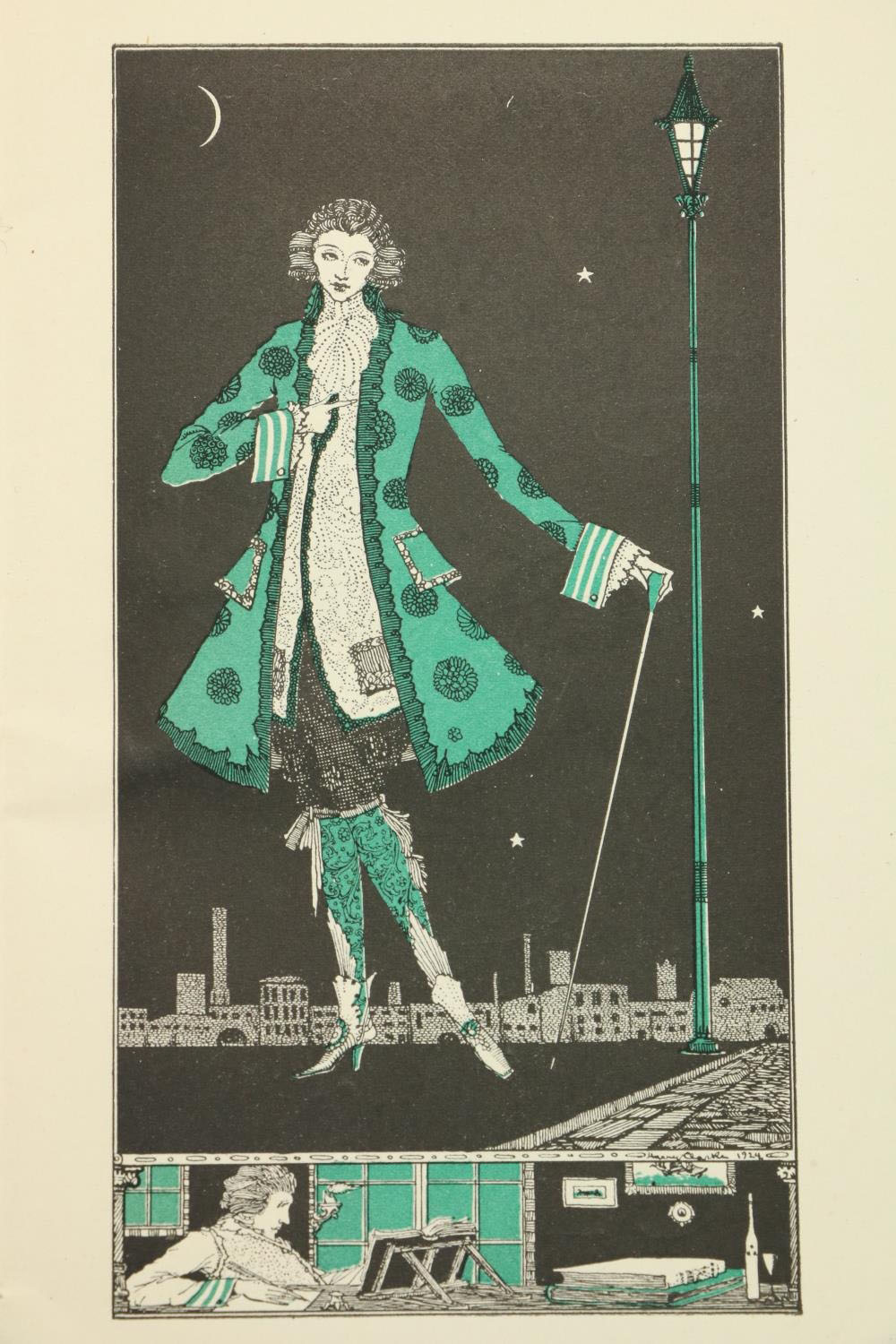
Of all the books illustrated by Harry Clarke the most scarce are a pair of slim volumes published 100 years ago by the Jameson distillery to promote their brand of Irish whiskey. The books were never widely distributed, being given away to distillery visitors. Copies of the illustrations were still hard to find in 2011 when I wrote a brief post about them. Collections of Clarke’s work seldom pay the books much attention beyond reproducing one or two drawings but by trawling the auction houses it’s now possible to accumulate most of the illustrations. With the ongoing interest in Clarke’s work I keep expecting Jameson to publish facsimile reprints but so far this doesn’t seem to have happened. The information below is taken from Harry Clarke: His Graphic Art (1983) by Nicola Gordon Bowe. A couple more illustrations from The History of a Great House may be found in Hiroshi Unno’s exceptional study, Harry Clarke – An Imaginative Genius in Illustrations and Stained-glass Arts.


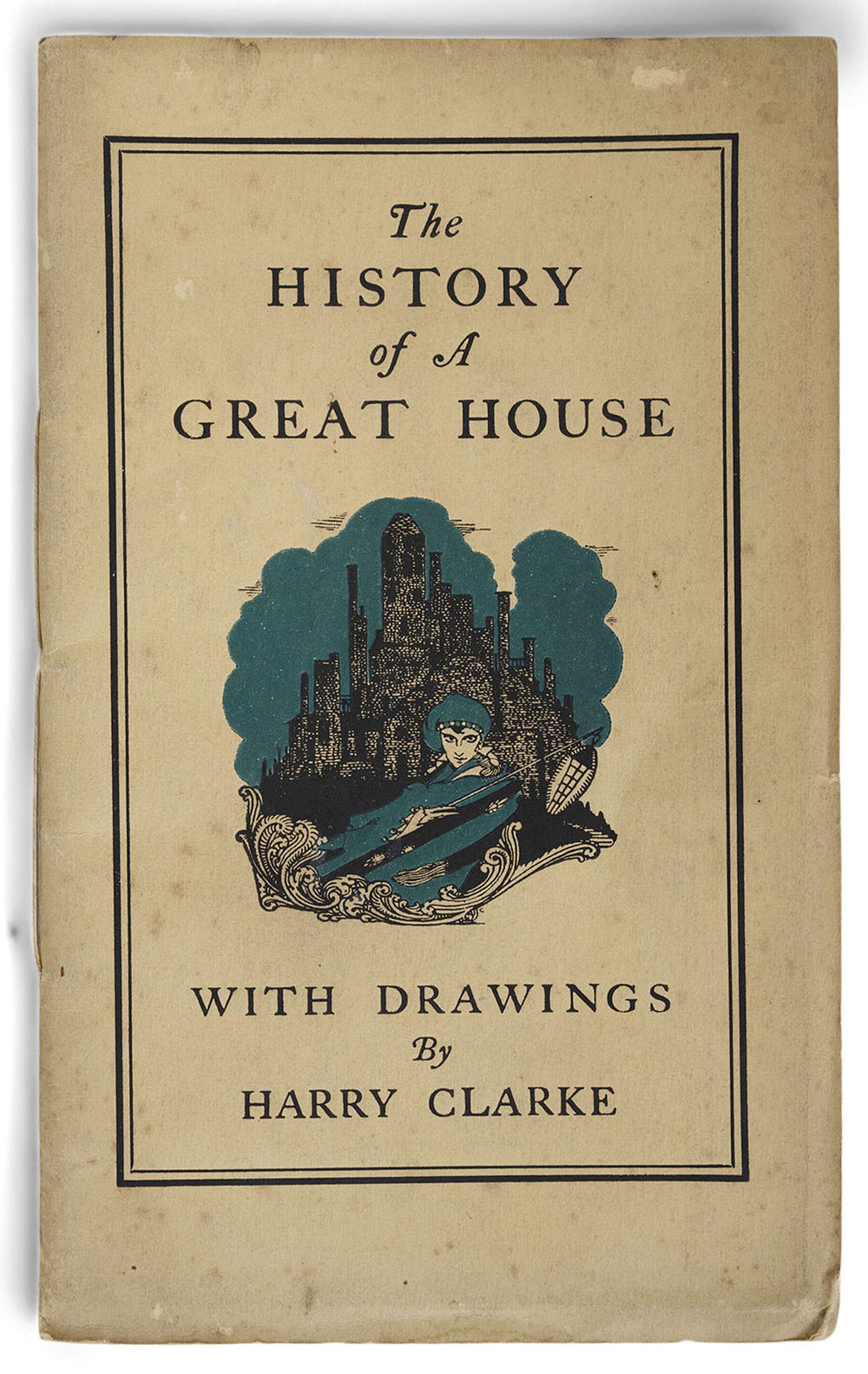
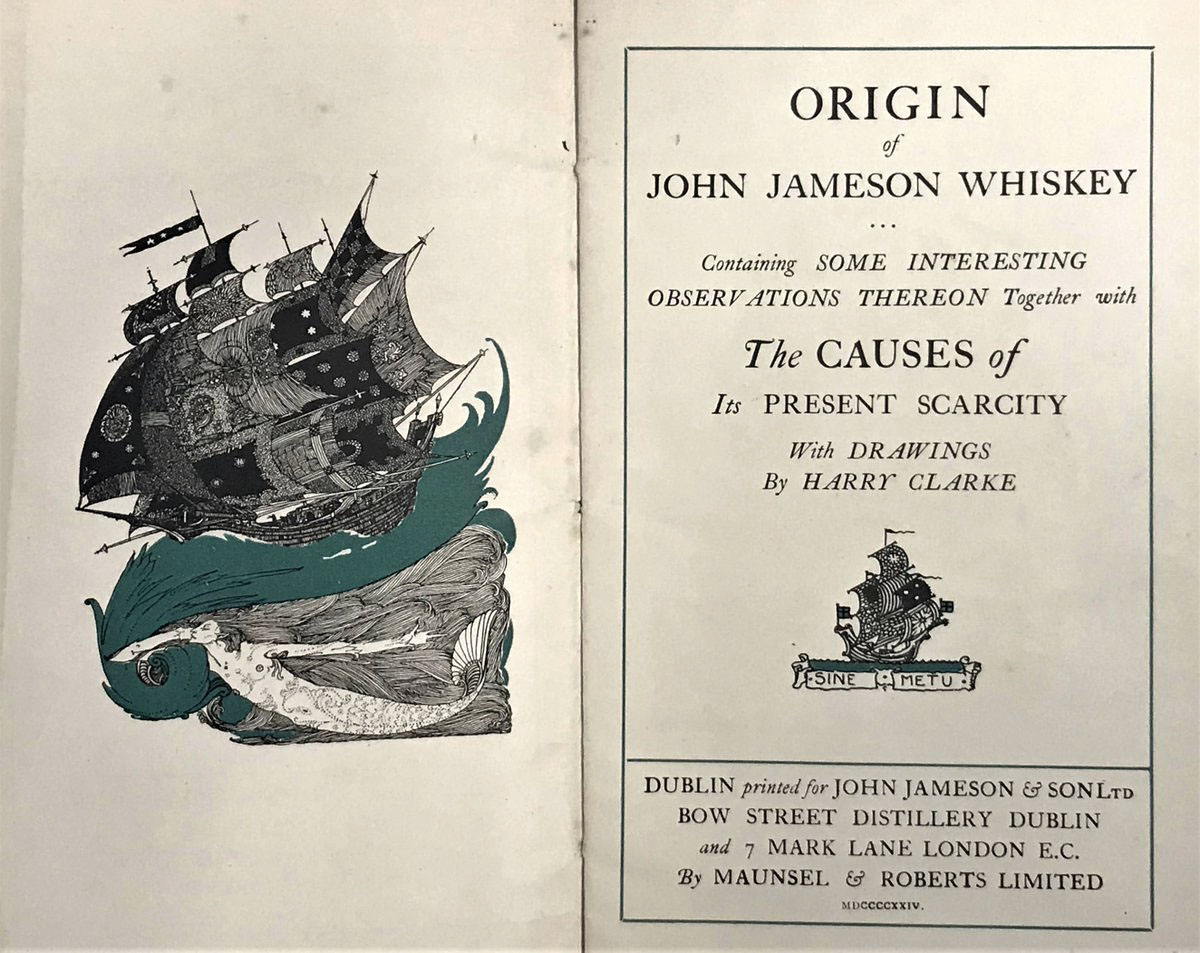
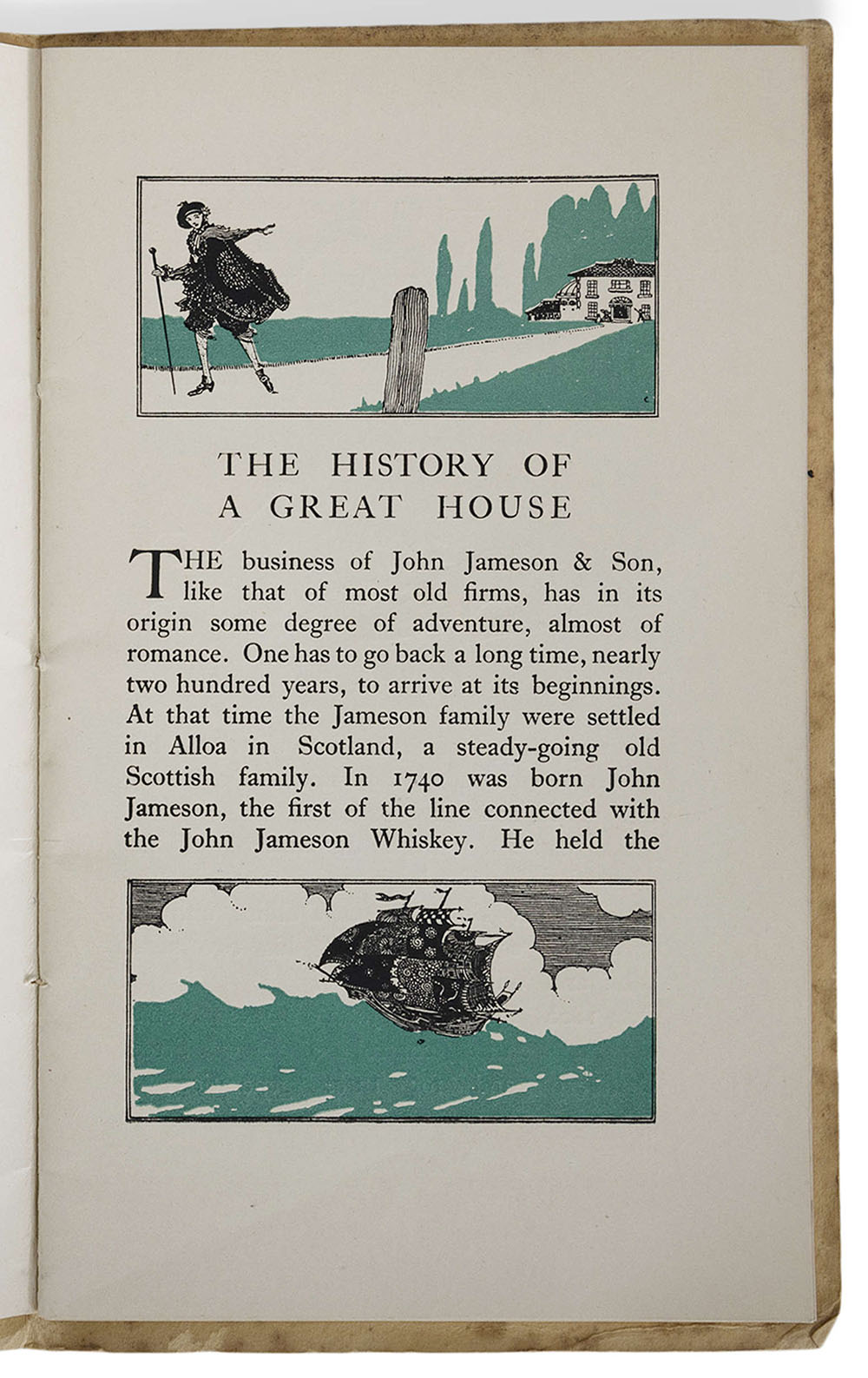
The History of a Great House — Origin of John Jameson Whiskey, containing some Interesting Observations thereon together with the Causes of Its Present Scarcity. Printed by Maunsel and Roberts Ltd, Dublin 1924 for the distillers; 24 pp, 8 x 4.75 inches, 21 black line drawings blocked in with viridian, one repeated as an endpiece, custard paper cover (8 x 5 inches), printed with additional black and viridian drawing.

jameson-history01.jpg

jameson-history02.jpg

jameson-history03.jpg

jameson-history04.jpg

Continue reading “Harry Clarke’s Elixirs of Life”

Fire in the Blood: Harry Clarke

clarke1.jpg

An all-too-short run through the biography of Harry Clarke, Fire in the Blood was made by Irish TV channel RTE in 2016 as part of a series devoted to the Celtic Revival. Camille O’Sullivan is the guide to Clarke’s life and work in a film which includes some commentary from Clarke expert Nicola Gordon Bowe, among others. 24 minutes isn’t enough time to cover the full range of the artist’s work but any Clarke documentary is better than none, and this one has a number of points in its favour. Clarke’s stained-glass windows are given a prominent place in the discussion, a reminder that stained-glass production was Clarke’s primary business even while his success as an illustrator increased. The stained-glass medium is an especially attractive one for a TV documentary—the colours of the windows glow on the screen in a manner they can never do on a page—and you could easily fill an hour with a discussion of Clarke’s remarkable glasswork alone. The end of the film includes some discussion about the scandal of Clarke’s last major work in the medium, the so-called Geneva Window, commissioned by the Irish government as a gift for the League of Nations then disowned when Clarke’s choice of subject (and the manner of its depiction) was deemed unsuitable. As with earlier objections to the work of Aubrey Beardsley, the complaints seem scarcely credible today but the window ended up being sold to an American collector.

clarke2.jpg

On the illustration side we get to see pages from a little-known work of Clarke’s, the frame designs for the pages in Ireland’s Memorial Records, a multi-volume record of the names of Irish soldiers who died in the First World War. Nicola Gordon Bowe’s Clarke studies show the title page but seeing all the frames in print wasn’t possible until the publication of Harry Clarke’s War by Marguerite Helmers. The silhouettes of the soldiers embedded in each frame form a sequential narrative describing the progress of the war amid knotted borders that hark back to the page designs of the Book of Kells.

Elsewhere on { feuilleton }
The illustrators archive

Previously on { feuilleton }
Harry Clarke’s illustrated Swinburne
More Harry Clarke online
Harry Clarke online
Harry Clarke record covers
Thomas Bodkin on Harry Clarke
Harry Clarke: His Graphic Art
Harry Clarke and others in The Studio
Harry Clarke’s Fairy Tales of Charles Perrault
Harry Clarke in colour
The Tinderbox
Harry Clarke and the Elixir of Life
Cardwell Higgins versus Harry Clarke
Modern book illustrators, 1914
Illustrating Poe #3: Harry Clarke
Strangest Genius: The Stained Glass of Harry Clarke
Harry Clarke’s stained glass
Harry Clarke’s The Year’s at the Spring
The art of Harry Clarke, 1889–1931

Harry Clarke’s illustrated Swinburne

clarke30.jpg

Aholibah (1928).

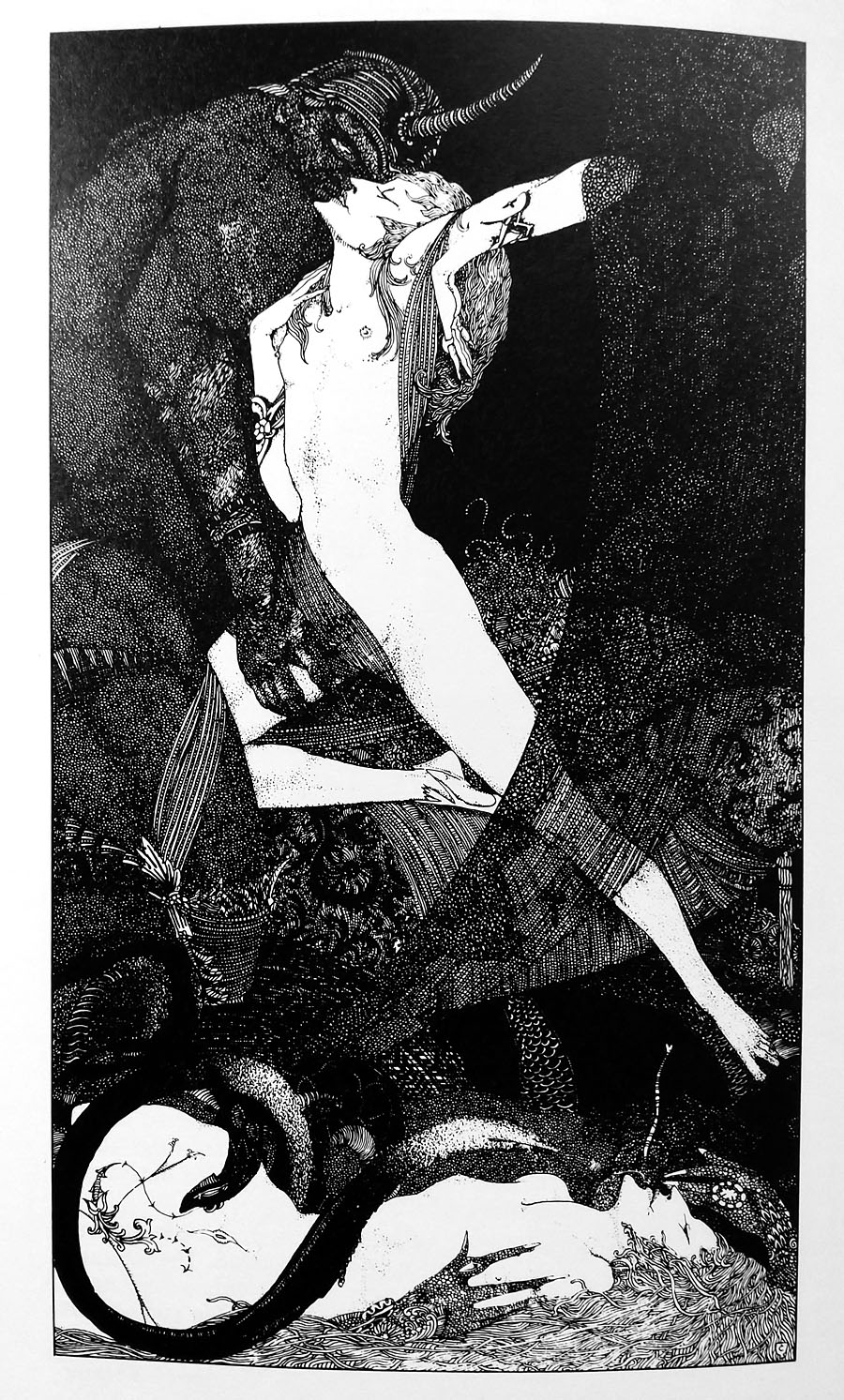
You won’t find Harry Clarke’s illustration for Swinburne’s Aholibah in Selected Poems of Algernon Charles Swinburne even though it was intended for the book, and was the illustration that Clarke deemed his favourite of the series. The erotic nature of the drawing was too much for the publisher so Clarke had to content himself by pasting a reproduction in his own copy. The copy above has been scanned from Nicola Gordon Bowe’s Harry Clarke: His Graphic Art; everything below is from the published Swinburne collection which turned up recently at the Internet Archive.

clarke01.jpg

Selected Poems of Algernon Charles Swinburne was Clarke’s last illustrated book, published in 1928, three years before his untimely death. Of all the major Clarke books that appeared during the artist’s lifetime it’s always been the most difficult to find. Some of the drawings have been reprinted in recent collections but never the book itself. As with Clarke’s Faust, the erotic and morbid qualities of the illustrations generated disquiet outside the publisher’s office, with Humbert Wolfe in the book’s introduction stating that Clarke’s interpretations were completely opposed to his own. Given the erotic and morbid preoccupations of the poet and his work this surprises me; Swinburne’s poetry was admired by Aleister Crowley and HP Lovecraft, among others. They weren’t reading him because he was writing paeans to daffodills.

clarke02.jpg

My earlier mention of this volume included a link to a defunct blog with a collection of the illustrations separated from the text. This was unavoidable at the time, there wasn’t anywhere else that you could see all of them in one place. But seeing the illustrations with the poems benefits the drawings as well as the verse, especially when the poems themselves aren’t so familiar. For my part it’s also good to see all of the illustrations, being the owner of a first edition which I bought many years ago only to discover that a couple of the best pictures had been carefully removed with a razor. This is a common problem with old illustrated books. Caveat emptor as always.

clarke29.jpg

Clarke didn’t do many double-page illustrations. This is one of his best.

clarke05.jpg

Continue reading “Harry Clarke’s illustrated Swinburne”

The Golden Hind: A Quarterly Magazine of Art and Literature

golden01.jpg

Well, here we are at last… After years of waiting for scanned copies of The Golden Hind to turn up, now that they have done I’m still frustrated. The magazine was one of the many small arts periodicals being published in Britain during the 1920s. It had an erratic, eight-issue run from 1922 to 1924, and remains notable for being the second (and last) magazine to be co-edited by Austin Osman Spare. The artist’s first magazine venture, Form, had been edited by Spare and “Francis Marsden” (Frederick Carter), with the pair publishing two issues before the outbreak of the First World War, followed by a final issue in 1921. Spare co-edited The Golden Hind with writer Clifford Bax, creating a publication whose contents were less mystical than Form had been, while also providing more of a showcase for artists other than Spare himself.

golden02.jpg

Inevitably, it’s the artists that interest me the most in The Golden Hind, even though the magazine was running pieces by writers like Aldous Huxley and Edith Sitwell. Many of the artists have been featured here before, some of them on many occasions: Alastair (Hans Henning Voigt), John Austen, Harry Clarke, Garth Jones, Henry Keen, and Allan Odle. Spare’s own drawings have since been recycled in various books but most of the other drawings, woodcuts, linocuts and prints remain exclusive to the magazine. The John Austen contributions are especially fine, further examples of his decorated style which borrows heavily from Aubrey Beardsley and Harry Clarke, and which he used so well in his illustrated Hamlet. The spirit of Beardsley’s 1890s is very much in evidence in The Golden Hind, a demonstration, perhaps, that Spare was once again looking back to The Savoy magazine as an example to be followed; one of the essays concerns the poety of The Savoy‘s literary editor, Arthur Symons.

golden03.jpg

In addition to artists whose popular works are still reprinted today there are less well-known figures like Sidney Hunt whose drawings owed more to contemporary trends than many of the other contributors. Hunt later edited an avant-garde magazine of his own, Ray, while producing his own brand of homoerotic prints like the Ganymede with Zeus which may be seen in The Golden Hind’s final issue.

golden04.jpg

The frustration I referred to above is my usual complaint about image quality. All the copies of the magazine have been taken from microfilm archives which means the pages aren’t grey enough to be illegible but their general murkiness is enough to destroy a lot of the artwork, especially the lithographs and other prints. The samples you see here have been brightened a little which does improve some of the line art but can do nothing for the rest. But I’m not going to complain too much. It’s taken a long time to be able to browse a complete run of this magazine, and I feel fortunate to do so even in this compromised manner. Better copies may still surface eventually. Fingers crossed.

golden05.jpg

Continue reading “The Golden Hind: A Quarterly Magazine of Art and Literature”

Harry Clarke: His Graphic Art

clarke1.jpg

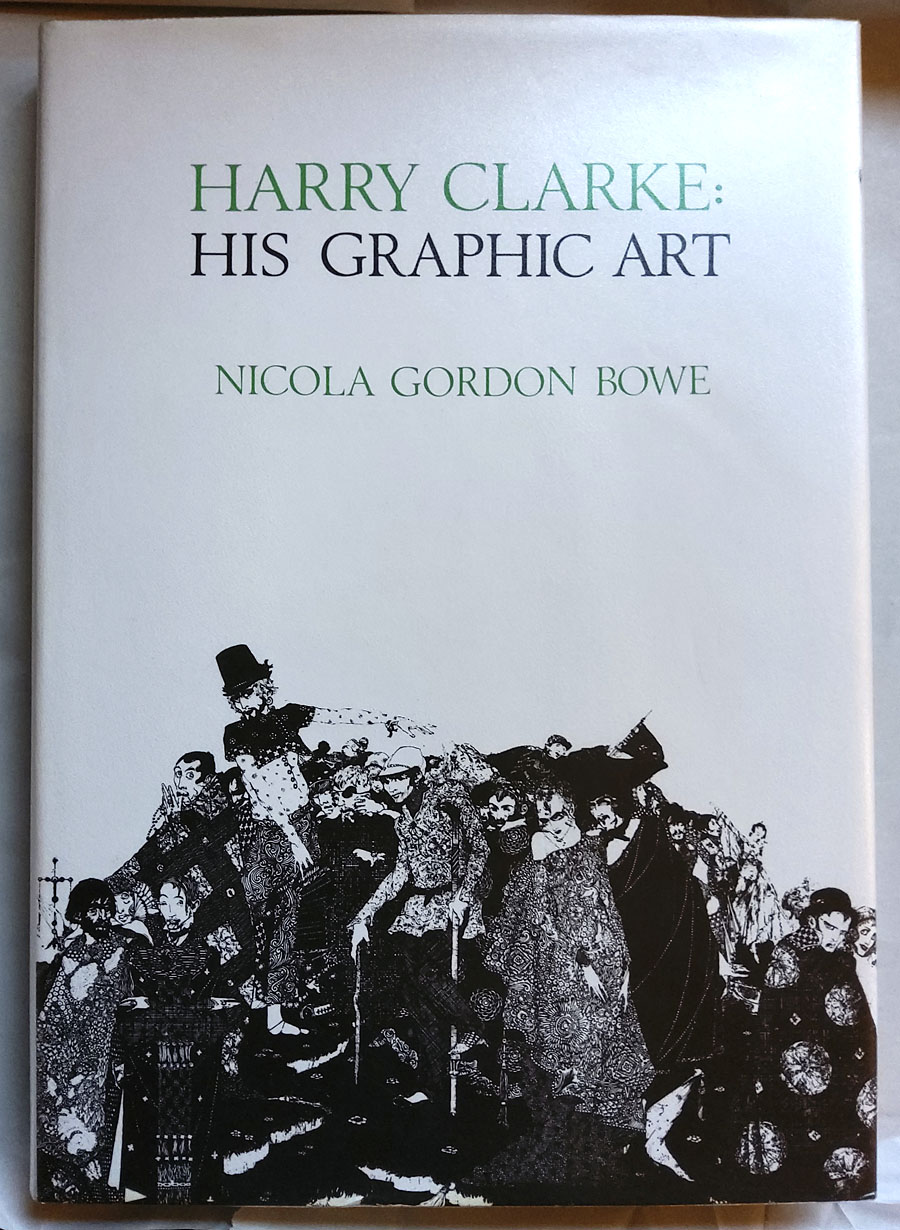
In today’s post, the Ur-text of Harry Clarke studies by the late Nicola Gordon Bowe. The book was published by Ireland’s Dolmen Press in 1983, and is difficult to find in fine condition for under £50; I was fortunate on both counts. In addition to a detailed biography the book contains many drawings for magazines and smaller publications which have seldom been reproduced elsewhere, together with works like the illustration below, intended for the Clarke-illustrated edition of Swinburne’s poetry but suppressed by the publisher. File next to The Life and Work of Harry Clarke (1989), Nicola Gordon Bowe’s continuation of the scholarship begun here.

clarke2.jpg

Elsewhere on { feuilleton }
The illustrators archive

Previously on { feuilleton }
Harry Clarke and others in The Studio
Harry Clarke’s Fairy Tales of Charles Perrault
Harry Clarke in colour
The Tinderbox
Harry Clarke and the Elixir of Life
Cardwell Higgins versus Harry Clarke
Modern book illustrators, 1914
Illustrating Poe #3: Harry Clarke
Strangest Genius: The Stained Glass of Harry Clarke
Harry Clarke’s stained glass
Harry Clarke’s The Year’s at the Spring
The art of Harry Clarke, 1889–1931