Chess players

chess10.jpg

Chess Problem 25 (13th century), from El Libro de los Juegos.

Chess-playing in art. Some of it, anyway. I hadn’t realised until I went searching for examples how many paintings there are of people playing chess. The prompt for this was my current reading, The Flanders Panel, a novel from 1990 by the Spanish author Arturo Pérez-Reverte. Arturo likes his art mysteries, as you’ll know if you’ve read The Club Dumas, an excellent novel that was reworked for cinema as The Ninth Gate. The chess game in The Flanders Panel is the subject of a painting by a fictional Flemish artist, Pieter Van Huys. Pérez-Reverte presents a biography of the artist and the three people depicted in the painting, with special attention given to the game of chess which gives the painting its title, a game which may or may not provide clues to a 15th-century murder mystery. Pérez-Reverte describes the painting itself in detail; Julia, the main character is a picture restorer so the descriptions extend to physical materials. Some of the novel’s cover designs have attempted to depict Van Huys’s picture, with unsuccessful results. There’s also a 1994 film adaptation, Uncovered, which I haven’t yet seen.

chess06.jpg

The Chess Player (no date) by Isidor Kaufmann.

I’ll admit to not having thought very much about chess-playing in art until the conversation in the novel turned to the subject of the painted game, and the question of whether or not the position of the pieces had anything to say about the people in the picture. (Pérez-Reverte helpfully includes a diagram that shows the layout of the board.) There’s no reason why a game of chess shouldn’t be used for semiotic reasons even if this is only to indicate the power relationship within a picture by making one party the dominant player. Given the ease with which this can be done I’d guess there are many such examples that use the game to communicate something about the players beyond the fact that they enjoy playing chess. If you’re painting a chess game you’re always going to be faced with the question of how you position the pieces, a problem that leads in turn to decisions about who should be shown to be winning or losing via the number of pieces and their placement on the board. Western art is replete with pictorial symbolism involving animals, plants, birds, colours, and so on; if the very old and very familiar game of chess is added to the symbolic repertoire then we’re left to decide which paintings are using the game for incidental reasons, and which have something more to communicate.

chess09.jpg

An Interesting Problem (no date) by Adolphe-Alexandre Lesrel.

In making a picture selection I’ve looked for paintings that clearly show the position of the pieces on the board, as well as those which depict the game with some accuracy. It becomes apparent when you examine many paintings on this subject that some artists don’t seem too familiar with the details of the game, a common error being the mispositioned board. This could also have a symbolic meaning, of course, but I’ll leave that question for others to explore. As a final note, Marcel Duchamp had a thing for chess.

chess05.jpg

Ein schwieriger Zug Öl auf Holz (no date) by Albert Joseph Franke.

chess11.jpg

Die Schachspieler (Faust und Mephisto) (1834) by Moritz Retzsch.

Continue reading “Chess players”

Minotaure, 1933–1939

minotaure35.jpg

Art by Diego Rivera for the Mexican supplement in Minotaure no. 13.

I was tempted to title this one Minotaure! since I’ve been searching for copies of the magazine in question for many years. I’m certain I went looking in all the usual sources last year in the run-up to the Surrealist centenary, without success. Anyway, here they all are at last, a complete run of one of the major Surrealist periodicals.

Minotaure was notable for a number of reasons, first among them the publisher, Albert Skira, whose resources enabled the production of a very desirable item, with good design, colour prints in each issue, and plenty of photos and other artwork throughout. The Surrealist publications of the 1920s had been historically important but all of them were monochrome documents with few pictures and few pages. Minotaure had the production values of a quality magazine and an impressive roster of artists and writers to fill each issue. Skira and editor E. Tériade originally intended their periodical to cover a wide range of art, past and present, but with most of the early contributors being members of André Breton’s Surrealist circle the magazine quickly became a showcase for Surrealist art and theorising. The first issue featured a cover by Pablo Picasso, with more Picasso artwork inside. Subsequent issues had covers by leading Surrealist artists–Dalí, Ernst, Magritte, Masson–which captured the movement at a time before Breton’s persistent expulsions hollowed out the original group. Breton writes in nearly all the issues but was forbidden from using Minotaure as a political platform (the previous Surrealist journal had been the very political Le Surréalisme au service de la révolution), a restriction he kept to. His manner was often dictatorial but he always had an eye for the main chance, or the bonne chance in this case.

The written contents of Minotaure are mostly in French but the pictorial matter is worth seeing even if much of it is very familiar today. Among the written highlights are two essays by Salvador Dalí, the first on the “edible” nature of Art Nouveau architecture, with an emphasis on the work of Gaudí; the second about Pre-Raphaelite painting. It’s understandable that Dalí would be attracted by the meticulous realism of early Millais and William Holman Hunt but I didn’t know his essay included an analysis of Hunt’s The Hireling Shepherd, a painting I look at every time I’m in the Manchester Art Gallery. Elsewhere there are articles about automatism, mediumship, the decalcomania technique in painting, the esoteric symbolism of the alchemists, naive or untutored art, and plenty of single-page items and visual novelties. Photography by Man Ray and Brassaï is a recurrent feature. Skira’s magazine established a template which the two American Surrealist periodicals of the 1940s, View and VVV, did their best to follow. Now that Minotaure is freely available I’ll be waiting impatiently for complete runs of its followers to turn up somewhere.

(Note: some of the copies linked below have had their colour prints removed.)


Minotaure no. 1 (1933)

minotaure01.jpg

Cover art by Pablo Picasso.

minotaure02.jpg

minotaure03.jpg


Minotaure no. 2 (1933)

minotaure04.jpg

Cover art by Gaston-Louis Roux.

Continue reading “Minotaure, 1933–1939”

First Papers of Surrealism, 1942

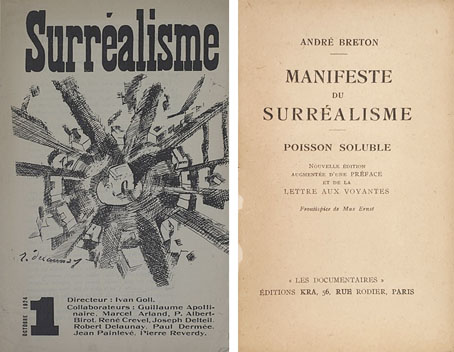
surrealisme.jpg

As I was saying a couple of weeks ago, Surrealism will be 100 years old this year, if you mark the movement’s birth from the first manifestoes (there were two different ones) published in October 1924. Surrealism doesn’t really have a definite beginning, however, either in 1924 or earlier on; the movement evolved over several years, with different factions competing for followers while squabbling over intentions. After a great deal of ferment the manifestoes from the opposed groups led by Yvan Goll and André Breton were a declaration that something substantial had been happening that required definition. I’m not sure why all of this interests me as much as it does just now, but I’m looking forward to seeing where the interest leads. Don’t be surprised to see more posts on the subject in the coming months.

firstpapers1.jpg

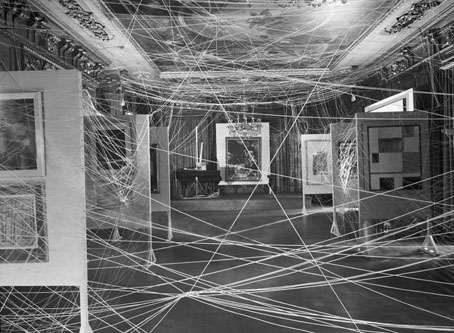
So, then… Fast-forward to 1942 and First Papers of Surrealism, an exhibition of paintings staged in New York City by the Coordination Council of French Relief Societies in October of that year. The exhibition was curated by André Breton with the assistance of Marcel Duchamp, Breton having recently arrived in the United States after escaping from Nazi-occupied France together with a small group of Surrealist artists, some of whom were represented in the show. Duchamp’s main contribution was His Twine, an installation of a large quantity of string threaded around the exhibition space through which the visitors had to peer in order to see the paintings. Duchamp also invited a group of children to play ball games inside the gallery on the opening night. This wasn’t the first Surrealist exhibition to be held in New York—Julien Levy had introduced the city to the latest art movement at his own gallery in 1933, and had been showing Surrealist paintings and Joseph Cornell’s artworks in the years that followed—but First Papers on Surrealism was an important event, with many major artists represented.

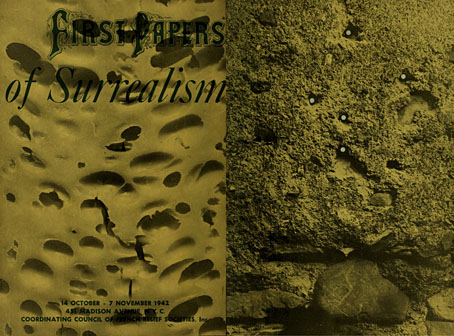
firstpapers2.jpg

What you see here are pages from the exhibition catalogue, a publication which is more like one of the smaller Surrealist magazines than a mere list of the pictures on display. Marcel Duchamp designed the die-cut cover (those holes make me wonder whether these were also originally threaded with string), while the catalogue interior contains an intriguing collection of quotes, captions, photographs and illustrations. Breton’s “Great Transparent Ones” raise their invisible heads again, while the artists and curators are all depicted in a series of “compensation portraits” which stand in for an absence of suitable photos.

Continue reading “First Papers of Surrealism, 1942”

Weekend links 626

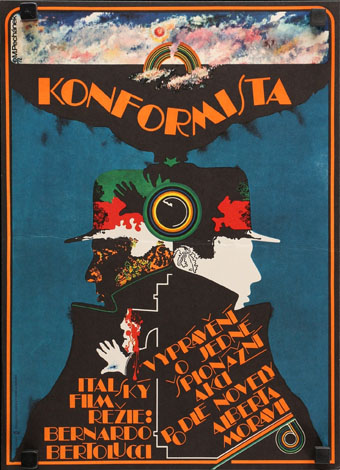
conformist.jpg

Czech poster for Bernardo Bertolucci’s The Conformist. Art and design by Miroslav Pechánek, 1972.

• “Acknowledgements are not part of the novel; in fact, they break the spell the author has spent 200 or more pages weaving. We should take a book on its merits, knowing as little about the author as possible. As one reader put it to me, ‘the end of a book is time for thinking about the book, not for an acceptance speech’.” John Self on dedications and acknowledgements.

• Mixes of the week: a Power Ambient mix by A Strangely Isolated Place, and a mix for The Wire by Nexcyia.

• At Spoon & Tamago: 3D-scanned stones create vessel for human-made interventions.

Weeks turned into months. Slowly it dawned on me that I was performing the role of Boswell for a man who might be: a) a put-on maestro or arcane troll; b) a fiction writer slash performance artist; or c) a lunatic. But by his own admission King had tagged me with a familiar spirit. Whether or not he was telling the truth was irrelevant at this point. I could feel something squatting on my soul. I needed to see what it was.

Kent Russell on looking for demons in a disenchanted world

• A trailer for Mad God, Phil Tippett’s 30-years-in-the-making animated feature.

• New music: Vesta by Azu Tiwaline, and Right, Right, Right by Nils Frahm.

• At Dennis Cooper’s: Max Hattler Day.

• “Marcel Duchamp was not a thief.”

• RIP Jean-Louis Trintignant.

Demons Of Rage (1972) by Nik Raicevic | Shall Come Forth The Demons (1991?) by Yuri Morozov | Angels Of Darkness, Demons Of Light (2011) by Earth

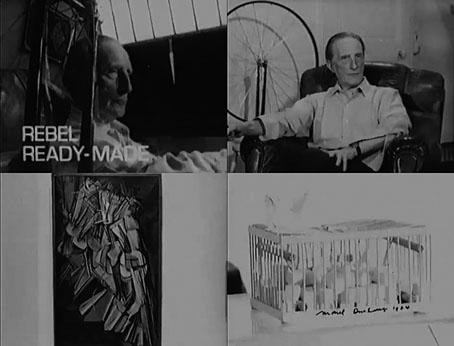
Rebel Ready-Made

duchamp1.jpg

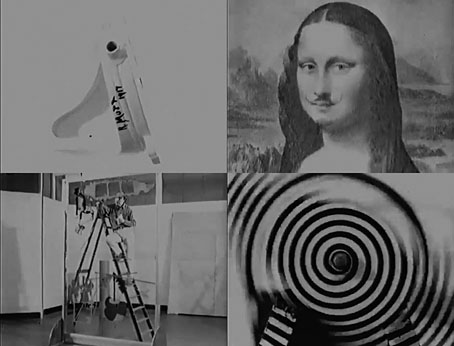
I think I spotted across this one while searching for more Robert Hughes, in which case I offer grudging thanks to the algorithms of the Great Panopticon. If you’ve ever seen Marcel Duchamp talking about his work in an arts documentary then it’s probable that the clip will have been taken from this film. (The Shock of the New is no exception.) Rebel Ready-Made was directed by Tristram Powell for a short-lived BBC arts series, New Release, and broadcast in June 1966 to coincide with a major Duchamp retrospective at the Tate Gallery, London. It’s fascinating for number of reasons, mostly the way that Duchamp is happy to talk about his sporadic art career, an occupation that in its mature phase consisted of spasms of invention followed by increasing boredom and a wandering off to do something else. The ease with which he did all this—the inventions which in other hands would have fuelled entire careers, and then the eventual abandonment of the whole art game—always made a sly mockery of the self-importance that sustained the art world in the 20th century.

duchamp2.jpg

Elsewhere in the film you get praise for Duchamp from Robert Rauschenberg and John Cage, plus the artist’s friend Richard Hamilton, seen briefly painting the replica of The Large Glass that appeared in the Tate exhibition as a substitute for the fragile original. This has been my favourite of Duchamp’s works since I saw the replica in the Tate a decade later. Having a duplicate stand in for the original isn’t such an unusual thing for Duchamp when most of his ready-made sculptures are also copies, the “originals” having been lost or destroyed shortly after their first exhibitions. From the 1930s on, Duchamp had also been making multiple copies of all his works in miniature for the various iterations of the Boîte-en-valise, or portable museum.

Tristram Powell was lucky to capture the artist being so talkative at such a late date. Two years after this Duchamp was dead, although there was one last surprise in store. Jasper Johns referred to Étant donné as “the strangest work of art in any museum”. Duchamp never acknowledged the existence of this life-size peepshow while he was alive, preferring it to be announced to the public only after his death, which is what happened in 1969. There are no replicas of this one; if you want to see it (or the parts of it the artist allows you to see) you have to go to Philadelphia and peer through the holes in the door.

Previously on { feuilleton }
Televisual art
Chance encounters on the dissecting table
The Witch’s Cradle by Maya Deren
Audio Arts
8 x 8: A Chess Sonata in 8 Movements
Anémic Cinéma
Dreams That Money Can Buy
Entr’acte by René Clair
View: The Modern Magazine