The Performers: Goya

goya1.jpg

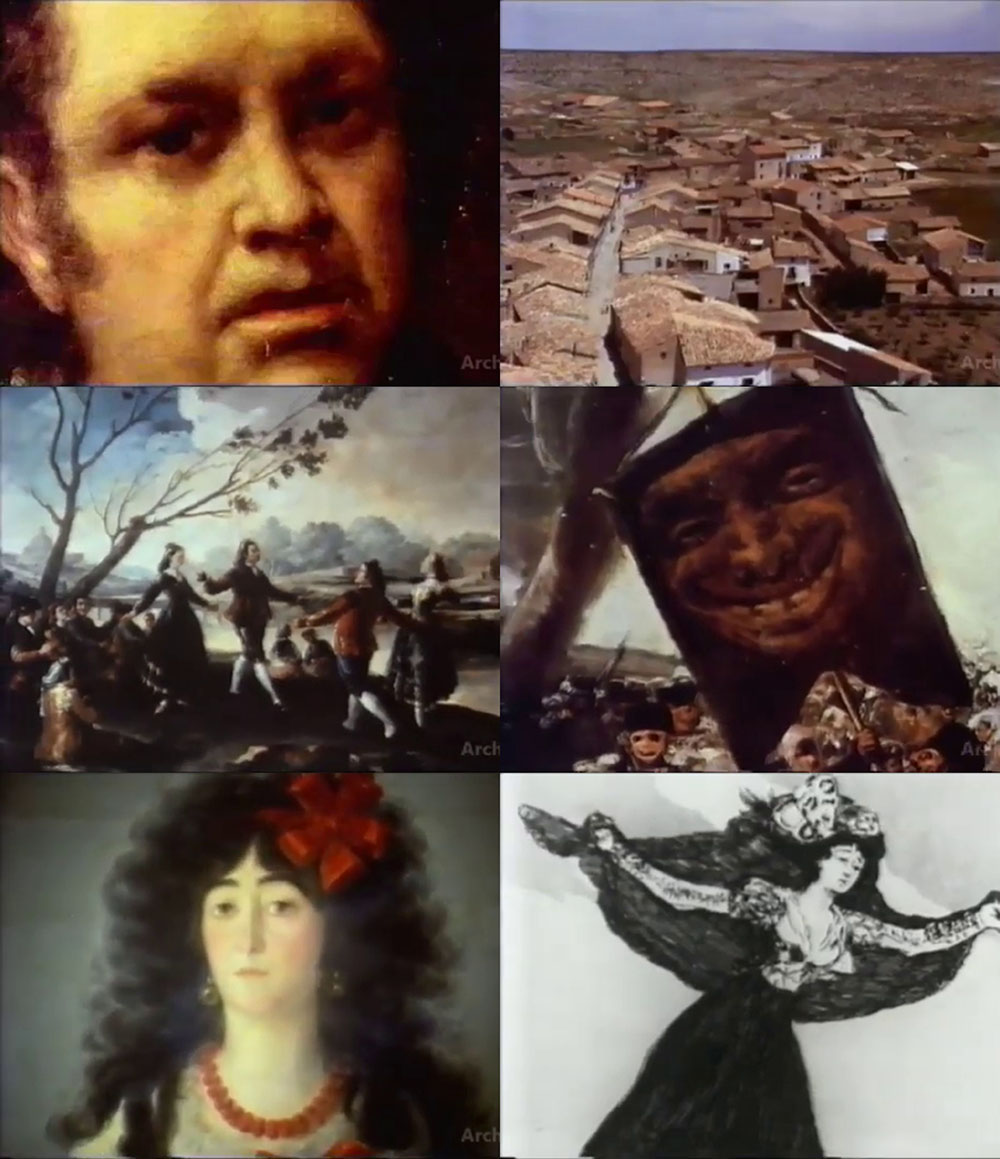
It’s good to find another arts documentary by Leslie Megahey turning up online. Not the best quality, unfortunately; the audio has been subjected to so much digital compression it sounds like it was run through a ring modulator but the visuals are decent enough. The Performers was originally made in 1972 for the BBC’s Omnibus arts strand. It was repeated in 1994 for the same series, with the name “Goya” appended to the title, the life and art of Francisco de Goya being the subject of the film. I remember watching the repeat screening but can’t remember why it was rebroadcast. Films like this usually remained stuck in the BBC’s vaults unless there was a good reason to show them again, as with Megahey’s portrait of György Ligeti which had the director revisiting the composer 15 years after their first meeting.

goya2.jpg

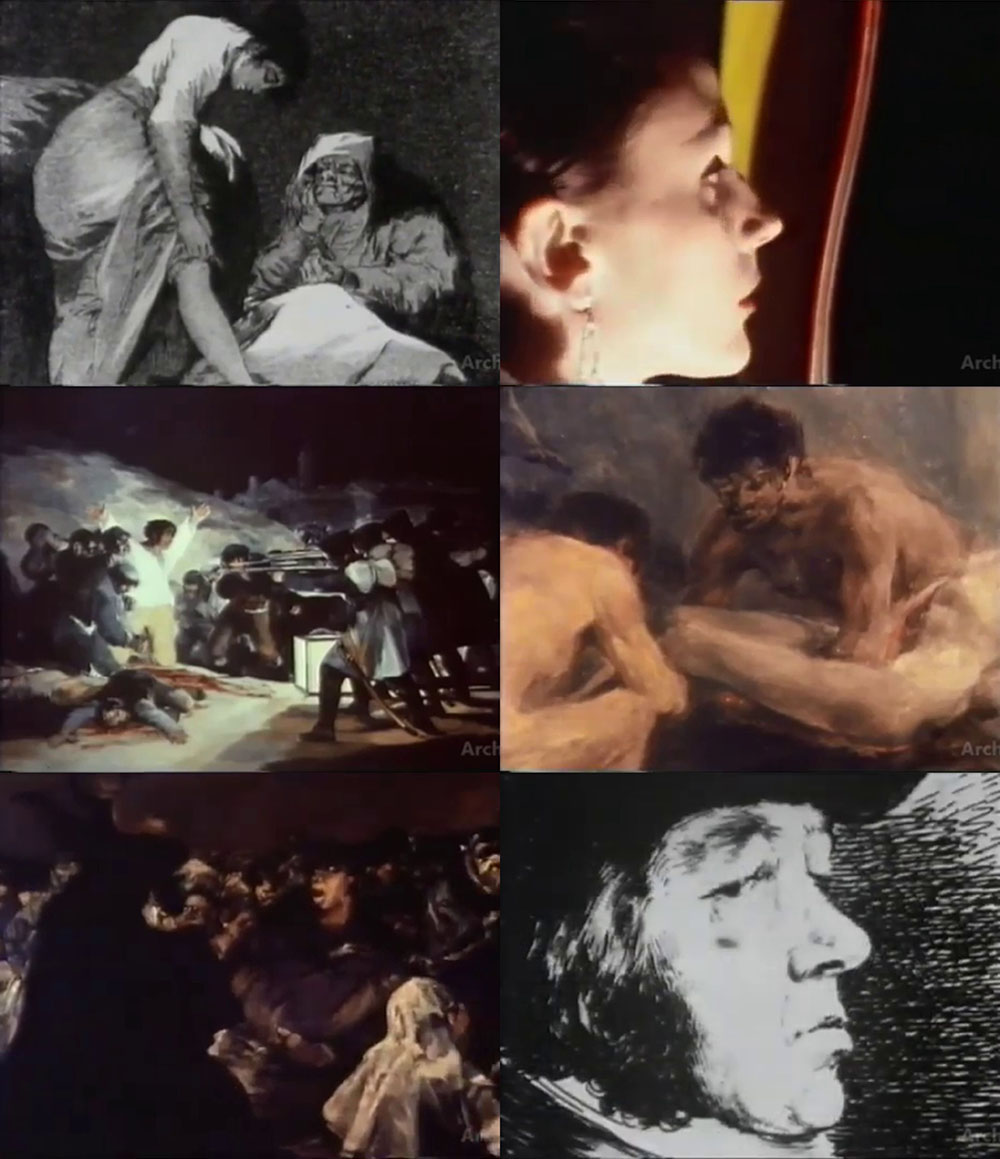
The Performers is less ambitious than Megahey’s later films, the majority of which had art or artists as their subject. The performers of the title are a pair of travelling players in modern Spain who adopt a series of roles in outdoor performances that parallel the stages of Goya’s career, from modestly successful muralist to very successful court portrait painter, and the later years when deafness left him isolated and depressed. The latter period resulted in the famous “Disasters of War” etchings and the so-called “Black Paintings” which were originally murals on the walls of the artist’s home.

The credits are missing from the end of the film but Leslie Megahey was the narrator as well as the director, with Colin Blakely reading from Goya’s diaries, and the performers played by Esperanza Malkin and Vallentin Conde. For a more personal take on the life and art of Francisco de Goya I recommend Robert Hughes’ 75-minute TV film from 2002.

Previously on { feuilleton }
All Clouds are Clocks: György Ligeti
Leslie Megahey, 1944–2022
Men and Wild Horses: Théodore Géricault
The Complete Citizen Kane
Schalcken the Painter revisited
Leslie Megahey’s Bluebeard

All Clouds are Clocks: György Ligeti

ligeti1.jpg

It’s unlikely that anyone will be stuck for anything to watch during the next few days but you could do worse than spend an hour with this documentary about the music of composer György Ligeti. I’ve mentioned this several times over the years, it’s one of my favourite films by the late Leslie Megahey, my favourite director of TV arts documentaries. All Clouds are Clocks was made for the BBC’s long-running Omnibus arts strand, and is unique among all the films made for that series in being broadcast twice (in 1976 and 1991), with the second broadcast appending new footage to the original film.

ligeti2.jpg

The film as a whole is fairly simple by today’s standards, an interview with the composer in his studio intercut with extracts from Ligeti recordings and performances. After years of documentaries filled with hyperactive editing and inane comments from celebrity interviewees Megahey’s straightforward approach is a considerable relief. You have the music, and you have the composer talking about the music; that’s it. Especially commendable is that there’s no mention at all of the use of Ligeti’s recordings as film scores. If the BBC made a film like this today (which they wouldn’t in any case) the first thing you’d see would be clips from Stanley Kubrick films.

ligeti3.jpg

As is often the case in Megahey’s documentaries, the director himself is the narrator, and in this one he’s also the off-screen interviewer as he was in his celebrated Orson Welles documentary. The illustrative episodes include melting plastic clocks, the slow awakening of a wooden puppet, and a performance of Poème symphonique, the composition which requires the priming and operation of 100 metronomes. Ligeti comes across as good-humoured and approachable, a serious artist but one whose general demeanour never seems loftily superior to ordinary human concerns the way Stockhausen often did. Ligeti’s manner confirms the sense of humour behind compositions like the one for the metronomes, and even more so in the choral/orchestral work Nouvelles Aventures. The latter is shown in an extract from a filmed performance at the Roundhouse, London, in 1971, a concert conducted by Pierre Boulez which provokes raucous laughter from the audience when a tray loaded with crockery is hurled into a bin. There’s humour of a blacker variety in the 1991 section which includes a description of Ligeti’s “anti-anti-opera”, Le Grande Macabre, based on a play by Michel de Ghelderode. This was Ligeti’s only operatic work, and I think it may be the only Ligeti composition I still haven’t heard in full. Most stagings are a riot of grotesque costuming and set design (the setting is a place called “Breughelland”) so it obviously needs to be seen as well as heard.

Previously on { feuilleton }
György Ligeti, a film by Michel Follin
Leslie Megahey, 1944–2022
Le Grand Macabre
Leslie Megahey’s Bluebeard
Metronomes

Powell’s Bluebeard on blu-ray

bluebeard1.jpg

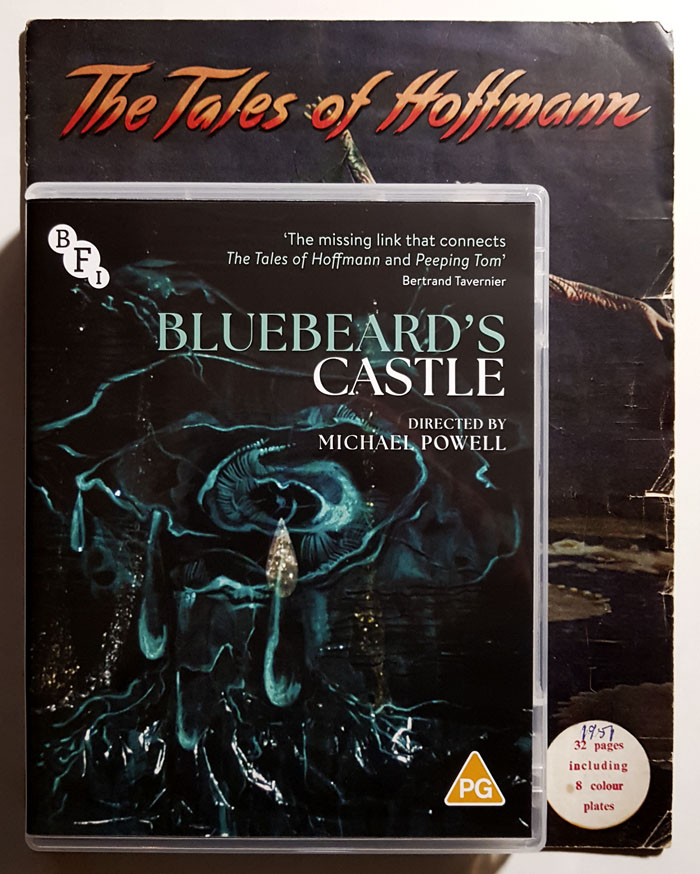
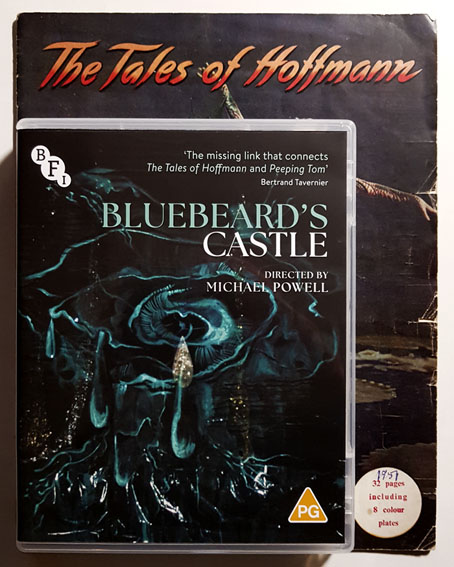
My film viewing at the weekend included a return visit to Michael Powell and Emeric Pressburger’s opéra fantastique, The Tales of Hoffmann, followed by the new blu-ray restoration of Powell’s Bluebeard’s Castle. This is the third time I’ve written about Powell’s film of the Bartók opera, the first occasion being a “When will I get to see this?” post, the second a review of a VHS copy which had turned up on YouTube. The new release, which is the film’s debut appearance on disc, is a restoration by the BFI under the supervision of Thelma Schoonmaker and Martin Scorsese.
bluebeard2.jpg

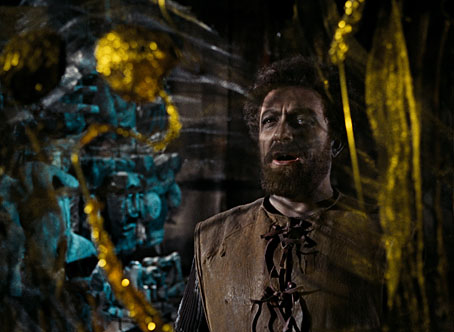
Norman Foster (Bluebeard).

Powell directed the hour-long dramatisation for the German TV channel Süddeutscher Rundfunk in 1963, at a time when his career was in the doldrums following the critical outrage provoked by the release of Peeping Tom. The production was a smaller one than he was used to but it was still shot on 35mm which has now been polished to a breathtaking degree, revealing rich shadows, deep colours and a profusion of glittering detail. (See this clip.) The audio track remains monophonic but the sound is a great improvement on the VHS version. Seeing the latter was gratifying after so long a wait but was also an underwhelming experience. The restoration proves once again how unfair it is to judge filmmakers from a low-grade copy of their work that’s been thrown onto the internet.
bluebeard3.jpg

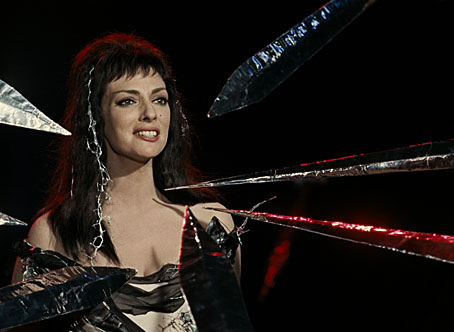
Ana Raquel Satre (Judith).

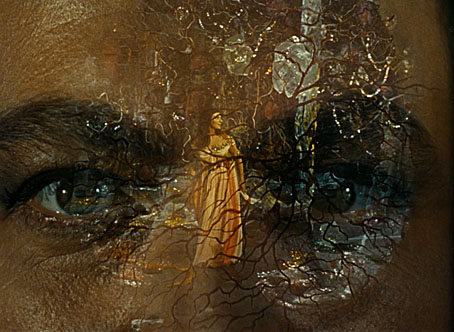
Bluebeard’s Castle (or Herzog Blaubarts Burg, to use the film’s German title) wasn’t a project that Powell inaugurated. Hein Heckroth, the production designer on many of Powell and Pressburger’s colour features, had been working for German TV since the late 1950s, and suggested to singer/producer Norman Foster that Powell might be interested in directing the film. The presence of Heckroth’s weirdly Expressionist designs give Bluebeard’s Castle a continuity with the extended ballet sequence in The Red Shoes and the “Giulietta” episode of The Tales of Hoffmann; all three stories share a dream-like atmosphere whose grading to nightmare is enhanced by Heckroth’s decors. I’ve often wondered whether the strangeness of some of Heckroth’s set designs, whose aesthetics extend to Dalínean Surrealism, were a factor in the frequent grumblings of distaste expressed by British critics for Powell and Pressburger’s films even before Powell made Peeping Tom. The first film that Powell worked on was The Magician in 1926, Rex Ingram’s adaptation of the Somerset Maugham novel, and a film which is at its best in its moments of visual excess. Powell’s films are valued today for their own visual excess but this quality hasn’t always been encouraged in British cinema, as Ken Russell later discovered. Favourable critics like Ian Christie often point to this as part of the “European” sensibility of Powell and Pressburger’s oeuvre, something which is present even when the subject matter is very English. Pressburger was a Hungarian emigré, while Powell met Ingram when he was living in the south of France; the production designers on all the major P&P films, Alfred Junge and Hein Heckroth, were both German, and the films themselves, especially The Red Shoes and The Tales of Hoffmann, feature a host of different nationalities. Watching Bluebeard’s Castle again I was reminded of Italian horror cinema, especially the films of Mario Bava. When you combine the artificiality of Heckroth’s sets with the Gothic story of a woman imperilled by a powerful aristocrat, plus the resemblance of Ana Raquel Satre to Barbara Steele, the whole thing assumes a very Bavaesque flavour.
bluebeard4.jpg

On a musical level I much prefer Bartók to Offenbach, (although Offenbach’s famous Barcarolle is always worth hearing) so I’m pleased that this minor work has been treated to the same restorative care as The Tales of Hoffmann. The 1988 version of Bartók’s opera directed for the BBC by the late Leslie Megahey remains my favourite filmed Bluebeard even though it lacks Powell’s flamboyance; Megahey’s film has more gravitas, and the direction, performances and musical recording are better. But seeing Powell’s film again revealed nuances I’d missed before, like the sustained shot near the end when Judith seals her fate by asking for the key to the forbidden room. It also makes a change hearing the whole thing sung in German, a language I can understand in parts. Bluebeard’s Castle is a further example of Powell’s idea of a “composed film”, a work that would combine all the dramatic arts. (Or almost all—this one lacks dance.) As I said ten years ago, it may be minor compared to the films that he made with Emeric Pressburger but it offers a more satisfying coda to his career than his final features.

Previously on { feuilleton }
Bluebeard’s Castle, 1981
Powell’s Bluebeard revisited
Joseph Southall’s Bluebeard
Leslie Megahey’s Bluebeard
Powell’s Bluebeard
The Tale of Giulietta

György Ligeti, a film by Michel Follin

ligeti1.jpg

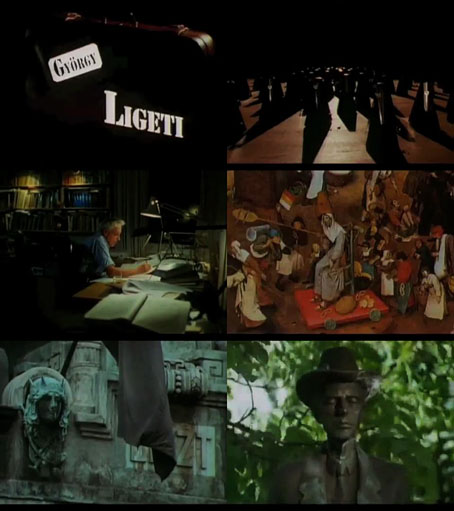
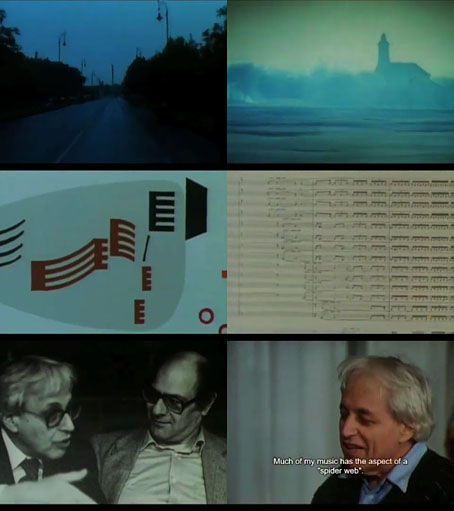
2023 is the centenary of György Ligeti’s birth so here’s an hour-long French documentary about the composer directed by Michel Follin. György Ligeti was made in 1993, two years after Leslie Megahey’s BBC crew had paid a return visit to Ligeti’s apartment to film an update to the Omnibus profile from 1976, All Clouds Are Clocks. The two documentaries complement each other rather well, although you’ll have to take my word for this since Megahey’s film has yet to appear on any video site. Both films interview Ligeti at the studio table where he wrote many of his compositions, and where he talks about his musical interests and intentions.

ligeti2.jpg

The two films differ in their approach to the world outside Ligeti’s window. Megahey concentrated on the music, illustrating a number of lengthy recording extracts with footage of melting clocks, a wooden puppet, etc, whereas Follin attends to the biography, with Ligeti relating his personal history while also describing the evolution of his musical ideas. Ligeti’s youth was a tumultuous one, encompassing the upheavals of the Second World War, during which he lost half his family to the Holocaust, and the later Communist years in Hungary when the kinds of modern music that he was trying to write were proscribed by the State. It’s good to see him confirm the importance of Bartók’s music to his growth as a composer. Ligeti’s oeuvre contains many Bartók-like moments but I’ve often thought that regarding these as any kind of influence or reference might be a lazy comparison based on a shared nationality.

All of this reminds me that I recently picked up a copy of the 5-disc Ligeti Project in a charity shop but still haven’t listened to it all the way through. Charity shops can be useful (and cheap!) sources of modern composition if you don’t mind trawling week after week through iterations of the classics. Secondhand shops were my first introduction to music like this, providing the opportunity to sample the recordings of those mysterious names at a bargain price. Bargains are still to be found if you’re patient, as with the Ligeti box. Other recent discoveries include Without Sinking by Hildur Guðnadóttir, and Memoryhouse, the first album by Max Richter, both of which were bought for a fraction of their usual asking price.

(A note about the film subtitles. These are an amateur translation which fails to recognise the names of Gyula Krúdy—the writer whose work Ligeti describes finding at an early age—and Paul Hindemith, the German composer.)

Previously on { feuilleton }
Le Grand Macabre
A playlist for Halloween: Orchestral and electro-acoustic
Metronomes

Leslie Megahey, 1944–2022

megahey.jpg

TV producer & film director Leslie Megahey died at the end of August but the news has taken a while to filter through to these pages where his BBC TV productions have been the subject of several posts. My recurrent comments about his work were effusive enough for him to send me a handwritten note of thanks a few years ago, plus a promotional card for one of the films in the Artists and Models series. If more of his productions had been available online or on disc I would have written something about them as well, but old television, especially the documentary variety, remains persistently inaccessible to future audiences.

There are biographical details in the link above so what follows is a list of the Megahey productions that, for this viewer at least, made his name one to look out for in the TV listings. Some of these are on YouTube, a couple are available on disc, while the rest have yet to resurface anywhere. Everything here is highly recommended…if you can find it.

Omnibus: All Clouds are Clocks (1976/1991): An hour-long interview with composer György Ligeti. I caught this one on its updated rebroadcast in 1991 when Megahey revisited Ligeti to see what directions his career had taken over the past 15 years. Currently unavailable.

Schalcken the Painter (1979): Another Omnibus film, and a ghost story (after Sheridan Le Fanu) that’s as good as any of the BBC’s MR James adaptations. Released on (Region B) blu-ray & (Region 2) DVD by the BFI.

Arena: The Orson Welles Story (1982): A two-part interview (165 minutes in total) which caught Welles in a rare mood when he was happy to talk at length about his career. The TV equivalent of the huge book of Peter Bogdanovich conversations. Part One | Part Two

Artists and Models (1986): Three drama/documentaries about French painters: David, Ingres and Géricault.

Cariani and the Courtesans (1987): Another historical drama about an artist, Giovanni Cariani (c. 1490–1547). Very much in the mould of Schalcken the Painter but without the supernatural element. Currently unavailable.

Duke Bluebeard’s Castle (1988): The best film version of Bartók’s opera. The Region 1 DVD by Kultur seems to be deleted but is worth seeking out for having removable subtitles. There’s a copy at YouTube.

The Complete Citizen Kane (1991): A 90-minute documentary about Welles’ film using extracts from the Arena interviews and the Megahey produced TV series The RKO Story, plus new material. No longer on YouTube (or anywhere else) due to a copyright complaint. This is why I’m always saying you should download these things as soon as you find them.

The Hour of the Pig (1993): A feature film about a medieval animal trial, this one was hacked around by Miramax then released in the US as The Advocate where it flopped. The hard-to-find UK version turned up on YouTube a few days ago.

Previously on { feuilleton }
Men and Wild Horses: Théodore Géricault
The Complete Citizen Kane
Schalcken the Painter revisited
Le Grande Macabre
Leslie Megahey’s Bluebeard