Fetish photographer Rick Castro

castro.jpg

Photographs by Rick Castro.

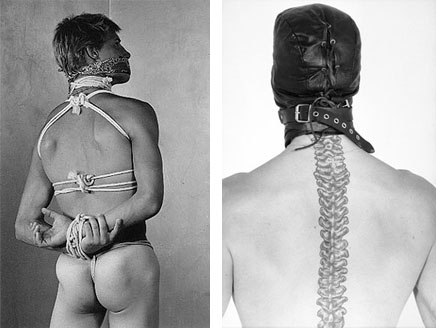
Presenting another guest post from John Wisniewski who back in May contributed an interview with William E. Jones about gay film director Fred Halsted. The subject this time is Rick Castro, pioneering bondage/S&M photographer, and also the proprietor of the Antebellum Gallery in Los Angeles which bills itself as the only fetish gallery in America. Castro has worked with Joel-Peter Witkin and Bruce LaBruce, and also photographed subjects as diverse as the Dalai Lama and Kenneth Anger, neither of them in bondage, unfortunately. As before, John offers a list of ten questions. Read on to discover why hustlers always used to wear white jeans (I have wondered about this)…

* * *

John Wisniewski: When did you begin photographing?

Rick Castro: 1986…around June…. My first photo was of my longtime friend (and former GF!), Odessa. I was a wardrobe stylist at the time, so I dressed her like Morticia Addams. Very high contrast/high shadowed B&W.

My second photo was of Tony Ward. I cast him for his first “mainstream” photo shoot. Editorial for a now defunct men’s magazine, INSTYLE, (published by porn mag IN TOUCH). We were working for photographer Albert Sanchez at the time. Between takes I’d dressed him up in full leather fantasy—leather hood, harness, gauntlets, codpiece, boots and horsetail!

JW: Whom are some of your influences in photography and art?

RC: I like the dead guys: Brassai, Pierre Moliner, F. Holland Day, Julia Margaret Cameron, Otto Dix, Paul Cadmus, Egon Schiele, Tennessee Williams, Pier Paolo Pasolini, Gilles De Rais.

JW: When did you meet fellow photographer Joel-Peter Witkin?

RC: Also during 1986, I bought Joel’s first book. At the back of the book was a request: “I am looking for people with physical deformations, amputees. Quadriplegics, burn victims, persons into extreme S&M, a woman with three breasts, geeks, pinheads, a woman with severe skin disease that will pose in an evening gown, anyone bearing the wounds of Christ, Christ.”

Later that year the new annex of Book Soup on Sunset Blvd hosted the first LA photo exhibit for Joel. I attended, introduced myself and gave him a stack of photos I had taken of my potential “models.” He called me the next morning. From then I worked with Joel on 13 of his most iconic photographs as a wardrobe stylist, costume designer, location scout, model scout, casting director, photo assistant, art director, make up artist and all around assistant.
Continue reading “Fetish photographer Rick Castro”

William E. Jones on Fred Halsted

halsted1.jpg

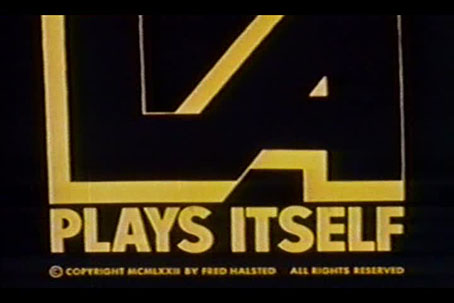
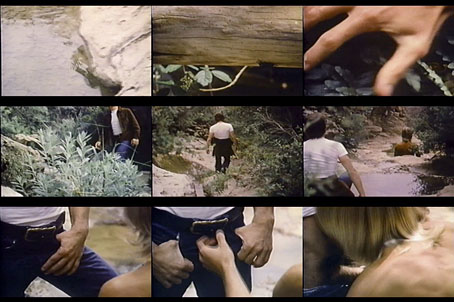
Presenting an interview by John Wisniewski with William E. Jones, author of Halsted Plays Himself (2011). The subject is gay filmmaker and performer Fred Halsted (1941–1989) whose 1972 film LA Plays Itself was a pioneering piece of low-budget cinema which combined a fragmented view of Los Angeles with explicit liaisons between several men, one of them portrayed by Halsted himself. Halsted took advantage of the period between 1970 and 1975 when porn in the US was no longer illegal but hadn’t yet been industrialised. As with Genet’s Un Chant d’Amour, what you get on the screen isn’t a product, it’s the representation of an obsession. It’s this that makes LA Plays Itself a still surprising and provocative piece of work.

I arrived at this film and Halsted somewhat belatedly, in fact I don’t think I’d read anything about him at all until William E. Jones was interviewed when his book was published. (Matters haven’t been helped in this country by the way hardcore porn of any kind was still illegal into the 1990s.) LA Plays Itself fascinates for the view it gives of the LA cruising scene which John Rechy described in considerable detail in The Sexual Outlaw. It’s a curiously hybrid film, neither straightforward porn—many of the sex scenes are fragmented—nor is it narrative fiction or outright documentary. Together with the recently reissued films of Peter de Rome, it’s the kind of thing that few people would be likely to make today, despite the easier access to film technology and the relaxing of censorship. And like all porn films of this era, it now has a unique look simply because it’s been shot on film.

halsted2.jpg

None of Halsted’s films appear to be on DVD at the moment, and as William Jones notes below, Sextool (1975), the film Halsted regarded as his major work, may only exist as a single fading print.

Here’s John and William.

* * *

John Wisniewski: Why did you choose to write your book on filmmaker Fred Halsted?

William E. Jones: For several years I made money in the adult video industry, producing budget DVD compilations (4 hours for $10) sold in adult video stores. Before technological innovation rendered my job redundant, I watched over 700 hours of gay adult film and video produced between 1969 and 1999. In such vast quantities, the material, especially from the second half of the period, began to seem nightmarish in its ugliness. I would relish the opportunity to see any earlier title, produced before 1985, directed more or less like a movie, shot on location, and sometimes even acted fairly well. I can say without hesitation that Fred Halsted’s films were my favorites of all the videos I saw during those years in the porn industry.

Fred Halsted’s films have many fans but few advocates, and I thought my book could intervene in a decisive way before his legacy – the films and the memories of those who knew him personally – disappears completely. I also chose him as my subject because of his connection to Los Angeles. He lived and worked in neighborhoods I pass through nearly every day. But there was something else that drew me to his films, the uncanny power of work by a novice, and a self-taught one at that. His films are crude, idiosyncratic, and at their best have the force of a revelation.

Continue reading “William E. Jones on Fred Halsted”

Street Fair, 1959

sf1.jpg

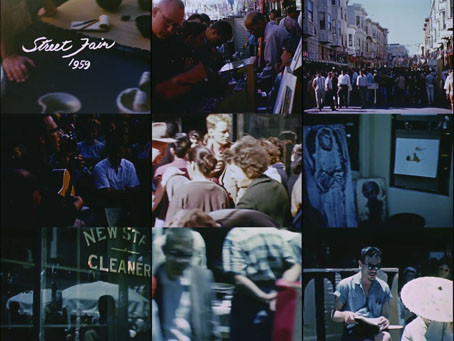
The street is upper Grant Avenue, San Francisco, seven minutes of local colour captured on silent 16mm film by Edward Silverstone Taylor:

This edited Ektachrome home movie with professional titles documents a 1959 street fair, upper Grant Avenue, San Francisco—the center of Beat culture. The film includes shots of filmmaker Dion Vigne and his wife Loreon, artist and occultist Marjorie Cameron, and artist Wallace Berman, displaying and selling their art works.

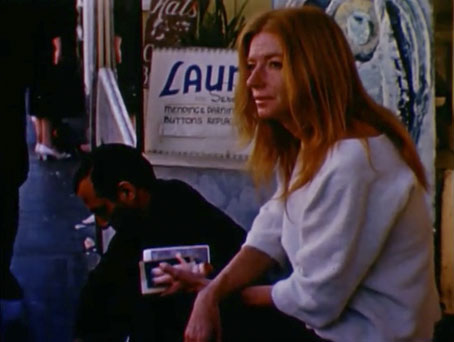
The presence of Marjorie Cameron (below) is what fascinates in these quarters, recognisable thanks to her red hair and the distinctive profile seen when she played the Scarlet Woman in Kenneth Anger’s Inauguration of the Pleasure Dome five years earlier. You also see what appear to be a couple of her paintings. The street fair looks pretty bohemian for the late 50s but a glance at Anthony Stern’s frenetic San Francisco short from a decade later shows a much wilder place. (Via Dangerous Minds.)

sf2.jpg

Previously on { feuilleton }
San Francisco by Anthony Stern
Kenneth Anger on DVD again

Weekend links 153

scarfolk.jpg

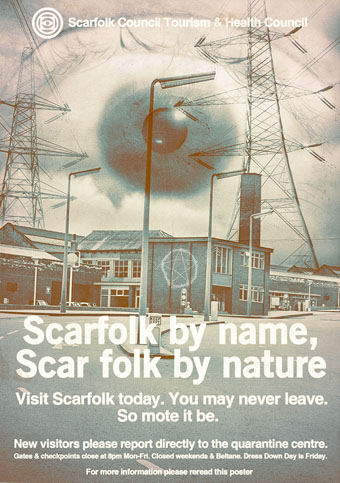
Scarfolk, as was noted here last month, is a home from home, especially if you grew up in the 1970s. The mayor of the rabies-afflicted town, Richard Littler, talked to Creative Review about his unheimlich design project.

Ensemble Pearl, an album stream of “cosmic psychedelic space-doom minimal drone soundscapes” by Atsuo, William Herzog, Eyvind Kang, Michio Kurihara, Stephen O’Malley and Timba Harris.

• At Dangerous Minds: Louise Huebner’s Seduction Through Witchcraft (1969), an album of occult instruction with an electronic soundtrack by Louis & Bebe Barron.

My apartment is teeming with unfinished books. They cover my desk, coffee table, and nightstand. They sit two rows deep on my bookshelves. There they remain, neglected, misunderstood, unappreciated, still with the last read page firmly marked with a piece of paper, a subscription card, or a proper bookmark: a reminder of my stagnation, my failure to engage.

Gabrielle at The Contextual Life on The Secret Lives of Unfinished Books.

• Hauntological mix of the week: Electronic Music For Schools by Pattern & Shape. Related: Pye Corner Audio live at Cafe OTO, March 2013.

• Tumblrs of the week: Des Hommes et des Chatons, Remarkably Retro, The Pop-Up Museum of Queer History, and Shit My Cats Read.

Icons: An exhibition of Kenneth Anger’s Hollywood memorabilia, and other material from his home, at Sprüth Magers, London.

hooray.jpg

Hooray for Gay, an exhibition of pre-Stonewall images at Boo-Hooray, NYC.

The Servant, “a 60s masterwork that hides its homosexuality in the shadows”.

The Cosmic Bicycle, collages by Wilfried Sätty made into a short film.

• Photos of the derelict R Power Plant in Pennsylvania.

1913: The Year of Modernism

• RIP Richard Griffiths

Wildspot (2005) by Belbury Poly | Now Ends The Beginning (2011) by The Advisory Circle | Wildspot (2012) by The Advisory Circle | Now Ends The Beginning (2012) by Belbury Poly

Brush of Baphomet by Kenneth Anger

anger2.jpg

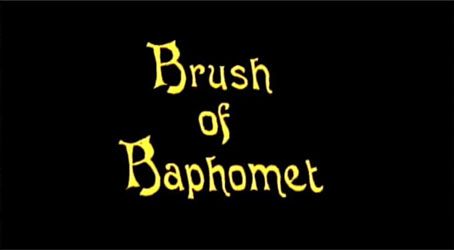
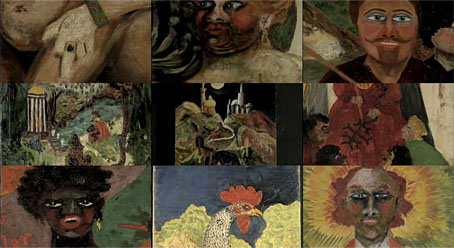
Another recent piece of Angeriana, and another short video sketch, Brush of Baphomet (2009) is a kind of addendum to Anger’s The Man We Want to Hang (2002), being a further look at Aleister Crowley’s paintings. The title refers to one of Crowley’s many occult names. As a painter Crowley’s technical ability was almost nil but that never dissuaded him from trying, and I’m sure I’m not alone in finding his work to have a naive malevolence. Anger has had a lifelong interest in Crowley’s paintings, famously journeying in 1955 to the abandoned villa in Cefalù, Sicily, where he cleaned whitewash from the walls to reveal the remains of the murals Crowley had painted there.

anger3.jpg

The music in Brush of Baphomet is a surprising choice, an extract from the second part of Morton Subotnick’s Silver Apples of the Moon (1967). Anger’s musical selections have never been random ones so you have to wonder why this particular score. Was it because the electronics are reminiscent of the Moog drones Mick Jagger supplied for Invocation of My Demon Brother (1969)? Subotnick’s title is borrowed from The Song of Wandering Aengus by WB Yeats, a poet for whom Crowley (also a poet) had little affection. In Crowley’s occult novel Moonchild, Yeats appears as “Gates”, a mediocre painter (yes, well…), who ends up being killed in an act of magical revenge. Crowley must have been mortified a few years later when Yeats was awarded a Nobel Prize.

Previously on { feuilleton }
Anger Sees Red
Kenneth Anger’s Hollywood Babylon
Lucifer Rising posters
Externsteine panoramas
Missoni by Kenneth Anger
Anger in London
Arabesque for Kenneth Anger by Marie Menken
Edmund Teske
Kenneth Anger on DVD again
Mouse Heaven by Kenneth Anger
The Man We Want to Hang by Kenneth Anger
Relighting the Magick Lantern
Kenneth Anger on DVD…finally