Firebirds

bilibin.jpg

Ivan Tsarevich Catching the Firebird’s Feather (1899) by Ivan Bilibin.

The firebirds are those that you find on the covers of recordings of Stravinsky’s Firebird ballet score, or on its popular distillation, The Firebird Suite. The latter has long been one of my favourite pieces of classical music, in fact it was one of the first I owned, via a cheap vinyl pairing with The Rite Of Spring that was mainly of interest for being conducted by Stravinsky himself. The cover photo showed a ballerina as the Firebird in a ballet performance, a common choice for the covers of Firebird recordings.
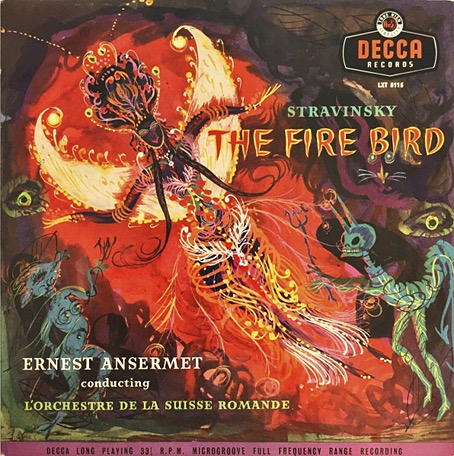
firebird-1955.jpg

No artist/designer credited, 1955.

Much better was the cover of Tomita’s Firebird album (see below) which I bought around the same time, an uncredited tapestry design which is also a better album cover than the painting used on the earlier Japanese release. Depicting the Firebird itself is the other obvious choice when designing Stravinsky albums, and the dazzling, magical bird has helped this particular opus fare better in the world of classical album design than many other recordings.
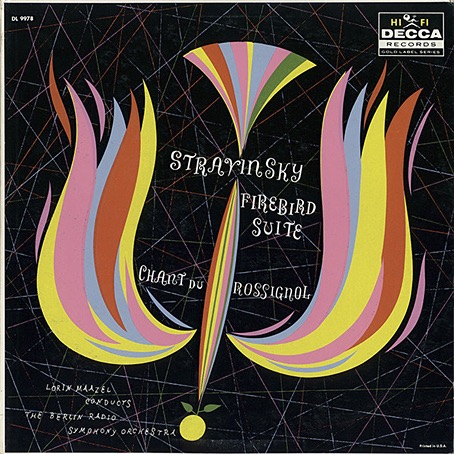
firebird-1958.jpg

No artist/designer credited, 1958.

It’s easy to cast aspersions at the designers or art directors of classical records when you see an uninspired cover design, but the format presents a number of difficulties. There’s no such thing as a fixed design for a classical album because classical albums have no fixed form. With the exception of albums devoted to a single long composition most classical albums are compilations, pairing longer works with shorter ones, often by two or more composers. This confusion of identity creates problems for the designer, as does the huge quantity of classical releases. Then there’s the problems posed by the music itself which is so often abstract; you can’t “illustrate” The Goldberg Variations. The default choice is to use a painting or a drawing or a photograph of the composer as a cover image, or a photo of the conductor or performer. The easiest assigments, as these Firebird covers demonstrate, are albums based around a composition with a well-defined theme that can be depicted visually. Nobody has ever had a problem designing a cover for recordings of Debussy’s La Mer, for example, the only difficulty is deciding what picture of the sea you want to use.

firebird-1960-1.jpg

No artist/designer credited, 1960.

I’ve never had the impression that classical devotees care very much about these issues, it’s the music and the performance they’re interested in. Record labels (or their marketing departments) do seem to pay attention to visual matters now and then, and you’ll find occasional attempts to create a new line of themed covers. (The Orphic Egg series was one of the more bizarre examples from the 1970s.) Deutsche Grammophon have a history of decent cover design but even they resort to using photos of the artist or conductor far too often. I’ve never been asked to design a classical release, and I’m not sure I’d relish the task, but the problems raised by the form fascinate me. This is a subject I’ll no doubt keep returning to.
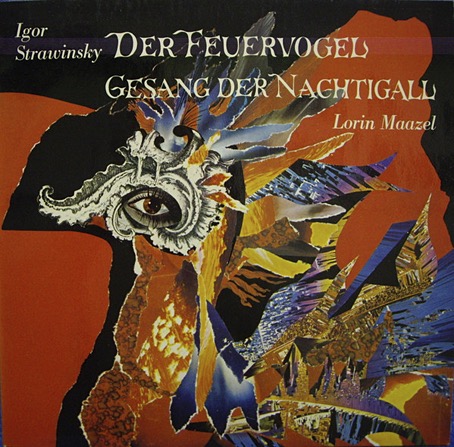
firebird-nd2.jpg

Irma Seidat, no date.

Continue reading “Firebirds”

Weekend links 664

warburton.jpg

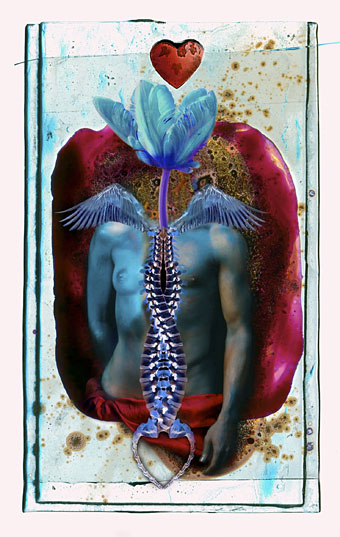
Caduceus: Tarot Card Study – Love by Holly Warburton.

• The week in stage magic: Ken Carbone, writing about playing cards and graphic design, points the way to an hour of Ricky Jay demonstrating his miraculous abilities with a pack of cards. Elsewhere, Erik Ofgang asks “Who was Mr. Electrico, the sideshow magician who inspired Ray Bradbury—then vanished?”

The 1980 Floor Show – Uncut / Unedited: 8 Hours of David Bowie in Ziggy Stardust guise performing for American TV cameras at The Marquee, London, in October 1973. That’s more Bowie than most people would want—there’s a lot of repetition—but it’s good to know things like this can still surface.

• “A supernova has gone out,” says David Grundy about the late Wayne Shorter. Also this: “Sci-fi fan Shorter suggested the title to [Weather Report’s] second album I Sing The Body Electric, taken from Walt Whitman via Ray Bradbury.”

• “We need to get away from thinking of ourselves as machines… That metaphor is getting in the way of understanding living, wild cognition.” A long read by Amanda Gefter about the secret life of plants, and “4E” cognitive science.

• “…why take a soft approach to safety when you can scare the sensible into the next generation with some of the most effective horror shorts of all time?” Ryan Finnegan on the notorious PIFs (public information films) of the 1970s.

• “I am increasingly of the Lynchian mindset of ‘never explain’…” Lynda E. Rucker talking to Steven Duffy about her latest story collection, Now It’s Dark.

• James Balmont presents a brief introduction to the mind-altering cinema of Sogo Ishii.

• At Spoon & Tamago: Hidari: An epic wooden puppet samurai stop-motion film.

• Old music: Musique De Notre Temps (1976) by Éliane Radigue.

• Steven Heller’s font of the month is Juma.

Body Electric (1982) by The Sisters Of Mercy | Super-Electric (1991) by Stereolab | Electric Garden (Deep Jazz In The Garden Mix) (2013) by Juan Atkins & Moritz von Oswald

Holly Warburton record covers

warburton09.jpg

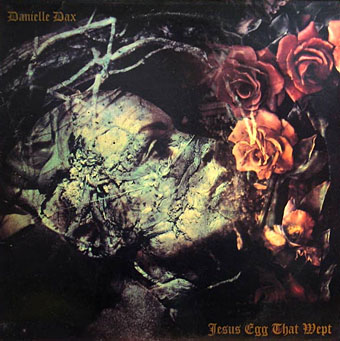
Jesus Egg That Wept (1984) by Danielle Dax.

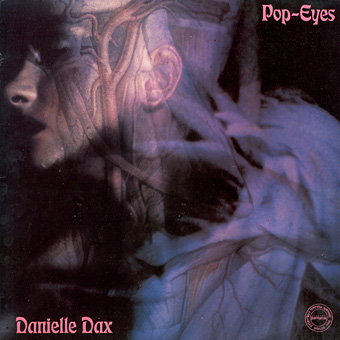
Most of the examples here are for singles and albums released by Danielle Dax in the 1980s but British artist Holly Warburton has done a lot more besides. The work from the 80s involved the re-photographing of images projected onto canvas or other materials, effects that are now more easily achieved by digital means. The Pop-Eyes cover was a substitute for the earlier, notorious “Meat Harvest” collage which Ms Dax hacked together from medical photos, and which caused the album to be shunned by shops and distributors for being too disturbing. (It’s here if you need to look.) There is a Holly Warburton website but there’s not much going on there at the moment. You can see more at Pinterest.

warburton05.jpg

Pop-Eyes (1985) by Danielle Dax.

warburton01.jpg

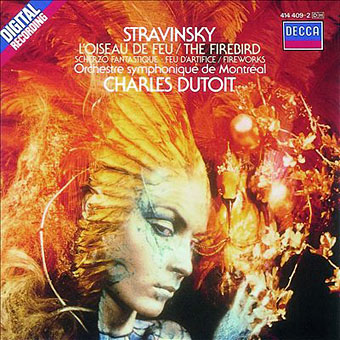
The Firebird (1986), the Montreal Symphony Orchestra conducted by Charles Dutoit.

Continue reading “Holly Warburton record covers”