Tentacles #1: The Boats of the ‘Glen Carrig’

boats-1945.jpg

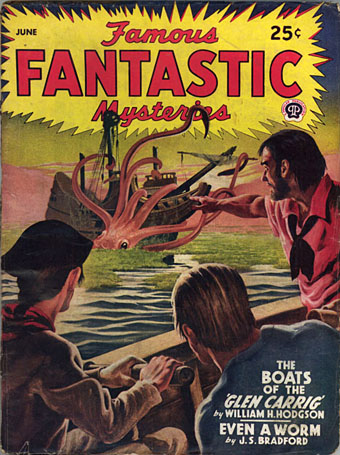
Famous Fantastic Mysteries, June 1945. Illustration by Lawrence (Sterne Stevens).

Following last week’s revelation of Lovecraftian horror, I thought it might be worth demonstrating just how much the tentacle-menacing-a-ship scenario is owned by William Hope Hodgson. The Boats of the ‘Glen Carrig’ (1907) is one of Hodgson’s lesser novels, overshadowed by the cosmic horrors of The House on the Borderland and The Night Land, but it’s a memorable work all the same. The narrative fits into his cycle of Sargasso Sea stories: a small band of 18th-century sailors, survivors of the wreck of the ‘Glen Carrig’, drift across the Atlantic into the weed-strewn “cemetery of the oceans” where they have to fight off giant octopuses and the predations of “weed men”, humanoid creatures with tentacular hands. As will be seen below, it’s the attack on a wrecked ship trapped in the weed that many of the illustrators have chosen to focus on.
tideless-1911.jpg

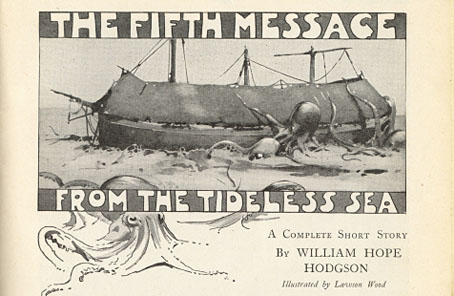
Illustration by Lawson Wood (1911).

This was something I hadn’t seen before: an illustration for a story with a scenario very similar to ‘Glen Carrig’ where the sailors journey under canvas in their lifeboats. Another tale of the sinister Sargasso:

This is the fifth message that I have sent abroad over the loathsome surface of this vast Weed-World, praying that it may come to the open sea ere the lifting power of my fire-balloon be gone, and yet, if it come there, how shall I be the better for it? Yet write I must, or go mad, and so I choose to write, though feeling as I write that no living creature, save it be some giant octopus that lives in the weed about me, will ever see the thing I write. (more)
boats-1971-1.jpg

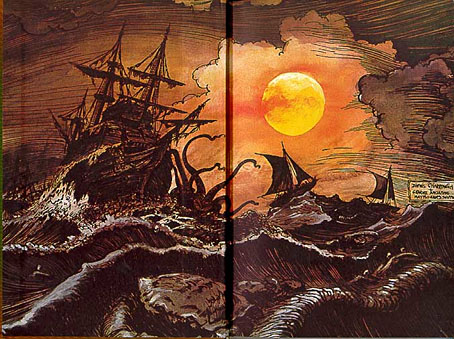
Les Canots du “Glen Carrig” / La Maison au bord du monde / Les pirates fantômes (1971). Illustration by Philippe Druillet.

A French Hodgson collection, the octopoid cover of which can be seen here. These were the endpapers; the rest of Druillet’s illustrations can be seen here.

Continue reading “Tentacles #1: The Boats of the ‘Glen Carrig’”
S. Latitude 47°9′, W. Longitude 126°43′

shipattack.jpg

Then, driven ahead by curiosity in their captured yacht under Johansen’s command, the men sight a great stone pillar sticking out of the sea, and in S. Latitude 47°9′, W. Longitude 126°43′, come upon a coastline of mingled mud, ooze, and weedy Cyclopean masonry which can be nothing less than the tangible substance of earth’s supreme terror—the nightmare corpse-city of R’lyeh, that was built in measureless aeons behind history by the vast, loathsome shapes that seeped down from the dark stars. There lay great Cthulhu and his hordes, hidden in green slimy vaults and sending out at last, after cycles incalculable, the thoughts that spread fear to the dreams of the sensitive and called imperiously to the faithful to come on a pilgrimage of liberation and restoration.

HP Lovecraft, The Call of Cthulhu (1928)

“Great Cthulhu and his hordes…” People never mention the hordes, do they? I’m pleased to say that the loathsome horde gathered in my forthcoming Cthulhu Calendar are in situ at last, since I’ve found the time this week to get everything finished. I still need to write a couple of new web pages then upload all the images to CafePress. I’ll be doing that over the weekend so Monday will be the launch day.

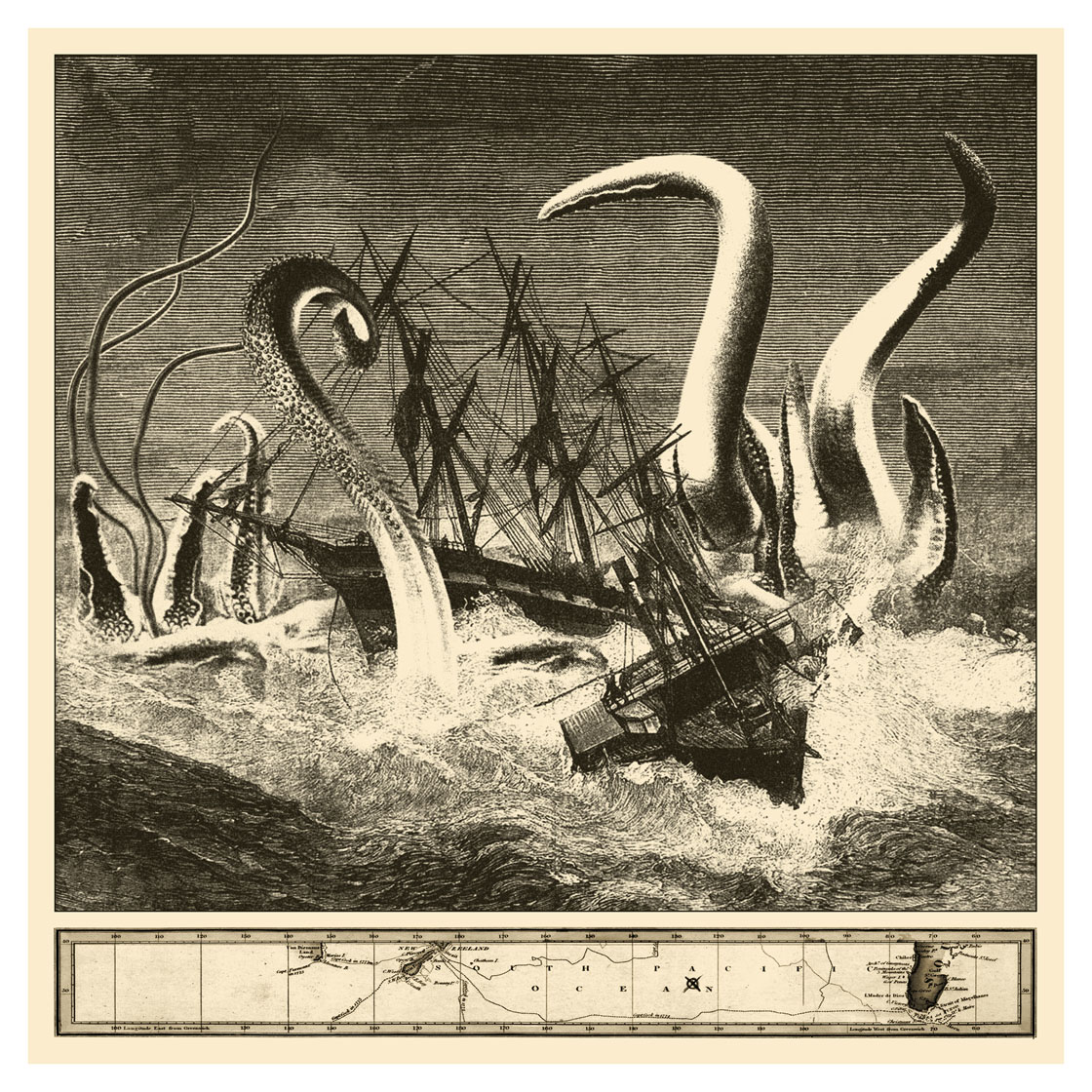
For the final piece I decided against doing another portrait in favour of a picture of an attack at sea as it might have appeared in a 19th-century newspaper. This kind of imagery will now make many people think of the Kraken scenes in the second Pirates of the Caribbean film but it predates cinema, of course, as it also predates Lovecraft. Despite Lovecraft’s indelible association with monstrous tentacles there are a lot more incidents of this nature in William Hope Hodgson’s stories and novels than in the Cthulhu Mythos. In which case this scene, which will be the page for December, can be regarded as a tip of the hat to William as much as to Howard.

Elsewhere on { feuilleton }
The Lovecraft archive

Books of blood

kushner1.jpg

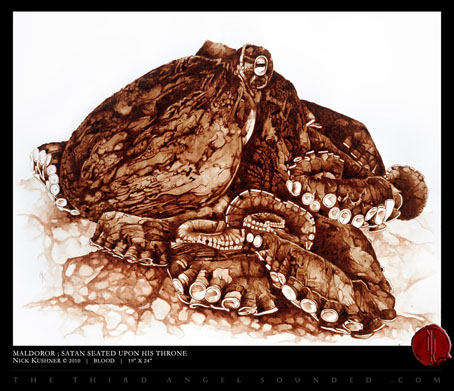
Artist Nick Kushner writes to alert me that his 2010 painting Maldoror: Satan Seated Upon His Throne has been used on the cover of a recent Russian edition of Lautréamont’s novel. Kushner uses his own blood to create his paintings, and the cover below has been created using the same material. Maldoror himself would no doubt demand that proper homage be paid by binding the volume in human skin. That’s something publisher Provocateurs’ Club can maybe try for the special edition.

kushner2.jpg

This news has reminded me that I had a mail last month from another American artist, Robert Sherer, concerning a book collection of his own blood paintings. Sherer also uses the blood of friends both HIV-negative and HIV-positive. Blood Works: The Sanguineous Art of Robert Sherer is published by Kennesaw State University Press.

Previously on { feuilleton }
Magritte’s Maldoror
Frans De Geetere’s illustrated Maldoror
The art of Robert Sherer
Maldoror illustrated

Weekend links 123

niceron.jpg

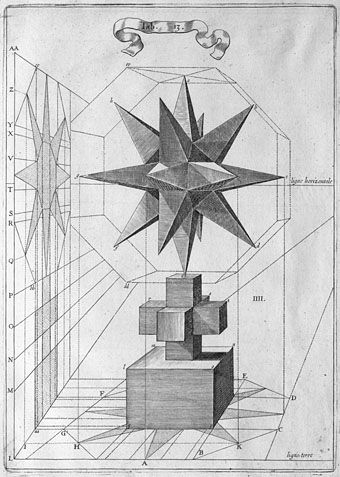
La Perspective Curieuse (1663) by Jean François Nicéron. From Curious Perspectives at BibliOdyssey.

1612 Underture is a forthcoming album by The Eccentronic Research Council and Maxine Peake which extends the electronics + occult concept to encompass Kraftwerk and the Pendle Witches. The Quietus has a review of their album, and an interview and report about a recent live performance (I missed the latter, unfortunately), while the Guardian’s interview with the splendid Ms Peake reveals that “musically, her tastes range from Japanese black metal, garage rock and folk, to techno and psychobilly.” The famous Lancashire witches also happen to be the subject of Jeanette Winterson’s latest novel, The Daylight Gate.

• Yet more Marker: The Owl’s Legacy: Chris Marker’s 13-Part Search for Western Culture’s Foundations in Ancient Greece, and J. Hoberman on The Lost Futures of Chris Marker.

Dr Oliver Sacks talks about how hallucinogenic drugs helped him empathize with his patients.

Paulo Coelho’s ill-judged Joyce-bashing has made him a butt of scorn this week, but he’s a safe target because, with books that multitask a little too openly as self-help manuals, he’s not so clubbable. Unlike, say, Ian McEwan, who not-that-differently declared against “the dead hand of modernism“, for all the world as if the dominant literary mode in post-war England was Steinian experimentation or some Albion Oulipo, against which young Turks hold out with limpidly observed interiority, decodable metaphors, strained middle-class relationships and eternal truths of the human condition(TM).

China Miéville on the always contentious future of the novel.

The Foliate Head: a new book by Marly Youmans with illustrations by Clive Hicks-Jenkins.

Hysterical Literature: Session Two: Alicia reads from Leaves of Grass by Walt Whitman.

Dreaming in Dirigibles: The Airship Postcard Albums of Lord Ventry.

The Art of the Literary Fake (with Violin) by Jeff VanderMeer.

RIP Neil Armstrong, first human on the Moon.

Macho Man: Morgan Meis on Robert Hughes.

• Book covers by Hannes Bok.

This Is Now!

Squid Moth

Lunar Rhapsody (1947) by Dr Samuel J. Hoffman | Lunar Musick Suite (1976) by Steve Hillage | Back Side Of The Moon (Steve Hillage’s Under Water Deep Space Remix) (1991) by The Orb.

Sea and Land: An Illustrated History

sealand1.jpg

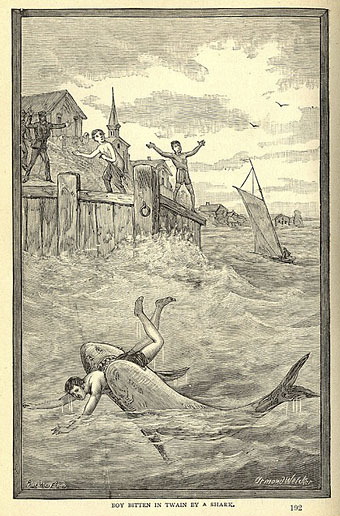
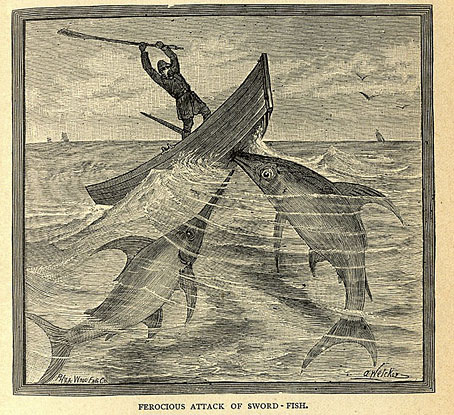
It’s all fun and games until someone gets bitten in twain by a shark. Illustrations from a Flickr selection of plates from Sea and Land: An Illustrated History (1887) by JW Buel, a compendium of stories about the natural world which tend towards the sensational. Many of these pictures are from what I call the “Die you brute!” school of illustration, in which exotic fauna is always on the rampage and needs to be violently subdued before someone is eaten alive (or bitten in twain). Buel’s book reprints pictures from other volumes including Gustave Doré’s Rime of the Ancient Mariner while one of the tentacled fiends below is an oft-reprinted item by Alphonse de Neuville & Edouard Riou from Twenty Thousand Leagues Under the Sea. The only copy of Sea and Land at the Internet Archive is poor quality, unfortunately; being partial to Victorian sensation I wouldn’t mind seeing the whole thing.

sealand2.jpg

sealand3.jpg

Continue reading “Sea and Land: An Illustrated History”