The Secret World of Odilon Redon

redon.jpg

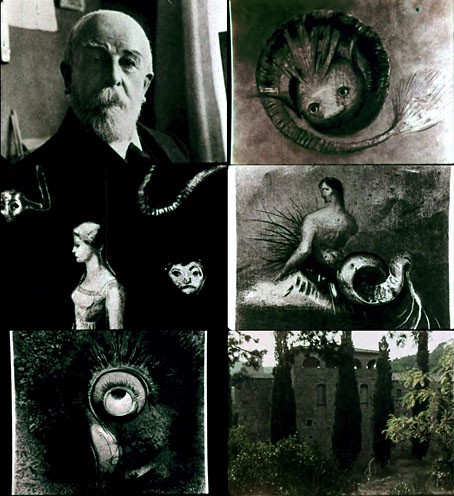
Documentaries about French artist Odilon Redon aren’t very common at all so it’s a shame this one isn’t better quality. The Secret World of Odilon Redon is another introductory film from the Arts Council of Great Britain, made in 1973, the same year as Magritte: The False Mirror. The print is in even worse condition than the Magritte, with washed-out colour and a quavering score that sounds like it was taken from a mispressed record; but the voiceover by Richard Hurndall makes it worthwhile, a series of quotes from Redon’s memoirs, in which the artist discusses his work and his philosophy. The accompanying visuals, which include views of places where he lived and worked, do nothing for the vivid colours of his pastel drawings but if you want those there are plenty of other resources elsewhere.

For a more Surrealist approach there’s Guy Maddin’s Odilon Redon, or The Eye Like a Strange Balloon Mounts Toward Infinity, a dreamlike excursion into the strange world of the artist’s etchings.

Previously on { feuilleton }
Odilon Redon’s Temptations
More chimeras
Odilon Redon’s musical afterlife
Odilon Redon and Magazine
Odilon Redon lithographs
The eyes of Odilon Redon

Switched On again (again)

stereolab.jpg

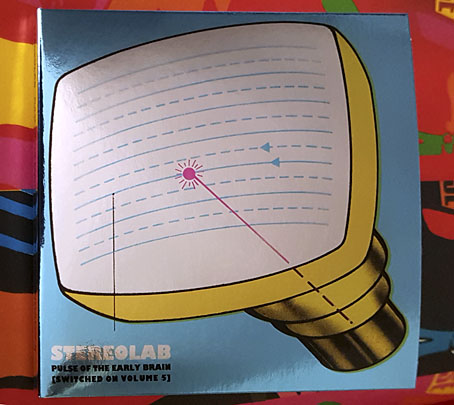
The soundtrack for this weekend is the fifth volume in Stereolab’s Switched On series of compilation albums; the subtitle this time, Pulse Of The Early Brain, is another of those titles I won’t be surprised to encounter in an unlikely place at some point in the future. These albums are always very welcome for those of us who don’t bother collecting limited single releases. The main highlight of the new set is the Nurse With Wound collaboration from 1997, Simple Headphone Mind, a 12-inch which contained over 30-minutes of music. Heard in retrospect, these recordings push the group into territory that Tim Gane would explore in Cavern Of Anti-Matter, especially on the title track, a 10-minute groove that wouldn’t be out of place on a Brain release from 1972. (Maybe this is the Brain being alluded to in that subtitle?) Elsewhere on the compilation there’s the whole of the Lo Fi EP from 1993, an odd omission from previous collections (and which I already had but thanks anyway…), plus a number of previously unreleased recordings. The hard-to-photograph mirror packaging is designed by Vanina Schmitt.

Previously on { feuilleton }
Switched On again

Weekend links 637

wong.jpg

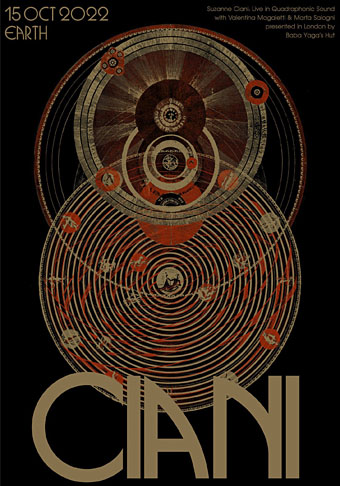
A Risograph print by Raimund Wong for a forthcoming London concert by Suzanne Ciani. Via.

• “What makes him such an exemplary film composer is the adroitness with which he used style as a catalyst, conspiring with directors to illuminate crucial elements of character, tone, and plot through the expressive resources at his disposal.” Nate Chinen on Henry Mancini, a timely piece since I’ve been watching a lot of film noir recently, including two of the features mentioned there, Touch of Evil and Experiment in Terror. The latter is an uncharacteristic thriller from Blake Edwards with a marvellous, brooding score by Mancini. Here’s the main theme.

• “Infinitesimal as they are, phytoplankton produce more oxygen than all the world’s rainforests combined and roughly half of the oxygen on the planet—in other words, roughly half of the air we humans breathe.” David Greer on the importance of plankton.

• “Someday I’ll come into a place and someone’s playing my music and I’ll leave immediately because I don’t want to go through the editorial process again!” Diamanda Galás talking to Kevin Mccaighy about her new album, Broken Gargoyles.

• At Dennis Cooper’s: 25 experimental horror films. Not sure I’d class Night of the Lepus as “experimental”—”rubbish” would be more accurate—but you may disagree.

• Coming soon from Strange Attractor: 69 Exhibition Road: Twelve True-Life Tales from the Fag End of Punk, Porn & Performance by Dorothy Max Prior.

• At Spoon & Tamago: Gunkanjima (aka Battleship Island) from above: exploring what was once the world’s most-densely populated city.

• Previews of pages from A Tiger in the Land of Dreams by Tiger Tateishi, newly reprinted by 50 Watts Books.

• Mix of the week: A mix for The Wire by Ali Safi of the Marionette label.

• New music: Verde Pino by Beautify Junkyards.

Mark Pawson & Disinfotainment

Tiger Rag (1929) by Duke Ellington And His Orchestra | Night Of The Tiger (1959) by The Markko Polo Adventurers | Tiger (1967) by Brian Auger & The Trinity

Broken Down Film by Osamu Tezuka

tezuka.jpg

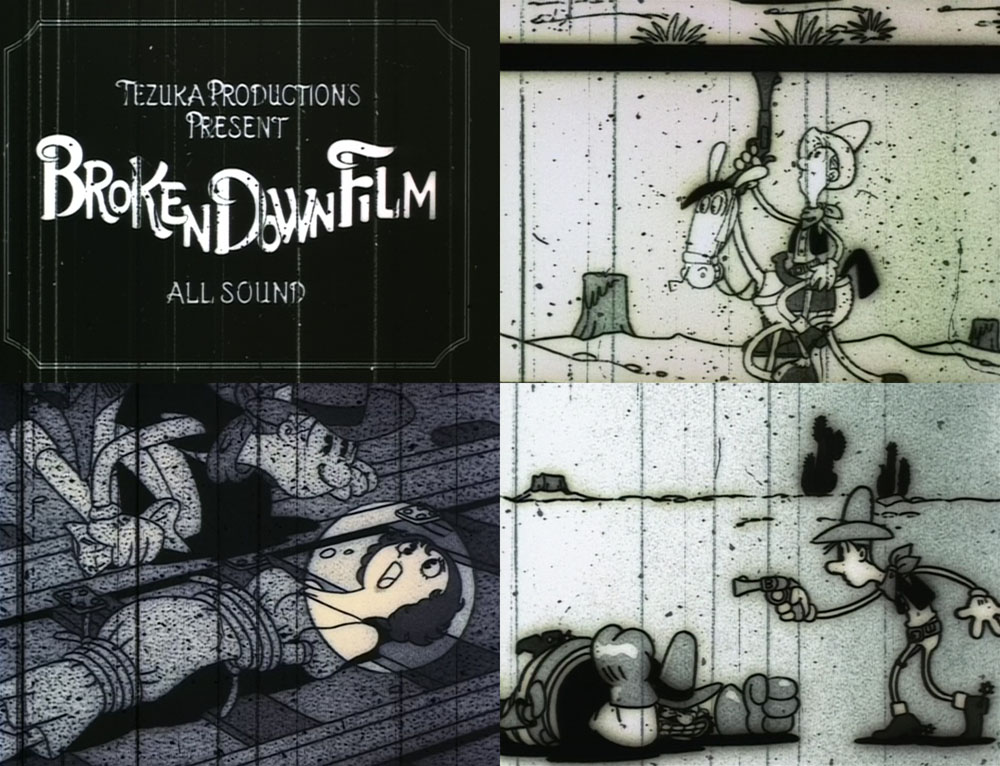
Astro Boy creator Osamu Tezuka directed a handful of short films throughout his career in which he used a reduced running time to try things that might not work so well at feature length. The shorts are often labelled “experimental”, which some of them are, although the term “playful” would be a better description for others. Broken Down Film (1985) is one of the latter, a Fleisher-like silent Western with a trio of stock characters and a stereotyped narrative that includes a gunfight (almost), and a heroine tied to a rail track. The playfulness is in the presentation which imitates all the material problems that can afflict a reel of film, from projection mishaps to various forms of damage, some of which impinge themselves on the characters. Tex Avery occasionally played with the medium in this way (I think it’s one of the Droopy cartoons where a character runs off the edge of the film) but even Avery never took things this far. The uncredited music, by the way, is Snake Rag by King Oliver’s Jazz Band.

Previously on { feuilleton }
Jumping, a film by Osamu Tezuka

Art on film: Je t’aime, Je t’aime

resnais1.jpg

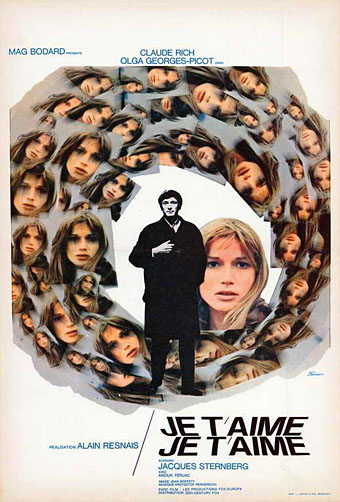
Design by René Ferracci.

Continuing an occasional series about artworks in feature films with a return to Alain Resnais. This one is less substantial than the Providence post, but 2022 happens to be the director’s centenary year, and this particular film, like Providence, is worthy of greater attention.

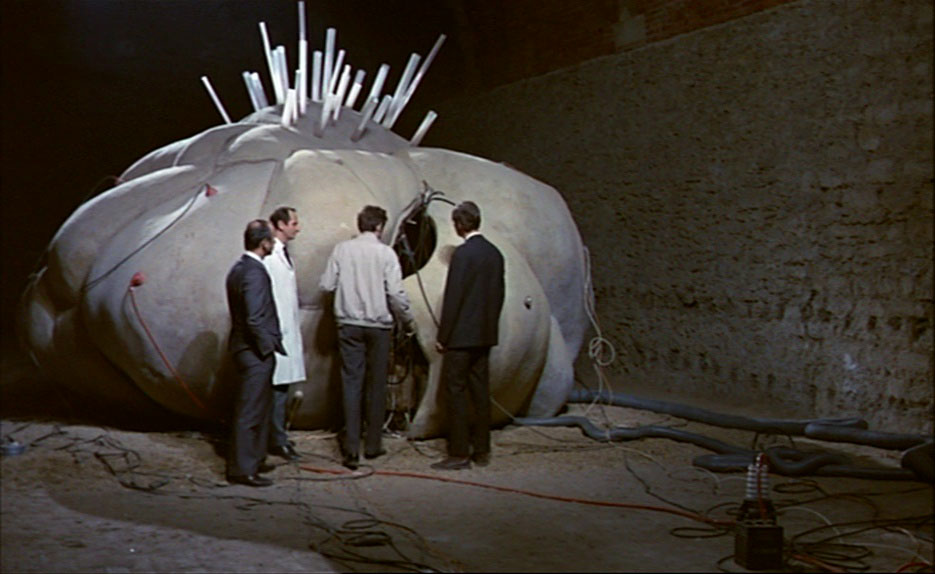
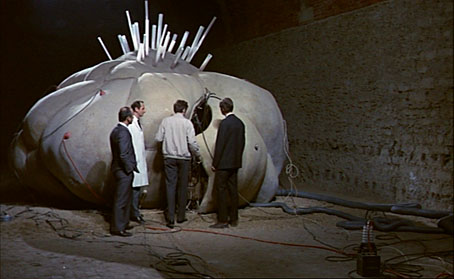
Last Year at Marienbad is occasionally proposed as science fiction of a very rarified sort (JG Ballard thought it was) but there’s no question about the SF credentials of Je t’aime, Je t’aime (1968), a drama that uses time travel to explore a troubled romantic relationship. Claude Ridder (Claude Rich), an unattached, suicidal man, is persuaded by scientists to assist with a potentially hazardous experiment. He agrees to a one-minute excursion into his past but the experiment doesn’t work as intended, causing him to be caught between the present—in which he can’t escape from a womb-like time machine—and his recent past, in which he relives brief moments without any awareness during the return period of their being a part of the experiment. The flashbacks that comprise most of the film’s running time show us a random sequence of the events leading to Claude’s suicide attempt, the end result of his relationship with his terminally ill partner, Catrine (Olga Georges-Picot).
resnais2.jpg

The time machine.

Despite the presence of a time machine and a script by Jacques Sternberg, a Belgian science-fiction writer, Resnais was adamant that Je t’aime, Je t’aime wasn’t a science-fiction film. This is the kind of comment guaranteed to annoy the more zealous SF reader but it’s true in the sense that the film isn’t about time travel or time machines per se; the temporal experiment is a device to allow the non-linear exploration of a human drama that’s the real concern of director and writer. Previous Resnais films had dealt with remembrance of one sort or another, often using flash cuts to juxtapose different moments or scenes remembered or imagined. Je t’aime, Je t’aime pushes these techniques to an extreme, showing us every facet of the Claude/Catrine relationship, from initial meeting to tragic end. The narrative fragmentation isn’t so surprising today but it was a radical step in 1968, one that proved commercially unsuccessful.

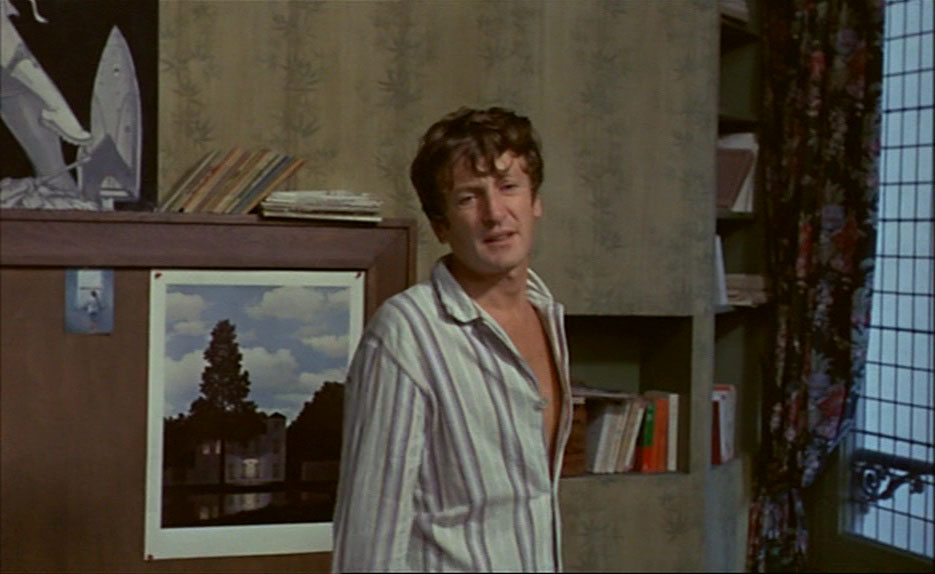
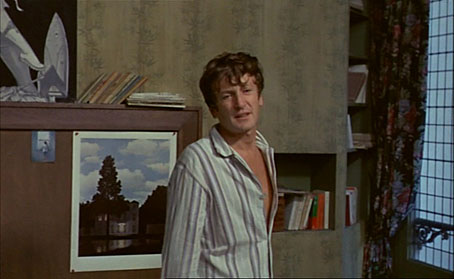
In addition to having a Belgian writer, Je t’aime, Je t’aime is mostly set in Brussels, so the art this time is a famous Belgian painting, one of the many versions of The Empire of Light by René Magritte, which appears in the scenes in Claude’s apartment.
resnais3.jpg

In other hands this might be an incidental decoration but, as Providence demonstrates, Resnais was a director who enjoyed significant details, even if the signification isn’t always obvious. The Magritte painting serves two functions: its slow migration from one side of Claude’s apartment to the other (and the appearance of other pictures around it) shows the passage of time from one flashback to the next.

Continue reading “Art on film: Je t’aime, Je t’aime”