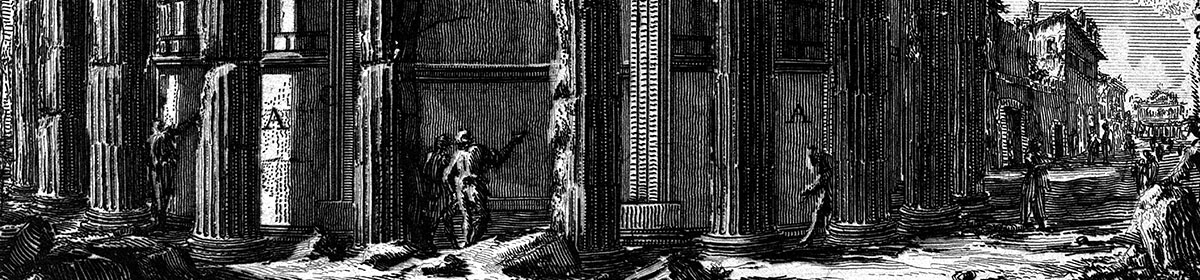
Fifty neglected novels
Ballard, Vikings and Samuel Johnson.
The art of Matthew Stradling
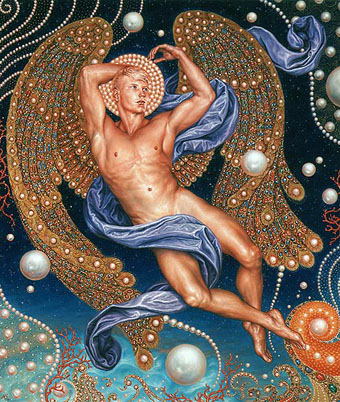
Angel (no date).
Lots more lavish and erotic work at Matthew Stradling’s site.
Thanks again to Thom for the tip!
Elsewhere on { feuilleton }
• The gay artists archive
Previously on { feuilleton }
• Obverse Paintings by Fred Chuang
• The art of Jacques Sultana
• The art of Lucio Bubacco
• The art of Hubert Stowitts, 1892–1953
Olafur Eliasson’s Serpentine Pavilion
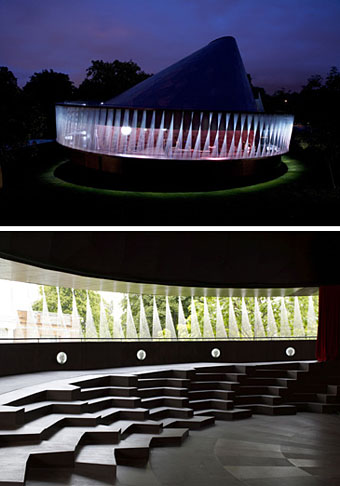
The Serpentine Gallery Pavilion 2007, designed by the internationally acclaimed artist Olafur Eliasson and the award-winning Norwegian architect Kjetil Thorsen, of the architectural practice Snøhetta, is now open to the public and will remain on site until November 2007.
The Pavilion acts as a “laboratory” every Friday night with artists, architects, academics and scientists leading a series of public experiments. The programme, conceived by Eliasson and Thorsen with the Serpentine, will begin in September and culminate in an extraordinary, two-part, 48-hour marathon laboratory event exploring the architecture of the senses.
The Serpentine Pavilion 2007 is a spectacular and dynamic building. The timber-clad structure resembles a spinning top and brings a dramatic vertical dimension to the more usual single level Pavilion. A wide spiralling ramp makes two complete turns, ascending from the Gallery’s lawn to the seating area and continues upwards, culminating at the highest point in a view across Kensington Gardens and down into the chamber below.
Danish-Icelandic artist Olafur Eliasson is based in Berlin where he established Studio Olafur Eliasson, a laboratory for spatial research. His work explores the relationship between individuals and their surroundings, as experienced in his awe-inspiring large-scale installation The weather project, 2003, at Tate Modern. Publisher of a new magazine that melds artistic and architectural experimentation, Eliasson is currently involved in numerous architectural projects such as the Icelandic National Concert and Conference Centre in Reykjavik (design of the building envelope).
He is collaborating with the Hirshhorn Museum and Sculpture Garden, Washington D.C., on a project that reconsiders the Museum’s communicative potential, and he recently won the competition for a large rooftop extension at ARoS Aarhus Kunstmuseum, Denmark.
Kjetil Thorsen is co-founder of Snøhetta, one of Scandinavia’s leading architectural practices, with offices in Oslo and New York. The Bibliotheca Alexandrina, Egypt, 1995–2001, is the commission that brought Snøhetta to international acclaim. Thorsen is responsible for the design of award-winning public buildings globally, and has collaborated with Eliasson several times, including The Opera House, Olso, currently under construction. He is a founder of Galleri Rom, Oslo, which focuses on the intersection of architecture and art, and is a member of the Norwegian Architectural Association (NAL) and the American Institute of Architects (AIA). He is also Professor at the Institute for Experimental Studies in Architecture at the University of Innsbruck, Austria.
Previously on { feuilleton }
• The London Oasis
• New Olafur Eliasson
Alexandre Alexeieff and Claire Parker
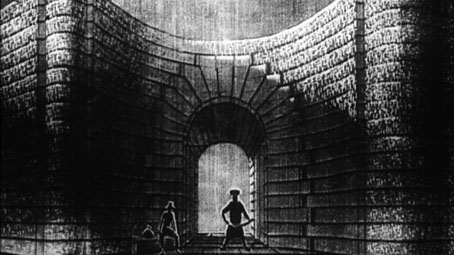
Before the Law from The Trial (1962).
I’d wanted to write something about this pair of animators last year but at the time there was none of their work available for online viewing. This situation has now been remedied thanks to the ubiquitous YouTube.
This is Kafka-related once again since most people have seen Alexeieff/Parker’s work—if at all—in the prologue they provided in 1962 for Orson Welles’ film of The Trial. Alexandre Alexeieff was a Russian illustrator and animator who met Claire Parker, an American art student, in Paris in 1930. The pair formed a life-long partnership and together developed a new style of animation using a pinscreen, a white board containing thousands of pins whose shadows when pushed out of the board provide the grey tones required to create a picture. At the time they began working with this most animation was flat and cartoony; the pinscreen enabled them to create the kind of subtleties of shading seen in pencil and ink drawing. Many of the effects they created are stunningly lifelike.
The prologue for The Trial is a pictorial rendering of Kafka’s parable, Before the Law, which Welles narrates. This is an impressive piece (and I always loved the distinctive Piranesi-style walls) but for a real taste of their breathtaking skill you need to see Night on Bald Mountain, whose Goya-like transformations precede Disney’s Fantasia version by nearly a decade, or their adaptation of Gogol’s The Nose. It’s a shame that YouTube’s compression degrades much of the detail in these films, they really deserve to be seen on a bigger screen, but—as with many of these obscurities—it’s good to know they’re available at all.
Alexeieff and Parker on YouTube:
• Night on Bald Mountain (1933)
• En Passant (1944)
• Before the Law (1962)
• The Nose pt. 1 | The Nose pt. 2 (1963)
Previously on { feuilleton }
• Steven Soderbergh’s Kafka
Gallery of Book Trade Labels
Gallery of Book Trade Labels
Marvellous.