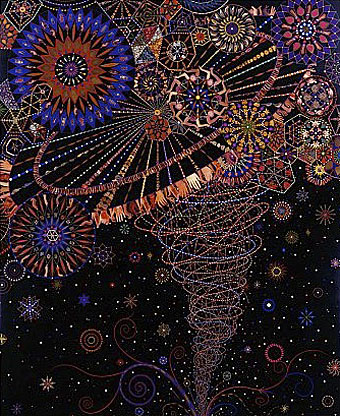
Abductor (2006).
Two examples from this gallery selection. There’s more at White Cube.

Halo of Flies (2006).
Previously on { feuilleton }
• Yoshitaka Amano in Berlin
• Visions and the art of Nick Hyde
• AVAF at Mao Mag
A journal by artist and designer John Coulthart.
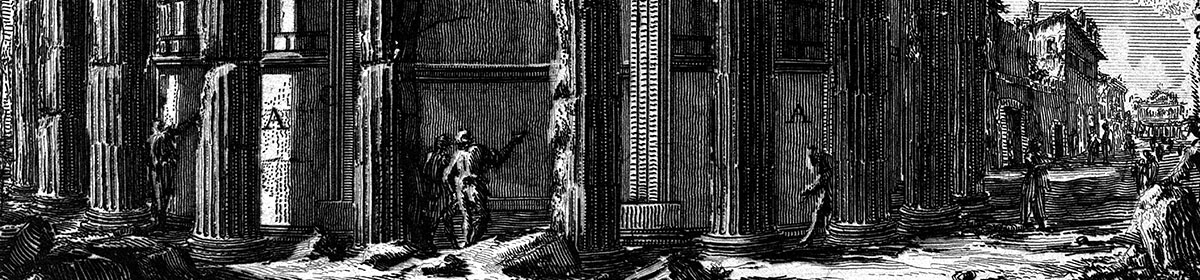
Abductor (2006).
Two examples from this gallery selection. There’s more at White Cube.
Halo of Flies (2006).
Previously on { feuilleton }
• Yoshitaka Amano in Berlin
• Visions and the art of Nick Hyde
• AVAF at Mao Mag
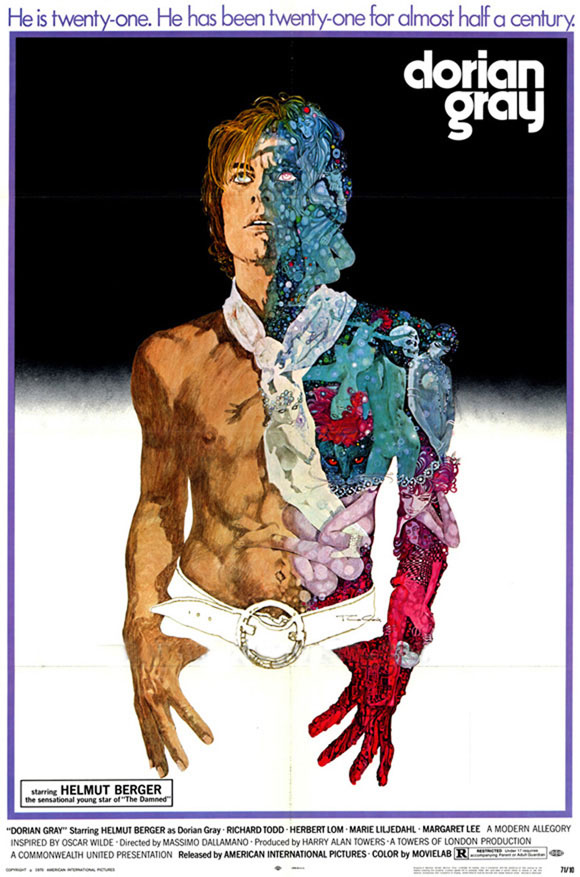
The 1970 screen adaptation of Dorian Gray by Massimo Dallamano is one film version I’ve yet to see. Given that it’s a production of notorious schlock merchants Samuel Z Arkoff and Harry Alan Towers I wouldn’t expect too much although it does have Helmut Berger as the star when he was at the height of his pulchritude. And I really like this Klimt-esque poster, a typical piece of Seventies design with an illustration that resembles many of the trendier European comic strips of the period. I’ve no idea who the artist was despite there being a scrawled signature. If anyone has a clue, please leave a comment.
Update: The artist is Ted Coconis.
• A lengthy review at Cinebeats
Elsewhere on { feuilleton }
• The Oscar Wilde archive
Sexual healing
| Simon Callow on gay roles in cinema.
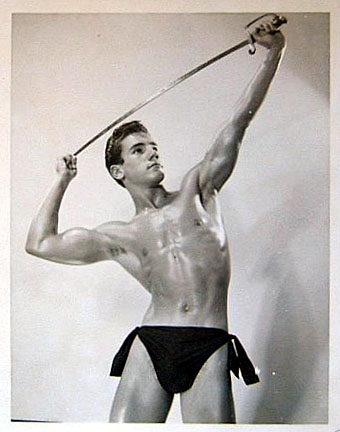
Even though I never really noticed before it’s become fairly obvious that adding a sword to a beefcake photo was a way of lending some spurious historicity to an otherwise overt piece of male nudity, the cheap version of having models pose among Greek or Roman ruins. Not that I’m complaining, of course. This example comes from Bob Anthony’s New York studio of the 1960s. Thanks to Aristan for the tip!
Elsewhere on { feuilleton }
• The men with swords archive
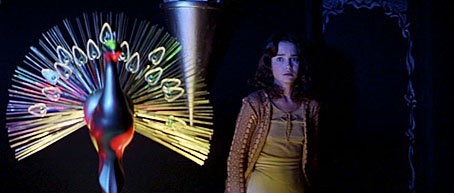
Suspiria: Jessica Harper and a bird with crystal plumage.
For this year’s Halloween playlist I’ve let Mark Pilkington from Strange Attractor make the selection. The following is from a CD-R collection of Italian horror soundtracks that Mark sent me some time ago. Not everything here is easy to find but the superbly nerve-jangling racket created by Goblin to accompany Dario Argento’s equally superb Suspiria (1977) is widely available and ideal Halloween listening.
If one hasn’t been written already, there’s probably a thesis to be found in the influence of progressive rock on Italian cinema. Many of these pieces represent a curious blending of the kind of Italian prog-rock exemplified by bands such as PFM together with the scores of (inevitably) Ennio Morricone. William Friedkin’s use of the opening of Mike Oldfield’s Tubular Bells in The Exorcist inspired legions of imitative themes in subsequent horror films, not least Suspiria. Dario Argento later brought in ELP’s Keith Emerson for the sequel, Inferno (1980), whose main theme—a kind of disco version of Jerry Goldsmith’s Latin chants from The Omen—I’ve always been rather partial to. The best of this music manages to be groovy and scary at the same time, Goblin being the masters in that department, and is often better than the films it was written for. The perfect thing for zombies in satin flares.
Cannibal Holocaust (Main theme) by Riz Ortolani
Death Dies (Profondo Rosso) by Goblin
Zombie Flesh Eaters (theme) by Fabio Frizzi
Sighs (Suspiria) by Goblin
Suoni Dissonanti (City of the Living Dead) by Fabio Frizzi
Flashing (Tenebrae) by Goblin
Adulteress’ Punishment (Cannibal Holocaust) by Riz Ortolani
Suspiria by Goblin
Voci Dal Nulla (The Beyond) by Fabio Frizzi
Deep Shadows (Profondo Rosso) by Giorgio Gaslini & Goblin
L’alba Dei Morti Viventi (Dawn of the Dead) by Goblin
Suono Aperto (The Beyond) by Fabio Frizzi
Markos (Suspiria) by Goblin
The Dead On Main St/Voodoo Rising (Zombie Flesh Eaters) by Fabio Frizzi
Escape From The Flesh Eaters (Zombie Flesh Eaters) by Fabio Frizzi
Roller (Non-soundtrack album) by Goblin
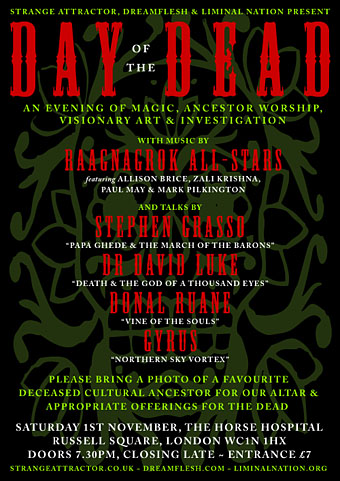
And while we’re on the subject of music and Halloween, Mark Pilkington is playing as part of the Raagnagrok All-Stars on November 1st at the Horse Hospital, London, as part of a Day of the Dead event. More about that here.
Happy Halloween!
Previously on { feuilleton }
• Another playlist for Halloween
• White Noise: Electric Storms, Radiophonics and the Delian Mode
• The Séance at Hobs Lane
• A playlist for Halloween
• Ghost Box