
One beetle, it seems. Klaus Bolte’s 40 X photograph is one of National Geographic‘s Best Microscopic Images of 2008.
Previously on { feuilleton }
• The art of Jo Whaley
• Endangered insects postage stamps
A journal by artist and designer John Coulthart.

One beetle, it seems. Klaus Bolte’s 40 X photograph is one of National Geographic‘s Best Microscopic Images of 2008.
Previously on { feuilleton }
• The art of Jo Whaley
• Endangered insects postage stamps
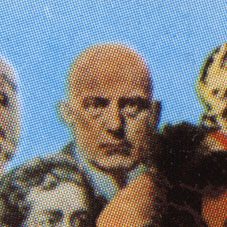 The appearance of occultist Aleister Crowley on the sleeve of Sgt Pepper is well-documented—here he is looking rather grainy on my CD insert—although I always forget which of the Beatles it was who put him in the list of “people that we like”. I’d guess John Lennon who would have appreciated Crowley’s obscene poetry, copious drug intake and ability to consistently épater la bourgeoisie.
Less well-known is what I presume must be the first outing for Crowley’s voice on this rare undated single from the mid-Seventies. Along with the cassette tapes I discussed earlier, this was another item turned up during a recent clearout of household junk. I’ve yet to see a detailed description of the origin of these Crowley recordings. I have the first CD pressing and haven’t looked at later editions so can’t say whether they contain more information about what are supposed to be wax cylinder recordings copied to acetates. The first complete collection of the recordings was a vinyl release produced by David Tibet in a limited edition in 1986. I was among those that ordered a copy.
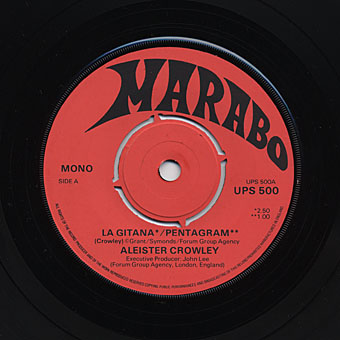
The Marabo single features two of the same recordings, of course, albeit in slightly poorer quality. (And I love the way it has a removable centre, as though it might well end up in a jukebox.) One feature of the continual reissuing of Crowley the recordings is that sound quality has improved over the years. The versions of The Pentagram and La Gitana on YouTube sound better than the ones on my CD. The occult resonance of Crowley’s voice (which always reminds me of Winston Churchill) have inevitably made it a popular sampling source. In the pre-sampling era 23 Skidoo and Psychic TV (both with David Tibet) used loops of the Enochian Calls. Bill Laswell later took to using samples on his ambient releases, while the most recent CD version includes an entire disc of ambience with Crowley’s voice subjected to digital processing.
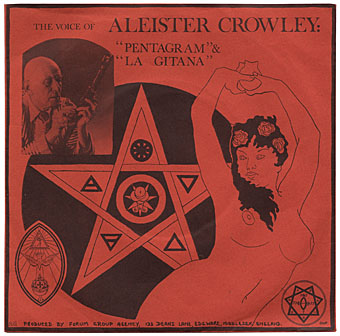
The sleeve art for the single was by Steffi Grant, occultist wife of occultist Kenneth Grant, and it’s possible the pair sing backing vocals on the less-than-compelling B-side, a soft rock number entitled Scarlet Woman by Chakra. The song is credited to “Ponton/Ayers/Grant/Magee” so even if one or other of the Grants didn’t sing they helped with the lyrics. It should be noted that Mrs Grant’s artwork is often better than these illustrations and does much to enliven her husband’s volumes of occult philosophy. Some of their work was also featured in the seven-volume encyclopedia, Man, Myth and Magic, which featured Kenneth among the staff of consultants.
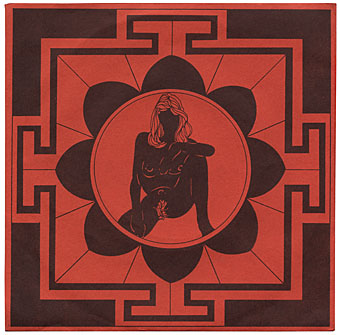
Before anyone asks: no, the single isn’t for sale. I’ve sold a lot of old vinyl over the past few years but I’m keeping this particular item. I know a couple of unreleased recordings by Chakra exist; if anyone has further information about the group, please leave a comment.
Update: Jok posted a link which resolves the mystery. It was indeed Kenneth Grant on backing vocals.
Previously on { feuilleton }
• Old music and old technology
• The Man We Want to Hang by Kenneth Anger
• The art of Cameron, 1922–1995
• Austin Osman Spare
Brits abroad
| When Maupassant met Swinburne.

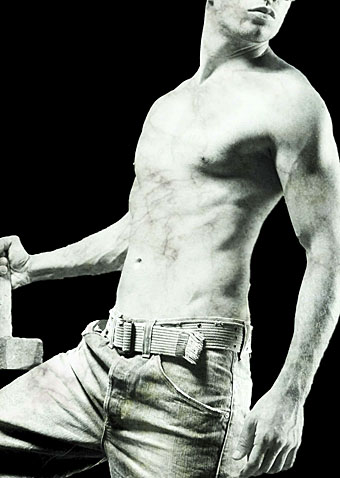
More unclothed men with swords and another vintage example, shamelessly swiped from Planet Fabulon.
And while we’re on the subject of men, the Kangaroo Court Theatre Company has another new adaptation of The Picture of Dorian Gray (Matthew Bourne’s dance version is still touring) opening this week at the Tabard Theatre, London.
A daring musical adaptation transports Oscar Wilde’s masterpiece into our own celebrity-obsessed, gossip-driven times – complete with shallow pop stars, sex-crazed artists and sleazy journalists. Co-produced with Kangaroo Court Theatre Company, this new adaptation of Dorian Gray updates the story incorporating new technology and an original musical score.
The company’s site has a few more details. The way they’re using the picture below to promote the work I think we can guess the audience they’re going for.
Elsewhere on { feuilleton }
• The men with swords archive
Previously on { feuilleton }
• Matthew Bourne’s Dorian Gray
• John Osborne’s Dorian Gray
• Dorian Gray revisited
• The Picture of Dorian Gray I & II
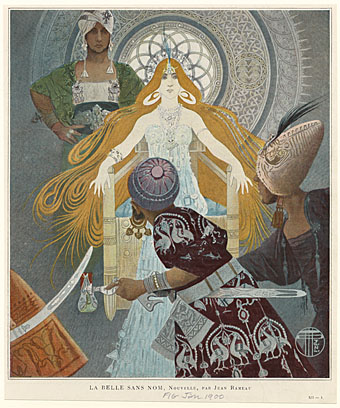
La belle sans nom (1900).
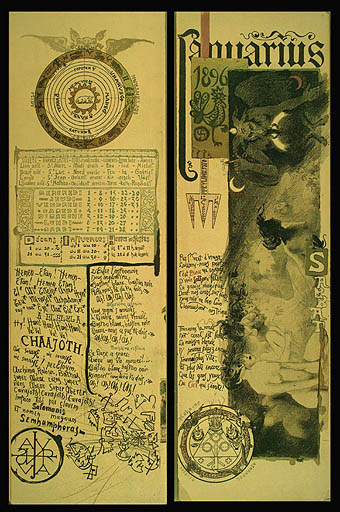
An illustration by French artist Manuel Orazi (1860–1934) from Figaro illustré for a story by Jean Rameau. Via NYPL Digital Gallery. It’s good to see something else by Orazi other than advertising illustration. His astonishing work for Austin De Croze’s 1895 Calendrier Magique (below) can be seen in full at the Cornell collection. Great graphics for Halloween.
Elsewhere on { feuilleton }
• The illustrators archive
Previously on { feuilleton }
• The Feminine Sphinx
• Le Monstre
• Carlos Schwabe’s Fleurs du Mal
• Empusa