Mikel Marton

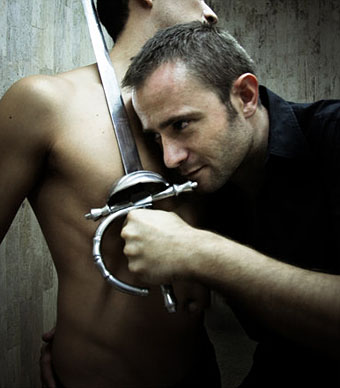
sailor.jpg

Mikel by Mikel.

Delectable Canadian photographer and self-proclaimed “renowned exhibitionist” Mikel Marton (aka Toxicboy) has finally moved from LiveJournal to Blogger. Looks like postings there of himself and his models will be more regular than before which is good to see. And his Toxicboy site is still active, of course.

Previously on { feuilleton }
Tiger Lily
Toxicboy

The art of John Hurford

hurford.jpg

Oz #45, November 1972.

This large-format issue of Oz magazine with John Hurford’s cover was one of the last published and is also one of the few issues I own. Hurford provided many interior illustrations for Oz and other magazines, as well as producing poster art and other graphics. Unlike many artists of the period he’s still active and has his own site with examples of recent work. For more Oz covers, go here.

Elsewhere on { feuilleton }
The illustrators archive

Previously on { feuilleton }
The art of Bertrand
Barney Bubbles: artist and designer
Oz magazine, 1967–73

More Barney Bubbles

reasons.jpg

For those who’ve been eagerly awaiting Paul Gorman’s Barney Bubbles monograph, here’s the latest. Readers in the UK may also like to know there’s a feature about the book in the current issue of The Word. By coincidence, if you turn the page in the magazine there’s another feature about the Rob Gretton book I designed recently, 1 Top Class Manager. And for coincidence overload, designer Peter Saville turns up in both volumes.

Reasons To Be Cheerful: The Life and Work of Barney Bubbles
By Paul Gorman

“Barney Bubbles is the missing link between pop and culture” Peter Saville

REASONS TO BE CHEERFUL is a lavishly illustrated celebration of the creative legacy of one of the most mysterious yet influential figures in graphic design: Barney Bubbles.

Bubbles – who died 25 years ago – links the colourful underground optimism of the 1960s to the sardonic and manipulative art which accompanied punk’s explosion a decade later.

Producing extraordinary artwork under the shroud of anonymity and a number of pseudonyms, in the 60s Bubbles created early posters for the Rolling Stones, brand and product design for Sir Terence Conran and psychedelic lightshows for the Pink Floyd.

He was also responsible for the art direction of underground magazines Oz and Frendz and the masthead for rock weekly the NME, and is best known for a plethora of stunning record sleeves, logos, insignia and promo videos for musicians and performers, from counter-culture collective Hawkwind to new wave stars Elvis Costello, Ian Dury, Nick Lowe, Graham Parker, The Damned, Billy Bragg, Squeeze, Depeche Mode and The Specials.

Meticulously researched with 600 images, REASONS TO BE CHEERFUL is the first and definitive investigation into Bubbles’ life and work, with interviews and contributions from family and close friends, college pals and workmates as well as collaborators including pop artist Derek Boshier, author Michael Moorcock and photographer Brian Griffin.

Incorporating many previously unpublished images, REASONS TO BE CHEERFUL is also the only comprehensive collection of Bubbles’ output over a 30-year period: every important record sleeve, poster and advertisement as well as examples of his excursions into abstract portraiture, book design and furniture, supported by student sketchbooks, working drawings, film proposals and personal photographs and correspondence.

Singer-songwriter Billy Bragg has contributed the foreword, graphic designer Peter Saville an essay on the significance of Bubbles’ oeuvre and his contemporary Malcolm Garrett a personal memoir.

REASONS TO BE CHEERFUL is published on December 4 2008.

Trim size: 280mm x 230mm
Binding: Hardback
Pages: 224
Words: 55,000
Images: 600
RRP: £24.99

And while we’re on the subject, Barney Bubbles enthusiasts Rebecca & Mike left news on the original BB posting about a forthcoming exhibition of work by photographer Brian Griffin.

On show will be the newspaper ‘Y’, the books ‘Copyright 1978′ and ‘Power’, and associated posters, including the ‘coat hanger and scarf’ poster for Brian’s photo show in 1980. All of these (apart from ‘Power’) will be available to buy too (we think)… so, if you want to, you can bag yourself an early Christmas present (and help put some turkey on Brian’s table!)

Here’s the details: Brian Griffin, 15 November – 8 December 2008 , Monday – Saturday 11 – 6, at ‘England & Co.’, 216 Westbourne Grove, London W11 2RH.

The ‘Y’ newspaper’s got a real chunky red button on the cover (in a little plastic bag); symbolic of the nuclear button we-thinks, and there’s a great concentric circle graphic on the cover too, which is reminiscent of a few things, like the back of the not-used Dury ‘4000 Weeks Holiday’ LP sleeve design and also the front of the never released ‘Station BPR’ LP sleeve (which was due to be the second release on Billy Bragg’s ‘Utility’ label). There’s also an illustration in ‘Y’ by Nazar Ali Khan of ICU fame.

The ‘Copyright 1978′ booklet is cool too; with nearly every one of Brian’s photos in it being accompanied by thumbnail graphics by Barney, which contain cryptically encoded comments. The one that always sticks in our mind is the one that questions whether it is good or bad to receive awards for your work.

Previously on { feuilleton }
Reasons To Be Cheerful, part 2
Reasons To Be Cheerful: the Barney Bubbles revival
Barney Bubbles: artist and designer

Aleister Crowley on vinyl

ac1.jpgThe appearance of occultist Aleister Crowley on the sleeve of Sgt Pepper is well-documented—here he is looking rather grainy on my CD insert—although I always forget which of the Beatles it was who put him in the list of “people that we like”. I’d guess John Lennon who would have appreciated Crowley’s obscene poetry, copious drug intake and ability to consistently épater la bourgeoisie.

Less well-known is what I presume must be the first outing for Crowley’s voice on this rare undated single from the mid-Seventies. Along with the cassette tapes I discussed earlier, this was another item turned up during a recent clearout of household junk. I’ve yet to see a detailed description of the origin of these Crowley recordings. I have the first CD pressing and haven’t looked at later editions so can’t say whether they contain more information about what are supposed to be wax cylinder recordings copied to acetates. The first complete collection of the recordings was a vinyl release produced by David Tibet in a limited edition in 1986. I was among those that ordered a copy.

ac4.jpg

The Marabo single features two of the same recordings, of course, albeit in slightly poorer quality. (And I love the way it has a removable centre, as though it might well end up in a jukebox.) One feature of the continual reissuing of Crowley the recordings is that sound quality has improved over the years. The versions of The Pentagram and La Gitana on YouTube sound better than the ones on my CD. The occult resonance of Crowley’s voice (which always reminds me of Winston Churchill) have inevitably made it a popular sampling source. In the pre-sampling era 23 Skidoo and Psychic TV (both with David Tibet) used loops of the Enochian Calls. Bill Laswell later took to using samples on his ambient releases, while the most recent CD version includes an entire disc of ambience with Crowley’s voice subjected to digital processing.

ac2.jpg

The sleeve art for the single was by Steffi Grant, occultist wife of occultist Kenneth Grant, and it’s possible the pair sing backing vocals on the less-than-compelling B-side, a soft rock number entitled Scarlet Woman by Chakra. The song is credited to “Ponton/Ayers/Grant/Magee” so even if one or other of the Grants didn’t sing they helped with the lyrics. It should be noted that Mrs Grant’s artwork is often better than these illustrations and does much to enliven her husband’s volumes of occult philosophy. Some of their work was also featured in the seven-volume encyclopedia, Man, Myth and Magic, which featured Kenneth among the staff of consultants.

ac3.jpg

Before anyone asks: no, the single isn’t for sale. I’ve sold a lot of old vinyl over the past few years but I’m keeping this particular item. I know a couple of unreleased recordings by Chakra exist; if anyone has further information about the group, please leave a comment.

Update: Jok posted a link which resolves the mystery. It was indeed Kenneth Grant on backing vocals.

Previously on { feuilleton }
Old music and old technology
The Man We Want to Hang by Kenneth Anger
The art of Cameron, 1922–1995
Austin Osman Spare