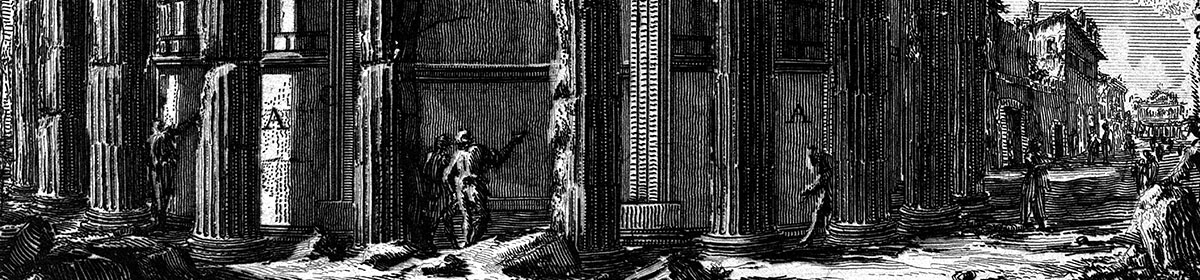
The name’s d’Eon. Chevalier d’Eon | “He was an 18th-century spy who loved to cross-dress and swordfight.”
Metronomes
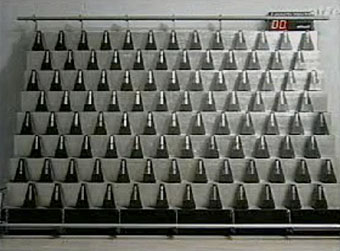
An automated performance of György Ligeti’s Poème symphonique for 100 metronomes at Ubuweb.
Since its world premiere in the Netherlands in 1963, Poème symphonique for 100 metronomes has been very rarely performed in public. The complicated scenographic staging, the detailed preparation by hand, the need for around ten technicians to activate more or less simultaneously the 100 metronomes, makes the demand for performances limited. Thirty-two years after the premiere, the sculptor and installation artist Gilles Lacombe heard a recording of the work. Impressed, he decided to invent a machine able to perform the piece automatically. After six months, he set up this ingenious device. Ever since, Poème symphonique can be performed accurately, at any time, and in public. Please understand that at its world premiere in 1963, the concert was filmed by Dutch television. On that night, after the final tick-tock of the metronome, there was a heavy silence, followed by booing, screaming, and threats. The concert was never broadcast.
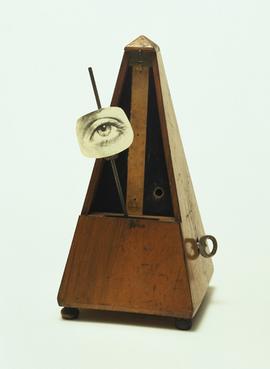
And while we’re on the subject, let’s not forget Man Ray’s Object to be Destroyed (1923) (aka Indestructible Object). Richard Cork looked at its origin and meaning for the Tate magazine.
Previously on { feuilleton }
• The Avant Garde Project
Font haiku
Nothing doing here for the past twenty-four hours due to things collapsing at the webhost end. Everything seems stable now (fingers crossed). In future when this happens check my Twitter feed for reports.
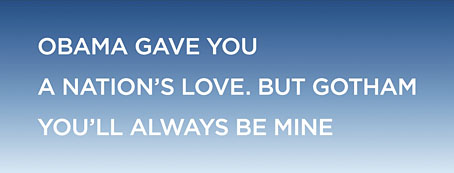
So then… The above is the better of my two entries for a Valentine’s day competition on the Extensis blog which required you to create a besotted ode to a typeface. The wonderful Gotham sans serif by Hoefler & Frere-Jones was used by the Obama campaign during the recent Presidential election, as I noted back in November. I didn’t win but they did give me an honourable mention which was a surprise. Some very witty and clever entries but it helps if you’re a type obsessive to appreciate many of the jokes.
Previously on { feuilleton }
• The best font won
The slow death of modernism
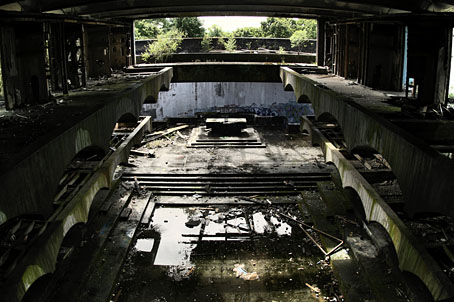
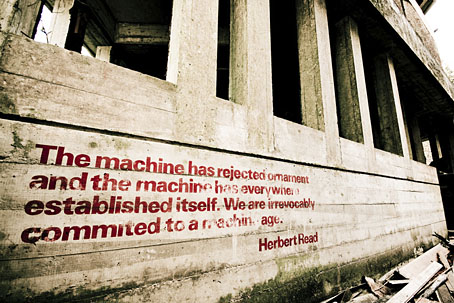
“Soon to be picturesque ruins” was a slogan the Situationists used to enjoy posting on Parisian buildings but their rebuke to architectural hubris can be applied anywhere. St Peter’s College seminary building at Cardross near Glasgow was an example of post-Le Corbusier concrete construction which drew praise for its clean modernity in the 1960s. Today it brings only photographers and graffiti kids to its dereliction. Brian Dillon notes that the seminary
resembles nothing so much as the desolate and sentient “zone” in Andrei Tarkovsky’s 1979 film Stalker: a place where snow falls slowly upon vacant altars, where stagnant pools are so full of rot that they look horribly alive even at the edge of winter, where a startlingly tame robin will perch on your head as you step delicately over the rubble. (More.)
Yes indeed, and Flickr is full of striking examples like these. Someone ought to take advantage of what Dillon calls the seminary’s “futuristic rot” and use the place as a film set before the decay becomes too hazardous or the building is demolished altogether.
Previously on { feuilleton }
• The ruins of Detroit
• Ephemeral architecture
• The temples of Angkor
• St Pancras in Spheroview
• The Stalker meme
Twittering

Tweet addicts may like to know that I’m now on Twitter.