Dream sleeves: John Walsh on how a 40 year old idea could save the music industry
L’Androgyne
L’Androgyne by Alexandre Séon (1890).
Related to yesterday’s post, I’ve been re-reading various books this week for details of the most curious character associated with the French Symbolist movement, novelist and occultist Joséphin Péladan (1859–1918), also known as Sâr Peladan, a Babylonian title he bestowed upon himself as more befitting his adopted role as Rosicrucian mystic. Péladan’s writings and occult art theories spurred many of the painters who banded together as part of his Salon de la Rose+Croix, a kind of anti-salon intended to stand in opposition to what the Sâr saw as the drab realism of the Impressionists and the staid historicism of academic painters. One gets the impression reading about Péladan that he was probably a rather preposterous figure—his obsession with androgyny caused him to change his forename from Joseph to Joséphin yet he kept his length of bristling beard. But, like Oscar Wilde in London, his presence in the pool of fin de siècle art creates considerable ripples. Alexandre Séon, whose frontispiece above was created for Péladan’s semi-autobiographical essay, L’Androgyne, was particularly devoted to him, as was Carlos Schwabe. Séon’s picture depicts “the androgyne Samas, stupefied by the sexual enigma”, a character with whom Péladan fully identified as he describes his youth and its apparent state of androgynous grace.
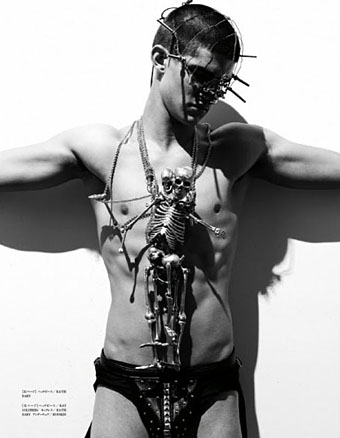
One doesn’t need a Rosicrucian salon today for examples of creative androgyny, of course, all you have to do is go to Flickr where you’ll find creatures such as the boy above from Roman Mitchenko’s photostream. The photos there are at the fashion end of the spectrum; for more of an amateur or semi-professional perspective there are groups like the Androgyny pool, and the Mommy, I want to be androgynous! pool, the latter featuring many striking boyish girls and girlish boys.
Previously on { feuilleton }
• Arthur Tress’s Hermaphrodite
• Carlos Schwabe’s Fleurs du Mal
• Czanara’s Hermaphrodite Angel
Delville, Scriabin and Prometheus
Another striking design found by chance. Symbolist artist Jean Delville (1867–1953) created this sheet music title page for Promethée by Scriabin in 1912, and the pair are well-matched given their shared predilection for mysticism (Theosophy in Delville’s case). Delville had also dealt with Prometheus in a typically dramatic, if sexless, picture a few years earlier (below). Once again it’s unfortunate that one of the really great artists of the Symbolist period is so poorly-served by the web that one has to discover his work by accident. There’s a dedicated site here but the gallery pages are only harvesting what’s already scattered around. Delville had a long and consistently high-quality career; he deserves better.
Prometheus (1907).
Update: Dave C reminds us of another Delville site with a better selection of pictures including a photo of the artist at work.
Previously on { feuilleton }
• The faces of Parsifal
• Masonic fonts and the designer’s dark materials
• Angels 4: Fallen angels
Caldwell & Co
A cosmic pendant lamp by New York lighting manufacturer, Caldwell & Co, created for the Rockefeller Center in 1932. The company’s Art Deco-styled designs for that building feature a number of other flying saucer pendants although none as striking as this one. The photo is one of many made available by the Smithsonian Institute on a site which catalogues the company’s history.
Edward F. Caldwell & Co., of New York City, was the premier designer and manufacturer of electric light fixtures and decorative metalwork from the late 19th to the mid-20th centuries. Founded in 1895 by Edward F. Caldwell (1851–1914) and Victor F. von Lossberg (1853–1942), the firm’s legacy of highly crafted creations includes custom made metal gates, lanterns, chandeliers, ceiling and wall fixtures, floor and table lamps, and other decorative objects that can be found today in many metropolitan area churches, public buildings, offices, clubs, and residences.
Previously on { feuilleton }
• Hugh Ferriss and the Metropolis of Tomorrow
Computers draw a new chapter in comics
Computers draw a new chapter in comics | Artist Dave Gibbons on comics and technology.