Gerald Scarfe’s Long Drawn-Out Trip

scarfe.jpg

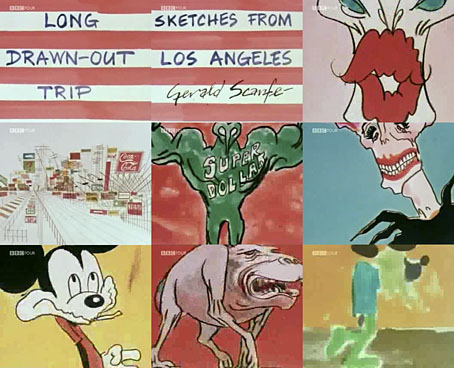
Yet more animation. Long Drawn-Out Trip was Gerald Scarfe‘s first foray into the medium, produced in 1972 at the request of the BBC who sent the artist to Los Angeles to try out the new De Joux animation system. The process needed only six or eight drawings per second of film thus reducing the usual amount of labour. Scarfe says in the first book collection of his work, Gerald Scarfe (1982), that the 16-minute film was still very labour intensive.

The subject of Long Drawn-Out Trip is Los Angeles and America itself, the concerns being the same ones that Ralph Steadman was depicting the same year in his illustrations for Hunter S. Thompson’s Fear and Loathing on the Campaign Trail ’72: venality, violence, vulgarity and the omnipresent spectre of Richard Nixon, a president who had the good fortune to be drawn many times by two of Britain’s greatest living satirists although he wouldn’t have thanked them for it. In Scarfe’s film we also find Mickey Mouse being reduced to his constituent lines and colours after smoking a joint. In the 1980s Scarfe regularly drew Ronald Reagan wearing the famous mouse ears, something that nearly got him fired from his post at the Sunday Times after Rupert Murdoch saw one of the cartoons. Long Drawn-Out Trip had a more favourable effect when it was seen by Roger Waters who asked Scarfe to create some animations for Pink Floyd’s Wish You Were Here tour. The animated sequences for The Wall have their origin in this short film. Watch it here.
Brothers Quay scarcities

quays7.jpg

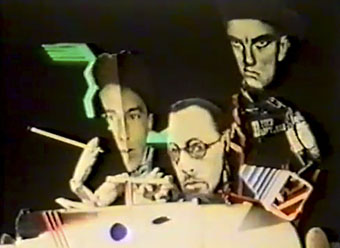
Igor: The Paris Years (1982).

More animation, and scarce in the sense that some of these films were omitted from the core Quay Brothers canon released in the UK by the BFI as Quay Brothers: The Short Films 1979-2003. Quay obsessives such as myself would have been happy to pay for an extra disc featuring more of their oeuvre but we can at least turn to YouTube to fill in some gaps. This is by no means everything so I may add more discoveries at a later date. Some of the DVD-issued films can be seen on the BFI’s official Daily Motion channel.

I was eager to see the Stravinsky film again having watched it one time only in a Channel 4 screening some 25 years ago. After a fresh viewing it’s not as impressive as I remembered, in part because the Quay’s distinctive approach to animation—and filmmaking generally—developed a great deal following the unforgettable Street of Crocodiles (1986). Igor: The Paris Years concerns the composer’s relationship with Jean Cocteau and Vladimir Mayakovsky, all of whom are animated as cut-out figures in a Modernist cityscape with The Rite of Spring playing on a piano.

quays6.jpg

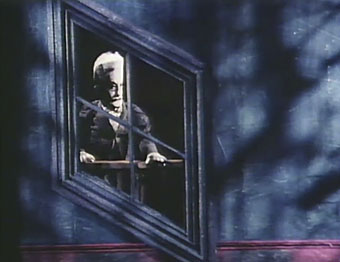
Leos Janácek: Intimate Excursions (1983). Part 2 is here.

In a similar vein, but more successful, is this portrait of Czech composer Leos Janácek. This uses the same cut-out character style but places the composer in Eastern European settings similar (down to the floating tram pantographs) to those seen in the very first Quay film, Nocturna Artificialia (1979). Among the other puppet characters there’s one figure singing an aria who later appears as Enkidu in This Unnameable Little Broom (1985).

quays1.jpg

Old Piano (1988).

A very short (and poor quality) ident for MTV.

Continue reading “Brothers Quay scarcities”

Achilles by Barry JC Purves

achilles.jpg

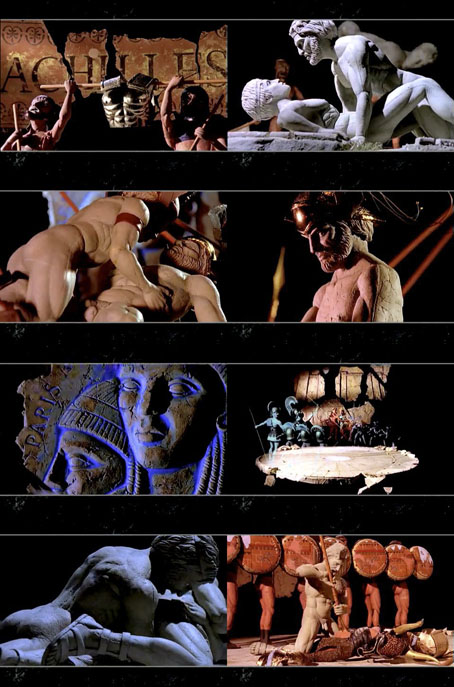
I wondered how to focus on the relationship between Achilles and Patroclus without the others getting in the way. This intense physical relationship developed into the focus of the film, rather than any more Harryhausenesque aspects of the Greek myths. Intimacy had not really been treated seriously with puppets…

Barry JC Purves

Several people seemed to appreciate the link a week or so ago to The Torchbearer by Václav Svankmajer so here’s another animated short about helmeted warriors, albeit with a very different tone. Barry JC Purves is a British animator and theatre director who produced Achilles, an 11-minute puppet animation, in 1995, back when the UK’s Channel 4 was still regularly financing animated films. Derek Jacobi narrates an exploration in the style of Ancient Greek theatre of the relationship between Achilles and his alleged lover, Patroclus. (Whether or not the pair were lovers is still a subject of dispute.) It’s rare to find any overt sexuality in the world of puppet animation unless the directors are the Brothers Quay; it’s even more rare for that sexuality to have a homoerotic aspect which is what Purves depicts. A groundbreaking piece of work, then, which can be viewed in full here. The director’s website has more about the creation of the film, and a collection of stills from the production.

Previously on { feuilleton }
The Torchbearer by Václav Švankmajer

Google Art Project revisited

google1.jpg

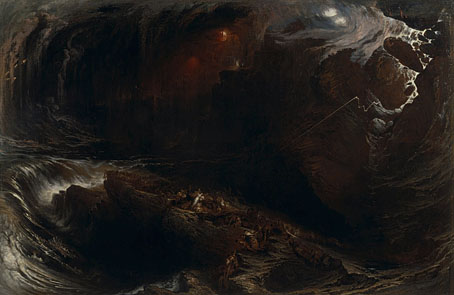
The Deluge (1834) by John Martin.

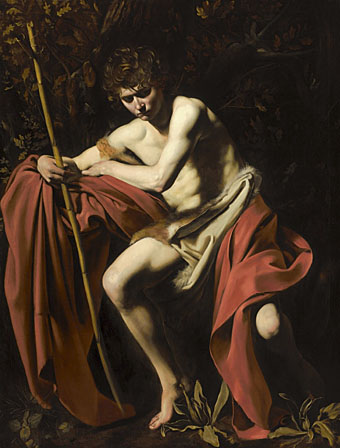
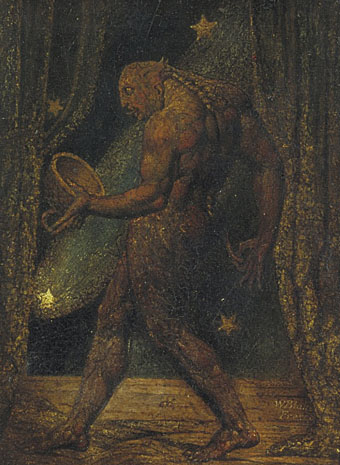
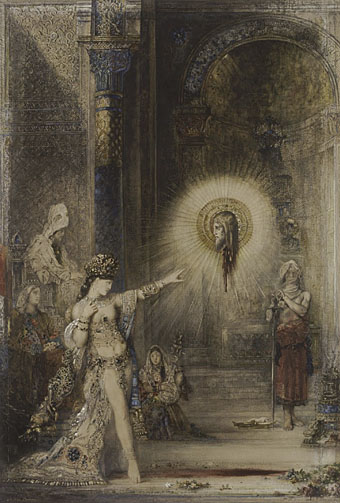
One of John Martin’s Biblical cataclysms succumbs to a Turner-like nebulosity at the Yale Center for British Art, something that can now be viewed in detail thanks to Google’s expansion of its Art Project. 151 additional galleries have been added, and the collections of those already present expanded, which means there are now 30,000 paintings and other art objects waiting to be examined. The examples here are those picked from a very cursory look at what’s on offer. Good to see the Musée d’Orsay is now one of the featured galleries where I ignored all the Van Goghs, Monets and the rest in order to select one of Gustave Moreau’s Salomés. Blake’s Ghost of a Flea is actually a lot more visible in its online state than in the original. Many of the works in the Blake collection at Tate Britain are so fragile the lights are kept low to avoid damaging their pigments. Most of Blake’s paintings are also very small, Ghost of a Flea included. Even peering at it up close doesn’t yield as much as the opportunity we now have to explore its frosted craquelure.

google2.jpg

Saint John the Baptist in the Wilderness (1604–1605) Michelangelo Merisi, called Caravaggio.

google3.jpg

The Ghost of a Flea (c. 1819) by William Blake.

google4.jpg

The Apparition (c. 1876) by Gustave Moreau.

Previously on { feuilleton }
The Ambassadors in detail

The art of Luis Toledo

toledo1.jpg

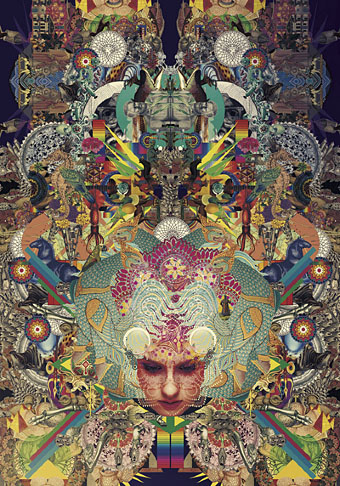
Invariancia.

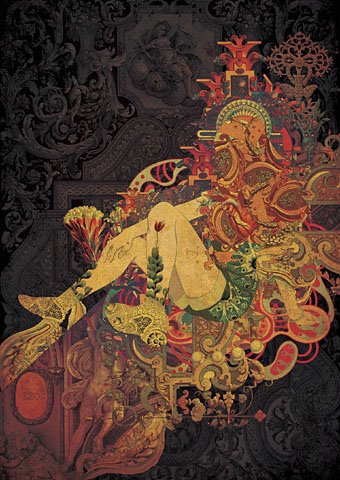
The workload has increased recently so posting here may tend to laziness for a while. I think I first saw the hyper-detailed digital collages of Luis Toledo aka Laprisamata at Form is Void where Thom has a knack for spotting the good stuff. I was reminded of them again last week thanks to Dressing the Air. The detail and variety of these works means they really need to be seen at a much larger size, something you can do at the artist’s Behance pages and at his website. As always with collage, composition is crucial, and Toledo certainly knows what he’s doing on that score. Those familiar with Ernst Haeckel’s Kunstformen der Natur can have fun playing spot the image source.

toledo2.jpg

Desaparecida.

Elsewhere on { feuilleton }
The fantastic art archive

Previously on { feuilleton }
Jacques Brissot’s Hay Wain
The art of Jindřich Štyrský, 1899–1942
Initiations in the Abyss: A Surrealist Apocalypse
Vultures Await
Wilfried Sätty: Artist of the occult
Illustrating Poe #4: Wilfried Sätty
Metamorphosis Victorianus
Max (The Birdman) Ernst
Gandharva by Beaver & Krause
The art of Stephen Aldrich