Witkinesque

supervert.jpg

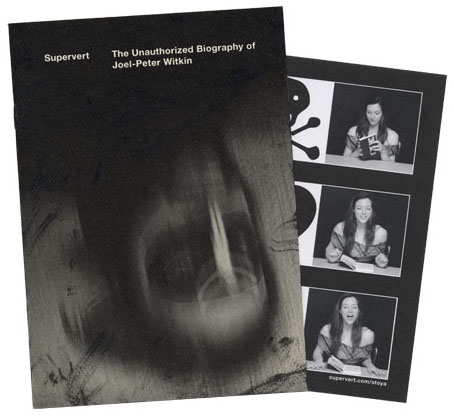
Arriving in the post this week, a Christmas gift from Supervert, a chapbook featuring a new piece of writing that purports to be the unauthorised biography of American artist/photographer Joel-Peter Witkin. The premise is that the facts of the real Witkin’s life are far too mundane to account for his extraordinary photo tableaux so Supervert supplies details such as “Mary Witkin [his mother] worked as a bookkeeper in a DDT plant, slowly saving to enrich the unfathomable reservoirs of the absurd.” A metaphysical portrait of the artist, then, with echoes of David Lynch or Bruno Schulz. Inside the chapbook was a promo postcard bearing pictures of the delightful Ms. Stoya whose reading of Necrophilia Variations has now gained over four million YouTube views.

The Witkin book isn’t for sale but copies are available to those who enter the Supervert contest which is running throughout December. All you need do is enter an email address here then keep your fingers crossed.
witkin.jpg

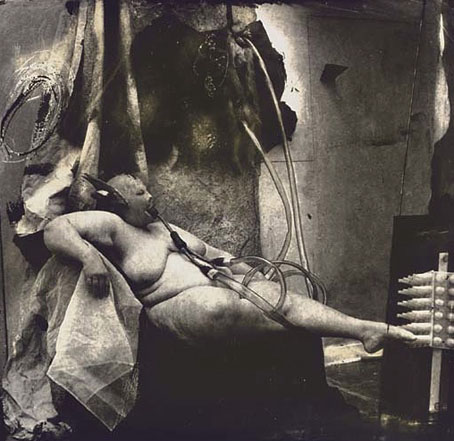
Sanitarium, New Mexico (1983) by Joel-Peter Witkin.

Witkin’s tableaux made an immediate impression circa 1993 when I bought a copy of PhotoVision, a Spanish photography journal which had devoted an entire issue to his work. This arrived at a point when I was halfway through drawing the Reverbstorm comic series, and Witkin’s parade of unorthodox humanity, crucified apes and sundry body parts seemed an ideal complement for the parade of similar grotesqueries (and sundry body parts) we were putting into the comic pages. I also liked the way Witkin worked his own variation on familiar scenes from art history, something we were doing throughout Reverbstorm (Witkin’s Vase: Study For the Base of the Crucifix just happens to combine a partly dissected human skull with Picasso’s Guernica, a recurrent motif throughout the series).
reverbstorm1.jpg

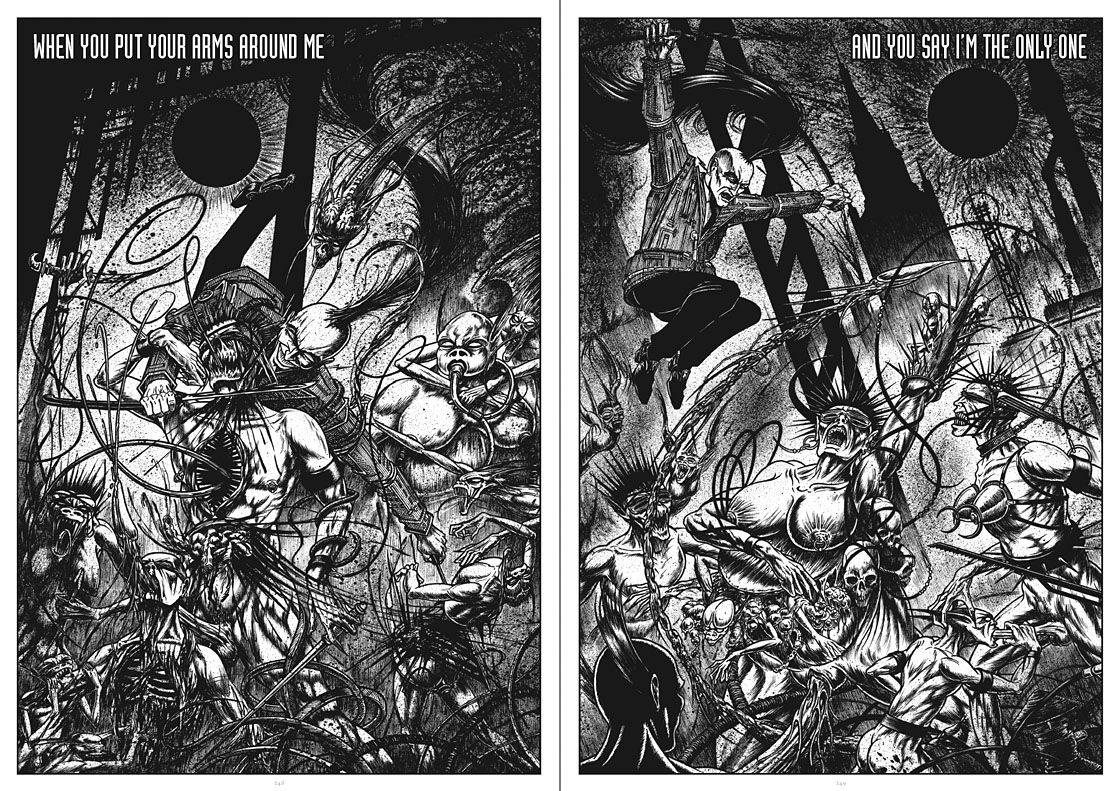
Above and below, some of the more Witkinesque details from part seven of Reverbstorm. The main figure above was a direct reference to Witkin’s Sanitarium, New Mexico. Many figures in other drawings are given Witkin-like blindfolds.
Continue reading “Witkinesque”

Harry Clarke in colour

years01.jpg

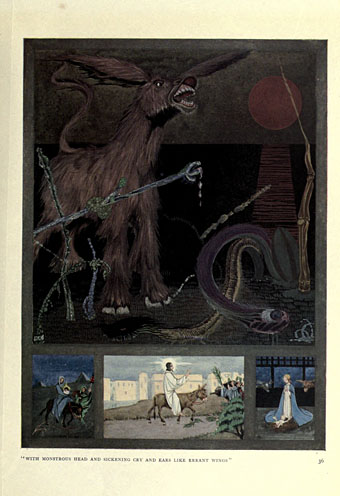
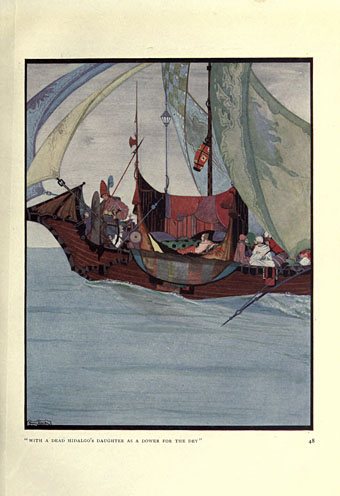
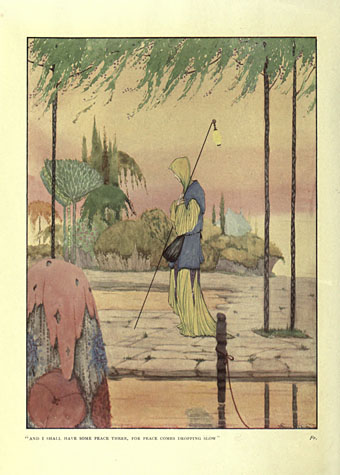
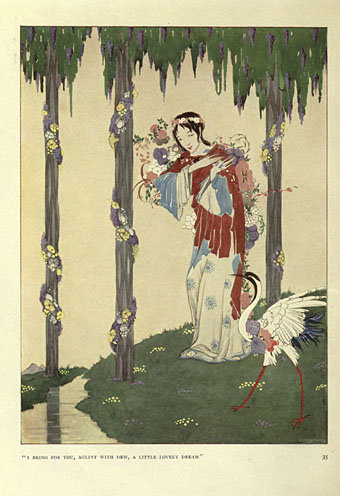
Older illustrated books often suffer at the hands of owners or a certain breed of iniquitous antique dealer who razor out their colour plates in order to frame them as prints. The Internet Archive has two copies of The Year’s at the Spring; An Anthology of Recent Poetry (1920) edited by Lettice D’Oyly Walters, and illustrated by Harry Clarke: one copy features all of the colour plates, the other has many of them missing. Looking at these again I thought it worth drawing attention to their peculiar mixture of the delicate and the grotesque, a result of illustrating a variety of content combined with Clarke’s habit of pushing book illustration into areas where few of his contemporaries would tread. His painting for The Donkey by GK Chesterton is at once an accurate illustration of the poem but also quite repellent, especially in the company of those phallic extrusions which become increasingly common in his later work. Elsewhere, when illustrating James Elroy Flecker’s The Dying Patriot, it’s a description of submerged corpses that he chooses to depict.

The rest of the book—which contains many beautiful ink drawings—may be browsed here or downloaded here. The Internet Archive is raising funds throughout December to support its running costs. I’ve been using their books as a source of reference a great deal over the past two years so was happy to contribute something.

years02.jpg

years03.jpg

years04.jpg

Continue reading “Harry Clarke in colour”

Caresses by Fernand Khnopff

khnopff1.jpg

khnopff2.jpg

khnopff3.jpg

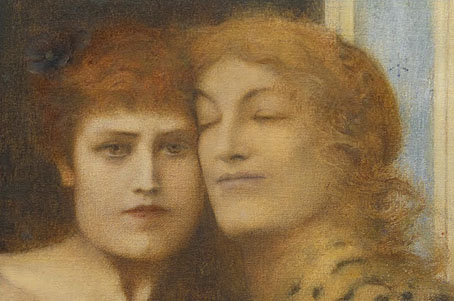
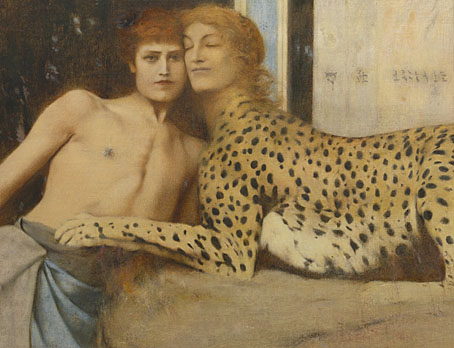
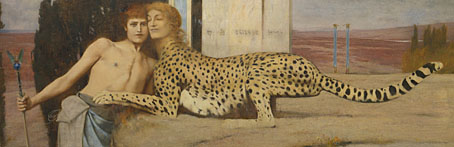
Details from Caresses aka The Caress (1896), the most famous painting by Belgian Symbolist Fernand Khnopff which can now be explored in detail at the Google Art Project. Caresses was one of Khnopff’s more enigmatic works although the term is a relative one when it comes to an oeuvre in which enigma is the default position. The combination of a young male, a feline female and the trappings of antiquity suggests Oedipus and the Sphinx although the Sphinx of mythology is a far more threatening presence. Adding to the enigma is the fact that Khnopff’s sister, Marguerite, was his model in most of his paintings which means we can recognise her heavily-jawed features in the male figure as well as the female. The essence of Symbolism for me has always been an atmosphere of unresolved pictorial mystery, a quality which this painting exemplifies.

khnopff4.jpg

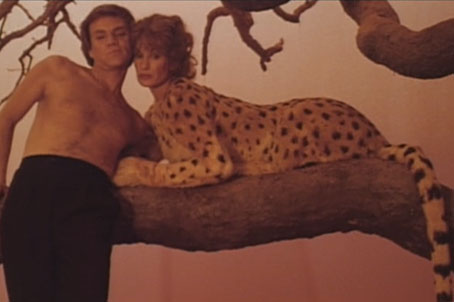
Malcolm McDowell and Ruth Brigitte Tocki in a deleted scene from Cat People (1982).

The mystery would have been carried over to the cinematic world in 1982 if the producers of Cat People had kept their nerve. The “Leopard Tree” dream sequence was to have featured a moment when Irena (Nastassia Kinski) meets her dead brother and mother in a pose which recapitulates Khnopff’s painting. The painting itself also appeared earlier in the film although it’s so long since I watched it I forget now whether that moment was also excised. The dream sequence may have been stretching audience credulity too far but the symbolism is fitting not least for the incestuous nature of the story. Here’s the scene in the final cut set to Giorgio Moroder’s fantastic score.

khnopff5.jpg

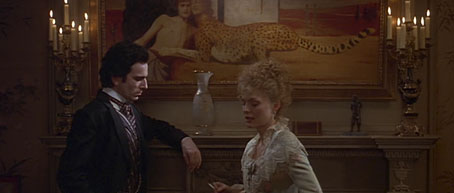
Daniel Day-Lewis and Michelle Pfeiffer.

The painting definitely did appear on-screen in 1993 where it overshadows a crucial conversation in Martin Scorsese’s adaptation of The Age of Innocence. Given that the setting is New York in the 1870s the usage is slightly anachronistic but once again the symbolism works for a scene which concerns unacceptable and unrequited passions.

Previously on { feuilleton }
Symbolist cinema
Bruges-la-Morte

The Blues Accordin’ to Lightnin’ Hopkins

lightninhopkins.jpg

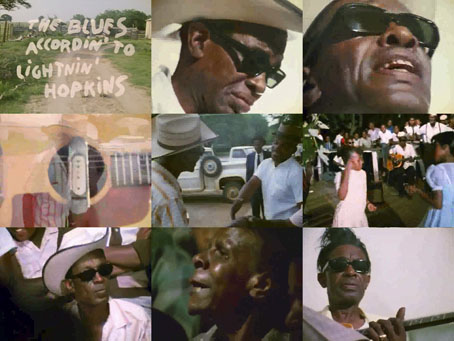
Yesterday’s film was no doubt approved by Ry Cooder in part because of this early Les Blank documentary, a 30-minute portrait of blues singer Lightnin’ Hopkins and his friends and neighbours in Centerville, Texas. The Blues Accordin’ to Lightnin’ Hopkins is dated 1968, and captures a group of aging blues musicians and a community for whom blues music was still part of the texture of everyday life. Earlier films about blues artists tended to be a lot more formal, usually based around a performance staged specially for the cameras. Blank’s snapshot has a looseness that suits its subject and is all the better for it.

Previously on { feuilleton }
Ry Cooder & The Moula Banda Rhythm Aces: Let’s Have A Ball

Ry Cooder & The Moula Banda Rhythm Aces: Let’s Have A Ball

rycooder.jpg

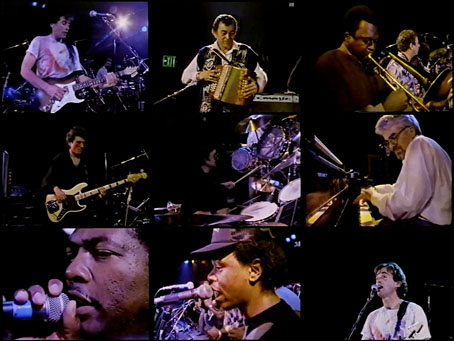
Someone told me once they didn’t like Ry Cooder, a sentiment I’d place in the same category as saying you don’t like, say, chocolate: as an attitude it’s within the bounds of possibility but it requires a considerable effort of sympathetic imagination to appreciate. Let’s Have A Ball is a 90-minute Ry Cooder concert film by the great documentary filmmaker Les Blank, better known for Burden of Dreams (1982), his chronicle of the trials of Werner Herzog and company during the making of Fitzcarraldo. Burden of Dreams is that rare thing among “making of” films, a documentary that’s as fascinating as the film whose production it depicts.

Let’s Have A Ball catches Ry Cooder and his band playing at the Catalyst in Santa Cruz, California, on March 25th, 1987 during their Get Rhythm tour. I’d seen this when it was broadcast on Channel 4 in 1988 but don’t have it on tape so thanks go to the Metafilter people for drawing attention to the entire concert at YouTube. The film was screened in Europe and elsewhere but not in the US, and for now remains unavailable in any official capacity for unspecified reasons; Les Blank’s site says Cooder doesn’t want it released. This is surprising since it’s a fantastic concert film, the sound quality and performances are easily as good as anything on his live albums. In addition to great renditions of Cooder’s back catalogue you get to see several of his regular collaborators in action, not least Van Dyke Parks playing some typically idiosyncratic piano. The high spot is a 16-minute version of Down In Hollywood where everyone, singers included, gets to show off their solo prowess.

The band:
Ry Cooder: guitar, vocals
Jim Keltner: drums
Van Dyke Parks: keyboards
Jorge Calderon: bass
Flaco Jiménez: accordion
Miguel Cruiz: percussion
Steve Douglas: sax
George Bohannon: trombone
Singers: Bobby King, tenor; Terry Evans, baritone; Arnold McCuller, tenor; Willie Green Jr, bass

The songs:
Let’s Have A Ball
Jesus On The Mainline
How Can A Poor Man Stand Such Times And Live?
Jesus Hits Like The Atom Bomb
Down In Mississippi
Maria Elena
Just A Little Bit
The Very Thing That Makes You Rich (Makes Me Poor)
Crazy About An Automobile
Chain Gang
Down In Hollywood
Good Night Irene

Previously on { feuilleton }
My Name Is Buddy by Ry Cooder