
Undulating terrain: Stalker (1979).
Marking the boundaries of an obsession, this post follows the discovery last week of the Sine Fiction soundtracks for science fiction novels, one of which was five tracks by Jos Smolders for Arkady and Boris Strugatsky’s Roadside Picnic. That album set me wondering what other recordings might have been inspired by that bounded region known as the Zone, whether derived from the Strugatskys’ novel, from Andrei Tarkovsky’s 1979 film Stalker (for whom the Strugatskys provided a screenplay) or even from the real-life Zone around the irradiated Chernobyl disaster site in Ukraine.
The cult status of the book and film can be measured by the following list which I’m sure will have many omissions, not least because searching music sites for “stalker”, “zone” and “roadside picnic” yields multiple results; all three of those terms happen to also be the names of musical artists or groups, as well as the names of labels, albums and individual recordings. (I’ll skip over the S.T.A.L.K.E.R. series of computer games. All have music but since I’ve not played any of them I can’t say much about them.)

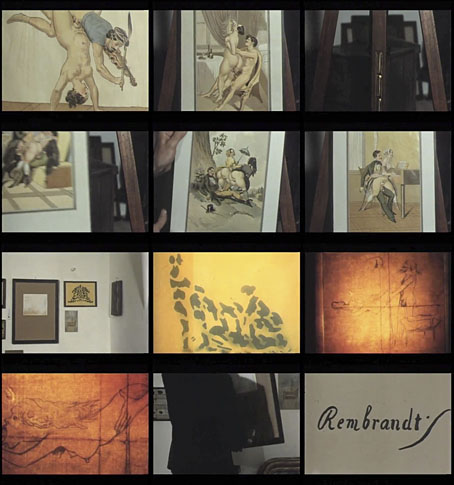
The stalker’s dream from Stalker.
The first release is of course the haunting film theme by Edward Artemyev, a mere five minutes of music which nonetheless adds a great deal to Tarkovsky’s unforgettable images. Artemyev also provided music for Tarkovsky’s Solaris (1972) and Mirror (1975) yet nothing else I’ve heard by the composer resembles this piece which wouldn’t be out-of-place on a compilation of German Kosmische music from the 1970s.
While that long camera shot over waterlogged objects is still in mind, there’s the following from Nova Swing (2006) by M. John Harrison, a science fiction novel which riffs on both Stalker and Roadside Picnic:
Upstairs, Emil Bonaventure was propped upright against the pillows like a corpse, his skin yellow in the streetlight from the window, his old ribs slatted with shadows. The energy had drained out of his smart tattoos and he was breathing ever so lightly. Edith watched the pulse in his neck. She could almost see the life through the skin, the thoughts in his head, and what were they but the dreams he couldn’t any longer have? Shallow water over cracked chequerboard tiles and cast-off domestic objects, books, plates, magazines, empty tunnels smelling of chemicals, a black dog trotting aimlessly round him in his sleep on some dirty waterlogged ground neither in nor out of anything you could think of as the world, while a woman’s voice mourned open-throat from a house not far enough in the distance.
Nova Swing will be available in a new edition later this year.
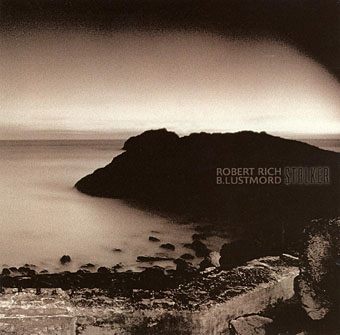
Stalker (1995) by Robert Rich & B. Lustmord.
The doomy atmospherics which have become the hallmark of Zone music begin with this album by Robert Rich and B. Lustmord. Seven tracks take Tarkovsky’s film as an inspiration with vaguely allusive titles—Undulating Terrain—and occasional snatches of dialogue buried in the mix. A superb piece of late-night listening even without the associations.