The art of Victor Linford, 1940–2002

linford1.jpg

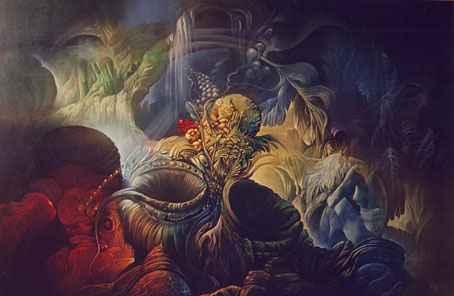
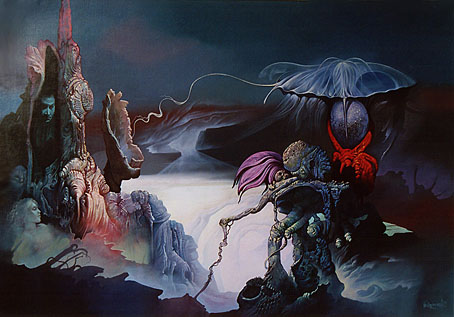
Victor Linford was a British artist who relocated to the Netherlands so his work seems to be more familiar there than elsewhere. According to the Johfra Museum site, Linford was part of the Dutch Meta-Realist group in the 1970s, along with Johfra Bosschart himself and five other painters. Johfra’s art has been mentioned here before but I hadn’t heard of the others, Linford included. You’d think someone who spent so much time producing detailed oil paintings of surreal/alien landscapes would be better known. Some of his works were used on a series of Dutch sf paperbacks in the 1970s, unsurprisingly when many of his paintings resemble the alien landscapes being produced by Bruce Pennington for British sf books throughout the decade.

There are two main sites showing Linford’s works, here and here. I prefer the landscapes that don’t have too many human figures inserted into them but even the ones that do are worth a look. (None of the paintings are titled or dated.)
linford2.jpg

Continue reading “The art of Victor Linford, 1940–2002”

American Art Posters of the 1890s

posters1.jpg

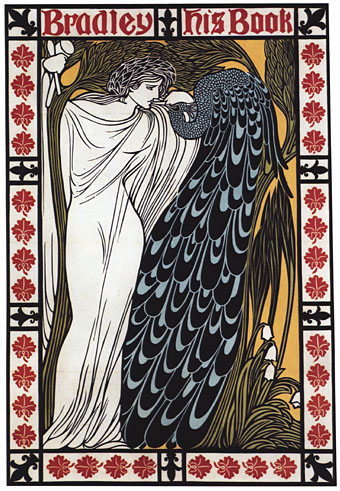
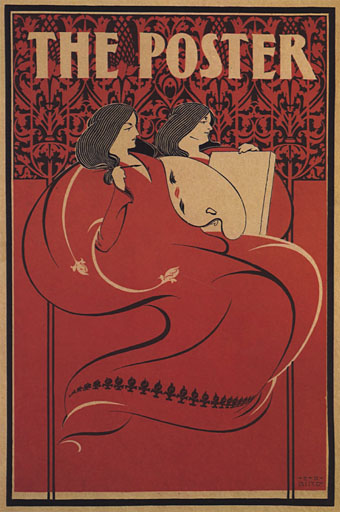
Selections from a 1987 Metropolitan Museum of Art exhbition catalogue which features many more colour plates. My choices gravitate as usual to the American Beardsley, Will Bradley. The other artists here are EB Bird (above) and Louis Rhead, both of whom also produced bookplate designs (see here and here).

posters2.jpg

Continue reading “American Art Posters of the 1890s”

Salon de la Rose + Croix

salonrc01.jpg

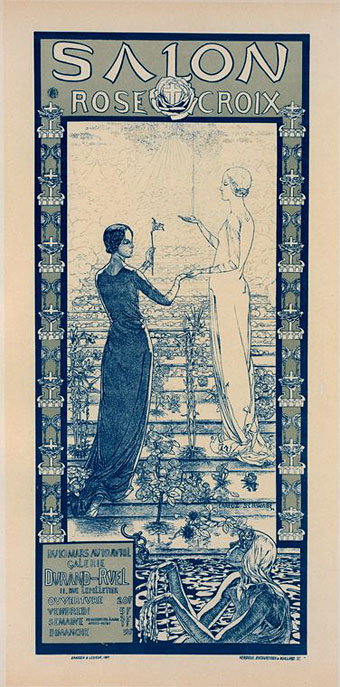
Carlos Schwabe’s poster from 1892 for the first of Joséphin Péladan’s art and music Salons de la Rose + Croix. The “Sâr” Peladan’s imposition on the artistic life of Paris in the 1890s may have the smack of a vanity project but he caused enough of a stir to give Rosicrucianism an unlikely fashionabilty for a while. The roster of contributing artists is also impressive, almost a who’s who of Symbolist art. There were six salons in all, the last being in 1897. The poster for the fifth salon by Armand Point & Léonard Sarluis shows Perseus holding the decapitated head of Émile Zola. The evangelist of literary realism was one of Symbolism’s arch-enemies but that didn’t prevent Carlos Schwabe from producing illustrations for Le Rêve.

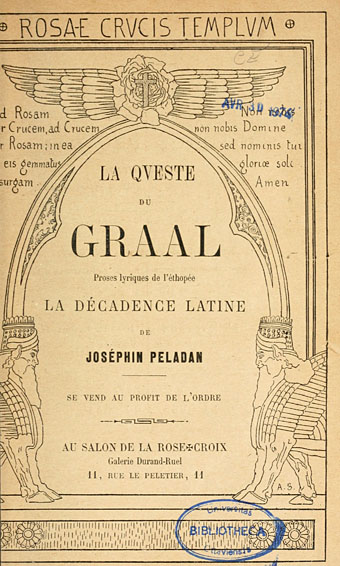
The pages below are from Peladan’s many books, La Queste du Graal: Proses Lyriques de l’Éthopée; La Décadence Latine (1892). The illustrations aren’t the best reproductions, and they aren’t the greatest artworks either, but they give a sense of what Peladan wanted to see embellishing his own brand of artistic mysticism. Gallica has a Salon de la Rose + Croix catalogue (also from 1892) but like many of the documents archived there the quality leaves a lot to be desired.

salonrc02.jpg

Continue reading “Salon de la Rose + Croix”

The art of Carlos Schwabe, 1866–1926

schwabe01.jpg

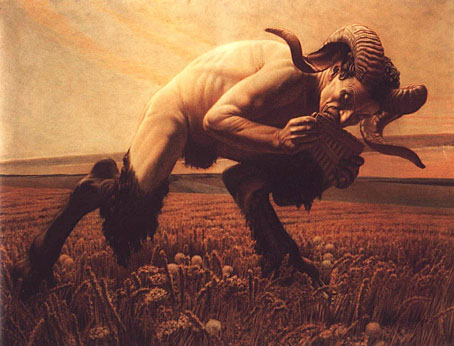
Le Faune (1923).

Yesterday’s Pan prompted me to repost Carlos Schwabe’s wonderful painting of a faun, one of my favourite faun/satyr depictions, and easily one of the best in the entire Symbolist corpus. Other satyr aficionados of the period such as Arnold Böcklin and Franz Stuck had an unfortunate knack for making their goat gods look rather foolish.

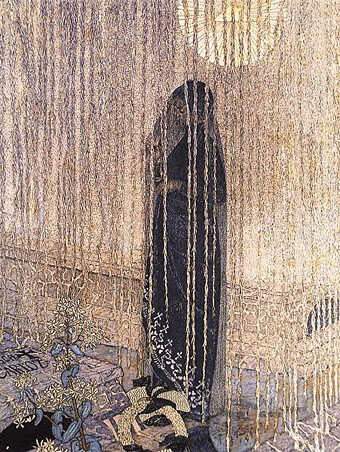
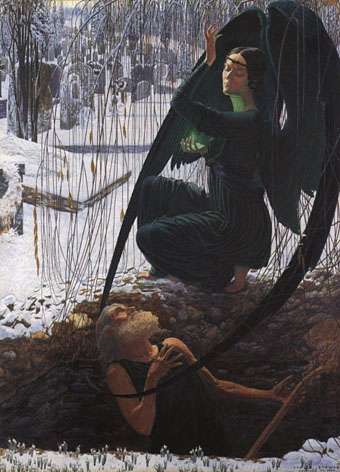
Schwabe was a German artist, and one of the more mystical of the Symbolists, with a fondness for winged figures and a preoccupation with death. The mystical end of the Symbolist spectrum is the one I enjoy the most so I often point to Schwabe or Jean Delville as exemplars of this type of art. Both Schwabe and Delville were connected briefly by Joséphin Péladan’s very mystical Salon de la Rose + Croix although Delville later gravitated to Theosophy. Schwabe produced illustrations for an edition of Baudelaire’s Les Fleurs du Mal, and would have featured in the Baudelaire posts last week if some of those drawings hadn’t appeared here already. The title page was a new find, however, so it’s included below.

schwabe09.jpg

Jour de morts (1890).

schwabe04.jpg

La mort du fossoyeur (1895).

Continue reading “The art of Carlos Schwabe, 1866–1926”

Athanasius Kircher’s Pan

kircher1.jpg

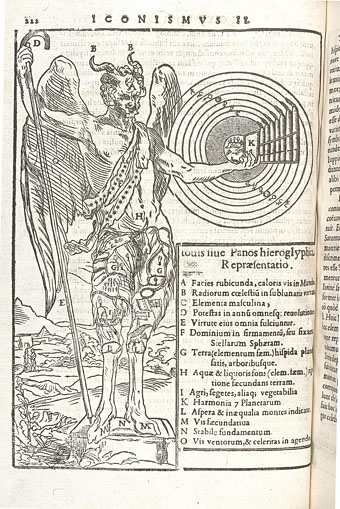
More from the Kircher archives at the University of Heidelberg. As before, it’s good to see illustrations familiar from countless reprintings in books in their place of origin. The volume in question is Obeliscus Pamphilius: hoc est, Interpretatio noua & Hucusque Intentata Obelisci Hieroglyphici (1650), one of Kircher’s attempts at deciphering the hieroglyphics on Egyptian obelisks. I’m still not sure how the Great God Pan fits into these speculations even as a diagrammatic figure, unless in this case it’s Pan as a representative of Nature as a whole.

Whatever the explanation, the Pan picture often turns up in occult anthologies although you’re as likely to see the copy from Manly P. Hall’s The Secret Teachings of All Ages (1928) as the original. Hall’s rendering is useful for the translation of the Latin although he also says it may represent the god Jupiter (?) and he censors the not-very-obtrusive penis, a rather fatuous bit of prudery for a book that’s supposedly concerned with universal truths.

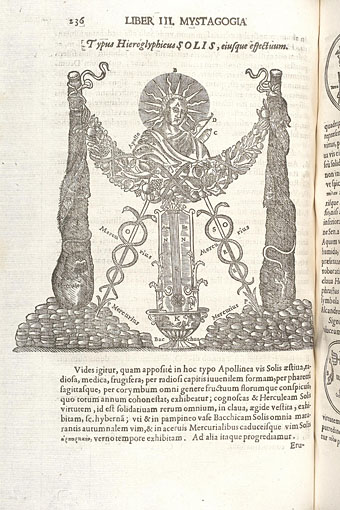
A few more plates follow, one of which features a serpent I swiped several years ago for a Cradle of Filth T-shirt design.

kircher2.jpg

Continue reading “Athanasius Kircher’s Pan”