Raw Deal

raw_deal.jpg

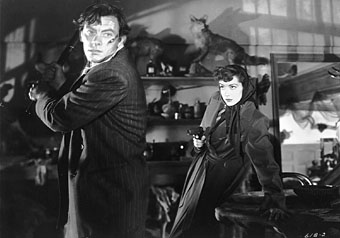
John Ireland and Marsha Hunt in Raw Deal (1948).

Yes, there was another decade besides the ’70s when Hollywood made films with downbeat endings. The NYT manages to write about Raw Deal without mentioning its director, the great Anthony Mann. Never mind, at least they credited John Alton.

Beyond a Shadow of a Doubt, Nights Are Noir in Fog City
By WENDELL JAMIESON
New York Times, January 29, 2007

SAN FRANCISCO, Jan. 28 — The orange and blue neon lights of the Castro Theater shone blurrily on the damp asphalt beneath the crisscrossing catenary wires of the streetcars. The words on the marquee in the Friday night gloom, read: “Marsha Hunt: In Person.”

Ms. Hunt made more than 50 movies before her career was wrecked in 1950 by the Hollywood blacklist. One of them, a 1948 crime melodrama called “Raw Deal,” has gone on to an unlikely second life as a favorite of the cultish devotees of film noir. On Friday it opened the fifth annual Noir City film festival here, and Ms. Hunt, 89, was on hand to watch its dreamlike silvery hues make a rare appearance on a big — very big — screen.

Lithe and glowing, Ms. Hunt took the stage after the film and said she was surprised not only that this dark little B movie had found fans nearly 60 years after its release, but that so many of them were here, nearly filling the Castro’s more than 1,400 seats. The crowd was a mix of young and old, polished and scruffy, with only a few fedoras in sight.

“I can’t get over this,” Ms. Hunt said as the film festival’s founder and organizer, Eddie Muller, genially interviewed her at the foot of the stage. “It was a strange sort of film,” she added, “about as negative as you can get. They hadn’t coined the term ‘noir’ yet.”

She’s right. It’s hard to imagine a darker film, literally or figuratively, than “Raw Deal.” Consisting almost entirely of luminescent day-for-night photography, it’s the story of an escaped con (played by Dennis O’Keefe) and the two women who love him (Ms. Hunt was one; Claire Trevor was the other), and features, among other pitch-black set pieces, a villain (Raymond Burr) who disfigures his girlfriend with a flaming dessert, and a furious midnight brawl in a seaside taxidermy shop. At the end everyone is either ruined, dead or under arrest.

And that darkness was just fine with the moviegoers here, which applauded vigorously as the closing titles rolled, just as they had at the beginning when the credit for the film’s director of photography, John Alton, the master of all that darkness, appeared on screen.

Mr. Muller, an author and film noir aficionado, dreamed up the film festival five years ago as a way to increase visibility for the Film Noir Foundation he runs, which works to restore the movies, and to promote his own books. (He most recently helped write Tab Hunter’s autobiography.) The Castro, built in 1922 and recently refurbished, had some dead time in January, and the festival (which runs this year through Feb. 4) was born — with a bang. The first double bill in 2003, “The Maltese Falcon” and “Dark Passage” — two seminal San Francisco noirs — sold out.

“It was huge right out of the gate,” he said. ”It totally threw me.” In the years since, he’s sold an average of 880 seats a night.

Of course subject matter and city are well matched. San Francisco has a noir pedigree rivaling that of New York or Los Angeles, its fog, slanting streets, circa-1940’s office buildings and dank narrow streets creating untold scores of blind alleys for characters unlucky enough to be trapped in them. Several noirs, including “Raw Deal,” have been set here.

On Friday the weather didn’t disappoint, with a steady rain falling much of the day. The sun made a half-hearted attempt to appear around noon, then gave up and went back to bed.

The Noir City festival may not be Sundance, but it too has its celebrities and scenes. Before “Raw Deal” on Friday the Castro’s balcony was crammed for a reception, with an open bar, a jazz band and Ms. Hunt signing copies of her book, “The Way We Wore: Styles of the 1930s and ’40s and Our World Since Then” (Fallbrook, 1993).

Among those on hand was Richard Erdman, 81, a character actor whose face is as recognizable — his credits include “Stalag 17” and “Tora! Tora! Tora!” — as his name is unknown. He had a supporting role in “Cry Danger,” the first film on Saturday night’s double bill, and looked so familiar standing there at the reception that it was almost impossible not to run up to him and say, “Haven’t we met before?”

Like Ms. Hunt, Mr. Erdman seemed a little puzzled as to why exactly, so many years later, these movies are finding a new following. Asked for a theory, he thought for a moment and said: “I really have no idea. I’m not putting it down, I just don’t understand it.”

He heaped praise on Mr. Muller and his crew of volunteers for running a high-class operation. “They’re not chintzy,” he said, sipping a glass of white wine.

Film noir is enjoying something of a second golden age at the moment. In addition to the San Francisco festival, the Film Forum in New York City offered a major noir series last year, and studios like Warner Brothers and Fox have ratcheted up their noir reissues to such an extent that many films that never made it out on VHS are appearing on DVD. Just last week Warner Home Video released 1952’s “Angel Face,” starring Robert Mitchum, which had only been available on foreign or pirated VHS tapes. Mr. Muller provides the commentary track.

“With film noir, if you show it to a group of 20-year-olds, they’ll find something to get hooked on,” said George Feltenstein, Warner Home Video’s voluble senior vice president for marketing for its classic catalog. “There is a sexiness to it, there is a mystery took it. These are very seductive movies, they are not cookie-cutter.”

Warner Brothers has released three noir box sets. The first, which came out in 2004 and featured titles like “Out of the Past” and “The Asphalt Jungle,” hit No. 1 on Amazon.com’s DVD list. This year Warner’s fourth noir set will include 10 rather than 5 movies. Here’s a scoop for noir fans: Two will star Mr. Mitchum.

Whatever the machinations of the DVD business, here at the Noir City festival, everyone was in a pretty good mood by the time the second title of opening night, “Kid Glove Killer,” a super-rarity from 1942, rolled to its conclusion. This one had a happier ending, with Ms. Hunt getting a marriage proposal, delivered beneath a microscope, from a skinny and surprisingly big-haired Van Heflin.

Coats and fedoras went back on, and the crowd headed for the exits. Ms. Hunt stood by the door, shaking hands and signing autographs, as her new legions of fans emerged onto the shiny street and headed off into the night.

Previously on { feuilleton }
Film noir posters
Early Kubrick
Kiss Me Deadly

The Decorative Age

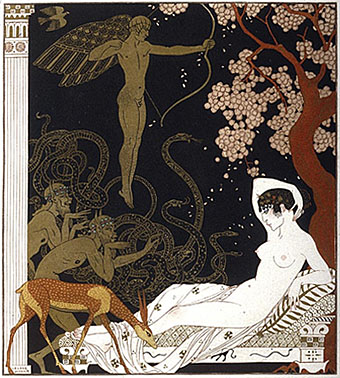
barbier1.jpg

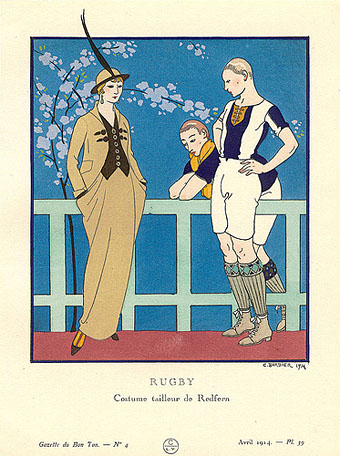
Continuing the George Barbier theme from the Nijinsky post, his work reminded me I’d had Artdecoblog bookmarked for some time. Searching there turned up some more of his pictures including this mythological scene done in his post-Beardsley style. The men in the picture below are hilariously effete for rugby players, they look more like a couple of costumiers casting aspersions on the poor woman’s outfit.

Artdecoblog is a great resource for pictures from this period and well worth a browse. The woman responsible has an equally excellent blog devoted to Belle Époque art and design.

barbier2.jpg

Elsewhere on { feuilleton }
The illustrators archive

To 3 or not to 3

Things are in a state of flux here while I upgrade the WordPress software. Updating to the latest version went fine, it’s been running for the past couple of days, but upgrading the theme is proving less than satisfactory since I’d been using an old version of the K2 theme that I’d hand-modified.

I’ve also been thinking about switching to a three-column arrangement, as Geoff did recently at Bldg Blog, although the three-column version of K2 still needs updating. It also seems to occupy more screen width than other three-column solutions which isn’t good for people with small monitors. Hmm…. If you notice any bizarre changes or alarming errors over the next day or so, this is the reason why.

The art of Erik Desmazières

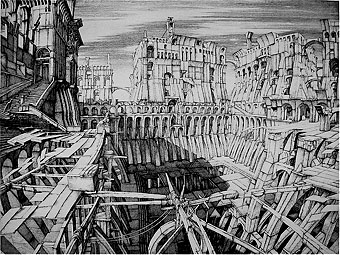
desmazieres1.jpg

La Place Désertée (1979).

Yet another French artist specialising in etchings with a focus on imaginary architecture. No dedicated website, unfortunately, so I’ve posted more images than usual. Of note is Desmazières’ illustrated edition (now out of print) of the Borges’ ficcione, The Library of Babel, published by Les Amis du Livre Contemporain in France and David R Godine in the US.

Erik Desmazières was born in Rabbat, Morocco, son of a French diplomat. He spent his childhood in Morcco, Portugal, and France. Desmazières studied at the Institute d’Etudes Politique, political science and took an evening art course at the Cours du Soir de la Ville. After graduation he decided to pursue a career as an artist.

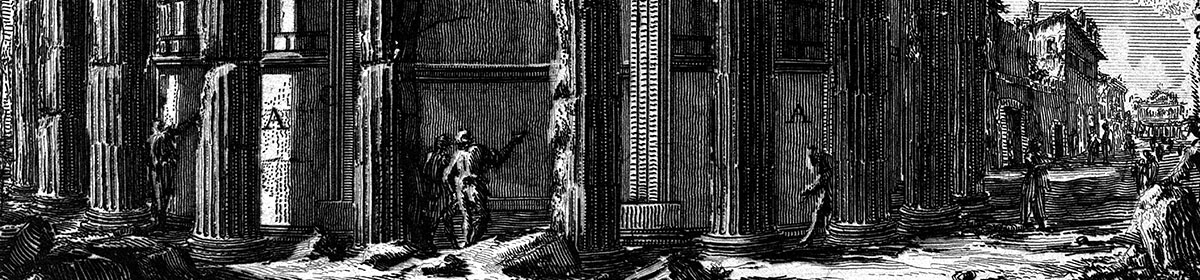
Considered to be one of the finest printmakers of his generation, Desmazières was strongly influenced by artists such as Giovanni Piranesi and Jacques Callot. Erik Desmazières work is represented by galleries in Europe, the United States, and Japan and is collected by important museums worldwide.

Update: Erik Desmazières at Velly.org.

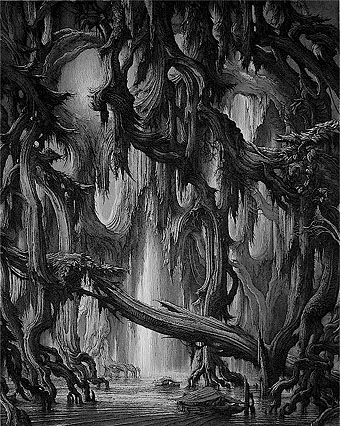
desmazieres2.jpg

Exploration (1984).

Continue reading “The art of Erik Desmazières”

Wallace Burman and Semina

semina.jpg

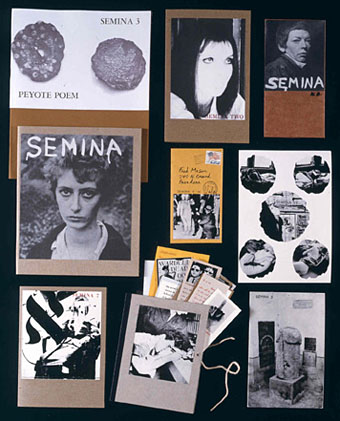
Semina, #1–9.

A Return Trip to a Faraway Place Called Underground
By HOLLAND COTTER
New York Times, January 26, 2007

Time is forever. Love is the goal. Art is what you are, not what you do. Many young artists and poets in California in the 1950s and ’60s felt and lived this way. And a traveling band of them, trailing a cloud of marijuana-fragrant air, has arrived at the Grey Art Gallery in “Semina Culture: Wallace Berman & His Circle.”

The mostly dense paintings, drawings and collages in the show make visual sense in New York today. Updated versions of their type have flooded galleries in the last few years. Yet the throwaway, amateur-proud spirit that propelled the older work is largely absent in the new. It belongs to another time and place, with a different set of possibilities and necessities, to a small imploded star, now far, far away, called Underground.

The artist Wallace Berman (1926-76) lived on that star. His name still rings only a faint bell. Actually, he was something of a mystery even to his friends, who were legion and seem to have loved him deeply. And as the show, a kind of scrapbook of art and ephemera, makes clear, three decades after his death he is well worth getting to know.

Born in Staten Island, a child of Russian Jews, he moved to Los Angeles with his family when he was 9 and turned into a classic California oddball. He loved sports, jazz, mind-altering substances, Dada, inside jokes and esoteric spiritual systems, notably the kabbalah. A spiritually minded secularist, he was intensely sociable and intensely quiet, a family man whose house was open to all.

He was also a collagist, painter, photographer and poet; his immersion in art was complete. He not only made it but also inspired others to make it, sparking hidden aptitude in startling places. After meeting him, drifters, movie stars, ex-marines and petty criminals found themselves starting to paint and write.

By temperament a collaborator, he was also, in his nonentrepreneurial way, a promoter. With other artists, he briefly opened a gallery in a roofless houseboat and gave one-day shows to people he admired. Shy of showing his own work, he had few exhibitions; one, at Ferus Gallery in Los Angeles in 1957, was particularly memorable. It led to his arrest for exhibiting lewd material.

The offending piece, a drawing of a copulating couple, was not by him but by a friend, Marjorie Cameron Parsons Kimmel (1922-95), an artist, performer and occult practitioner who went by the single name Cameron. (She is currently the subject of a solo show at Nicole Klagsbrun in Chelsea.) The image appeared in the first issue of Mr. Berman’s loose-leaf journal, Semina, copies of which he had scattered around the gallery floor.

It was Semina that carried Mr. Berman, and the artists and poets he championed, beyond a local audience. He produced the journal from 1955 to 1964 on a mail-order hand press with the help of two friends, the artist and poet Robert Alexander and the photographer Charles Brittin. There were only nine issues. The print run was minute. The contents were mind-boggling.

The magazine, its pages randomly compiled, mixed Berman heroes like Antonin Artaud and Jean Cocteau with established American poets like Robert Duncan and Allen Ginsberg, then added a slew of younger writers and artists — Philip Lamantia, Jack Anderson, Patricia Jordan, Kirby Doyle, Bob Kaufman, Aya Tarlow, Ruth Weiss, Michael McClure, the great gay poet John Wieners — all barely out of the starting gate. Sent, copy by copy, through the mail, Semina defined a distinctively trippy, sardonic West Coast surrealism. New York had hard, cold Pop; the West Coast had a woozy Peyote-Funk that prefigured the hippie era.

If the journal put Wallace Berman’s name on the national countercultural grapevine, his personal influence was still transmitted through artists and poets who met him. And four dozen of them take brief, individual bows in a show — organized for the Santa Monica Museum of Art by two independent curators and critics, Michael Duncan and Kristine McKenna — that feels like both a slice of still-warm history and a reliquary.

Several of the artists are now far better known than Mr. Berman himself. Joan Brown (1938-90), Bruce Conner and Jay De Feo (1929-89) are textbook figures. Ms. Brown’s fetishistic “Man on Horseback,” a 1957 sculpture of rolled and tied cloth, is an eye-catcher. So are two sumptuously abject assemblages by Mr. Conner, who also has an outstanding show of early work at Susan Inglett Gallery in Chelsea.

And for relics, there’s the pigment-caked footstool that Ms. De Feo used while creating “The Rose,” a painting that grew so heavy with applied matter that, at 2,000 pounds, it had to be forklifted from her tenement studio.

More famous at the time were Hollywood actors like Dean Stockwell and Russ Tamblyn, who met Mr. Berman and started making art. Another was Dennis Hopper, who picked up photography and film directing. (He cast Mr. Berman in a small role in “Easy Rider.”) And there was Billy Gray. A teenage heartthrob as Bud Anderson on “Father Knows Best,” he started making stained-glass sculptures after a drug arrest in 1962 crippled his show business career.

Chemicals of all descriptions gradually pulled the Berman circle down. It comes as a dawning shock to walk through the show and see so many young faces accompanied by so many curtailed dates.

The Pop assemblagist Ben Talbert and the abstract painter Arthur Richer died of drug overdoses in their early 40s. The Hollywood child actor Bobby Driscoll, the voice of Peter Pan in the Disney film and the creator of four glorious little collages in the show, was taken out by heroin at 31. By the end of the 1960s, methamphetamines had ruined John Reed, another wonderful artist and poet; he died homeless, almost all his work lost.

Three of these four, Richer being the exception, had little if any formal art training. They could be called outsider artists, except — well, except what? They weren’t crazy enough, or poor enough, or “ethnic” enough, or in some other way picturesque enough to qualify for that exaltedly abject name?

Their work is interesting in large part exactly because it muddies market-driven aesthetic divisions instituted since their day: artist versus outsider artist, trained versus self-taught, professional versus amateur. Most of the artists in the show fall on the alternative side of the equations.

In fact, one of the things that made them a “circle,” if they can really be called that, was their shared lack of traditional bona fides. They were artists because they said they were, and acted as if they were, and because someone — Wallace Berman — said, “You are.” Where would they have stood in relation to today’s standardized, professionalized art industry? Where do such artists stand today, since there are surely many out there, living artists’ lives?

Anyway, for the purposes of the exhibition, the Berman connection is the crucial link, the bond that makes outsiders insiders. They are held within his orbit, which Mr. Duncan and Ms. McKenna, in their charismatic catalog, depict as an accepting, protective space.

Acceptance, and the psychological protection it affords, are rare and invaluable. Are they extended to artists today, to all artists, equally? They should be. They must have felt especially necessary as the cold war 1950s turned into the Vietnam War 1960s, as modern art moved into its radically disruptive postmodern phase.

And as casualties among the artists and poets gathered in the show began to grow, no high in the world could have hidden the truth that time is very short, and that love is only as trustworthy as its object. People trusted Mr. Berman; that was the bottom line. They found him steady and there. I don’t believe in gurus, and especially not in art gurus, even those like Wallace Berman who didn’t want to be one. But I can understand why, when he died after being hit by a drunken driver on the eve of his 50th birthday, there was much grief.

“Semina Culture: Wallace Berman & His Circle” continues through March 31 at the Grey Art Gallery, New York University, 100 Washington Square East, Greenwich Village, (212) 998-6780, nyu.edu/greyart.

Previously on { feuilleton }
The art of Cameron, 1922–1955