
Making us all imbeciles
| (UK) censors were once sent packing. But now they’re back.
Category: {theatre}
Theatre
The Feminine Sphinx
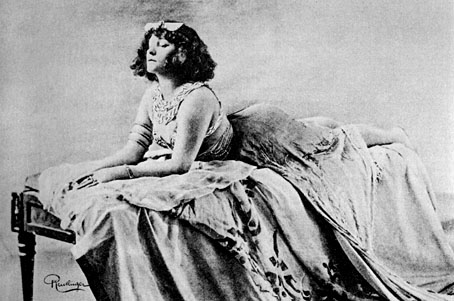
Colette.
Work this week designing a CD of readings from Colette had me searching books for pictures of the author. Of the few I found this is the most interesting, one of several Colette portraits made by photographer Leopold Reutlinger and one of at least two from 1907 which Colette used to promote her Moulin Rouge pantomime, Rêve d’Égypte. (You can see another one here.) The Egyptian theme explains the sphinx pose and her costume but there’s no indication as to whether the pose was borrowed from Franz Stuck’s famous painting (below) or whether the resemblance is coincidental.

The Sphinx by Franz Stuck (1889).
Stuck produced two nearly identical paintings on this theme; the other version is here in a rather muddy copy. I like the frame design for this one which explains in pictures the secret of the famous riddle which the Sphinx asks of Oedipus, “Which creature goes on four feet in the morning, two feet at noon, and three in the evening?” Stuck painted another sphinx picture three years earlier, The Kiss of the Sphinx, which portrays a less feminine and distinctly more rapacious hybrid.
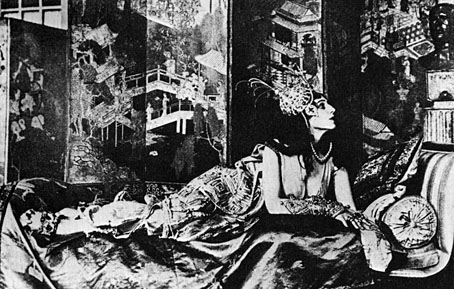
Ida Rubenstein.
Colette was famously bisexual and so too was dancer Ida Rubenstein. In the same book as the Colette picture, there’s this photo of Ida recumbent in a sphinx-like pose in a very exotic boudoir. Photographs such as these are the material connection between the extravagances of the fin de siècle and the Decadent strain of early cinema in works such as Cabiria (written by Ida Rubenstein’s friend Gabriele D’Annunzio), Intolerance and (of course) Alla Nazimova’s Salomé.
Previously on { feuilleton }
• The art of Heidi Taillefer
• Dorian Gray revisited
• Beardsley’s Salomé
• Lussuria, Invidia, Superbia
• Alla Nazimova’s Salomé
• The art of Giulio Aristide Sartorio, 1860–1932
Norman McLaren
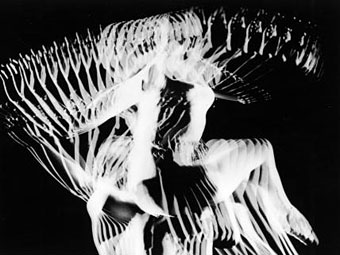
Pas de Deux (1968).
News of a theatre piece celebrating the creativity of Norman McLaren, the pioneering Scots (and gay) animator and film-maker, had me searching YouTube again for his work. His short film Neighbours (1952) is very well-known, oft-cited and imitated for its pixillated character movement. No surprise to see it there, then, along with other works such as Boogie Doodle (1941), Fiddle Dee Dee (1947), A Phantasy (1952), Blinkety Blank (1955) and several others.
Less well-known is a favourite film of mine which hadn’t been YouTubed last time I looked but which is now there in two parts, Pas de Deux (1968). This is a black and white film of a simple ballet performance transformed by its presentation to yield something that could only exist on film. Careful lighting, an atmospheric score, judicious use of slow motion and the stunning application of optical printing to multiply and mirror the figures makes one of the best ballet films I’ve ever seen; it was also one of McLaren’s personal favourites among his many films. He used slow motion again for two more dance works, Ballet Adagio (1972) and Narcissus (1983), one of his final films which impresses for its overt homoerotics but is less striking than its predecessor. The only version of the latter on YouTube is this scratch version with the visuals set to more recent music.
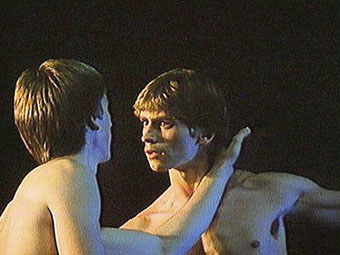
Narcissus (1983).
The best way to see McLaren’s incredible films is at a decent resolution, of course, and the National Film Board of Canada have made them available on a seven-DVD box set.
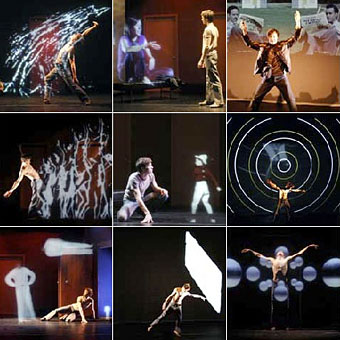
The theatre work mentioned above is Norman by Michel Lemieux and Victor Pilon which is at Macrobert, Stirling, from 17–19 April, 2008 then the Theatre Royal, Brighton from 6–10 May, 2008.
In an improbable act of theatrical alchemy, dancer/choreographer Peter Trosztmer literally inhabits McLaren’s cinematic universe. He dances, weaves, converses and interacts with the animator’s pulsing images and leaping figures, set loose in a riotous ballet of line, light and movement.
Previously on { feuilleton }
• Reflections of Narcissus
‘Adults are idiots’
‘Adults are idiots’
| Laurie Anderson and her new show, Homeland.
Paradise Now available now

Arthur Magazine‘s second essential DVD release is now available.
“Life, revolution and theater are three words for the same thing: an unconditional NO to the present society.” Julian Beck (Living Theatre)
“Paradise Now … more relevant now because we’re closer to now than we ever have been.” Hanon Reznikov (Living Theatre)
Arthur Magazine proudly presents PARADISE NOW: The Living Theatre in Amerika DVD — a fulminating art-meets-life installation brought to you in collaboration with The Living Theatre, The Ira Cohen Akashic Project and Saturnalia Media Rites of the Dreamweapon featuring rare, never-before-distributed films and a bacchanal of revolutionary multimedia documents from The Living Theatre’s historic and influential ’68–’69 American tour.
LIMITED EDITION OF 1,000 – AVAILABLE NOW NOW NOW NOW
Previously on { feuilleton }
• Paradise Now: The Living Theatre in Amerika DVD
• William Burroughs by Ira Cohen, 1967
• The Invasion of Thunderbolt Pagoda